Early Years
From an early age, Gurdjieff received an unconventional education shaped by circumstance and destiny. In his book Meetings with Remarkable Men, he recounts some of the individuals who influenced his development and the unique methods through which they taught him.
His education was comprehensive, combining both practical skills and theoretical knowledge. He trained in numerous crafts and trades, devoting himself completely to each one. Through this total commitment, he became proficient in every activity he undertook. This process helped him develop the ability to concentrate his mind deeply and enter states of intense inner calm.
Yet, as part of his training, he was always required to abandon each mastered craft. The primary goal of his father – his most important teacher – was to cultivate independence and the ability to adapt to unexpected situations in life.
Because his family was poor, Gurdjieff learned to support himself from an early age through the many skills he acquired.
The people who surrounded him during childhood were highly unusual individuals – independent, self-reliant, and inwardly centered. This environment alone made his upbringing exceptionally rare and fascinating.
Over time, through conversations and encounters with remarkable people, Gurdjieff’s interests shifted away from learning practical trades and toward philosophical and existential questions. His attention gradually turned inward.
Thanks to his early education, he developed a powerful curiosity toward everything he did not know or understand. This trait became one of the driving forces of his entire life.
Travels and Spiritual Quest
Gurdjieff undertook numerous journeys throughout Asia and Africa, where he encountered spiritual teachers, monks, hermits, Sufis, yogis, ascetics, and occult practitioners. Some of these meetings had a profound and lasting impact on him, fundamentally changing his understanding of humanity and reality.
The primary motivation for these travels arose from several encounters with phenomena that even the most educated people around him could not adequately explain.
Devoting much of his life to investigating the supernatural and the spiritual, he claimed to witness individuals whom he regarded as genuine „magicians.“
Through contact with such people, as well as through extended stays in monasteries and interactions with practitioners from different traditions, he developed a deeper understanding of what he called occult knowledge.
According to this understanding, the same energy that sustains life within the human body – heartbeat, hair growth, blood circulation, thought, and consciousness – can, through sufficient understanding and practice, be manifested in many different ways.
In India, this energy is known as Prana.
The principles governing this energy cannot be fully understood through reading alone, because the process is internal rather than external. Only someone who has naturally withdrawn attention from the outer world can begin to perceive, understand, and experiment with the life-force operating within themselves.
Gurdjieff eventually developed a perception of life that existed beyond ordinary thought – one based on direct sensation.
His encounters with awakened individuals repeatedly redirected his attention back toward himself. As a result, something within him awakened – the same potential, he believed, that exists within every human being.
He reached a point where the essential insights of different religions appeared to converge, and from this perspective he developed an understanding of the more subtle dimensions of life.
His early education, diverse life experiences, and freedom from rigid identification with any particular religion, nationality, or ideology played a crucial role in this development.
As a young man, he also underwent a near-death experience that abruptly dissolved many of his personal ambitions and desires. This left him exceptionally sensitive, and that sensitivity, combined with the influence of extraordinary individuals, became a key element in his awakening.
Occultism and Realization
Gurdjieff is one of those rare individuals whose life resembles that of a character from a fantastical novel. At times, descriptions of his experiences seem so extraordinary that they appear fictional, yet they often carry a strange sense of authenticity.
His first major work, Beelzebub’s Tales to His Grandson, is famous for being notoriously difficult to read. Many readers become discouraged before reaching the halfway point.
The book contains numerous invented words and deliberately complex constructions that make understanding difficult. Gurdjieff designed it this way intentionally.
His goal was to disrupt habitual patterns of thought and weaken the mind’s dependence on memory and automatic associations. In doing so, he hoped to „cleanse“ consciousness of accumulated assumptions and mechanical thinking.
Although the book does not address every aspect of life, it contains enough material to provoke profound doubt regarding everything one assumes to be known.
Few people manage to finish it, fewer still truly understand it, and only a handful grasp the deeper analogies and insights hidden within its pages.
The Nature of Occultism
Within Gurdjieff’s teaching, occultism should not be understood as magic, witchcraft, or the supernatural. Those are merely possible manifestations.
Occultism, in its deeper sense, is knowledge arising from the observation of the inner world and from understanding the laws that create and sustain life itself.
According to this view, it forms the foundation of phenomena as diverse as shamanic practices, Reiki healing, the extraordinary abilities attributed to Shaolin monks, hypnosis, regression work, and other similar disciplines.
A person may learn certain techniques without fully understanding the laws behind them, but Gurdjieff warned that this is dangerous.
Such knowledge, he suggested, is like „a grenade in the hands of a child“ – not primarily because of immediate side effects, but because of a lack of understanding regarding its long-term consequences.
Occult practice can be seen as an attempt to interfere with life itself. For this reason, someone who has attained genuine understanding tends to avoid such interference, recognizing that „life knows more than the ego.“
Gurdjieff himself ultimately chose not to focus on displaying occult powers. Instead, he devoted his efforts to creating a system aimed at awakening the essence of human beings.
The Teaching of Man and the Soul
One of Gurdjieff’s most striking assertions is that human beings are not born with a fully developed soul. Rather, they possess the possibility of creating one.
According to him, only fully realized beings such as the Buddha and Jesus Christ remain truly alive after physical death because they fulfilled this potential completely.
This teaching serves two purposes.
First, it prevents the comforting assumption that immortality is automatically guaranteed to everyone, which might encourage an unconscious way of living.
Second, it emphasizes that a person who identifies exclusively with the body and mind loses everything at death, since those are the elements that constitute their ordinary sense of self.
From this perspective, human life is an opportunity for awakening – a chance to transform unconscious life-energy into conscious life-energy.
It is a process of individuation, the creation of a true individuality.
According to Gurdjieff, the central task of life is not merely to live, but to become truly conscious. Through awareness, discipline, and inner work, a human being can develop an enduring essence that survives beyond the limitations of the physical body.
The Fourth Way
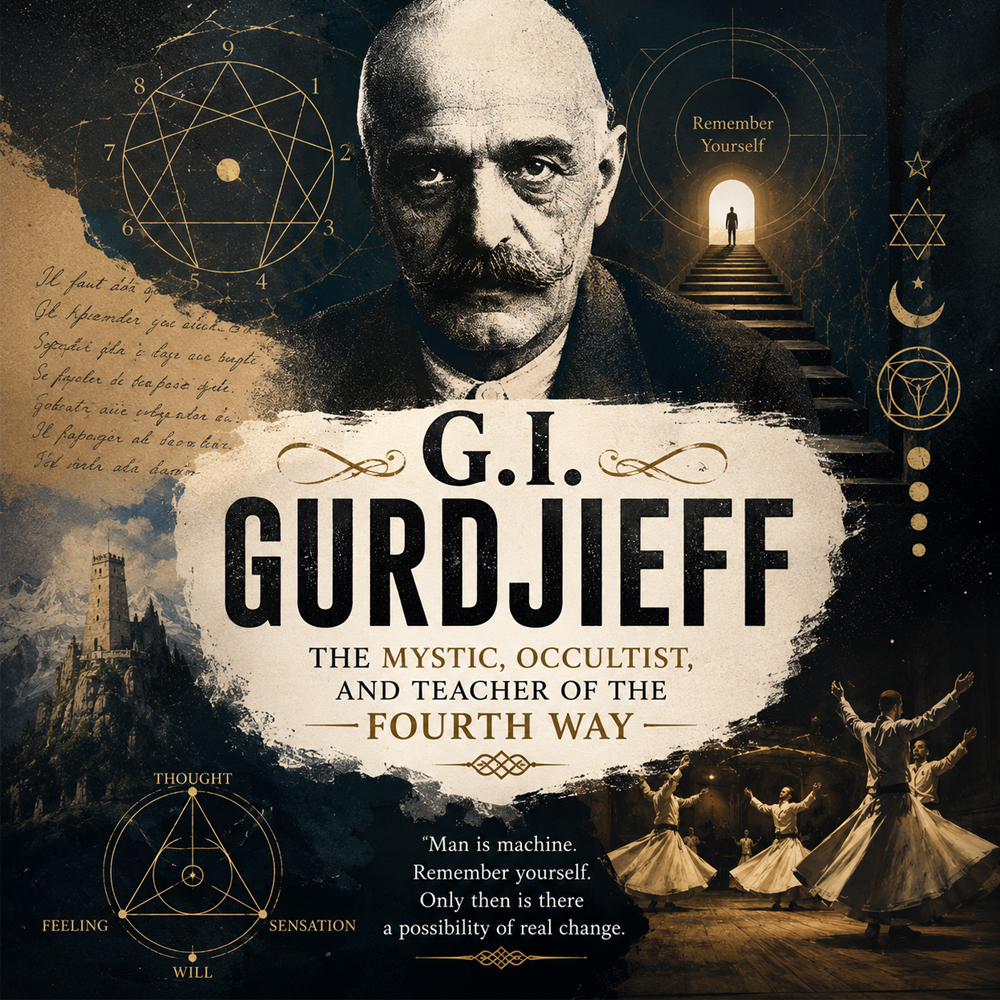
Among all of Gurdjieff’s teachings, none is more famous than what he called The Fourth Way. He believed that throughout history there had been three traditional paths available to those seeking higher consciousness.
The first was the path of the fakir. This path focused primarily on the body. Through extreme physical discipline, endurance, and self-denial, the fakir attempted to gain mastery over himself. Such individuals might spend years standing motionless, fasting, enduring pain, or practicing difficult bodily exercises. According to Gurdjieff, this path could produce extraordinary willpower, but it often left emotional and intellectual development neglected.
The second was the path of the monk. Here the focus was on faith, devotion, and emotion. The monk sought transformation through prayer, worship, sacrifice, and surrender to a higher power. This path developed the emotional center but often neglected the body and intellect.
The third was the path of the yogi. The yogi worked primarily with the mind. Through meditation, concentration, philosophy, and inner observation, he sought mastery over thought itself. This path cultivated intellectual clarity and insight but could leave other aspects of the human being underdeveloped.
Gurdjieff argued that all three paths shared a common limitation. They required withdrawal from ordinary life. One had to enter a monastery, an ashram, a desert, or some other isolated environment.
Modern humanity, however, lives in a different context.
For this reason, Gurdjieff proposed a Fourth Way.
Unlike the other three paths, it does not require abandoning society. A person can follow it while working, raising a family, conducting business, and participating fully in everyday life. The ordinary circumstances of life become the laboratory of transformation.
In the Fourth Way, every frustration becomes an opportunity for observation. Every conflict becomes a mirror. Every desire, fear, habit, and emotional reaction becomes material for inner work.
Rather than escaping life, one uses life itself as the path.
Gurdjieff often emphasized that awakening cannot occur through comfort. Human beings usually live mechanically, responding automatically to circumstances without genuine awareness. The purpose of the Fourth Way is to interrupt this automatic functioning and gradually cultivate consciousness.
The central question is simple:
Can a person remain awake while living an ordinary life?
According to Gurdjieff, this is the greatest challenge of all.
The Mechanical Man
A cornerstone of Gurdjieff’s teaching is the idea that human beings are largely mechanical.
At first glance this statement appears offensive. Most people believe they possess free will, individuality, and conscious control over their actions.
Gurdjieff challenged this assumption.
He argued that thoughts appear automatically. Emotions arise automatically. Reactions occur automatically. Even many decisions are merely the result of habits, conditioning, and external influences. A person may believe he is acting freely while actually functioning like a machine.
For example, someone receives criticism and instantly becomes angry. Another person receives praise and immediately feels proud. A smell triggers a memory. A memory triggers an emotion. An emotion triggers an action.
The entire chain unfolds automatically. The tragedy, according to Gurdjieff, is not that this mechanism exists. The tragedy is that most people never notice it. True freedom begins with seeing one’s own mechanical nature. Only then can consciousness emerge.
Self-Remembering
If mechanical living is the problem, then self-remembering is one of Gurdjieff’s primary solutions. Self-remembering means becoming simultaneously aware of both the external world and oneself.
Normally, attention flows outward. We become absorbed in conversations, work, emotions, desires, and distractions. We forget ourselves. Gurdjieff observed that people rarely experience genuine presence. Even when physically present, their minds are elsewhere.
To remember oneself is to maintain awareness of one’s own existence while engaging with life.
A simple example might be speaking with another person while simultaneously remaining aware of one’s breathing, posture, and inner state. This sounds easy in theory but is remarkably difficult in practice. Most people discover that they can maintain such awareness for only a few seconds before becoming lost again in thought.
For Gurdjieff, this observation is not a failure – it is the beginning of awakening.
The realization that one is asleep is the first sign of awakening.
Conscious Labor and Intentional Suffering
Two concepts frequently associated with Gurdjieff are conscious labor and intentional suffering. These phrases are often misunderstood. Conscious labor means performing actions with awareness rather than mechanically. It is the effort to remain present while acting. Intentional suffering does not mean seeking pain. Rather, it refers to willingly accepting the discomfort that arises during self-observation.
For example, a person may notice pride, jealousy, fear, or vanity within himself. The instinctive reaction is usually to justify or suppress these qualities. Intentional suffering means seeing them clearly without escape. It is the willingness to face reality rather than illusion.
According to Gurdjieff, this process creates the energy necessary for inner transformation. Without effort, nothing changes. Without awareness, effort becomes mechanical. Both are required.
The Creation of a Real „I“
One of Gurdjieff’s most provocative teachings is that ordinary human beings do not possess a single unified self. Instead, they consist of many contradictory „I’s.“ At one moment a person wants to exercise. Later he wants to sleep. One part desires discipline. Another seeks comfort. One moment he loves someone. The next he resents them.
Each impulse temporarily takes control and says „I.“ Because these different selves continually replace one another, the individual lacks inner unity. Real individuality, according to Gurdjieff, must be created. This process requires awareness, observation, and the gradual integration of the fragmented personality. Only then can a stable center emerge.
This center is what many traditions call the soul.
Legacy of the Fourth Way
The Fourth Way became one of the most influential spiritual teachings of the twentieth century.
Its impact can be seen in modern psychology, mindfulness practices, human potential movements, and contemporary approaches to self-development. Unlike many spiritual systems, it does not ask people to reject the world. Instead, it asks them to become conscious within it. Its message remains challenging because it offers no easy comfort. Gurdjieff repeatedly insisted that awakening requires effort, honesty, and courage.
Yet this is also what makes his teaching enduring.
The Fourth Way suggests that enlightenment is not reserved for monks, saints, or ascetics. It is available to ordinary people living ordinary lives – provided they are willing to observe themselves deeply enough to awaken from the dream of mechanical existence.
Read More:
- Farid ud-Din Attar – “The Mystic Who Turned the Soul into a Journey”
- Sufism: The Mystical Path to God – History, Secrets, and Great Sufi Teachers
- Jalal ad-Din Rumi – “The Poet Who Turned Pain into a Path to God”
Author: Vasil Stoyanov