
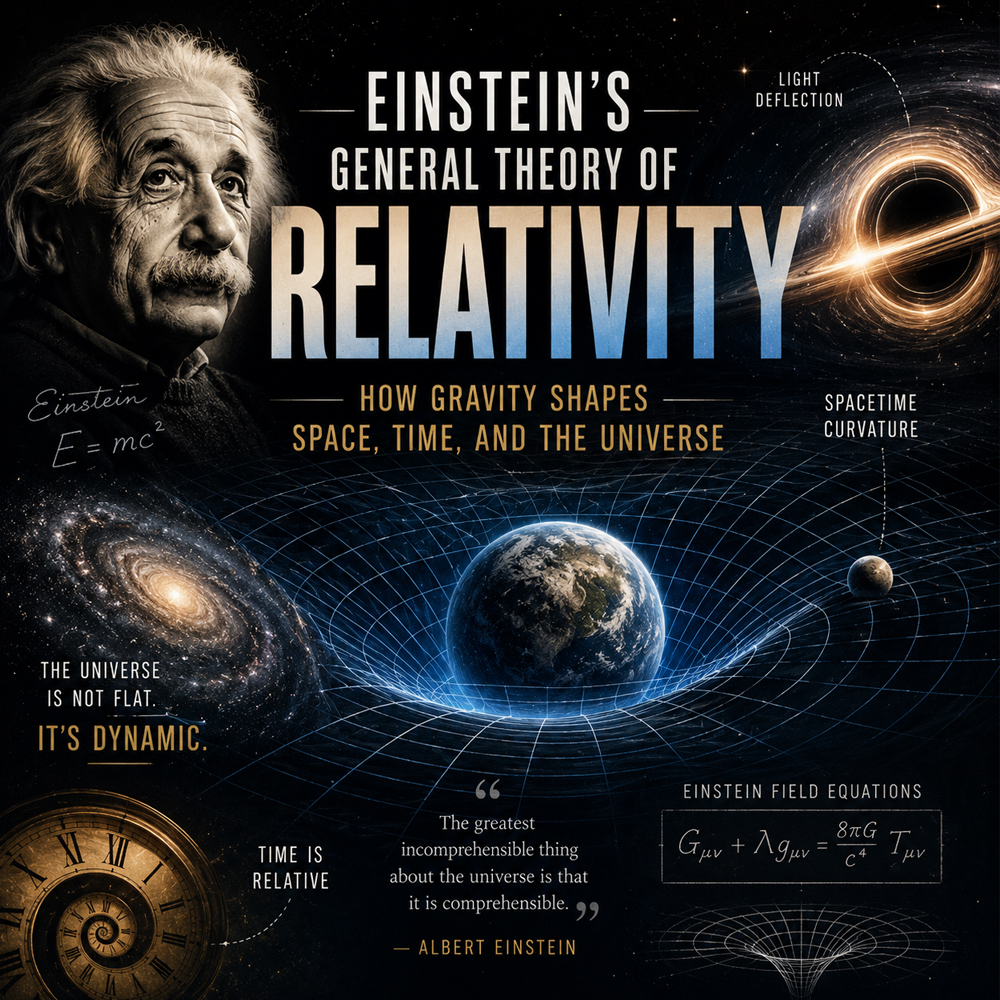
In 1905, Albert Einstein transformed our understanding of reality with the publication of his Special Theory of Relativity. In that groundbreaking work, he demonstrated that space and time are not fixed and absolute, but are instead deeply connected and influenced by motion. Concepts that had seemed obvious for centuries – such as the idea that time flows equally for everyone – were suddenly called into question.
Ten years later, Einstein introduced an even more revolutionary idea. In 1915, he published the General Theory of Relativity, a theory that fundamentally changed humanity’s understanding of gravity. Before Einstein, scientists knew that gravity existed and could accurately predict its effects using Isaac Newton’s laws. Planets orbited the Sun, moons orbited planets, and falling objects accelerated toward Earth exactly as Newton’s equations predicted. What nobody understood was why gravity behaved this way.
For more than two centuries, gravity remained a mystery. Newton himself admitted that he had no explanation for how one object could influence another across empty space. Scientists proposed many hypotheses. Some imagined invisible forces acting between bodies, while others speculated about unknown particles or hidden mechanisms. Yet no explanation fully revealed the true nature of gravity itself.
Einstein approached the problem differently. Rather than asking how gravity acts between objects, he began asking whether gravity was actually a force at all. This simple shift in perspective ultimately led to one of the most profound discoveries in the history of science. His answer would reveal that gravity is not a force pulling objects together through space, but rather a consequence of the geometry of space and time themselves.
The Power of Imagination
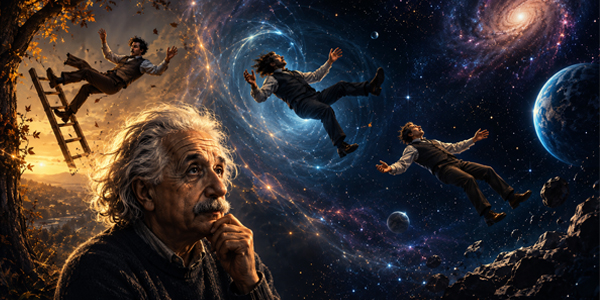
Einstein is often remembered not only for his intelligence but also for his extraordinary imagination. Many of his greatest discoveries began as simple thought experiments – mental exercises in which he imagined unusual situations and followed their consequences logically. These experiments allowed him to explore ideas that were impossible to test directly at the time.
One of the key insights that led to General Relativity began with a surprisingly ordinary image: a person falling from a ladder. Einstein imagined someone falling freely toward the ground. During the fall, the person would accelerate downward, but would not feel their own weight. Since everything around them would be falling at the same rate, there would be no force pressing against their body.
This observation led Einstein to a remarkable conclusion. For a person in free fall, the experience would be indistinguishable from floating weightlessly in space. In both situations, there would be no sensation of gravity acting on the body. This realization became the foundation of what is now known as the Equivalence Principle, one of the central ideas of General Relativity.
The Elevator Thought Experiment
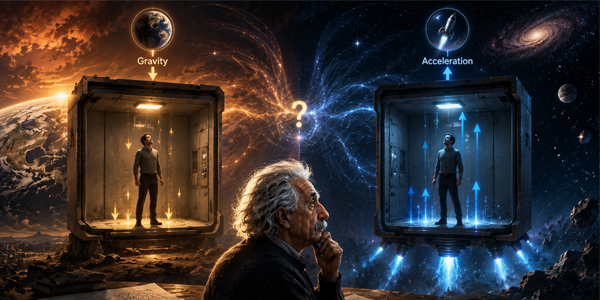
To explore this principle further, Einstein imagined a person inside a sealed room with no windows. The room could either be resting on Earth’s surface or floating far away in empty space. If the room were located in deep space and accelerated upward by powerful rockets, the person inside would feel pressed against the floor.
As the acceleration increased, the apparent weight of the person would also increase. The effect would be identical to standing on a planet with stronger gravity. From inside the room, without any view of the outside world, the person would have no way of knowing whether they were experiencing gravity or acceleration.
This led Einstein to an extraordinary conclusion. Gravity and acceleration are fundamentally related. In many situations, they are physically indistinguishable. What we experience as gravity may not be a conventional force at all, but rather something deeply connected to accelerated motion and the structure of space-time.
A Beam of Light Reveals the Truth
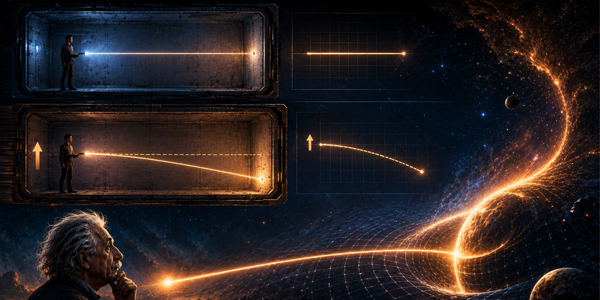
Einstein then imagined another experiment inside the accelerating room. Suppose a person standing on one side of the room shines a flashlight horizontally toward the opposite wall. If the room remains stationary, the beam would travel in a perfectly straight line and strike the opposite wall at the same height.
However, if the room is accelerating upward while the light travels across it, something interesting happens. By the time the light reaches the opposite wall, the room has moved upward slightly. To an observer inside, the beam would appear to curve downward, striking the wall lower than expected.
This observation had profound implications. If acceleration causes light to appear curved, and acceleration is equivalent to gravity, then gravity must also bend light. This was a radical prediction because light has no mass. According to traditional thinking, gravity should only affect massive objects.
Einstein realized that the bending of light could only be explained if space itself were curved. Light always follows the straightest possible path available to it. If its path appears curved, then the space through which it travels must be curved as well.
Understanding Curved Space
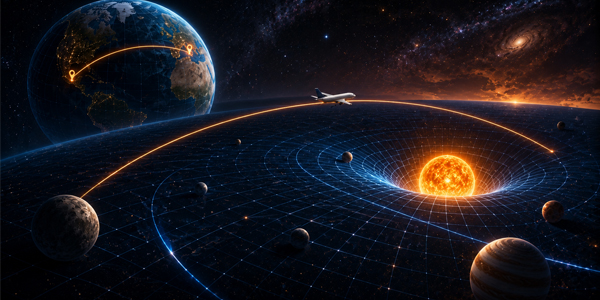
The idea of curved space can be difficult to visualize because we naturally think in three dimensions. A useful analogy is the surface of a sphere. If you draw what appears to be a straight line across a globe, the line will eventually curve because the surface itself is curved.
An airplane flying between two cities often follows such a path. On a flat map, the route appears curved. On the curved surface of Earth, however, it is actually the shortest possible path. The airplane is moving straight relative to the geometry of the surface.
Einstein proposed that the same principle applies to the universe. Massive objects such as planets and stars curve the fabric of space-time around them. Objects moving through that region simply follow the natural paths created by this curvature. What we perceive as gravitational attraction is actually the result of moving through curved space-time.
Experimental Confirmation
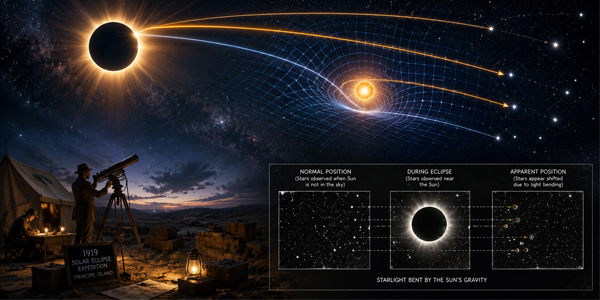
Einstein’s theory made a bold prediction: light from distant stars should bend when passing near a massive object such as the Sun. This effect would cause stars to appear slightly displaced from their true positions in the sky.
Testing this prediction was extremely difficult because the Sun’s brightness normally obscures nearby stars. However, during a total solar eclipse in 1919, astronomers were able to observe stars near the Sun and compare their apparent positions to measurements taken at other times.
The results matched Einstein’s predictions with remarkable accuracy. The starlight had indeed been bent by the Sun’s gravity. Overnight, Einstein became internationally famous, and General Relativity emerged as one of the most successful scientific theories ever developed.
What Gravity Really Is
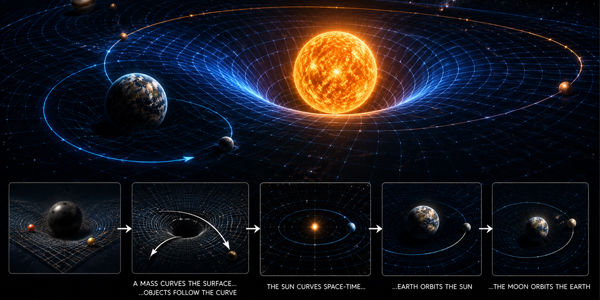
General Relativity completely changed humanity’s understanding of gravity. Instead of viewing gravity as an invisible force acting across empty space, Einstein described it as the curvature of space-time caused by mass and energy.
A useful analogy is a stretched rubber sheet. If a heavy bowling ball is placed on the sheet, it creates a depression. Smaller balls rolling nearby naturally move toward the larger ball, not because it is pulling them directly, but because the surface beneath them is curved.
Although this analogy is not perfect – it uses gravity to explain gravity – it helps illustrate the concept. Massive objects distort the geometry around them, and other objects follow the paths created by that distortion. Planets orbit stars because they are moving through curved space-time, not because they are being pulled by an invisible force.
The Sun, containing more than 99% of the mass of our solar system, creates a deep curvature in space-time. Earth follows a stable path within that curvature, producing its orbit. Similarly, the Moon follows a path through the space-time curvature created by Earth.
Black Holes: Extreme Curvature
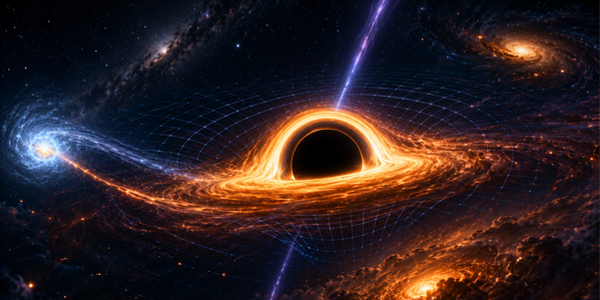
One of the most astonishing consequences of Einstein’s equations was the prediction of black holes. Initially, even Einstein himself was skeptical that such objects could exist. However, later calculations revealed that the equations naturally allowed for regions where space-time becomes so severely curved that nothing can escape.
A black hole forms when a sufficient amount of mass is compressed into an extremely small volume. The resulting curvature becomes so intense that every possible path leads inward. Even light, the fastest thing in the universe, cannot escape once it crosses a boundary known as the event horizon.
Because no light can leave, black holes appear completely dark. We cannot observe them directly. Instead, we detect their presence through their effects on nearby stars, gas clouds, and light passing around them.
Modern astronomy has now confirmed that black holes are real. They exist throughout the universe, from stellar-mass black holes formed by collapsing stars to supermassive black holes containing billions of times the mass of the Sun at the centers of galaxies.
Gravity and Time
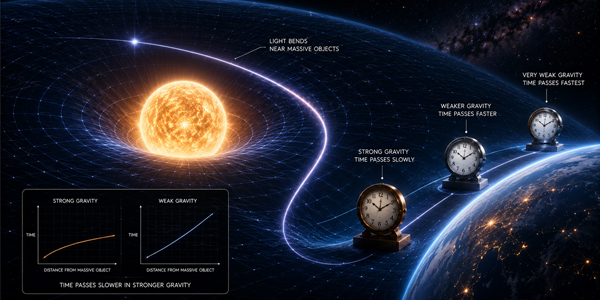
Perhaps the most surprising consequence of General Relativity is that gravity affects time itself. This idea sounds almost impossible because we tend to think of time as universal and unchanging. Einstein showed that this intuition is incorrect.
The key lies in the constant speed of light. According to Special Relativity, light always travels at approximately 300,000 kilometers per second in a vacuum, regardless of the motion of the observer. This principle remains true even in gravitational fields.
Imagine a beam of light passing near a massive object. Gravity causes the light’s path to bend. Yet the speed of light remains constant. Something else must therefore change to preserve this constant speed.
The answer is time. Near massive objects, time itself flows more slowly. This phenomenon is known as gravitational time dilation. The stronger the gravitational field, the slower time passes relative to regions with weaker gravity.
This effect has been measured repeatedly using highly precise atomic clocks. Clocks placed at higher altitudes, where Earth’s gravity is slightly weaker, run faster than clocks at sea level. Although the difference is tiny, it is entirely real and measurable.
Time Near Black Holes
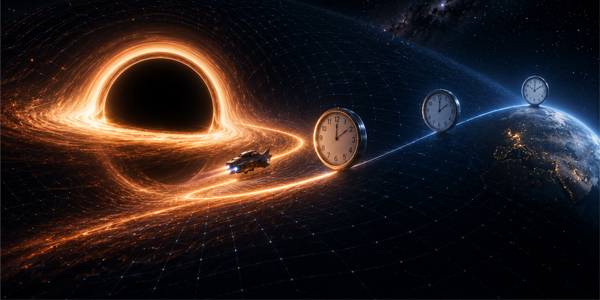
The effects of gravitational time dilation become dramatic near black holes. A person orbiting close to a supermassive black hole might experience only a few hours while years or even decades pass for observers far away.
This is not science fiction. It is a direct consequence of Einstein’s equations and has been confirmed through numerous experiments involving gravity and time. While humans have never traveled near a black hole, the mathematics describing these effects has repeatedly matched observations.
The famous depiction in the film Interstellar, where time passes much more slowly near a black hole, was based directly on calculations derived from General Relativity. Although dramatized for storytelling purposes, the underlying science is genuine.
Why General Relativity Matters Today
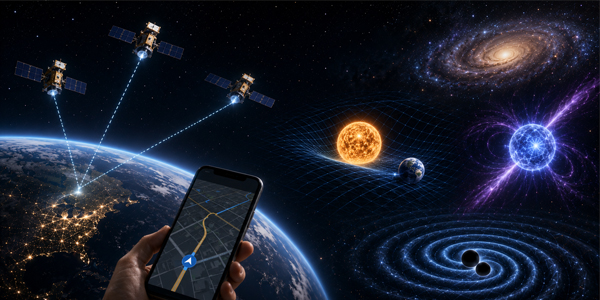
General Relativity is not merely an abstract theory about distant stars and exotic cosmic phenomena. It plays an essential role in everyday technology. One of the most important examples is the Global Positioning System (GPS).
GPS satellites orbit Earth at high altitudes where gravity is weaker than on the planet’s surface. As a result, time passes slightly faster for the clocks aboard these satellites. Without correcting for this effect, GPS calculations would accumulate errors of several kilometers per day.
Modern navigation systems constantly account for both General Relativity and Special Relativity. Every time someone uses a smartphone to find directions, they are relying on Einstein’s theories.
General Relativity also underpins modern cosmology. It allows scientists to understand the expansion of the universe, the formation of galaxies, the behavior of neutron stars, gravitational waves, and the evolution of cosmic structures on the largest scales imaginable.
Conclusion
More than a century after its publication, Einstein’s General Theory of Relativity remains one of humanity’s greatest intellectual achievements. It transformed gravity from a mysterious force into a manifestation of the geometry of space-time itself. Through a combination of imagination, mathematics, and physical insight, Einstein revealed a universe far stranger and more beautiful than anyone had previously imagined.
Today, General Relativity continues to guide astronomical discoveries, technological innovations, and our understanding of the cosmos. From GPS satellites orbiting Earth to black holes billions of light-years away, its predictions have been confirmed again and again. Few scientific ideas have reshaped our understanding of reality so completely, and few continue to inspire wonder in the same way that Einstein’s vision of space, time, and gravity does.
Read More:
- The Genius of Albert Einstein: Understanding the Special Theory of Relativity
- Quantum Field Theory – Does Anything Truly Exist?
- Black Holes: What They Are and Why They Hold the Greatest Secrets of the Universe
- How Do Solar Systems and Meteor Showers Form?
Author: Vasil Stoyanov