
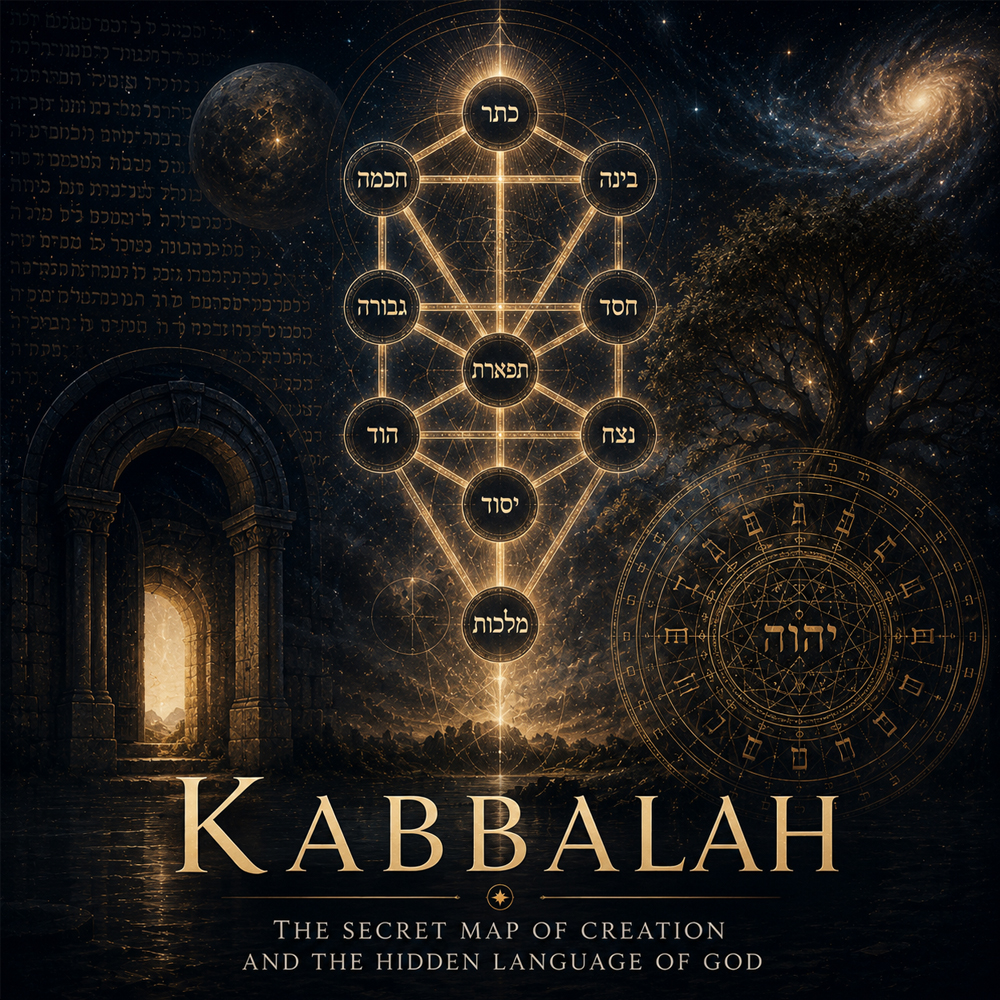
Introduction to the Mystery of Kabbalah
Among all the mystical traditions of the world, few teachings are surrounded by as much mystery, reverence, and spiritual power as Kabbalah. For centuries, its name has inspired both admiration and awe. To some, it is the supreme wisdom of ancient Israel; to others, it is the secret key to understanding the universe; and to still others, it represents a lost science of the structure of reality and the nature of the human soul.
Kabbalah is not merely a philosophy, religion, or system of beliefs. It is a mystical map of existence that seeks to explain how the infinite Divine manifests within the finite world of matter. It views the human being as a living reflection of the cosmos and teaches that behind all visible phenomena lies a hidden order governed by eternal spiritual laws.
Throughout the centuries, Kabbalah has influenced countless thinkers, mystics, alchemists, occultists, philosophers, and spiritual seekers. Its symbols can be found in Western esotericism, Hermeticism, Rosicrucianism, Freemasonry, and various mystical schools of the modern era. Whether one regards it as a sacred tradition or as a universal system of symbolic knowledge, Kabbalah continues to attract those who seek a deeper understanding of life and their place within the universe.
This teaching begins with one fundamental idea: the world is not a chaotic collection of accidents. The universe is an expression of an infinite intelligence, and every being, every event, and every particle of matter contains a hidden connection to that primordial source. Kabbalah seeks to reveal these connections and show the path back to the Divine.
The Meaning of the Word Kabbalah
The word “Kabbalah” itself derives from the ancient Hebrew verb lekabel, meaning “to receive” or “to accept.” This name was not chosen by chance. It reflects the central idea that true wisdom is not a human invention but knowledge passed down from generation to generation as a sacred inheritance.
According to tradition, this wisdom originates from God Himself and was transmitted to the ancient prophets, patriarchs, and initiates. Over the centuries, it was carefully guarded and revealed only to those who had attained the necessary level of spiritual maturity. The reason for this caution was the belief that certain truths could be misunderstood and misused by those who were unprepared.
From the Kabbalistic perspective, knowledge is not merely information. It is a living force capable of transforming consciousness. The true student does not study Kabbalah solely to understand the world. He studies it in order to transform himself from within and restore the lost connection between the human soul and its Divine source.
For this reason, Kabbalah has always been not only an intellectual system but also a spiritual path. Its symbols, numbers, letters, and mystical concepts serve as gateways to deeper levels of awareness. They are not ends in themselves but tools for inner awakening.
The Origins of the Kabbalistic Tradition
Historically speaking, Kabbalah began to take shape as a distinct mystical system during the Middle Ages, particularly in Spain and Southern France. Kabbalists themselves, however, maintain that its roots are far older and extend back to biblical times.
According to some traditions, the first person to receive Kabbalistic knowledge was Adam. After his expulsion from Eden, he became aware of certain spiritual truths concerning the structure of creation. Other legends identify Abraham as the first great Kabbalist. He is traditionally associated with the mystical text Sefer Yetzirah, known as the “Book of Creation,” which explores the role of letters and numbers in the process of creating the world.
Later, this line of transmission became linked to Moses and the prophets of Israel. It was believed that alongside the written law there existed a hidden law containing deeper meanings and secret knowledge. From this idea, the Kabbalistic tradition gradually emerged.
Regardless of the historical debates surrounding its origins, one thing is certain: Kabbalah became one of the most influential mystical systems in human history. Its influence extends far beyond the boundaries of Judaism and reaches nearly every branch of Western esotericism.
Ein Sof – The Infinite God
At the foundation of Kabbalistic cosmology stands one of the most sublime concepts in mystical philosophy: Ein Sof. This name means “Without End,” “The Boundless One,” or “The Infinite.” It refers to Divine reality before any creation, before time, space, and every form of existence.
According to Kabbalah, God in His absolute essence is so vast and transcendent that He cannot be described in words. Any definition would limit that which is, by its very nature, infinite. Ein Sof is not a person in the ordinary sense of the word. It is the ineffable source of all possibilities and all being.
This idea carries profound mystical significance. If God is infinite, then no being can be completely separate from Him. Everything that exists is an expression of the same infinite reality. The division between spirit and matter, between the sacred and the ordinary, between humanity and God is largely an illusion created by limited perception.
Kabbalists believe that the spiritual path consists of gradually unveiling this truth. The more a person frees himself from illusions and limitations, the more clearly he begins to perceive the presence of the Infinite in everything around him.
Tzimtzum – The Great Contraction
One of the most mysterious and beautiful concepts in Kabbalah is the doctrine of Tzimtzum. According to this teaching, before creation there existed only Ein Sof-the infinite Divine Light. Since this light filled everything, there was no room for a separate reality to exist.
In order for the world to come into being, God performed a mystical act of self-limitation. He symbolically “withdrew,” creating a space in which different levels of existence could emerge. This process is known as Tzimtzum.
Of course, Kabbalists do not claim that God literally departed from any part of reality. Rather, it is a mystical symbol that explains how the infinite can give rise to the finite. The world exists because the Divine voluntarily concealed a portion of its infinity.
This idea also has a profound psychological dimension. It suggests that true power is not always expressed through domination and expansion. Sometimes the highest creative act is the ability to create space in which something new can be born. For this reason, Tzimtzum is often regarded as a cosmic act of love and sacrifice.
The Tree of Life – The Map of Creation
The most famous symbol of Kabbalah is the Tree of Life. It consists of a complex diagram of ten spheres, known as the Sephirot, connected by numerous paths. For Kabbalists, this is not merely a diagram. It is a map of all existence.
The Tree of Life describes the way Divine energy manifests from the highest spiritual levels down to the material world. Each sphere represents a particular aspect of Divine consciousness. At the same time, each of them also exists within the human soul.
For this reason, the Tree of Life is both a cosmological and a psychological map. It reveals the structure of the universe while simultaneously unveiling the structure of the human being. Through its study, a person gradually comes to understand not only the world around them but also themselves.
Over the centuries, this symbol became a central element of Western occultism, Freemasonry, Hermetic Kabbalah, and numerous mystical schools. For many, it represents the most perfect symbolic map ever created by the human spirit.
The Ten Sefirot – The Ten Faces of the Divine
At the heart of Kabbalah are the Ten Sefirot-the ten manifestations of Divine energy through which the Infinite becomes knowable to creation. Kabbalists do not view them as separate beings or gods. Rather, they are different aspects of the same Divine reality, much like light passing through various prisms and revealing itself in a spectrum of colors.
The first Sefirah is Keter-the Crown. It symbolizes the primordial will of God, pure existence before any thought or form. Keter is the closest point to Ein Sof and therefore remains almost beyond the grasp of the human mind. Kabbalists often describe it as a radiant emptiness from which all other levels of existence emerge.
Next comes Chokhmah-Wisdom. This is the first flash of the creative idea, the first spark of cosmic inspiration. Chokhmah represents pure illumination, the sudden insight that arises before logical thought. It symbolizes the dynamic and active aspect of creation.
The third Sefirah is Binah-Understanding. If Chokhmah is the spark, Binah is the vessel that gives it form. It transforms inspiration into structure and chaos into the possibility of order. In Kabbalistic symbolism, Binah is often called the Great Mother because all forms of existence are born through her.
The remaining Sefirot form a complex system of forces that govern the universe. Chesed represents mercy and generosity, Gevurah embodies strength and justice, and Tiferet symbolizes the harmony between them. Netzach represents victory and perseverance, Hod signifies intellect and the beauty of reason, Yesod is the foundation that connects the spiritual with the material, and Malkuth is the kingdom of physical reality.
According to Kabbalah, these ten spheres do not exist only in the cosmos. They are also present within the human soul. The human being is a living Tree of Life. Within each person exist the same forces, the same conflicts, and the same possibilities for harmony. For this reason, the study of the Sefirot is not merely metaphysics-it is a process of self-discovery.
The Four Worlds of Kabbalah
The Kabbalistic tradition teaches that existence is organized into four great worlds. These are not physical places but different levels of reality through which Divine light gradually manifests itself.
The highest world is Atziluth-the World of Emanation. Here there is almost complete unity with the Divine. Forms are so subtle that they can scarcely be distinguished from their source. This is the realm of pure consciousness and archetypal forces.
Next comes Beriah-the World of Creation. Here the first distinctions and structures appear. It is the domain of higher intellect, angelic intelligences, and the great spiritual ideas that will later manifest in the lower worlds.
The third world is Yetzirah-the World of Formation. It is here that ideas begin to take on more concrete outlines. This is the kingdom of emotions, symbols, and subtle energies that shape human experience.
The final world is Assiah-the World of Action. This is the physical reality perceived through the senses. Although it appears to be the most distant from the Divine, Kabbalah teaches that it too is sacred because it represents the final result of the creative process.
Manly P. Hall and the Secret Wisdom of Kabbalah
Among the most influential researchers of Western esotericism in the twentieth century stands the figure of Manly P. Hall. His works have had a profound impact on the understanding of Kabbalah, Hermeticism, Freemasonry, and the ancient mysteries.
Hall viewed Kabbalah as a universal key to all mystical traditions. According to him, behind the various religions and philosophical systems lies a primordial wisdom that manifests itself in different forms across different cultures. He believed that Kabbalah is one of the most refined tools for deciphering this universal symbolism.
In his famous book The Secret Teachings of All Ages, Hall describes the Tree of Life as a map of human evolution. For him, each Sefirah represents a stage in the development of consciousness. Ascending the Tree symbolizes the gradual liberation of the soul from the limitations of the material world.
Hall often emphasized that Kabbalah should not be interpreted literally. Its symbols are living archetypes that speak directly to the deeper layers of the psyche. When a person begins to work with them, they do not merely learn new ideas-they gradually transform the way they perceive themselves and reality.
Particularly important to Hall was the idea that true wisdom does not consist in accumulating information but in transforming character. According to him, the mysteries of Kabbalah cannot be fully understood through intellect alone. They reveal themselves gradually through spiritual growth and inner discipline.
Kabbalah and Freemasonry
Although Freemasonry did not historically originate directly from Kabbalah, there are numerous symbolic and philosophical connections between the two traditions. During the eighteenth and nineteenth centuries, many Masonic thinkers began integrating Kabbalistic ideas into their systems.
For many higher Masonic degrees, the Tree of Life became a symbolic map of the initiate’s spiritual development. Like the Kabbalist, the Mason undergoes a series of inner transformations aimed at refining character and deepening understanding of the world.
Many Masonic authors interpret the construction of Solomon’s Temple as a symbol of the inner building of the human being. The stones of the Temple represent different aspects of the personality that must be shaped and perfected. This idea strongly resembles the Kabbalistic concept of restoring harmony among the various forces of the soul.
Manly Hall frequently pointed out that Freemasonry and Kabbalah use different languages but speak about similar spiritual processes. Both traditions encourage self-knowledge, moral refinement, and the pursuit of higher consciousness.
The Shattering of the Vessels and the Birth of the World
One of the deepest mystical ideas in Kabbalah is the concept of Shevirat Ha-Kelim-the Shattering of the Vessels. According to this teaching, the original Divine light was so powerful that the vessels intended to contain it could not withstand its intensity and shattered.
As a result, fragments of Divine light were scattered throughout creation. These sparks exist within every being, every object, and every human heart. The world we perceive is both beautiful and imperfect because it bears the traces of this primordial fragmentation.
This idea offers a remarkable explanation for the existence of suffering and chaos. They are not the result of God’s absence but part of a deeper process of cosmic restoration. Humanity plays an active role in this process. Through actions, thoughts, and spiritual work, people help gather the scattered sparks and restore the original harmony.
This mission is known as Tikkun Olam-the Repairing of the World. It is one of the most beautiful and inspiring ideas in the entire Kabbalistic tradition.
Hermetic Kabbalah and Western Occultism
During the Renaissance, and especially in the nineteenth century, Kabbalah began to develop in a new direction. It merged with Hermeticism, alchemy, astrology, and various esoteric systems. Thus emerged what is known as Hermetic Kabbalah.
This tradition became the foundation for numerous occult organizations, including the Hermetic Order of the Golden Dawn. Within these schools, the Tree of Life evolved into a universal map upon which planets, elements, angels, archetypes, Tarot cards, and various spiritual forces were arranged.
Later figures such as Aleister Crowley expanded these ideas even further. Although his views were often controversial, his influence on modern occultism was immense. For Crowley, Kabbalah represented a universal symbolic language capable of connecting all mystical systems into a single coherent structure.
During this period, Kabbalah ultimately moved beyond the boundaries of traditional Judaism and became a global esoteric system. Its ideas began influencing psychology, literature, philosophy, and various forms of modern spirituality.
Kabbalah as a Path to Inner Awakening
Despite all its complex diagrams, symbols, and philosophical concepts, the ultimate goal of Kabbalah remains remarkably simple. It seeks to help human beings remember their true origin. According to Kabbalists, every soul carries within it a spark of the Infinite and longs to return to its source.
The spiritual path is not an escape from the world. It is a process of gradually realizing that the world itself is a manifestation of the Divine. The deeper one penetrates the mystery of existence, the more clearly one understands that the boundaries between oneself and the universe are far smaller than previously imagined.
Thus, Kabbalah becomes more than a system of knowledge-it becomes a journey. It is a journey through symbols, through the mysteries of the soul, and through the invisible dimensions of reality. At the end of this journey, one does not discover something entirely new. One discovers what has always been hidden within-the spark of the Infinite that has never ceased to shine.
The Zohar – The Book of Splendor
If the Tree of Life is the heart of Kabbalah, then the Zohar is its soul. Few books in the history of mysticism have had as profound an influence on spiritual thought as this enigmatic text. The very name “Zohar” means “splendor” or “radiance,” hinting at its purpose-to reveal the hidden light concealed behind the letters of the sacred scriptures.
According to tradition, the author of the Zohar was the ancient sage Rabbi Shimon bar Yochai, who lived during the second century. Legend tells that he hid in a cave for thirteen years, where he received divine revelations concerning the mysteries of creation and the nature of God. Historians, however, believe that the text was edited or composed in the thirteenth century by the Kabbalist Moses de León in Spain.
Regardless of the debates surrounding its origin, the Zohar became the most influential work of Kabbalah. Within its pages, biblical stories are interpreted not as historical events but as symbolic descriptions of cosmic and inner spiritual processes. Every character, every word, and every letter contains multiple layers of meaning that can be uncovered only through mystical contemplation.
The Zohar teaches that the entire universe is alive and that everything in existence is connected through invisible threads of spiritual light. Human beings are not separate observers of this reality. They are active participants in it. Every thought, every action, and every spiritual practice influences cosmic harmony.
Throughout the centuries, many Kabbalists believed that simply reading the Zohar carried spiritual power. Even when the text was not fully understood, its words were regarded as channels of higher energies. For this reason, the book was revered almost as a living entity containing a fragment of the Divine Presence.
The Sacred Letters and the Language of Creation
According to Kabbalah, language is not a human invention. The letters of the sacred Hebrew language are viewed as fundamental forces through which God created the world. Each letter possesses its own energy, vibration, and spiritual significance.
This idea is developed in great detail in the ancient text Sefer Yetzirah, or The Book of Creation. It describes how the twenty-two letters of the Hebrew alphabet participated in the formation of the cosmos. They are not merely symbols representing sounds. They are the building blocks of reality itself.
Kabbalists believe that there is a profound connection between sound, form, and energy. When certain letters are combined in specific ways, they create patterns that reflect different aspects of existence. For this reason, the study of letters becomes a spiritual practice and a means of penetrating the mysteries of creation.
Particular importance is given to the first letter, Aleph. It symbolizes the unity of God and the primordial reality that exists before all opposites. Though it appears simple, Kabbalists discover endless layers of symbolism within it. To them, every letter is a gateway to inexhaustible dimensions of meaning.
This concept had a tremendous influence on later Western esotericism. Hermeticists, alchemists, and occultists embraced the idea that symbols are not arbitrary signs but living carriers of spiritual power.
Gematria – The Mathematics of Mystery
One of the most famous Kabbalistic practices is Gematria. It is based on the fact that every Hebrew letter also possesses a numerical value. In this way, words can be transformed into numbers, and numbers into symbolic keys to deeper meanings.
For Kabbalists, this is not merely a game of numbers. They believe that words sharing similar numerical values are connected on a mystical level. Through this method, hidden relationships between different ideas, texts, and spiritual principles can be discovered.
One of the most well-known examples is the number eighteen, which corresponds to the word Chai, meaning “life.” For this reason, the number eighteen holds particularly auspicious significance in Jewish tradition.
Gematria is used to uncover hidden meanings within sacred texts. Kabbalists often spend years analyzing specific passages, searching for numerical patterns and symbolic correspondences. To them, the Bible is not merely a book. It is a complex code in which every word and every letter has been placed with precise intention.
This idea inspired numerous esoteric traditions. Manly P. Hall, for example, regarded Gematria as part of the universal symbolic language through which the ancient mysteries transmitted their wisdom to future generations.
Isaac Luria and the Great Revolution in Kabbalah
In the sixteenth century, Kabbalah underwent one of its greatest transformations through the teachings of Isaac Luria. Born in Jerusalem and working primarily in the city of Safed, he developed a system that forever changed the way mystics understood creation.
Luria introduced the doctrines of Tzimtzum, the breaking of the vessels, and the gathering of the Divine sparks. His ideas presented a dramatic vision of the cosmos. The world was no longer seen as a static structure but as the stage of an ongoing process of restoration and spiritual evolution.
According to Luria, every human soul has a specific role within this cosmic process. No one is accidental. Every individual carries a unique mission and participates in the repair of the world through their actions. This gives immense significance to everyday life, because even the smallest deeds can have spiritual consequences.
Lurianic Kabbalah exerted enormous influence not only on Jewish mysticism but also on later occult movements. Many concepts used in Western esotericism today originate directly from his teachings.
Qliphoth – The Shadow Side of the Tree of Life
One of the most mysterious and frequently misunderstood subjects in Kabbalah is the doctrine of the Qliphoth. The word itself means “shells” or “husks.” According to tradition, these are forces that emerged as a result of the breaking of the vessels and represent distorted reflections of Divine light.
It is important to understand that the Qliphoth are not simply demons in the popular sense of the word. They symbolize states of disharmony, spiritual delusion, and separation from the source. If the Sephiroth represent harmonious manifestations of the Divine, the Qliphoth are their shadows.
Kabbalists teach that every force in the universe has both a light and a dark aspect. Love can become obsession, strength can become tyranny, and wisdom can become pride. The Qliphoth embody these distortions. They do not exist independently of the light but are its deformations.
For this reason, the true spiritual path does not involve fleeing from the shadow. It requires recognizing and transforming it. The Kabbalist must learn to identify their own inner Qliphoth and gradually turn them into sources of wisdom and strength.
Later occult schools developed this theme in various directions. Some transformed it into a complex system of magical practices, while others used it as a psychological map of the unconscious.
Kabbalah and the Archangels
The Kabbalistic universe is populated by countless spiritual beings that act as intermediaries between different levels of reality. Among them, the archangels occupy a special place.
Each archangel is associated with a particular Sephirah and represents a specific aspect of the Divine Will. Michael is linked to the solar principle and the harmony of Tiphereth. Gabriel is associated with the Moon and the forces of change. Raphael symbolizes healing and wisdom, while Uriel represents enlightenment and spiritual knowledge.
For Kabbalists, these beings are not merely mythological figures. They are living archetypal forces that operate both within the cosmos and within the human psyche. Encounters with archangels are viewed as inner experiences of specific spiritual qualities and states of consciousness.
Many mystics describe the archangels as guardians of the various levels of the Tree of Life. They guide the soul along its path of ascent and assist in its gradual approach toward the Divine Source.
Kabbalah and the Tarot
One of the most fascinating connections in Western esotericism is that between Kabbalah and the Tarot. Particularly during the nineteenth century, mystical schools began associating the twenty-two letters of the Hebrew alphabet with the twenty-two Major Arcana of the Tarot.
According to this system, each card represents a particular stage in the spiritual journey of the individual. The path of The Fool, for example, is viewed as a symbol of the soul beginning its journey through the various dimensions of experience and knowledge.
When these cards are placed upon the structure of the Tree of Life, a complex map of consciousness emerges. Every symbol, image, and letter begins to interact in ways that reveal new layers of meaning.
Manly P. Hall regarded the Tarot as a kind of book of mysteries that uses symbols instead of words. According to him, the cards do not predict the future but reveal the universal archetypes that operate in every human life.
Kabbalah as an Eternal Mystery
The deeper one ventures into Kabbalah, the more clearly one realizes that it does not offer final answers. Its power lies not in dogma but in its ability to open new horizons of understanding. Every mystery that is solved leads to an even deeper mystery.
For some, Kabbalah is a philosophy; for others, it is a spiritual path; and for still others, it is a map of consciousness itself. Yet regardless of the approach, it remains one of the greatest achievements of the human spirit. Its symbols continue to inspire seekers around the world because they speak of something universal-the eternal human quest to understand who we are, where we come from, and where we are going.
And perhaps this is the true secret of Kabbalah. It is not knowledge that can simply be learned. It is a journey that must be experienced.
Albert Pike and the Kabbalistic Secrets of High Freemasonry
When discussing the connection between Kabbalah and Freemasonry, one name inevitably emerges from the shadows of history-Albert Pike. For many researchers, he is the most influential Masonic philosopher of the nineteenth century and the man who integrated much of Kabbalistic symbolism into the higher degrees of the Scottish Rite.
Pike did not view Kabbalah as a separate religious system. To him, it represented a universal key to understanding the ancient mysteries. In his monumental work Morals and Dogma, he repeatedly referred to Kabbalistic concepts, linking them to the philosophy of initiation, the symbolism of light, and the spiritual evolution of humanity.
According to Pike, the symbols used in Freemasonry are not arbitrary. They are remnants of an ancient language of the mysteries that has been preserved through the centuries by various schools and traditions. Kabbalah is one of the most important components of this language. Through it, one can understand the deeper meanings of the Temple, the pillars, the degrees of initiation, and even the very idea of humanity’s spiritual construction.
Pike believed that the true purpose of initiation is the awakening of the inner light. This idea strongly resembles the Kabbalistic concept of the Divine Spark present within every soul. A person does not acquire something new through initiation. Rather, they gradually uncover what has always been hidden within them.
Albert Pike’s influence on modern esotericism is immense. Although his writings are often complex and difficult to understand, they continue to inspire students of Kabbalah, Freemasonry, and the Western Mysteries.
Kabbalah and the Rosicrucian Tradition
Among all the esoteric movements of Europe, Rosicrucianism is one of the most closely connected to Kabbalah. Emerging in the seventeenth century through a series of mysterious manifestos, the movement claimed to preserve ancient knowledge capable of transforming both the individual and society as a whole.
The Rosicrucians adopted Kabbalah as a map of spiritual initiation. The Tree of Life gradually became a symbol of the inner path that every student must travel. Each Sephirah represents a particular stage in the development of consciousness, and every step along this path requires overcoming new limitations.
For the Rosicrucians, the world is a vast symbolic text filled with hidden meanings. Nature, the stars, mathematics, and the human soul are different manifestations of the same divine wisdom. Kabbalah provides the tools for deciphering this great book of existence.
Many Rosicrucian rituals and symbols contain elements that can be traced back to Kabbalistic concepts. The rose often symbolizes the blossoming of the soul, while the cross represents the meeting of spirit and matter. Their union reflects the quest for harmony among the various forces represented within the Tree of Life.
Kabbalah and the Psychology of Carl Jung
In the twentieth century, the Swiss psychologist Carl Jung discovered numerous parallels between ancient mystical systems and the structure of the human psyche. Although he was not a Kabbalist in the traditional sense, his ideas are often used in contemporary interpretations of Kabbalah.
Jung introduced the concept of the collective unconscious-a deep layer of the psyche containing universal symbols and archetypes. For many researchers, the Sephiroth can be viewed as such archetypes. They represent fundamental patterns of consciousness that manifest both in spiritual life and in everyday human experience.
Particularly intriguing is the connection between the Qliphoth and Jung’s concept of the Shadow. According to Jung, every individual carries repressed aspects of their personality that often remain unconscious. Kabbalah describes a similar process through the concept of distorted forces that must be recognized and transformed.
For Jung, true spiritual evolution does not consist of denying the darker side of the psyche. It requires integrating it into a higher wholeness. This idea bears a remarkable resemblance to the Kabbalistic aspiration to restore the original harmony among all aspects of existence.
Practical Kabbalah and Mystical Techniques
In addition to being a philosophical system, Kabbalah has always existed as a practical tradition. Many Kabbalists believe that certain exercises can help individuals perceive deeper levels of reality.
One of the most widespread practices is meditation on the Sephiroth. The student focuses attention on a particular sphere of the Tree of Life and contemplates its qualities. In this way, they gradually begin to recognize the corresponding forces within their own consciousness.
There are also practices involving contemplation of the sacred letters. Kabbalists believe that the letters are not merely graphic symbols but living emblems capable of opening gateways to subtler states of perception. Through prolonged concentration on specific combinations of letters, a person may attain states of profound intuition and spiritual insight.
Another important practice is prayer with intention, known as Kavanah. Here, the emphasis is not solely on the recitation of words but on the inner state of consciousness. According to Kabbalah, the quality of attention is far more important than the external form of the ritual.
It is important to note that traditional Kabbalists have always emphasized the necessity of moral discipline. Without the development of character, even the deepest mystical practices can become sources of illusion. True Kabbalah is not a search for power but a pursuit of wisdom.
Kabbalah and Modern Occultism
Nearly all significant occult schools of the past two centuries have used Kabbalah as a foundation. Whether in Hermetic orders, magical systems, or contemporary esoteric movements, the Tree of Life remains a central map of spiritual development.
The reason lies in its extraordinary universality. Kabbalah offers a model capable of connecting astrology, alchemy, Tarot, mystical philosophy, and psychology within a single unified structure. Few other systems possess such an ability to integrate so many diverse fields of knowledge.
For many, the Tree of Life becomes a map of consciousness itself. It allows various spiritual experiences to be organized and understood as parts of a larger process of development. In this way, Kabbalah remains relevant even in the modern world, where traditional religious forms often lose their influence.
Modern interpretations, however, sometimes differ significantly from the original Jewish tradition. Some schools emphasize psychological aspects, others focus on magical practices, and still others explore the philosophical dimensions of Kabbalah. Despite these differences, the central message remains unchanged: human beings are far more than they appear to be on the surface.
The Secret Meaning of Initiation
At the heart of all Kabbalistic teachings lies an idea that appears again and again in different forms: initiation. Initiation is not a ceremony, a title, or membership in a particular organization. It is an inner process of awakening.
Each stage of the Tree of Life can be viewed as a specific degree of initiation. A person gradually frees themselves from illusions and begins to perceive reality in a new way. The world remains the same, but the consciousness observing it changes.
Manly Hall often emphasized that all ancient mysteries were directed toward this transformation. The true temple is not built of stone. It exists within the individual. True initiation does not occur in the external world. It takes place when the soul begins to recognize its own divine nature.
This idea connects Kabbalah with nearly all major mystical traditions. Whether one speaks of Hermeticism, Gnosticism, Rosicrucianism, or Freemasonry, the ultimate goal remains the same-the awakening of the inner light.
Kabbalah and the Future of Spirituality
In an age when more and more people seek personal spiritual experiences beyond traditional religious frameworks, Kabbalah continues to attract new generations of seekers. The reason is that it does not demand blind faith. Instead, it encourages exploration, contemplation, and direct personal experience.
Its symbols can be understood simultaneously as religious, philosophical, psychological, and mystical. It is precisely this multilayered nature that allows Kabbalah to remain alive and relevant even after centuries of change.
For some, Kabbalah is ancient wisdom; for others, it is a map of consciousness; and for still others, it is a key to understanding reality itself. Yet regardless of interpretation, it continues to convey the same message-that behind the visible world lies a deeper order, and that human beings possess the ability to discover it within themselves.
And perhaps that is precisely why Kabbalah never ceases to be a mystery. The more it is studied, the more horizons it reveals. It remains like an ancient mirror in which every generation sees a new reflection of the eternal mystery of existence.
Kabbalah and the Lost Mysteries of the Ancient World
One of the most intriguing ideas developed by Manly P. Hall and other esoteric authors is the suggestion that Kabbalah is not an isolated tradition that emerged solely within the framework of Jewish history. According to this view, it is part of a much older stream of universal wisdom that manifested itself in various forms throughout Egypt, Babylon, Greece, Persia, and other great civilizations of the ancient world.
Manly Hall often spoke of the existence of a primordial philosophy that he called the Ancient Wisdom. In his view, the various religions and mystical schools were merely separate branches of a much older tree. Kabbalah was among the purest and best-preserved expressions of this lost tradition.
Although this perspective is not accepted by all historians, it has had a profound influence on Western esotericism. Many mystics began to regard Kabbalah as a bridge between different spiritual teachings. In their eyes, it was not limited to a particular people or religion but represented a universal language of symbols through which all great mysteries could be understood.
This helps explain why so many philosophers, occultists, and Freemasons were drawn to Kabbalah. They saw in it an opportunity to discover the hidden unity behind the seemingly different traditions of the world. For them, it was not merely a system of knowledge but a map of Truth itself.
The Mystery of Solomon’s Temple
Few symbols have exerted as much influence on Kabbalah and Freemasonry as the Temple of King Solomon. For most people, it is a historical structure described in the Bible. For mystics, however, the Temple carries a far deeper meaning.
Kabbalists believe that Solomon’s Temple represents a symbolic model of the universe itself. Its dimensions, proportions, and architectural features reflect cosmic principles and spiritual laws. Every column, chamber, and hall contains hidden meanings that can be revealed through mystical interpretation.
Freemasonry adopted this idea and developed it even further. According to many Masonic authors, the Temple symbolizes the human soul. The process of its construction represents the inner work of refining character and consciousness. Every individual is called to become the architect of their own spiritual temple.
Manly Hall devoted many pages to this symbol. He emphasized that the true Temple was never built of stone and wood. The real Temple is the human being, gradually transformed into a worthy dwelling place for Divine Light.
In this sense, the story of Solomon’s Temple becomes an allegory for spiritual development. The destruction of the Temple symbolizes the loss of the original unity with the Divine, while its restoration represents the path toward inner awakening.
Kabbalah and the Mystery of Light
Among all the symbols used in Kabbalah, none is more important than Light. From the very first lines of mystical texts, the Divine is described as an infinite Light that fills all existence.
This Light is not physical. It represents consciousness, life, wisdom, and creative energy. Everything that exists originates from it and strives to return to it. Kabbalists believe that every soul is a spark of this primordial Light.
Many spiritual practices are directed toward experiencing this inner Light. Mystics describe moments of profound contemplation in which reality appears filled with radiance and presence. For them, this is not hallucination or imagination but a brief glimpse into the true nature of the world.
This symbol also plays a central role in Freemasonry. One of the most important moments of initiation is the reception of Light. This does not mean physical illumination but the awakening of inner understanding. The initiate begins to see the world in a new way and gradually perceives the hidden connections between all things.
It is this idea that links Kabbalah, Hermeticism, Rosicrucianism, and many other mystical traditions. Light becomes a universal symbol of truth and spiritual awakening.
The Journey of the Soul After Death
The question of the soul’s destiny after death occupies an important place in the Kabbalistic tradition. Unlike popular notions of heaven and hell as permanent places of reward or punishment, Kabbalah offers a far more complex picture.
According to many Kabbalists, the soul passes through various states and levels of existence after leaving the physical body. Its experience depends on the degree of spiritual development achieved during earthly life. The stronger its connection to the Divine, the more conscious and harmonious this transition becomes.
Some Kabbalistic schools also embrace the concept of reincarnation, known as Gilgul. According to this idea, the soul may incarnate many times until it fulfills its spiritual purpose and reaches the necessary level of perfection.
This view of life as a continuous process of learning and growth had a strong influence on later esoteric traditions. It offers an optimistic perspective on human destiny, according to which no one is permanently lost and every soul has the opportunity to draw closer to its source.
Kabbalah and the Search for Immortality
Since ancient times, humanity has dreamed of immortality. Most people interpret this desire as a longing for eternal physical existence. Kabbalah, however, offers a very different understanding.
According to Kabbalists, true immortality does not mean the endless continuation of earthly life. Rather, it is the realization of that part of ourselves which was never born and can never die. The soul originates from Ein Sof and therefore carries within it the imprint of eternity.
Many mystical texts describe the process of spiritual awakening as a form of inner resurrection. A person begins to identify not with the transient personality but with the deeper dimension of their being. This realization is regarded as the true victory over death.
Manly Hall often wrote that the great mysteries of antiquity were devoted precisely to this idea. The initiate had to symbolically die to the old self in order to be reborn into a higher state of consciousness. This symbolic death and rebirth can be found both in Kabbalah and in nearly all ancient schools of initiation.
The Hidden Meaning of the Number 33
Among those interested in Freemasonry and Kabbalah, the number 33 often attracts special attention. Although many myths and speculations have arisen around it, its symbolic significance is far deeper and more fascinating.
In the esoteric tradition, numbers are not merely mathematical quantities. They represent principles and archetypes. The number 33 is often associated with the spiritual completion of a particular cycle of development. It symbolizes the attainment of a higher level of understanding and responsibility.
Some authors, including Manly Hall, regard numbers as keys to universal laws. They believe that mathematics is one of the languages through which Divine Intelligence manifests itself in the universe. In this context, the number 33 gains significance not as a secret code but as a symbol of spiritual growth.
Similar ideas can also be found in Kabbalah, where numbers play a central role in understanding the structure of existence. For mystics, mathematics and spirituality have never been opposites. They are different aspects of the same reality.
The Great Purpose of Kabbalah
After thousands of years of development, countless books, schools, and interpretations, one may ask what the true purpose of Kabbalah really is. Why does this complex system of symbols, numbers, letters, and mystical concepts exist?
The answer is both simple and profound. Kabbalah exists to help human beings remember their origin. It teaches that we are not accidental creatures lost in an indifferent universe. We are fragments of an infinite reality that gradually seeks to become conscious of itself through us.
All the symbols of Kabbalah point toward this truth. The Tree of Life, the Sephiroth, the sacred letters, the numbers, and the mystical stories are different ways of describing the same journey. It is the journey of the soul from forgetfulness to remembrance, from separation to unity, and from limitation to infinity.
This is why Kabbalah continues to inspire people around the world. It does not offer easy answers, but it offers something far more valuable-a map for exploring the deepest mysteries of existence. And the farther one travels along this path, the more one realizes that the greatest mystery was never hidden somewhere outside. It has always lived within one’s own consciousness.
Kabbalah Beyond Myths and Conspiracies
Modern popular culture often presents Kabbalah through the lens of sensationalism, secret societies, and conspiracy theories. The internet is filled with stories about hidden elites, forbidden knowledge, and mysterious organizations that supposedly use Kabbalah to gain power over the world. While such narratives attract the attention of many people, they rarely reflect the true essence of the tradition itself.
Authentic Kabbalah has never been a system for controlling others. On the contrary, it is focused on mastering one’s own nature. In Kabbalistic philosophy, the greatest enemy is not an external adversary but inner ignorance. The real battle is not fought between secret societies and hidden forces, but between the light of awareness and the shadows of illusion.
Manly Hall repeatedly warned against taking mystical symbols literally. According to him, many people spend years searching for external secrets without realizing that the true mystery lies within themselves. They chase legends of lost books, hidden treasures, and ancient brotherhoods while neglecting what matters most-their own inner development.
Kabbalah is not a theory of global conspiracy. It is a theory of human consciousness. Its true subject is the transformation of the soul. That is why all of its symbols ultimately direct attention inward rather than outward.
Why Kabbalah Has Survived Through the Centuries
History has witnessed countless philosophies, religions, and spiritual movements that have appeared and disappeared. Yet Kabbalah has endured for centuries. The reason is not only its antiquity but also its remarkable ability to speak to different generations in different ways.
For the medieval mystic, it was a path to God. For the Renaissance philosopher, it represented a key to the lost wisdom of antiquity. For the Freemason, it became a symbolic map of initiation. For the psychologist, it evolved into a model of inner development. For the modern individual, it often serves as a tool for self-discovery and spiritual exploration.
This extraordinary adaptability stems from the fact that Kabbalah works with symbols rather than dogmas. A symbol can be understood on multiple levels and from different perspectives. It does not impose a single interpretation but invites reflection and discovery.
That is why the Tree of Life continues to inspire people from diverse cultures and religions. Each person finds something different within it, yet at the same time senses that behind all these differences lies a common truth. It is precisely this universality that allows Kabbalah to remain alive even in a world that is constantly changing.
Kabbalah and the Future of Human Consciousness
Many contemporary researchers believe that humanity is entering a period of profound transformation. Technology is advancing at an unprecedented pace, access to information is becoming easier than ever, and traditional views of the world are constantly evolving. In such an era, the question arises: what place can an ancient mystical system like Kabbalah still hold?
The answer likely lies in its very essence. Kabbalah is not merely a system for describing the external world. It is a system for understanding consciousness. And the more science and technology advance, the more important the question of the nature of the human mind becomes.
An increasing number of scholars acknowledge that consciousness remains one of the greatest mysteries of existence. We can study the brain, yet we still do not fully understand how the experience of reality itself arises. This is precisely where ancient traditions such as Kabbalah remain relevant. They do not offer scientific theories in the modern sense, but they contain thousands of years of experience in exploring the inner world.
It is possible that the future will bring new syntheses between psychology, philosophy, neuroscience, and mysticism. In such a world, Kabbalah may become not merely a historical curiosity but a valuable source of symbolic models for understanding human nature.
The Final Gate of the Tree of Life
Many Kabbalistic texts speak of a moment when the seeker reaches the summit of the Tree of Life. This is not a physical place, nor is it a final destination. It represents a state of consciousness in which the separation between the seeker and the sought begins to dissolve.
At this stage, one realizes that all symbols, all teachings, and all mysteries were merely maps. They were never the territory itself. The Tree of Life is not simply a diagram. It is a reflection of something that has always existed in the depths of consciousness.
Kabbalists often use the metaphor of the mirror. As long as a person is absorbed in the external world, they see only reflections. But when they begin to explore their own nature, they gradually realize that the observer is also part of the mystery. The boundary between subject and object begins to fade.
This experience cannot be fully described in words. That is precisely why Kabbalah employs symbols, parables, and paradoxes. It seeks to direct attention toward something that transcends ordinary language. True understanding comes not through logical analysis but through direct realization.
Conclusion – The Ancient Whisper of the Infinite
Kabbalah is far more than a mystical philosophy, a system of symbols, or a historical tradition. It represents one of humanity’s most ambitious attempts to understand the relationship between the finite and the infinite, between humanity and God, between consciousness and reality.
From the enigmatic pages of the Zohar to the teachings of Isaac Luria, from the reflections of Manly Hall to the symbolism of Freemasonry and Hermeticism, Kabbalah continues to influence generations of seekers. Its ideas pass through the centuries like a thread of light connecting antiquity with the modern world.
At the heart of this teaching lies a simple yet profound message. Human beings are not separate from the Divine. Within every soul exists a spark of the Infinite. Every spiritual search, every mystical practice, and every step along the Tree of Life is an attempt to become aware of that spark.
For this reason, Kabbalah is not knowledge that can ever be completed. It is a process. It is an ongoing journey toward deeper understanding. The further one enters its mysteries, the more one realizes that the true goal was never to uncover some hidden secret in the external world.
The real secret has always been consciousness itself.
And perhaps that is why, after so many centuries, the ancient whisper of Kabbalah can still be heard. Not as a voice coming from the past, but as a quiet reminder that beyond the visible lies something infinite. Something that has never ceased to be present. Something that mystics call Ein Sof, philosophers call the Absolute, and seekers of wisdom simply call the Truth.
- Hermeticism – The Secret Wisdom of the Universe and the Path to Divine Knowledge
- Alchemy – An Understandable Explanation of an Ancient Science
- The Philosopher’s Stone: Alchemy, Transmutation, and the Path to Enlightenment
Author: Vasil Stoyanov