

Mawlana Jalal ad-Din Muhammad Rumi was a Persian mystic, poet, and Sufi best known for his masterpiece, the Masnavi, a poetic work containing nearly 25,000 verses. Often referred to as the “Quran in Persian,” it is considered one of the most influential spiritual texts in human history. Rumi’s path to God was one of love, devotion, and purity of heart.
Here are three stories from the Masnavi that beautifully capture the spirit of Rumi’s poetry.
The Lion, The Fox and The Wolf

A lion, a wolf, and a fox became partners in hunting.
The lion did not particularly enjoy being seen in the company of lowly creatures such as the fox and the wolf, but he tolerated their presence because he considered it his duty as king of the plains to allow lesser animals to benefit from his favor.
Just as the stars receive their light from the sun, the lion felt obliged to be generous toward weaker and less worthy creatures.
Their first hunt together in the highlands was a success. Under the lion’s leadership, the trio managed to capture a bull, a mountain goat, and a fat rabbit.
With the lion’s help, the two smaller animals carried the rich bounty back down to the plains, growing hungrier with every step. The wolf and the fox were afraid to raise the question of how the prey would be divided, but deep down they believed the mighty lion would be fair in distributing it. Perhaps, they thought, he might even allow them to take the larger share, since he was so noble.
The lion, meanwhile, sensed exactly what his companions were thinking, but chose to remain silent until the proper moment to show them who made the decisions.
“Ah, you lesser beasts,” he thought to himself, “is my precious company not enough for you? How dare you imagine that you can influence my decisions or predict them? Do you not understand that every thought you have and every action you take is possible only because of me?”
As these thoughts crossed his mind, the lion burst into laughter, causing the wolf and the fox to believe their empty stomachs would soon be filled.
“Wolf!” roared the lion. “Be my representative and divide the prey. Be perfectly fair in your distribution. Show me what you are worth!”
“My king,” said the wolf, believing he had reached the wisest conclusion, “the great bull should be yours, since it is the largest of our catches. The mountain goat should be mine, as it is smaller and suits my size. The rabbit will be enough for the fox.”
“How dare you speak of yourself in my presence?” snarled the lion. “To imagine that you even exist in the company of an incomparable and magnificent king is blasphemy! Step forward immediately!”
The moment the wolf obeyed, the lion raised his enormous paw and struck off his head. He then tore apart the body, leaving only a skeleton behind.
“This lowly creature was ruled entirely by his ego,” declared the lion majestically. “There is no place for such a being in my kingdom.”
Having finished with the wolf, he turned to the fox.
“Fox, now it is your turn to divide the prey. Hurry – I am hungry.”
The fox bowed respectfully, swallowing her fear.
“Your Majesty,” she said nervously, “this fat bull would make a magnificent breakfast for you. The mountain goat would be a fitting lunch, and the rabbit should provide a delightful supper.”
“Where did you learn to divide prey in such a manner?” asked the lion in surprise.
“I learned by looking at the disgraced body of the wolf, Your Majesty.”
“You are a clever fox,” said the lion. “Consumed by your love for me, you ceased to see yourself as separate from the object of your devotion. Now you can see me only when you yourself do not exist. Therefore, I shall give you all three animals. Take them and go. I will never harm you. Not only the prey, but I myself am yours now. The one who learns by observing the mistakes of others is truly the wisest of all.”
The fox could hardly believe her good fortune. Silently she thanked God that the lion had chosen the wolf to divide the prey first – for otherwise, pieces of her own body would now be scattered across the plains.
The Lesson
Wisdom often comes from observing the consequences of others’ actions. Pride and self-importance can blind us to reality, while humility and awareness help us navigate life’s dangers. Those who learn from the mistakes of others rarely need to repeat them themselves.
The Chinese and Greek Painters
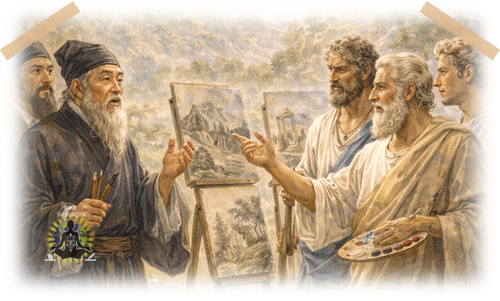
The Chinese painters and their Greek counterparts from Asia Minor had been great rivals for as long as anyone could remember. Each group considered itself superior to the other, and no one could say whose style was more refined or whose works were more beautiful.
Their rivalry had gone on for far too long, and the Sultan of Rum in Asia Minor had grown weary of the endless criticism and boasting from both sides. At last, he decided to hold a competition to determine once and for all which artists were the most talented and worthy representatives of their age.
He assigned two empty villas facing one another to the competing groups. The Chinese painters would occupy one villa, while the Greek painters would live and work in the other. They were given one month to prepare their masterpieces for the Sultan’s judgment.
The Chinese painters were eager to begin. They requested the finest and most colorful paints available and immediately set to work covering the walls with magnificent paintings.
The Greeks requested nothing.
Instead, they had brought special polishing stones. Shortly after arriving, they began the exhausting task of removing years of decay and neglect from the walls of their villa.
For countless hours they worked relentlessly, erasing the marks of time. They scrubbed away old paint, mold, and stains, polishing the walls again and again. Meanwhile, the Chinese artists applied layer upon layer of color, beautifying their paintings and covering the remnants of the old surfaces beneath.
The Greek painters were well acquainted with Chinese art and techniques. The Chinese, however, had no idea what the Greeks were doing.
People throughout the region eagerly awaited the outcome. They could hardly wait to see what the greatest artists of their time had created. After a month of labor, the painters were finally ready to present their work to the supreme judge – the Sultan.
The day of judgment arrived.
The palace gardens were filled with musicians, while crowds danced and celebrated as they awaited the announcement of the results. At last, the Sultan appeared with his entourage and went directly to the Chinese villa to view their masterpiece.
The paintings and colors on the walls had transformed the little house into a magnificent palace straight out of a dream.
The Sultan had never seen such exquisite artistry. He was astonished. It took him a long time to tear himself away from the beauty surrounding him and step back outside.
Having witnessed what the greatest painters could achieve, he became intensely curious to see what the Greeks had created.
Reluctantly leaving the Chinese villa behind, he made his way toward the second house, which was concealed behind a great curtain. He ordered the curtain to be drawn aside, and instantly understood the miracle the Greek painters had accomplished.
Before him stood the same old villa, yet it no longer appeared old or dilapidated.
The mold and stains of the past had been patiently and diligently removed. The walls had been polished and refined to such perfection that everything around them – including the magnificent Chinese paintings in the villa opposite – was reflected flawlessly upon their surfaces, highlighting their purity.
The work of the Chinese painters, in all its complexity and beauty, appeared within the Greeks’ art of simplicity and transparency, making it seem unimaginably more magnificent.
The Sultan could not hide his amazement at the Greeks’ ability to reveal beauty in its purest form by creating a state of perfect clarity.
He had no hesitation in choosing the superior group.
The Lesson
True beauty is not always created by adding more – it can also emerge through clearing away what obscures it. The Chinese painters represent the art of creation, while the Greeks symbolize inner purification. A polished mind and heart become a mirror that reflects reality in its fullest splendor.
The Dervish and the Firewood Gatherer
It was a cold and windy evening, and a novice dervish had gone to bed early.
He dreamed that he was in the company of great Sufi masters and hurried to make the most of his good fortune. He asked them for advice on how to live honorably and avoid creating bad karma. Endowed with boundless wisdom, the teachers entrusted him with the great secret of a magical mountain where trees bore every kind of fruit and where one could live on their bounty for the rest of one’s life.
Without much effort, the dervish soon found the mountain and its abundant fruits. To his delight, they were not only sweet but also transformed his speech in such a way that whenever he spoke, people listened as if hypnotized.
He was pleased, believing that he would never again have to worry about earning a living.
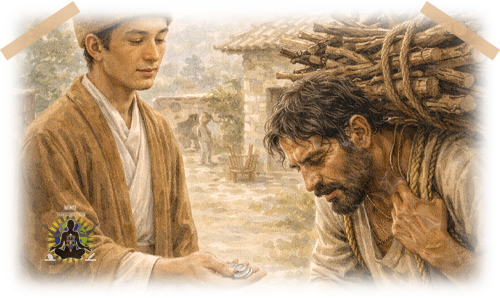
One day, the dervish went to wash himself at a nearby stream. As he removed his robe, he felt two silver coins sewn into the hem of a pocket – coins he had hidden there long ago when he had still been a laborer.
At that moment, he noticed an elderly man in the distance carrying a bundle of firewood on his bent back.
“I no longer need this silver,” the dervish thought. “Why not give it to this poor man? It may help feed his frail body.”
But before he had even finished the thought, the old man was standing before him, his eyes blazing.
The young dervish did not realize that the stranger was a high Sufi master capable of reading minds.
The old man threw the heavy bundle of wood to the ground before him, filling him with awe and fear of God. Then he whispered something so softly that the dervish barely managed to hear it.
The elder rebuked him for humiliating him by assuming that he was so incapable and helpless that he deserved charity.
Clearly offended, the old man raised his hands toward the sky.
“My God, only You know who Your special servants are and what a precious gift they are to this world. Therefore, for our sake, I ask You – use Your alchemy and turn this pile of wood into gold!”
Instantly, the firewood transformed into pure gold, as if engulfed in invisible flames.
The young dervish was so astonished that he could not move.
After a few moments, the old man once again lifted his eyes to heaven.
“Almighty God, You are all-knowing. For the sake of Your faithful servant, I ask You to return this gold to its original form.”
At once, the pile of gold became a stack of firewood again.
The old man swiftly lifted the bundle onto his frail back and set off toward the city without paying any attention to the young dervish’s cries. He hoped the youth had learned his lesson.
He wanted him to remember this encounter and never again underestimate the dignity and effort of a person who works to earn a living rather than relying on charity, as some do.
The Lesson
True wealth lies not in what we possess, but in our dignity and self-respect. Compassion without understanding can easily become condescension. Before trying to help others, we must first learn to see them clearly and honor their strength.
- 10 Sufi Stories About Truth, Ego, and Inner Peace
- 15 Wise and Humorous Stories of Nasreddin Hodja
- 5 Sufi Wisdom Stories That Will Change the Way You See Life
Author: Vasil Stoyanov