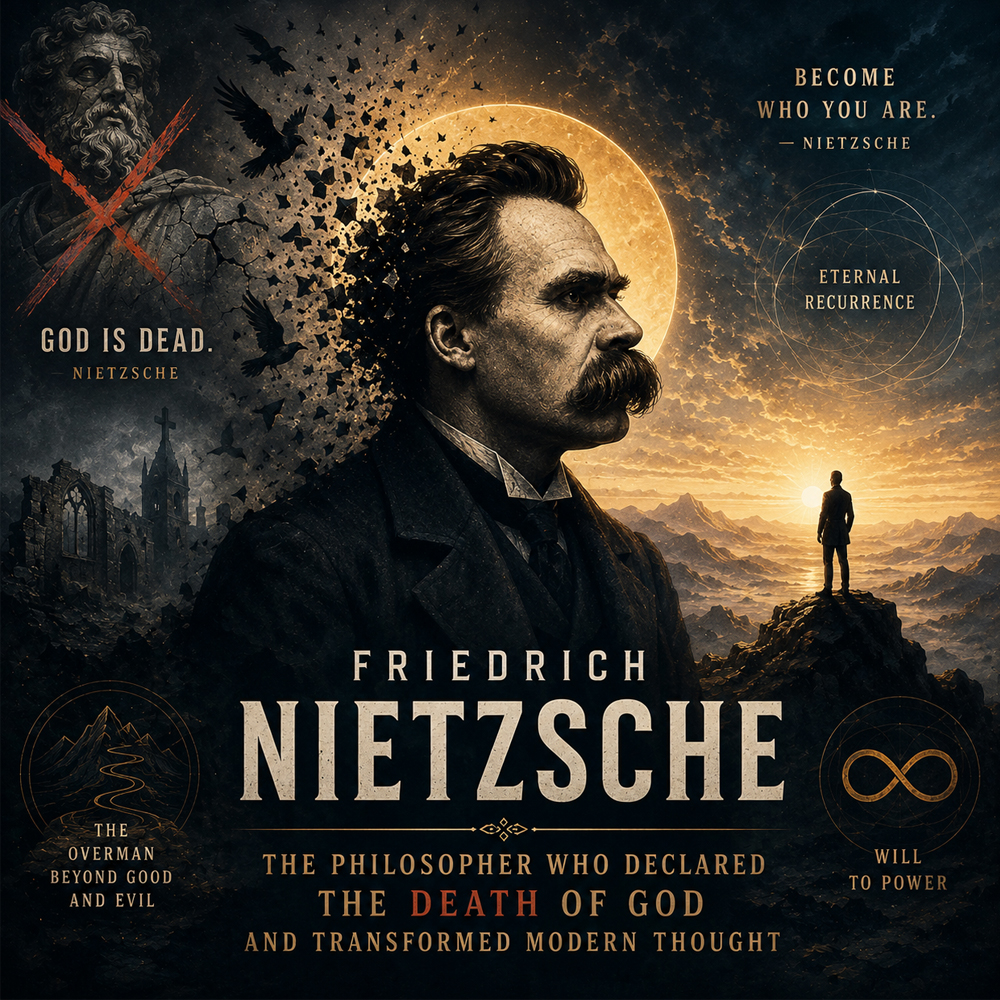
Introduction
Few philosophers have provoked such strong reactions as Friedrich Nietzsche. For some, he is the greatest critic of Western civilization; for others, a prophet of the modern world; and for still others, a dangerous thinker whose ideas have been misunderstood and misused in politics. More than a century after his death, his books continue to spark intense debates because they offer no comfort but instead question nearly every value people take for granted.
Nietzsche did not aim to create a closed philosophical system, as Plato, Aristotle, or Hegel did. Instead, he wrote through aphorisms, poetic imagery, and psychological observations that compel the reader to reach their own conclusions. It is precisely this unusual form that makes his works both beautiful and difficult to understand, as each sentence contains more than one possible meaning.
Today, his ideas influence far beyond philosophy. They can be found in the psychology of Carl Jung, in the existentialism of Jean-Paul Sartre and Albert Camus, in the philosophy of Michel Foucault, in the literature of Hermann Hesse and Thomas Mann, as well as in contemporary discussions about freedom, morality, meaning, and human identity. Even though many people have never opened a book by Nietzsche, a large part of the ideas that shape modern culture bear his imprint.
To understand Nietzsche, however, we must set aside the myths. He is not a philosopher of hatred, nor a preacher of senseless violence. He is not the man who invented dictatorship or racial superiority, as is often mistakenly claimed. In fact, many of these interpretations emerged decades after his death, when his sister altered and edited parts of his manuscripts, and later when National Socialist propaganda used excerpts from his texts out of context.
The real Nietzsche is far more complex. He is a philosopher of the free spirit, a ruthless psychologist of human nature, and a man who devoted his life to one question: what happens to humanity when old values cease to be convincing? It is precisely this question that makes his philosophy so relevant in the 21st century, when more and more people experience a crisis of meaning, distrust of traditions, and a sense of spiritual emptiness.
The Childhood of an Extraordinary Mind
Friedrich Wilhelm Nietzsche was born on October 15, 1844, in the small German village of Röcken, not far from Leipzig. His father was a Lutheran pastor, and the family lived in an atmosphere of strong religiosity, discipline, and respect for education. From the very beginning, the future philosopher’s fate was marked by dramatic events that deeply influenced his character.
When Nietzsche was only four years old, his father died after a severe brain illness. Shortly afterward, the family also lost his younger brother. Thus, the future philosopher’s childhood was spent almost entirely among women-his mother, grandmother, two aunts, and his sister Elisabeth. Later, he himself admitted that his early encounter with death left a lasting mark on the way he perceived life, suffering, and human fragility.
Even as a student, Nietzsche displayed extraordinary intellectual abilities. He studied classical languages, music, poetry, and philosophy with such ease that his teachers considered him a true phenomenon. In addition to writing poems and musical compositions, he demonstrated an unusual ability to analyze ancient texts with a precision that impressed even experienced scholars.
In 1858, he enrolled in the prestigious school Schulpforta, known for its exceptionally rigorous academic training. There, he immersed himself in the world of ancient Greece and Rome, studying Homer, Aeschylus, Sophocles, Plato, and numerous Latin authors. It was during this time that his conviction began to take shape-that ancient culture possessed a vitality and spiritual strength that the modern world was gradually losing.
While most of his peers viewed classical works as historical monuments, Nietzsche read them as living testimonies of a different way of existence. He sensed that the ancient Greeks had the ability to accept tragedy as a natural part of life without falling into despair. This discovery would later become one of the central themes of his philosophy.
From Theology to Classical Philology
After graduating from high school, Nietzsche enrolled in theology and classical philology at the University of Bonn. Choosing theology seemed entirely natural for someone raised in a family of a Protestant pastor. However, just a few months later, he definitively lost his religious faith and abandoned theology.
The reason was not a sudden rebellion against his family or a desire for scandal. On the contrary, Nietzsche arrived at his decision after prolonged reflection and critical study of the Bible, history, and philosophy. He began to feel that religious dogmas could no longer be defended through reason and that European culture was gradually entering an era in which traditional faith was losing its influence.
This decision caused serious tension in his relationship with his mother and especially with his sister Elisabeth, who remained deeply religious throughout her life. Nevertheless, Nietzsche never changed his position and gradually began to build his own worldview, based not on revelation but on philosophical inquiry into human nature.
Shortly afterward, he moved to the University of Leipzig, where he encountered the man who would have a profound influence on his early thinking-Arthur Schopenhauer. Although the two never met in person, the book The World as Will and Representation shook the young student. Nietzsche felt he had discovered a philosopher who did not embellish life with beautiful illusions but looked directly into the face of suffering.
Schopenhauer described the world as a place governed by a blind and insatiable will that constantly generates desires, and desires inevitably lead to suffering. For a time, Nietzsche embraced this pessimistic philosophy almost unconditionally. Later, however, he would carry out one of the most radical transformations in the history of European thought, turning his teacher’s pessimism into a philosophy of affirming life.
The Youngest Professor in Europe
Nietzsche’s exceptional abilities impressed his professor Friedrich Ritschl, who recognized in him a rare talent. Thanks to his recommendation, in 1869, at just twenty-four years old, Nietzsche was appointed professor of classical philology at the University of Basel. This was an almost unprecedented case, as he received the position even before officially defending a doctoral dissertation.
The appointment caused genuine astonishment in academic circles. Most professors reach such a position after decades of work, while Nietzsche achieved it at the very beginning of his career. However, this success also brought significant pressure, as expectations toward the young scholar became extremely high.
His work at the university gradually began to exhaust him. Instead of limiting himself to philological analysis of ancient texts, Nietzsche became increasingly interested in the philosophical and psychological questions behind them. For him, Homer, the tragedians, and Plato were not merely objects of scholarly study but windows into different ways of understanding human existence.
It was during this period that his friendship with the great composer Richard Wagner began. The two spent long hours discussing music, art, ancient Greece, and the future of German culture. Wagner saw in the young professor a brilliant philosopher, while Nietzsche believed that the composer was capable of reviving the tragic spirit of ancient Greece through music.
The Birth of Tragedy
In 1872, Nietzsche published his first major book, The Birth of Tragedy from the Spirit of Music. From the moment it appeared, it provoked strong reactions. Academic philologists considered it too philosophical, while philosophers found it unusually literary. Thus, his very first book showed that its author did not fully belong to any single discipline.
The central idea of the work is that great Greek culture was born from the tension between two opposing forces, which Nietzsche called the Apollonian and the Dionysian. The Apollonian symbolizes order, harmony, clarity, and rationality. The Dionysian represents chaos, ecstasy, instinct, passion, and the creative energy of life.
According to Nietzsche, true greatness arises when these two forces coexist. If a person submits only to reason, life becomes a sterile scheme without inspiration. If one surrenders entirely to instinct, destruction and chaos follow. Great art, great individuals, and great civilizations succeed in combining these opposites into a dynamic balance.
This idea reveals something essential about how Nietzsche understands the human being. For him, human nature is never entirely rational. In the depths of the psyche operate powerful forces that cannot be reduced to logical arguments. Long before Freud and Jung began to speak about the unconscious, Nietzsche already suspected that human decisions are often determined by impulses that reason merely justifies afterward.
Even in this early work, it becomes clear that the philosopher does not intend merely to analyze the world. He wants to show how cultures are born, how they reach their peak, and why they gradually begin to lose their vitality. It is here that the first seed of an idea appears-one that will later become his hallmark: the conviction that European civilization is entering a period of deep spiritual crisis.
According to Nietzsche, this crisis is not economic or political. It is far deeper. The Western individual is gradually losing the ability to create new values and begins to live off the inheritance of the past. Old ideals are still repeated, but they no longer truly inspire anyone. It is upon this troubling diagnosis that his entire later philosophy will be built, including his most famous statement that “God is dead”-a sentence that would change the history of modern thought and mark the beginning of one of the deepest philosophical discussions of the modern era.
The Break with Richard Wagner and the Final Separation from the Past
At first, Nietzsche regarded Richard Wagner not only as a great composer but also as a man capable of transforming European culture. He believed that Wagner’s music could awaken the same tragic power that once existed in ancient Greek tragedies. To the young philosopher, the composer appeared as a rare figure who combined artistic genius, spiritual depth, and the ability to inspire an entire generation.
Over time, however, this admiration began to crack. Nietzsche noticed that Wagner was gradually moving away from the ideal of the free creator and increasingly becoming a symbol of German nationalism, cultural conservatism, and Christian sentimentality. He was especially disappointed by the composer’s final opera, Parsifal, which he saw as a return to the religious morality from which the European spirit needed to free itself.
The break between the two was not merely a personal conflict. It symbolized Nietzsche’s final separation from all his intellectual teachers. Having already distanced himself from Schopenhauer’s pessimism, he now freed himself from Wagner’s influence as well. For the first time, he stood completely alone-without philosophical authority, without a spiritual guide, and without any desire to belong to a particular school.
This solitude would not be temporary. In the following years, Nietzsche would become one of the loneliest thinkers in European history. While other philosophers taught at universities, gathered students, or participated in public life, he lived almost continuously in small apartments, boarding houses, and mountain resorts, traveling between Switzerland, Italy, and southern France. It was in this voluntary isolation that his most radical ideas would be born.
Solitude as a Philosophical Method
Nietzsche’s health gradually deteriorated. He suffered from severe migraines, intense stomach pains, vision problems, and long periods of near-total physical incapacity. At times, he could not read for more than a few minutes without unbearable pain, and writing became a true ordeal.
In 1879, he was forced to leave the University of Basel. He was only thirty-four years old, yet his academic career was already over forever. Instead of a secure profession and public recognition, he chose the life of an independent writer, relying solely on his small pension and his own discipline.
For many, such an existence would seem like a failure. For Nietzsche, however, this independence became the very condition for genuine philosophizing. He began to believe that great ideas are born far from the noise of society, because a person can think freely only when they stop seeking the approval of the majority.
It is no coincidence that the image of the mountain appears so often in his works. The mountain symbolizes not only physical height but also spiritual distance from commonly accepted beliefs. The person who climbs upward sees the world differently. They lose the security of the crowd but gain the freedom to create their own perspective.
This idea would later become central in Thus Spoke Zarathustra, where the main character lives alone in the mountains for years before descending among people. The story is not a random allegory. To a large extent, it reflects Nietzsche’s own inner life, as he believed that true spiritual transformation begins with the ability to remain alone with one’s own thoughts.
“God Is Dead” – The Most Misunderstood Sentence in Philosophy
There is probably no other philosophical statement that has been quoted so often and yet so widely misunderstood as the words: “God is dead.” For many, this appears to be a simple atheistic provocation or a mockery of religion. In reality, Nietzsche meant something far deeper.
When he wrote these words in The Gay Science, he was not claiming that some supernatural being had literally ceased to exist. Rather, he was describing a historical process in which the Christian worldview was gradually losing its credibility. Science, historical criticism, industrialization, and the development of modern culture were changing the way Europeans understood reality.
According to Nietzsche, it was the Western individual who had “killed God”-not through violence, but through their own thinking. Over centuries, civilization developed rational knowledge that gradually undermined the religious picture of the world. People continued to use the language of faith, but increasingly lived as if they did not truly believe in it.
Most importantly, Nietzsche did not celebrate this event. On the contrary, he described it almost as a cosmic catastrophe. If God had been the ultimate source of morality, truth, and meaning, what would replace them? If there was no longer an absolute foundation for human values, how would we know what is good and what is evil?
It is here that the drama of the modern individual begins. Old values gradually lose their power, but new ones have not yet been created. According to Nietzsche, humanity is entering a dangerous transitional period in which it may fall into spiritual emptiness. He calls this condition nihilism.
Nihilism – When Life Loses Its Meaning
The word “nihilism” is often used as a synonym for pessimism or despair, but for Nietzsche it has a much more precise meaning. Nihilism is the moment when the highest values cease to be convincing. A person no longer truly believes in them, yet has not discovered others upon which to build their life.
This condition does not necessarily mean depression. A person may be successful, wealthy, and socially respected, yet internally feel that everything lacks ultimate meaning. According to Nietzsche, it is precisely this emptiness that gradually begins to define European civilization.
He believed that nihilism has different forms. Passive nihilism appears when a person gives up creating, stops believing in their own strength, and simply drifts along with life. Active nihilism is more dangerous and at the same time more creative. It consciously destroys old values in order to make room for the creation of new ones.
Nietzsche did not want people to remain in a state of nihilism. For him, it was only an intermediate stage. The destruction of old idols is necessary, because without it true spiritual freedom cannot emerge. But destruction alone is never enough. It must be followed by creation.
This is why his philosophy is often misunderstood as purely negative. In reality, Nietzsche does not destroy values to leave an empty space. He dismantles what he believes has lost its vitality in order to give human beings the opportunity to become creators of their own values.
The Revaluation of All Values
One of Nietzsche’s most ambitious ideas is the need for a “revaluation of all values.” This phrase does not mean that every tradition must automatically be rejected. It means that every value must be questioned, no matter how ancient or sacred it may appear.
Nietzsche was convinced that many moral rules do not originate from eternal truths, but from specific historical circumstances. What one civilization calls good, another may consider weakness. Therefore, morality is not an unchanging law of the universe, but a human creation.
This view was revolutionary for its time. Instead of asking what is absolutely good, Nietzsche asked how a given value affects life. Does it make a person stronger, braver, and more creative, or does it make them fearful, dependent, and submissive? This practical criterion gradually replaces traditional moral categories.
For Nietzsche, life should not be subordinated to abstract rules. On the contrary, rules should be evaluated according to whether they serve life. This does not mean justifying arbitrariness or violence, but insisting that individuals think independently rather than mechanically inherit the beliefs of previous generations.
This idea lays the foundation for a new understanding of human freedom. A person is not free simply because they break rules. True freedom belongs to the one who has the courage to examine the origins of their own beliefs and to take responsibility for choosing how to live.
The Birth of Zarathustra
Between 1883 and 1885, Nietzsche wrote the work he himself considered the pinnacle of his творчество-Thus Spoke Zarathustra. The book does not resemble a traditional philosophical treatise. It is at once poetry, mythology, philosophy, and a spiritual parable, written in a language reminiscent of Old Testament prophets.
The main character, Zarathustra, descends from the mountain to speak to people about the need to overcome themselves. He does not preach a new religion or offer a ready-made moral code. Instead, he calls on each individual to become the creator of their own existence.
It is in this book that one of Nietzsche’s most influential ideas appears for the first time-the figure of the Overman. This concept would become one of the most misunderstood in the history of philosophy, and its true meaning will be the subject of the next part of this article.
The Overman – The Most Misunderstood Concept in Nietzsche’s Philosophy
Few of Nietzsche’s ideas have been as frequently distorted as the concept of the “Overman” (Übermensch). After the rise of National Socialism, many began to associate this idea with racial superiority, political domination, or physical strength. However, such an interpretation has almost nothing to do with what Nietzsche actually meant.
For him, the Overman does not belong to a particular nation, race, or social class. He is a spiritual ideal-a person capable of overcoming their own limitations, fears, and inherited prejudices. This is an individual who does not live according to others’ expectations but creates their own way of existence.
Nietzsche sees the human being as a transitional entity, not as a finished product of evolution. The famous phrase “Man is a rope stretched between the animal and the Overman” expresses precisely this idea. Every person carries within themselves the potential for development, but realizing it requires immense inner discipline, courage, and a willingness for continuous self-improvement.
The Overman does not dominate others. Above all, he masters himself. He does not blame society for his failures, does not seek excuses in external circumstances, and does not wait for someone else to give his life meaning. Instead, he takes full responsibility for his life and turns his own existence into a creative act.
This is why Nietzsche contrasts the Overman with the “last man”-a figure that symbolizes spiritual mediocrity. The last man chooses comfort over risk, security over freedom, and convenience over growth. He does not wish to suffer, but precisely for that reason, he never reaches true depth. For Nietzsche, the greatest danger to civilization is not evil, but mediocrity, which gradually kills every desire for spiritual growth.
The Will to Power
One of Nietzsche’s most discussed ideas is the concept of the “will to power.” A superficial reading creates the impression that the philosopher speaks only of political domination or the desire to control others. In reality, his understanding is far deeper and more psychologically nuanced.
According to Nietzsche, every living being strives not merely to survive, but to unfold its own potential. Life constantly seeks growth, development, and self-realization. This inner movement he calls the will to power. Here, power does not mean control over others, but the ability of a person to realize the potential they carry within themselves.
This idea can be found in all areas of life. The artist who creates a great work, the scientist who discovers a new law of nature, the musician who composes a symphony, or the person who overcomes a severe trial-all of them express different forms of the same vital energy. For Nietzsche, true strength is always creative.
He believes that civilizations decline when this vital energy begins to weaken. People stop creating new ideas and begin only to defend old ones. Instead of creativity, conformity appears; instead of courage, fear of change. That is why the philosopher constantly calls on individuals to overcome their own limits.
In this sense, the will to power is close to the modern concept of self-actualization, though far more radical. It does not promise tranquility, but continuous development. For Nietzsche, life is never a static state. To live means constantly becoming something more than you were yesterday.
Eternal Recurrence
Among all of Nietzsche’s ideas, perhaps the most enigmatic is that of eternal recurrence. He proposes the following thought experiment: imagine that one day a demon tells you that you will have to live exactly the same life an infinite number of times-every joy, every pain, every mistake, and every encounter will repeat eternally.
The first reaction of most people would likely be horror. This is precisely what interests Nietzsche. If a person feels despair at such a thought, perhaps they are not truly living the life they desire. But if they are able to respond with joy and say, “Yes, I would live it all again,” then they have reached the deepest affirmation of life.
It is not entirely clear whether Nietzsche himself understood eternal recurrence as a cosmological theory or merely as a philosophical experiment. For his philosophy, this distinction is not decisive. What matters more is the question this idea poses to every individual.
Do we live in such a way that we could accept the repetition of our own life? Or do we constantly postpone real living for some indefinite future? For Nietzsche, one must live in a way that deserves to be repeated infinitely many times.
This idea combines freedom with responsibility. If there is no external judge to ultimately evaluate our lives, then life itself becomes the highest criterion. Every decision gains enormous weight because it shapes the person we gradually become.
Christianity and the Critique of Morality
One of the most controversial aspects of Nietzsche’s philosophy is his critique of Christianity. It is often presented as simple hatred toward religion, but such an explanation is too superficial. In reality, Nietzsche does not attack spirituality as such. He attacks a moral system that, in his view, places weakness above strength, obedience above creativity, and suffering above the joy of life.
According to him, early Christianity arose in a world dominated by powerful empires and social inequality. In this environment, values such as humility, patience, and compassion gave hope to the oppressed. Nietzsche acknowledges the historical role of these ideas but believes that over time they began to hinder the development of human potential.
He introduces the distinction between “master morality” and “slave morality.” The former arises among people who actively create their values, while the latter, according to him, is based on a reaction against the strong. Although this theory is controversial and often criticized, it has had a profound influence on later sociology, psychology, and political philosophy.
It is important to emphasize that Nietzsche does not advocate cruelty. His aim is to show that moral systems have a history and that they can be critically analyzed. He insists that one should not accept any value simply because it is ancient or widely accepted.
The Final Years and the Tragic End
During the last decade of his life, Nietzsche wrote with incredible intensity. In just a few years, he produced works such as Beyond Good and Evil, On the Genealogy of Morality, The Twilight of the Idols, The Antichrist, and Ecce Homo. It was during this period that his philosophy reached its most mature form.
Paradoxically, almost no one paid attention to these books. Most editions were sold in extremely small numbers, and the author remained largely unknown. Nietzsche often joked that he had more readers in the future than in the present, without realizing how prophetic those words would prove to be.
In January 1889, in Turin, he suffered a mental breakdown. According to the well-known story, the philosopher saw a coachman beating his horse, rushed toward the animal, embraced it, and then collapsed to the ground. Whether this incident is entirely accurate is still debated by historians, but it is certain that after this moment Nietzsche never fully recovered his mental health.
He spent the last eleven years of his life under the care of his mother and later his sister Elisabeth. During this time, he no longer wrote philosophical works. He died on August 25, 1900, unaware that he would soon be recognized as one of the most influential thinkers in history.
How His Ideas Were Misused
After Nietzsche’s death, his sister Elisabeth Förster-Nietzsche took control of his literary legacy. She held strong nationalist and anti-Semitic views-positions that Nietzsche himself repeatedly criticized in his letters and books.
Elisabeth edited parts of his manuscripts, selected excerpts according to her own beliefs, and published unfinished texts as completed works. Later, these edited versions made it easier for National Socialist propaganda to present Nietzsche as a precursor to their ideology.
Modern research shows that such an interpretation is deeply misleading. Nietzsche openly despised anti-Semitism, nationalism, and mass politics. His ideal was the independent thinker, not a person who blindly follows the state or an ideology.
This does not mean that his philosophy is free of controversial ideas. On the contrary, it continues to provoke lively debates. But today, most scholars agree that it cannot fairly be reduced to the political abuses carried out decades after his death.
Nietzsche’s Legacy
Nietzsche’s influence on modern culture is difficult to overestimate. Without him, existentialism would likely look different, depth psychology might not have developed in the same way, and modern philosophy of values would have taken an entirely different path.
Carl Jung used many of his ideas in developing analytical psychology. Martin Heidegger devoted years to analyzing his work. Albert Camus and Jean-Paul Sartre continued his questions about freedom and meaning. Michel Foucault developed his genealogical approach to the history of morality and knowledge.
Today, his influence can also be found beyond academic philosophy. Literature, cinema, psychology, art, and even entrepreneurship often draw on his ideas about personal responsibility, overcoming limitations, and creating one’s own path in life. Although these interpretations are sometimes simplified, they demonstrate how remarkably alive his legacy remains.
Conclusion
Friedrich Nietzsche is a philosopher who refuses to offer easy answers. Instead, he poses questions that continue to sound strikingly relevant more than a hundred years after his death. What remains when old values cease to be convincing? Can a person create meaning for their own life? And are we brave enough to take full responsibility for our own existence?
His philosophy does not invite despair, but spiritual maturity. It reminds us that freedom is never a gift, but a task. To be free means to live without ready-made excuses, to overcome one’s own fears, and to continuously become a better version of oneself.
That is why Nietzsche remains one of the most influential philosophers of the modern era. Whether one agrees with his ideas or rejects them, encountering them rarely leaves anyone indifferent. He does not offer a comfortable worldview, but a challenge-to look honestly at ourselves, our values, and the life we have chosen to live. Perhaps this is his greatest legacy: not to tell us what to think, but to teach us to think for ourselves.
Read more:
- Fyodor Dostoevsky: The Writer Who Descended into the Abyss of the Human Soul
- Plato: The World of Ideas, the Nature of the Soul, and the Search for True Reality
- Carl Jung and the Depths of the Human Psyche
- Marcus Aurelius: The Philosopher Emperor and Stoic Wisdom for Living Amid Cha
Author: Vasil Stoyanov