
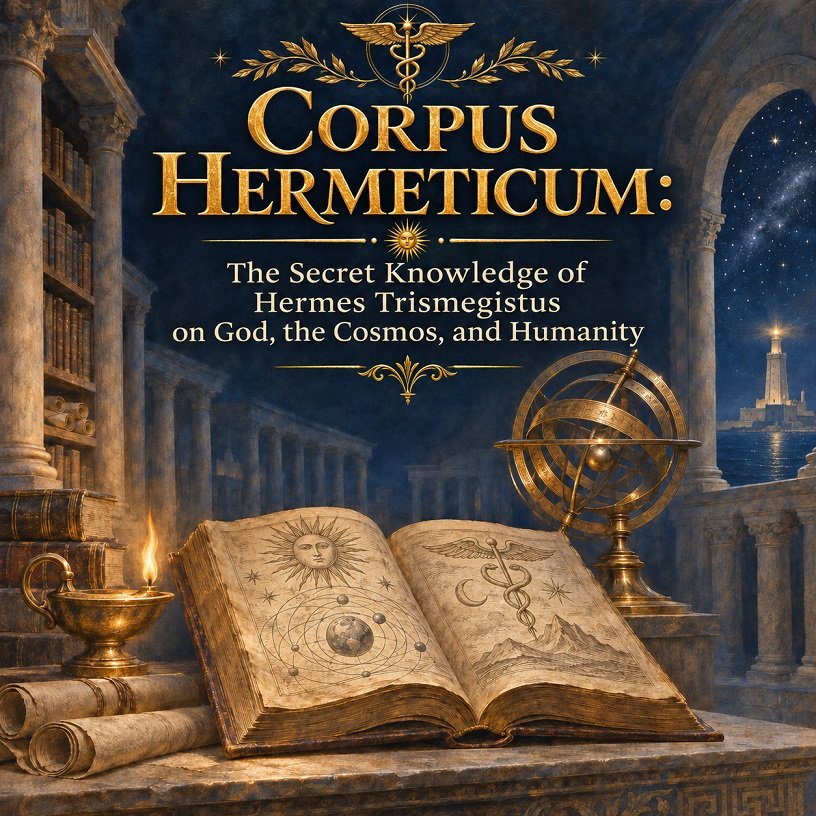
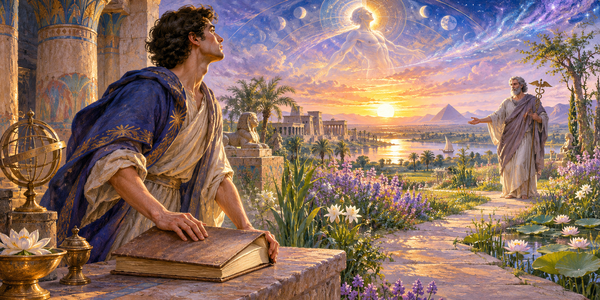
Hermes is absorbed in contemplation of the nature of existence when his ordinary sensory perceptions grow quiet. An immense presence reveals itself before him, identifying itself as Poimandres, the Mind of supreme sovereignty. Asked what he wishes to learn, Hermes declares that he wants to understand the nature of existing things and know God. The answer does not come in the form of a definition. Before him unfolds a vision of the birth of the Cosmos, the origin of humanity, and the soul’s journey toward its source.
Thus begins the first treatise of the Corpus Hermeticum, a collection in which cosmology, philosophy, and mystical knowledge form a unified spiritual inquiry. In its dialogues, the teacher does not merely convey information to the student. He prepares him for a transformation of the very faculty through which he understands himself and the world.
In the following pages, we will explore the individual treatises, examining the relationships between their imagery, arguments, and practical messages. Particular attention belongs to the divine Mind, the Word, the living Cosmos, fate, spiritual rebirth, and the enigmatic status of humanity as both mortal and immortal.
The Origins and Structure of the Corpus Hermeticum
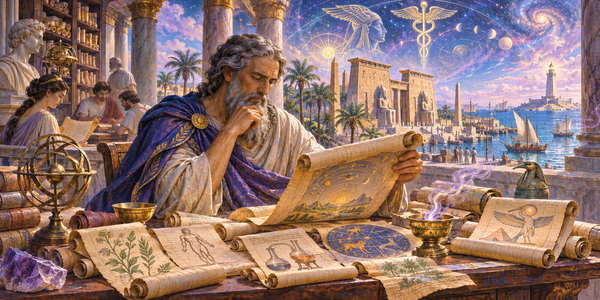
The Corpus Hermeticum is a collection of Greek philosophical and religious writings composed primarily during the first centuries of the Common Era in the cultural environment of Roman Egypt. Their literary teacher is Hermes Trismegistus, a figure emerging from the convergence of the Greek Hermes and the Egyptian Thoth. Thoth is associated with writing, measurement, knowledge, and sacred order, while Hermes serves as a mediator between different realms of existence. In the Hermetic dialogues, these characteristics unite in the figure of a discoverer and transmitter of divine wisdom.
The collection is neither a novel with a unified plot nor a systematic textbook written by a single author. It consists of seventeen treatises numbered I through XVIII, with number XV absent from the established modern edition. The individual writings employ a shared vocabulary but develop their own arguments and sometimes different assessments of the material world. This diversity makes them particularly rewarding to read: the same question is approached through cosmology, moral education, prayer, and mystical experience.
Among Hermes’ interlocutors, Tat, Asclepius, and King Ammon stand out. In the first treatise, Hermes himself is the student of Poimandres. In other writings, he conveys knowledge to Tat, who gradually progresses from questions about the structure of the world to questions about his own spiritual birth. In the sixteenth treatise, Asclepius in turn instructs Ammon. This exchange of roles demonstrates that knowledge is not the private property of one teacher but something to be assimilated and transmitted.
The broader Hermetic literature includes the Latin Asclepius, fragments preserved by Stobaeus, and writings from the Nag Hammadi library. These are not identical to the Corpus Hermeticum itself. The distinction matters because it allows each idea to be examined within its actual literary context. The present retelling follows the numbering of the Greek collection.
During the Renaissance, Marsilio Ficino translated the first fourteen treatises into Latin at the request of Cosimo de’ Medici. Completed in 1463, his translation exerted a powerful influence on European intellectual culture. In 1614, the philologist Isaac Casaubon argued for the late antique origins of the texts on linguistic and historical grounds. This dating situates them within the rich interaction between Egyptian religion, Greek philosophy, and the religious movements of the Roman Empire.
Several concepts are essential to understanding the book. Nous means Mind or intellect in a deeper sense than everyday reasoning. Logos denotes the Word, rational expression, or an organizing principle, depending on the context. Gnosis is knowledge that transforms the knower’s relationship with existence. Kosmos means an ordered world. These concepts establish the language through which the treatises move from visible nature toward its invisible foundation.
Poimandres: The Vision of Creation and the Origin of Humanity - Treatise I
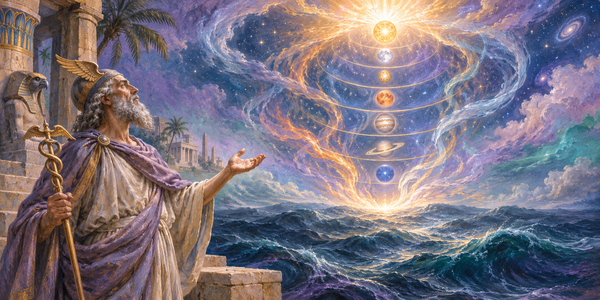
At the beginning of the vision, Hermes sees boundless light. Darkness subsequently appears, transforming into a moist, restless nature. From the light, a holy Word descends toward this nature. Fire rises upward, air follows it, and earth and water remain in the lower region. This primordial picture represents the transition from indeterminacy toward differentiation and order.
Poimandres explains that the light is the divine Mind and that the Word proceeding from it is its son. The relationship between Mind and Word is not described as ordinary physical kinship. It expresses the relationship between the source of rationality and its active manifestation. Just as meaning precedes a sentence but becomes accessible through it, the invisible principle reveals itself through its expressed activity.
The first Mind generates a second, creative Mind, which fashions seven governors. They encompass the sensible world within circles, and their government is called fate. This image is connected with the ancient conception of the seven visible planetary luminaries and their spheres. Within the narrative, they represent the cosmic order in which bodily existence unfolds through regular movements and limitations.
The Word unites with the creative Mind, while lower nature remains without reason in the same higher sense. The rotation of the celestial circles sets nature in motion, and it produces living beings. The cosmogony presents the world not as an accidental accumulation of objects but as the organized unfolding of different degrees of life.
Next comes the appearance of the primordial Human. The divine Mind generates him in its own image and loves him as its own child. The Human contemplates the creation of the creative Mind and desires to create as well. He receives a share in the authority of the seven governors and passes beyond their circles to reveal his image to lower nature.
Nature sees his beauty reflected in the water and his shadow upon the earth. The Human in turn sees his own likeness in nature and falls in love with it. He desires to dwell there. Nature embraces him, and the two unite. From this encounter arises the dual condition of the human being.
The reflection in water is one of the most powerful symbols in the treatise. It is not the primordial Human himself, but it bears his image. Attraction to the reflection expresses the danger of a being identifying itself with its manifested form. The beauty of nature is not denied: it genuinely reflects something divine. The error arises when the image is confused with its source.
The human being is mortal with respect to the body and immortal with respect to his essential origin. He participates in the government of the Cosmos, yet through embodiment comes under the authority of fate. This duality explains why human life contains both an aspiration toward unlimited knowledge and dependence on bodily conditions.
Poimandres describes the original human beings as androgynous, after which the sexes are separated and reproduction begins. The myth employs the transition from unity to multiplicity to explain the emergence of generations. Humanity unfolds within nature through birth, change, and death, while knowledge directs human beings toward their imperishable origin.
Hermes asks why those who know themselves attain life, whereas those attached to the body remain under the authority of death. Poimandres connects salvific knowledge with the understanding that the primordial Human originates in life and light. Self-knowledge here does not simply mean describing one’s character, habits, and preferences. It means recognizing the deeper foundation of existence.
At the end of earthly life, the body is surrendered to dissolution, and the human being passes through the seven cosmic regions. In the first, he relinquishes the activity of growth and diminution; in the second, the instrument of maliciousness; in the third, the deception of desire; in the fourth, the lust for power; in the fifth, impious audacity; in the sixth, the pursuit of wealth through evil; and in the seventh, the falsehood that lays traps. These characteristics are presented as acquisitions of conditioned existence that no longer belong to the ascending human being.
Having been released from them, he reaches the eighth region, where he joins the beings singing praises to the Father. From there, the ascent continues toward the divine powers. The ultimate goal is deification through knowledge. The eighth region symbolizes transcendence of the sevenfold order of fate, while the song expresses the harmony of the liberated being with divine life.
The treatise concludes with the transformation of Hermes himself. He addresses humanity, calling people to awaken from the intoxication of ignorance, and conveys what he has learned. The vision becomes a moral obligation. The knowledge received does not remain enclosed within personal experience but gives rise to responsibility toward those who continue to live in error.
The Invisible Foundation of Motion and the Sacred Order - Treatises II and III
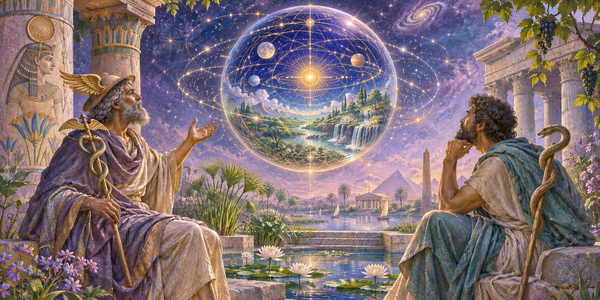
In the second treatise, Hermes discusses motion with Asclepius. The opening question appears technical: does everything that moves not move within something and by means of something? The interlocutors gradually distinguish the moving body, the space in which it moves, and the cause of its motion.
The Cosmos is an immense body, but its motion requires a foundation that cannot be reduced to another moving body. Hermes directs attention toward the incorporeal and the unmoving. If every cause requires another cause of the same kind, the explanation remains incomplete. The treatise seeks a principle that makes motion possible without itself being subject to the same order.
The conversation also employs the example of opposing motions. Stability does not necessarily mean the absence of all activity; it can result from a relationship between forces. The dialogue thus moves from immediate observation of nature toward the question of its metaphysical foundation.
Hermes examines Mind, Word, soul, and spirit in relation to motion and life. The body does not independently explain its own vitality. The incorporeal principle is not an object that can be discovered by dissecting the body. It belongs to a different order of explanation. This is the treatise’s characteristic transition from a physical question to an intellectual one.
Toward the end of the conversation, attention turns to God and the Good. God is not simply one among many minds or one among the beings possessing goodness. He is the foundation from which their possibility of existence proceeds. The distinction between possessing a quality and being its ultimate source acquires even greater significance in the sixth treatise.
The third treatise, known as the Sacred Discourse, presents a brief cosmogony. At the beginning stand darkness, water, and a subtle intellectual spirit. Holy light manifests itself, and the elements become differentiated. The celestial gods occupy their regions, and the stars are arranged according to their movements.
The creation of living beings is connected with the different capacities of nature. Animals, plants, and human beings appear. Humanity receives the task of observing the heavens, knowing divine activity, investigating nature, and recognizing the Good. Knowledge here has a cosmic function: through humanity, the ordered world becomes an object of conscious contemplation.
The third treatise does not repeat in detail the drama of the primordial Human from Poimandres. Its emphasis lies on the orderly formation of the world and humanity’s place within it. Creation is presented as the emergence of definite relationships, boundaries, and capacities. The sacred character of the Cosmos manifests through its organization.
The two treatises form a natural pair. The second asks what makes motion possible, while the third describes how cosmic order is established through divine activity. One develops an argument; the other offers a condensed image of creation. The reader receives two different approaches to the shared question of the dependence of the visible upon the invisible.
The Mixing Bowl of Mind and the God Revealed Through Creation - Treatises IV and V
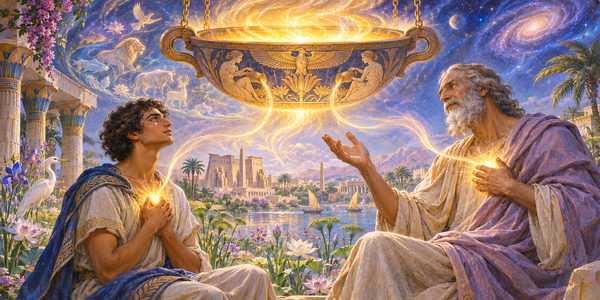
The fourth treatise is entitled The Mixing Bowl or the Monad. Hermes explains to Tat that the creator fashions the world not with hands and instruments but through the Word. Creation is an expression of divine activity rather than a fabrication dependent on external means.
God grants human beings the capacity for rational speech, but participation in Mind is represented through a particular mystical action. He fills a great mixing bowl with Mind, sends it downward, and instructs a herald to call human hearts to immerse themselves in it. Those who answer the call receive knowledge and participate in Mind.
The mixing bowl symbolizes a vessel, but its contents are not an ordinary liquid. Immersion signifies the transition from external listening to actual participation. The student must not simply learn what Mind is. He must acquire the capacity to live and know through it.
The distinction between speech and Mind in this treatise allows two levels of intellectual life to be distinguished. A person can possess language, perform calculations, and defend beliefs without directing these abilities toward knowledge of their own nature. Mind denotes a higher orientation of knowledge that transforms the purposes of reasoning.
Hermes presents Tat with a choice between attachment to the bodily and aspiration toward the divine. The choice is not presented as acquiring another possession in life. It requires a reassessment of what a person regards as their highest good. Adding spiritual knowledge to an unchanged system of desires is insufficient.
The Monad is an image of unity and the beginning of numbers. Hermes uses numerical symbolism to demonstrate how multiplicity depends on unity without exhausting it. Every number is constructed through units, but the originating principle does not become a separate object among its own manifestations. The analogy points toward God as a source that is not divided into parts in the manner of material bodies.
The fifth treatise examines the apparent paradox of God being invisible and simultaneously the most manifest of all. Hermes encourages Tat to contemplate the heavens, the movements of the luminaries, the structure of the earth, and the emergence of living beings. The invisible creator becomes knowable through his activity.
Particular attention is devoted to the formation of the human body. Hermes asks who determined the position of the eyes, connected the bones, fashioned the organs, and established the relationships between the different parts. The body becomes an object of wonder because its complex organization directs thought beyond the individual materials from which it is composed.
The treatise does not merely conclude that the creator stands somewhere outside creation. God reveals himself through everything he generates. His invisibility arises from the fact that he is not limited to one particular form. If he were identified with a specific object, the remainder of creation would be excluded from the conception of his activity.
In the concluding prayer, Hermes addresses God as the one who is everything and simultaneously transcends every individual thing. Knowledge passes into gratitude. Contemplation of the world is no longer simply the collection of observations but the recognition of an uninterrupted creative presence.
The fourth treatise emphasizes the transformation of the knower, while the fifth emphasizes the interpretation of the knowable world. The mixing bowl of Mind prepares the student to perceive more than superficial forms in nature. Contemplation of creation in turn provides content for the newly acquired capacity for knowledge.
The Absolute Good, Ignorance, and the Mystery of Death - Treatises VI, VII, and VIII
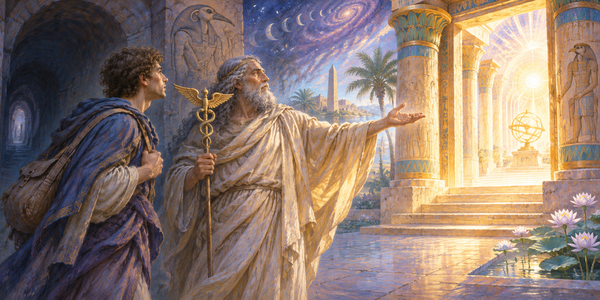
The sixth treatise begins with a categorical distinction: the Good in an absolute sense is found in God alone. Everything subject to change, need, and suffering lacks the same unconditional fullness. Hermes examines the Good not as an individual quality but as perfect self-sufficiency.
In human life, good things are frequently associated with particular needs. Food is good for the hungry, rest for the exhausted, and medicine for the sick. Their value is real but depends on circumstances. The absolute Good does not arise in response to a deficiency. It requires nothing to make it complete.
Hermes emphasizes that the Cosmos is beautiful and organized but subject to motion and change. Human beings experience the contradiction between desires and reality even more directly. When someone calls something good merely because it provides pleasure, they confuse the satisfaction of a need with the highest good.
This distinction has moral significance. The student must recognize the limits of pleasure and possession without expecting them to provide what they cannot provide by their nature. Otherwise, the pursuit of fullness becomes dependent on objects whose value is conditional and transient.
The seventh treatise is a brief, energetic address to humanity. Hermes describes people as intoxicated by ignorance and unable to see the path toward knowledge. He calls upon them to seek a guide who will lead them to the gateway of knowledge, where pure light shines.
The image of intoxication expresses a condition in which people remain unaware of their impaired judgment. Ignorance is not simply a lack of information. It is the inability to recognize one’s own error. Awakening therefore requires more than receiving new information.
Hermes describes bodily attachment as a garment of ignorance that suffocates the soul. This severe symbolism presents the body as an obstacle when a person identifies entirely with it. A garment is something we wear, but it does not exhaust the identity of the being wearing it. Recognizing this distinction is the first step toward liberation.
The eighth treatise develops a different aspect of the relationship with the bodily world. Its central thesis is that nothing that exists perishes in the sense of an absolute passage into nonexistence. What people call death is the dissolution of constituent bonds and transformation.
The Cosmos is described as a living being that receives its life from God. Its parts continually change their forms. Composite bodies disintegrate, but their elements continue to participate in the cosmic order. The death of a particular form does not mean the destruction of the whole to which it belongs.
Hermes examines God, the Cosmos, and humanity within a hierarchical relationship. God is the first principle, the Cosmos is his image, and humanity is the image of the Cosmos. The human being contains capacities through which both the bodily world and its intellectual source can be known.
The relationship between the seventh and eighth treatises reveals an important characteristic of the collection. One employs the language of liberation from bodily attachment; the other affirms the life and continual transformation of the Cosmos. These perspectives should not be erased through forced uniformity. They address different problems: mistaken self-identification and the place of bodily change within the comprehensive order.
Mind, the Senses, and the Key to Spiritual Knowledge - Treatises IX and X
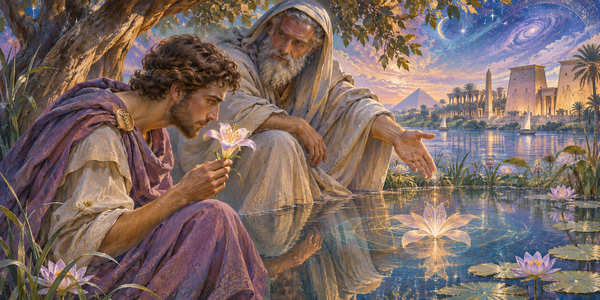
The ninth treatise investigates the relationship between thinking and sensory perception. Hermes explains to Asclepius that these faculties operate together in human beings but are not identical. The senses provide access to manifested forms, while thinking enables their understanding and evaluation.
Perception does not guarantee correct knowledge. Two people can observe the same event and draw different conclusions. The difference does not arise from the visible object itself but from the way the mind organizes what has been perceived. Hermes directs attention precisely toward the moral quality of this inner activity.
The treatise describes the influence of different spiritual powers upon human thoughts. Unfavorable influences generate inclinations toward violence, greed, and impiety, while divine knowledge directs humanity toward reverence. This demonological picture presents human inner life as a field of influences that must not be accepted indiscriminately.
Within the narrative, the reverent person is not protected from every external difficulty. His distinctive capacity is to recognize the significance of events beyond immediate pleasure and suffering. Knowledge transforms judgment and, through judgment, behavior.
Hermes also examines the Cosmos as a living whole possessing its own manner of perception. Its motion is not directed toward objects outside itself, because all bodily things belong to its entirety. This idea prepares the way for the more detailed description of cosmic life in subsequent treatises.
The tenth treatise, entitled The Key, summarizes and develops several Hermetic ideas in a conversation between Hermes and Tat. God is the Good, and his activity is creation. The Cosmos receives life from God and in turn generates and sustains living beings. Humanity occupies a special position because of its capacity to direct itself toward divine knowledge.
An important theme is the distinction between contemplation and ordinary sight. Hermes describes knowledge of the Good as a condition in which ordinary bodily activities yield to the light of Mind. The knower does not observe God as an object situated in a particular place. He participates in an intellectual condition that transcends the spatial limitations of sensory perception.
Tat receives an explanation of the movements of souls and the consequences of their moral orientation. The soul remaining subject to ignorance experiences its own passions as punishment. The soul directed toward knowledge becomes liberated from their authority. In this context, punishment is not merely an externally imposed sanction but a consequence of the soul’s own condition.
The treatise examines the human capacity for knowledge as a distinctive privilege. Human beings can measure the earth, investigate celestial movements, and understand things that are not immediately present to their senses. Their intellectual activity extends beyond the place occupied by the body. This capacity reveals why humanity cannot be reduced to its physical dimensions.
The Key is neither an object nor a secret formula. The title denotes knowledge that enables the student to connect the individual propositions of the teaching. Cosmology explains his place in the world, psychology reveals his inner conflicts, and knowledge of God establishes the goal of his development.
Eternity, Time, and Boundless Contemplation - Treatises XI and XII
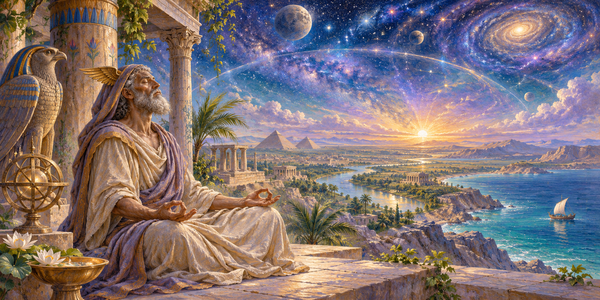
In the eleventh treatise, Mind instructs Hermes. The conversation begins with a sequence of five concepts: God, eternity, Cosmos, time, and becoming. God produces eternity, eternity produces the Cosmos, the Cosmos produces time, and time produces becoming. Each level possesses its own character and participates in the unfolding of the next.
Eternity is not simply time of infinite duration. Time manifests through succession, motion, and change. Eternity is presented as the stable foundation in which cosmic order possesses its entirety. The distinction is between the unfolding of individual events and the principle encompassing their possibility.
The Cosmos contains bodies that continually emerge and transform. It is not motionless, but its wholeness is preserved through the orderly movement of its parts. Mind directs Hermes toward understanding that change does not necessarily contradict stability. It can be the means by which a living whole is sustained.
Following the cosmological exposition comes one of the most remarkable instructions in the entire collection. To know God, Hermes must transcend the conception of himself as limited to a particular place and time. Mind calls upon him to encompass intellectually the earth, sea, heavens, birth, death, and the different ages of life.
This exercise employs the distinctive capacity of thought to extend beyond the immediate position of the body. A person can contemplate distant stars, vanished centuries, and events never personally witnessed. The Hermetic instruction radicalizes this capacity, transforming it into a means of overcoming a narrow conception of personal identity.
Knowledge of the boundless requires the knower to cease measuring it exclusively through bodily limitations. God is not situated at a particular distance that can be traversed through physical movement. The obstacle lies in how a person thinks about themselves and what they wish to know.
Mind concludes by affirming divine activity throughout all realms of existence. Nothing is completely separated from its source. The search for God therefore cannot be reduced to leaving the world but includes transforming one’s understanding of its unity.
The twelfth treatise examines the universal Mind and its relationship with humanity, fate, and suffering. Tat asks how Mind operates in different living beings. Hermes explains that in humanity it can counter irrational impulses and direct the soul toward a higher good.
To clarify this activity, Hermes employs the analogy of a physician. Treatment sometimes causes pain because it must remove disease. Similarly, Mind opposes desires that the soul regards as pleasant but that keep it in dependency. Resistance to them is experienced as suffering precisely because attachment has already become strong.
Tat raises the question of fate. If bodily events are subject to cosmic order, what remains of freedom? Hermes distinguishes what happens to a person from the moral activity of their Mind. Knowledge does not eliminate every condition of embodied existence, but it transforms one’s relationship with those conditions and the possibility of conscious action.
The conversation expands toward language and reason. Human peoples employ different words, but the capacity for meaningful expression connects them. The multiplicity of languages does not destroy the shared foundation of rationality. This idea again demonstrates the characteristic Hermetic movement from diverse manifestations toward the unity that makes them possible.
The eleventh treatise expands the horizon of contemplation, while the twelfth investigates the practical activity of Mind in human life. Without the former, knowledge remains enclosed within the limited perspective of the individual; without the latter, elevated ideas fail to transform behavior.
The Secret Rebirth of Tat - Treatise XIII
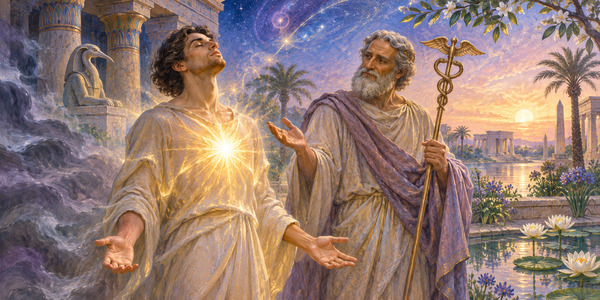
The thirteenth treatise is the dramatic culmination of Tat’s discipleship. He reminds Hermes that he promised to reveal the teaching of rebirth when Tat became ready to withdraw from the deception of the world. Tat now insists on learning how this birth occurs and from what the new human being is generated.
Hermes responds through the symbols of the womb, the seed, and the parent. The womb is wisdom in silence, the seed is the true Good, and the parent is God’s will. Spiritual birth is not a repetition of the biological process. It does not create another physical body but transforms the way a person exists and knows.
Tat struggles because he cannot see the new birth with his eyes. Hermes explains that he himself has undergone the transformation and no longer perceives himself in the previous manner. The visible body remains accessible to the senses, but the actual event belongs to Mind.
The teacher describes twelve tormentors that hold humanity captive: ignorance, grief, incontinence, desire, injustice, greed, deception, envy, treachery, anger, recklessness, and malice. They form a system of mutually reinforcing dependencies. Ignorance obstructs correct judgment, desire distorts one’s goals, and anger and deception determine actions toward others.
Liberation occurs through the arrival of the divine powers. Knowledge expels ignorance, joy expels grief, self-control expels incontinence, steadfastness expels desire, justice expels injustice, generosity expels greed, and truth expels deception. After them, the Good, life, and light reveal themselves. The ten powers transform the human being, liberating him from the authority of the twelve tormentors.
The numerical opposition is significant. Twelve is associated with the zodiacal order and the conditioned character of bodily existence, while ten represents the fullness of the spiritual powers. Transformation is not a mechanical correspondence between one passion and one virtue. The final powers complete liberation as a comprehensive process.
Tat gradually begins to understand that the new birth cannot be observed from outside. He declares that he sees himself in all things: in heaven, earth, water, and air, in living beings, and in the different moments of existence. Limited self-identification gives way to an experience of belonging to the whole.
Here the instruction of the eleventh treatise is realized. What was described there as an expansion of contemplation now becomes the student’s experience. Hermes is no longer the only one speaking about transformation. Tat begins expressing knowledge in his own words.
A secret hymn follows, in which Hermes calls upon nature to fall silent and the divine powers to praise the creator. The prayer is not a request for material acquisition. It expresses gratitude for the knowledge received and liberation from the inner tormentors.
Tat also wishes to praise God. Hermes instructs him to address the divine through the powers already active within him. The student does not merely repeat another person’s prayer. He speaks from his newly acquired condition of understanding.
Silence in this treatise has a dual function. It establishes conditions for inner knowledge and protects the teaching from becoming empty talk. The secret does not consist solely in restricting access to particular words. The words themselves are insufficient for someone who has not undergone the moral preparation described in the dialogue.
The Creator and the Continuity of Creation - Treatise XIV
The fourteenth treatise takes the form of a letter from Hermes to Asclepius. The teacher returns to the fundamental distinction between the creator and what is created. Everything that comes into being depends upon an activity through which it receives existence. Creation cannot be understood without a creator, nor the creator as such without creative activity.
Hermes emphasizes that God does not create because of a deficiency. He does not need what he produces in order to attain perfection. Creation expresses his nature. This distinction separates divine activity from human labor, which is frequently directed toward satisfying needs.
Countless forms of becoming can be observed in the world: plants grow, animals reproduce, and bodies transform. Hermes examines these processes as manifestations of uninterrupted creative activity. Creation is not merely a distant event at the beginning of time after which the world is left without a relationship with its source.
The treatise also examines the difference between divine action and the activity of created beings. Human beings work with available materials and instruments. God is the foundation of the very possibility of becoming. The analogy with a human craftsman is therefore useful insofar as it demonstrates the relationship between activity and result without attributing human limitations to God.
Hermes does not allow the multiplicity of created forms to become an argument for multiple independent ultimate sources. The diversity of products does not destroy the unity of the creative principle. This idea gives the brief letter particular significance after the mystical culmination of the thirteenth treatise: knowledge of God returns to everyday observation of the emerging world.
The Sun, Cosmic Powers, and Sacred Images - Treatises XVI and XVII
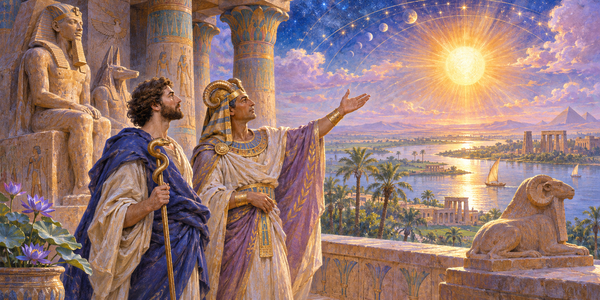
The sixteenth treatise is presented as an instruction from Asclepius to King Ammon. Its opening contains a warning concerning the translation of sacred speech. Asclepius emphasizes the power of the Egyptian language and the danger of losing it through translation into Greek. This passage is particularly interesting within a Greek text: it establishes the authority of Egyptian sacred wisdom and raises the question of the relationship between meaning and the sound of words.
The conversation then turns toward God, matter, nature, the Cosmos, and the Sun. Asclepius presents unity as the foundation of multiplicity. Everything belongs to the whole and cannot be definitively separated from it.
The Sun occupies a central place in cosmic organization. Its light and warmth sustain earthly life, and its movement participates in determining natural cycles. In the treatise, this visible activity also acquires religious significance: the Sun performs a mediating function in the transmission of cosmic powers.
Asclepius describes numerous daemonic beings associated with celestial movements and human birth. The word daemon here denotes an intermediary spiritual power and does not automatically carry the later meaning of an entirely malevolent being. Different powers influence the bodily and psychic inclinations through which humanity participates in the order of fate.
Despite this conditioning, the rational part of the soul can receive divine illumination. When it turns toward God, the authority of lower influences loses its finality. The treatise thus develops the cosmological dimension of the question of freedom examined earlier in the twelfth dialogue.
Solar symbolism unites visibility and vitality. Light enables the eyes to see objects, while intellectual illumination enables Mind to understand their origin and significance. The Sun does not exhaust God; it is a magnificent manifestation of cosmic order.
The seventeenth treatise is brief and survives in incomplete form. In it, Tat discusses the treatment of sacred images with a king. The argument rests on the relationship between the bodily and the incorporeal. Visible forms can direct attention toward invisible foundations, and reverence for an image derives its meaning from what it represents.
This question has a direct connection with the fifth treatise. If the invisible God reveals himself through his manifestations, a material image is not necessarily an obstacle to contemplation. The problem arises when the image is regarded as a self-sufficient object and the relationship with its meaning is forgotten.
The brief dialogue does not provide a comprehensive teaching on the creation or consecration of statues. Detailed passages on this subject belong to other Hermetic writings, particularly the Latin Asclepius. Within the Corpus Hermeticum, the seventeenth treatise contributes primarily to understanding the image as a mediator between different levels of existence.
Harmony, Praise, and the Final Message - Treatise XVIII
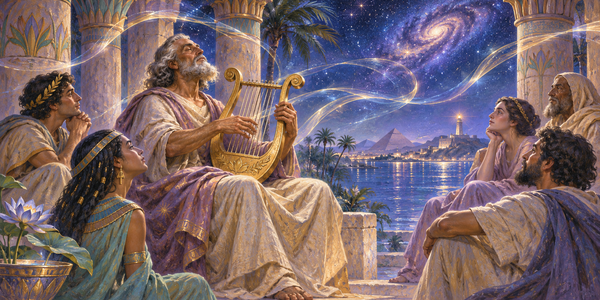
The final treatise differs in literary form from most preceding dialogues. It examines the praise of God and rulers through imagery associated with music, performance, and the human body. The discourse has a ceremonial character and connects religious gratitude with the ideal of harmonious order.
The musical instrument serves as an analogy for the relationship between the acting principle and its bodily means. A skilled musician can demonstrate his ability even when the instrument has imperfections. At the same time, the condition of the instrument influences the way the music becomes audible. The distinction allows the soul and body to be considered without reducing either to the other.
Musical harmony is an appropriate image of cosmic order because it arises through relationships between different tones. Unity does not require every part to be identical. It requires harmony in their relationships. The diversity of the world thus acquires a positive significance.
The praise of rulers reflects the political and religious language of late antiquity. Royal authority is examined in connection with order, prosperity, and divine favor. This aspect distinguishes the treatise from the more intimate instructions between Hermes and Tat and extends the scope of Hermetic discourse toward public life.
The final position of praise within the collection allows a general movement from inquiry toward gratitude to be traced. At the beginning, Hermes wishes to know God and nature. In the middle treatises, the students investigate motion, the Good, the soul, and fate. In the thirteenth, knowledge becomes spiritual birth. The final text emphasizes the expression of gratitude and harmony with order.
This is not a unified plot planned by a single author but a meaningful relationship emerging when the collection is read as a whole. It reveals how different literary forms - vision, argument, instruction, letter, and hymn - serve different dimensions of spiritual inquiry.
The Deeper Meaning of the Corpus Hermeticum: From Knowledge to Transformation
After reading all the treatises, one fundamental characteristic stands out: knowledge in the Corpus Hermeticum remains incomplete until it transforms the knower. Hermes does not educate his students merely to memorize the structure of celestial spheres or a sequence of metaphysical principles. He directs them toward a different way of existing.
The symbols of light and darkness reveal two conditions of knowledge. Light discloses the relationships between things and their source. Darkness denotes a condition in which individual forms are perceived without understanding their foundation. The transition between them is an intellectual and moral event.
Water performs different functions in the individual narratives. In the cosmogony, it participates in the primordial indeterminacy of nature. In the story of the primordial Human, it reflects his image. In the symbolism of the mixing bowl, immersion denotes participation in Mind. What these uses share is the capacity of water imagery to express receptivity, reflection, and transformation without their meanings becoming entirely identical.
The ascent through the celestial regions represents liberation from acquired dependencies. It has a cosmological dimension but also reveals the moral logic of Hermetic teaching. Humanity does not attain higher knowledge while preserving the authority of greed, deception, and lust for power intact. Liberation involves a restructuring of desires.
The spiritual rebirth of Tat develops the same logic within the immediate experience of the student. It is not a promise of another earthly incarnation but the birth of a new relationship with existence. The twelve tormentors and ten powers provide a concrete moral vocabulary for this transformation.
The distinction between Mind and ordinary intellectual cleverness is equally important. The ability to defend an argument does not guarantee knowledge of the Good. A person can employ reason for deception, the accumulation of wealth, or the justification of injustice. Hermetic Mind denotes an orientation of knowledge toward its divine source and the transformation of life.
The relationship with the Cosmos remains complex. Some treatises emphasize the danger of attachment to the bodily, while others praise the beauty and vitality of nature. Read together, they raise the question of how humanity can contemplate the world without becoming captive to its transient forms. The problem cannot be reduced to choosing between acceptance and rejection of matter. It concerns the manner of participation in it.
Prayer and hymn demonstrate that Hermetic knowledge does not conclude with an analytical proposition. Having recognized his origin, the student expresses gratitude. This is a transition from the attitude of an observer to that of a participant. The knower discovers himself as part of the order he seeks to understand.
The final lesson of the collection is already contained in Hermes’ opening question. He seeks neither power over others, extraordinary abilities, nor a formula for acquiring wealth. He seeks knowledge of existence and God. The path he follows reveals that these two questions are inseparable from the question of his own nature. Human beings must know not only the world in which they live but also that within themselves through which they are capable of knowing it.
Author: Vasil Stoyanov