
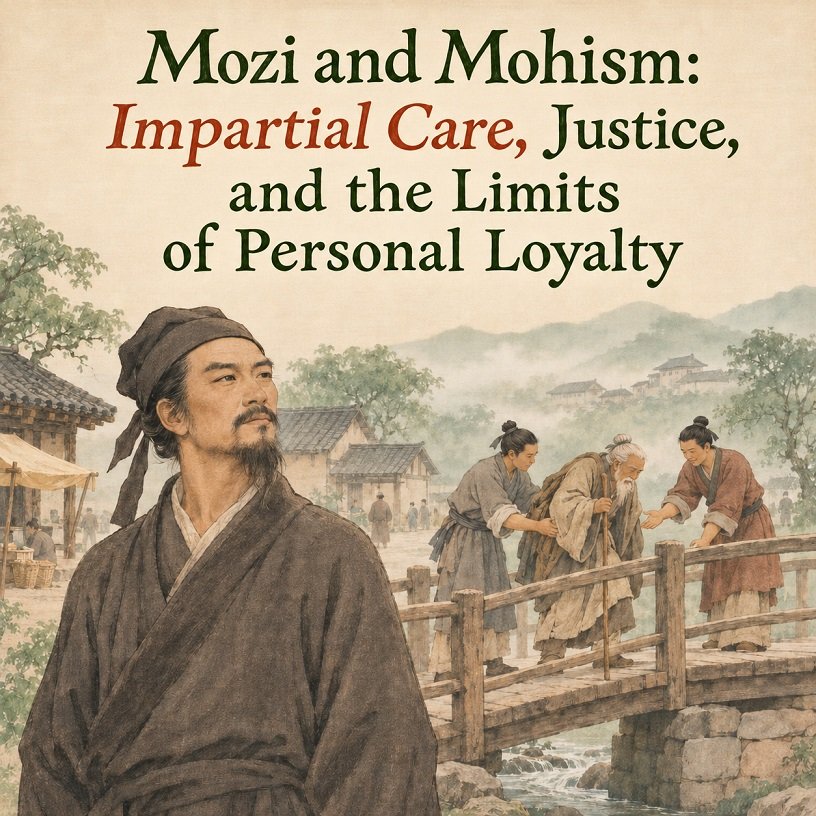
Mozi occupies a distinctive place in the history of Chinese philosophy. While rulers fought over territory and powerful clans defended their privileges, he asked a question that challenged the foundations of the social order: why does a person regard harm done to their own family as an injustice, yet readily justify the same harm when it affects strangers?
From this question emerged one of antiquity’s boldest moral teachings. Mohism advocates impartial care, condemns wars of conquest, insists on appointing capable officials, and judges social customs by the benefits they bring. Its philosophy is not confined to reflections on virtue. It seeks principles capable of reducing suffering and making life together more just.
The most difficult question arises where public justice meets personal love. People have special responsibilities toward those closest to them. But how far do those responsibilities extend? When is giving priority to a relative or friend justified, and when does it become an abuse of privilege? At precisely this boundary, Mozi’s teaching reveals its greatest strength.
Mozi and China in the Age of Warring States

Mozi, also known as Mo Di, lived approximately in the fifth century BCE. The exact dates of his life have not been established, but his teaching belongs to an era of profound political upheaval, when the authority of the Zhou dynasty was weakening and individual states increasingly resorted to military force. The ancient order, founded on hereditary titles, ritual obligations, and relationships between noble families, could no longer prevent conflict.
Wars had consequences far beyond the battlefield. Farmers abandoned their fields to serve in armies. Harvests went uncollected, fortifications consumed labor and materials, and victors frequently seized the food supplies of conquered lands. For a ruler, a successful campaign brought prestige; for an ordinary family, it meant the loss of loved ones, hunger, and insecurity.
It was in this world that different philosophical schools emerged, each offering its own answer to the question of how social order could be restored. Confucians emphasized moral education, filial respect, and ritual tradition. Mozi also sought a stable moral order, but questioned whether inherited customs deserved respect merely because they were old.
His approach was practical. A custom had to be judged by its actual consequences. A war did not become just because it was called glorious. A ruler did not become competent because he came from an influential family. An extravagant celebration was not beneficial simply because it impressed those attending.
Mozi’s school also developed an unusual organization. Mohists studied morality, debated questions of logic, and developed technical knowledge for defending cities. In traditional accounts of Mozi, the philosopher does not remain a passive observer of rulers’ military plans. He seeks to prevent attacks, while his followers acquire skills that can help threatened communities. For them, moral conviction becomes action.
Jian Ai: What Impartial Care Really Means

The central concept of Mohism is jian ai, translated as “universal,” “inclusive,” or “impartial care.” It expresses the conviction that other people’s interests must be taken seriously regardless of their origin, position, or membership in a particular family or state.
This principle is often misunderstood as a demand that everyone feel the same emotional attachment to every person they meet. The Mohist idea, however, is primarily moral and social. It concerns the rules by which we act and the harms we are willing to cause or prevent. Deep love for one’s own child does not justify indifference toward the life of someone else’s child.
Mozi identifies the source of many conflicts in the opposition between “our own” and “outsiders.” A person is outraged when someone steals from his home, yet may regard theft from another household as acceptable if it benefits his family. One clan condemns violence against its members while justifying an attack on a rival clan. A state celebrates its victories without accounting for the suffering it causes beyond its borders.
What these cases share is inconsistency. The same action receives a different moral judgment depending on who gains and who loses. Impartial care challenges precisely this double standard. If another person’s property deserves protection, it does not lose that protection because its owner is a stranger. If life is valuable, its value does not depend on a person’s political allegiance.
In Mohist reasoning, care also has a social dimension. When people recognize one another’s interests, they have fewer reasons to attack, rob, and deceive one another. Parents receive support, children grow up in a safer environment, and rulers are restrained from expanding their own power at others’ expense.
Thus jian ai is not merely an elevated feeling. It is a principle for limiting selfishness in relationships between individuals, families, and states. Its radical character lies in its insistence that being human is sufficient grounds for moral concern.
The Debate with Confucianism: Family as the Beginning or the Boundary of Morality

The Confucian tradition builds moral education upon concrete human relationships. Respect for parents, regard for elders, and loyalty between close companions provide the foundation upon which a person develops character and a sense of duty. The family is not an incidental part of life, but the first place where we learn to care for others.
Mozi does not deny the importance of parents and loved ones. His objection is directed against turning personal closeness into a justification for unjust actions. Family loyalty can be a virtue when it means care, responsibility, and support. It becomes a social problem when it allows relatives to receive advantages at the expense of people with equal or stronger claims.
The difference between the two schools becomes sharper with Mencius, one of the most influential Confucian thinkers after Confucius. He criticizes Mohist inclusive care because he believes it undervalues the special moral significance of relationships between parents and children. For Confucians, morality does not begin with an abstract humanity, but with the actual bonds in which we live.
This debate cannot be reduced to a conflict between love and indifference. Both traditions accept that human relationships should be guided by virtue. They differ in how they define obligations. Confucianism emphasizes degrees of closeness; Mohism insists that these differences must not destroy fair treatment of others.
In contemporary society, the tension between the two approaches is readily recognizable. Parents naturally devote more time to their own children than to strangers. But when a judge hears a case, the decision must follow the law rather than family feelings. When a hospital allocates scarce resources, its decisions must follow medical and fair criteria rather than the family connections of its employees.
The debate between Mozi and the Confucians therefore remains alive. Family relationships create genuine obligations, but public institutions require impartiality. Moral maturity appears in the ability to distinguish between these two kinds of responsibility.
When Giving Priority to Someone Close Is Justified

Personal loyalty is not the same as injustice. A parent bears an immediate responsibility for their child. An elderly person has a legitimate expectation of support from loved ones. Friendship creates mutual trust built through shared experiences and promises. These relationships cannot be replaced by a perfectly equal distribution of attention among all human beings.
The boundary appears when personal obligation conflicts with rights and rules that protect others. A manager who appoints an unqualified relative to an important position is not simply showing family affection. The manager is using entrusted authority to grant an unfair advantage. If other people’s safety depends on that position, the consequences can be serious.
A similar problem arises when public funds are directed toward relatives of officials without transparent criteria. The money was collected for a public purpose, not to serve personal relationships. A biased decision violates the trust of people who expect the same rules to apply to everyone.
There are, however, circumstances in which giving priority is entirely defensible. A person caring for a sick parent is fulfilling a specific responsibility. A mother who spends the evening with her child rather than helping a distant acquaintance with a nonurgent task is not declaring other people’s needs insignificant. She is fulfilling an obligation arising from dependence and trust within the family.
Justice therefore does not require eliminating every difference between relationships. It requires determining whether a preference violates someone’s rights, causes preventable harm, or uses a public resource for private gain. This is the question that separates responsible family care from favoritism.
The Mohist principle adds another test: would we defend the same rule if we were not among those benefiting from it? If the answer changes solely because of our own position, the reasons for the decision deserve serious reconsideration.
Human Welfare and the Critique of Extravagance

Mohism is remarkable for insisting that moral ideas must be tested through their actual impact on human life. Good government provides conditions for work, food, security, and social order. Decisions that exhaust resources without corresponding benefit deserve criticism even when supported by a prestigious tradition.
This outlook explains Mohist disapproval of excessively lavish funerals and extravagant ceremonies. For influential families, such events demonstrate wealth and social position. For Mozi, the decisive question is what they cost the people who must supply the money, materials, and labor.
In a society where farming families live close to the edge of survival, prolonged ceremonies can divert workers and food away from urgent needs. The Mohist criticism is not simply a dislike of beauty. It is an objection to a system of priorities in which the prestige of a few consumes resources needed for the well-being of many.
This principle has immediate relevance to modern public decisions. With a limited budget, maintaining a dangerous bridge, providing clean drinking water, and equipping a hospital often have more urgent value than expensive prestige projects. Public expenditure should be justified by genuine needs, not merely by the desire of those in power to leave an impressive symbol.
The Mohist emphasis on outcomes resembles certain modern consequentialist theories, but the two are not identical. In the classical texts, public benefit is also connected with moral order, worthy government, traditional conceptions of Heaven, and shared rules of conduct. This historical complexity makes Mohism a philosophical tradition in its own right, rather than merely an early form of modern utilitarianism.
Why Wars of Conquest Are Injustice on an Enormous Scale

One of Mozi’s most powerful ideas is his condemnation of aggressive warfare. He exposes the moral contradiction in a society that punishes an individual thief but praises a ruler who has conquered foreign lands. If taking another person’s property is wrong, the greater scale of the taking cannot by itself transform it into a worthy action.
Military glory often conceals the real cost of conquest. Victory is described through new territories and captured banners, while behind those symbols lie interrupted farming, destroyed settlements, depleted supplies, and human losses. Mozi directs attention toward the people who pay the price of rulers’ ambitions.
His objection is especially forceful because it follows from the same principle that governs relationships between individuals. If one person has no right to attack a neighbor for profit, a ruler does not acquire that right merely because he commands an army. State power does not cancel moral limitations.
At the same time, Mohists distinguish aggression from defense. Texts associated with the school preserve detailed information about fortifications, defensive mechanisms, and responses to sieges. Their purpose is to enable threatened cities to resist aggression. Rejecting conquest does not mean refusing to protect innocent people.
This distinction remains important today. The security of one community should not be built upon the denial of security to another. Neither patriotic pride nor political prestige can justify indifference toward the lives of foreign civilians.
Government by Merit and the Danger of Family Privilege

Mozi insists that public offices should be entrusted to people with suitable abilities and moral qualities. This position challenges hereditary privilege in ancient society and connects good government with the actual competence of officials.
An unprepared administrator does not harm only their own reputation. Their mistakes affect farmers, merchants, soldiers, and families who depend on their decisions. An appointment should therefore not be a reward for ancestry or proximity to power.
The principle is especially clear in activities involving public safety. An engineer responsible for flood defenses must understand the structures and risks involved. A physician must possess the necessary knowledge. A judge must apply the rules independently of personal relationships. When these requirements are ignored, the cost is borne by people who had no part in the selection.
The Mohist conception of social order also includes strong discipline and an aspiration toward coordinated moral standards. Some of these features differ from contemporary understandings of political pluralism. This historical limitation does not weaken the idea that power should be exercised in the public interest rather than for the benefit of a ruling family.
Modern competitive recruitment, conflict-of-interest rules, and transparency requirements address a similar problem. They seek to prevent personal loyalty from replacing competence and the fair distribution of opportunities.
Reason, Evidence, and Testing Moral Claims

The Mohist tradition develops not only a social ethics but also a serious interest in logic and argumentation. Some texts associated with the school examine distinctions between concepts, grounds for claims, and ways of establishing whether words correspond to reality.
This intellectual legacy is closely connected with Mohism’s practical orientation. A political decision that promises prosperity must also be assessed according to the results it achieves. A law that claims to protect the poor does not fulfill its purpose if it deprives them of their means of living. A well-intentioned explanation is no substitute for genuine benefit.
Mohists employ different criteria, including appeals to historical models, observation, and consequences for government and society. These methods belong to their era, but express an enduringly important requirement: claims must have grounds that can be discussed and examined.
The same principle matters in contemporary moral debates. A measure may appear fair in its intention yet still produce undesirable consequences. Responsible judgment requires examining both the goal and the actual effect on people.
Thus Mozi’s philosophy connects morality with intellectual honesty. Defending what is good means not only declaring the right values, but also being willing to check whether one’s actions actually put them into practice.
The Final Dilemma: Duty to Loved Ones and Justice Toward Strangers
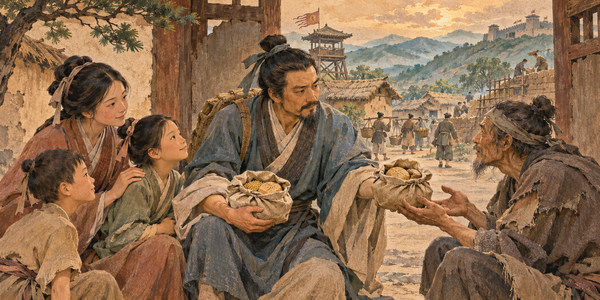
The hardest test of impartial care comes when personal loyalty conflicts with a public obligation. The director of a charitable organization has enough money for one urgent medical procedure. The organization has already approved a patient according to its established criteria. Before the money is transferred, the director learns that a close relative needs the same treatment.
Both patients have genuine needs. The family connection creates a powerful personal motive to help, but the funds do not belong to the director. They have been entrusted to the organization under specific conditions. Secretly redirecting the donation would turn public trust into an instrument of private advantage.
Mohist impartiality requires that the stranger’s need be acknowledged with the same seriousness as the suffering of the loved one. This does not mean abandoning the relative. Other funds, a new fundraising campaign, or additional treatment options can be sought. Personal care remains an obligation, but it does not grant permission to break promises made to another person.
Similar conflicts arise outside charitable work. A teacher grades a student whose parents are close friends. An employer chooses between a qualified applicant and a relative. A municipal official must decide whether someone close to them qualifies for public assistance. In every case, justice requires decisions to rest on reasons that can be defended before everyone affected.
This is where Mozi’s teaching acquires its deepest human value. It does not call for coldness, nor does it diminish the importance of family love. It places a boundary around the temptation to treat our own feelings as sufficient justification for every action.
Love for those close to us is part of a good life. But when it becomes a reason to disregard the rights of others, it ceases to be only a virtue and begins to produce injustice. Impartial care extends our responsibility beyond our immediate circle without requiring us to destroy the relationships that shape us as individuals.
Mozi leaves behind a question that has lost none of its force over the centuries: how would we judge our own decisions if we saw them through the eyes of someone who does not belong to our family, circle of friends, or country? This change in perspective is where the true test of justice begins.
Mohism’s strength lies in its conviction that moral principles must withstand their encounter with real life. Caring for others means limiting preventable harm, protecting people from aggression, entrusting responsibility to the worthy, and refusing to let personal preferences determine the value of another person’s existence. This is why Mozi’s philosophy continues to challenge our ideas about duty, love, and justice.
Author: Vasil Stoyanov