
A person can spend decades pursuing a goal without ever asking why that goal deserves their life. They complete their education, find a job, start a family, acquire property, and seek recognition. Every achievement opens the way to the next. Yet a moment arrives when the very logic of this movement comes into question. Not because the person has lost the ability to achieve, but because they no longer understand why they should continue achieving.
This is the territory of nihilism. The question here is not how to attain what we desire, but what makes the desired object worth pursuing. This is not simply a matter of low spirits, pessimism, or disappointment with society. Nihilism challenges the foundations upon which we construct our ideas of truth, goodness, justice, and meaning.
Friedrich Nietzsche sees it as a historical crisis of European culture. Fyodor Dostoevsky explores its consequences through human destinies in which ideas become actions. Albert Camus confronts the question of how to live when the world provides no definitive answer to our search for meaning. The three do not offer the same philosophy. Their differences reveal the depth of the problem.
What Does Nihilism Actually Mean?

The word derives from the Latin nihil, meaning nothing. In philosophy, it denotes a family of positions that deny the existence or validity of certain fundamental foundations. Existential nihilism denies that human life possesses an inherent, predetermined meaning. Moral nihilism denies objective moral facts or truths. Epistemological nihilism radically questions the possibility of knowledge. These positions are not interchangeable.
A person can reject the idea of a cosmic purpose for humanity while simultaneously defending scientific knowledge, human rights, and the significance of friendship. Another can accept the existence of an objective physical reality while denying the objective validity of moral norms. The answer to one philosophical question does not automatically determine the answers to all the others.
The distinction between the absence of inherent meaning and the absence of any meaning whatsoever is particularly important. The first claim concerns the origin of meaning: the world does not provide us with a ready-made purpose independent of human interests. The second is considerably stronger: nothing can acquire significance even within human life. A logical gulf separates these two positions.
A game of chess has no significance for the movement of galaxies. That does not make its moves arbitrary. Once the players participate in a particular practice, real differences emerge between good and bad decisions. The analogy does not prove that life is a game, but it demonstrates why the absence of a universal cosmic purpose does not automatically eliminate every basis for evaluation.
Nihilism also differs from skepticism. The skeptic asks whether we have sufficient grounds to accept a particular claim. The nihilistic position goes further when it denies the very existence of a particular kind of foundation. Doubt is a method of inquiry; denial is a philosophical thesis that also requires arguments.
Pessimism, in turn, evaluates life as predominantly filled with suffering or dissatisfaction. It presupposes a criterion according to which that evaluation is made. Nihilism can challenge the validity of the criterion itself. A pessimist can therefore be deeply convinced of the moral significance of compassion, while a nihilist can be cheerful and reject the objective nature of values.
Philosophical precision has practical significance. When someone says that nothing has meaning, they are sometimes describing the loss of a particular goal, sometimes expressing emotional exhaustion, and sometimes defending a metaphysical position. These three cases require different responses. Losing a job is not evidence against objective values, just as a philosophical argument is not a diagnosis of its author’s mental condition.
From the Destruction of Authority to Russian Nihilism
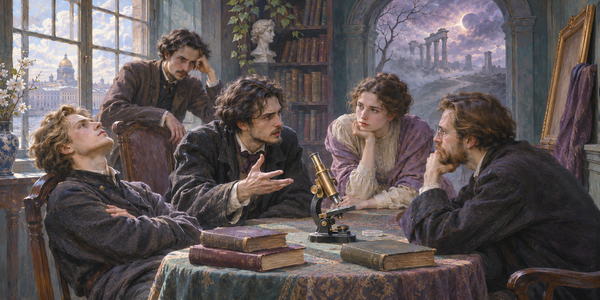
The history of nihilism does not begin with Nietzsche. In the late eighteenth century, Friedrich Heinrich Jacobi employed the concept in his criticism of philosophical idealism. He perceived a danger in systems of thought that transform reality into a construction of reason and thereby deprive immediate existence of its independence. In this context, nihilism denotes the alleged consequence of a particular philosophical method.
During the nineteenth century, the word acquired particular social significance in Russia. The empire experienced tensions between inherited institutions, reformist aspirations, and the emerging authority of the natural sciences. Educated young people questioned privileges, religious dogmas, and traditional ideas of social duty.
In 1862, Ivan Turgenev published his novel Fathers and Sons. Its protagonist, Yevgeny Bazarov, became a literary embodiment of the nihilist. He accepts no principles merely because previous generations have revered them. He prefers the natural sciences to romantic ideals and regards beautiful words with suspicion when he finds no practical substance behind them.
Bazarov, however, is not a person without interests or convictions. He believes in observation, work, and scientific investigation. His rejection is directed toward inherited authorities rather than every form of activity. This is precisely why Russian nihilism should not be equated with the conviction that life has no significance whatsoever.
Turgenev subjects his protagonist to a test that cannot be resolved through a declaration against romanticism. Bazarov falls in love with Anna Odintsova. The feeling undermines his confidence that human relationships can be explained and controlled entirely through physiology and rational detachment. He does not cease to be intelligent, but he discovers that intellectual consistency does not eliminate vulnerability.
At the end of the novel, Bazarov dies after contracting an infection during medical work. His encounter with death does not automatically turn his scientific convictions into errors. It reveals the boundary between knowing the mechanisms of life and answering the question of what it means to lose that life. Turgenev does not resolve the dispute through a treatise. He portrays a person whose philosophy must bear the weight of his own existence.
Russian radicalism encompasses different political and intellectual movements that cannot be reduced to a single literary character. Some thinkers seek liberation through education and social reform, while others defend revolutionary programs. The rejection of the old order is frequently accompanied by a powerful belief in a future order. Here the paradox of negation becomes apparent: a person destroys an authority in the name of a value that they themselves have not ceased to recognize.
Nietzsche and the Death of God: When the Highest Values Lose Their Value

In section 125 of The Gay Science, Nietzsche tells the story of a madman who carries a lit lantern in broad daylight and searches for God in the marketplace. The people around him laugh because they no longer believe in God. But the madman has not come to announce an ordinary atheistic proposition. He reveals the magnitude of an event whose consequences they do not yet understand.
The death of God signifies the collapse of the supreme authority that organized European ideas of truth, morality, and purpose for centuries. Christian metaphysics had provided not only an explanation of the world’s origin but also a hierarchy of values. Earthly life received its significance through its relationship with eternity.
When this structure loses its credibility, more than religious conviction disappears. The question arises of what justifies the moral norms associated with it. Nietzsche recognizes that modern humanity continues to employ inherited evaluations even after rejecting the metaphysical foundations through which they were defended.
This is not proof that secular morality is impossible. It is a challenge to its justification. A norm does not acquire sufficient grounds merely because it has survived the disappearance of the old authority. Its origins, the interests it protects, and its consequences for human life must be investigated.
In On the Genealogy of Morality, Nietzsche undertakes precisely this investigation. Rather than accepting the concepts of good and evil as eternal and transparent, he examines their historical formation. He is interested in the relationships between power, ressentiment, guilt, punishment, and ascetic ideals. His question is not only what we value, but what our manner of evaluating reveals about ourselves.
The ascetic ideal occupies a particularly important place. It provides an explanation of suffering and incorporates it into a system of purposes. For Nietzsche, human beings find the meaninglessness of suffering harder to endure than suffering itself. The ascetic ideal resolves this problem, but the price of that resolution can be the denial of embodiment, desire, and earthly existence.
Nihilism thus emerges as more than a consequence of the loss of religion. In Nietzsche’s analysis, certain religious and philosophical evaluations already contain a nihilistic tendency when they locate the true value of life in another world and devalue actual existence. The destruction of the otherworldly ideal exposes the crisis it had concealed.
Nietzsche’s posthumous notebooks contain a distinction between active and passive nihilism. Passive nihilism expresses exhaustion and an inability to affirm purposes. Active nihilism denotes a strength that destroys values that have lost their vitality. Destruction, however, is not the ultimate achievement. It clears a space without determining what will arise within it.
In Thus Spoke Zarathustra, the figure of the last man illustrates one possible consequence of the crisis. This person does not aspire to profound transformation. He prefers comfort, security, and the absence of risk. His life is organized around avoiding anything that requires overcoming established habits. Nietzsche does not condemn rest or material prosperity in themselves. His criticism concerns their elevation into the ultimate horizon of existence.
The Übermensch represents the opposing image: human self-overcoming and the creation of values, rather than a biological race or a political right to domination. Eternal recurrence poses a further test of life affirmation. In section 341 of The Gay Science, Nietzsche asks how we would respond to the prospect of experiencing the same life again and again. The weight of the thought experiment comes from its refusal to let us redeem the present through the promise of an entirely different future.
Nietzsche offers no easy recipe for happiness. He demands a revaluation of values, the capacity for self-criticism, and an affirmation of existence without requiring its justification through its own negation. Nihilism is the problem his philosophy seeks to overcome, not the final truth before which it surrenders.
Dostoevsky: When a Philosophical Idea Becomes a Human Destiny
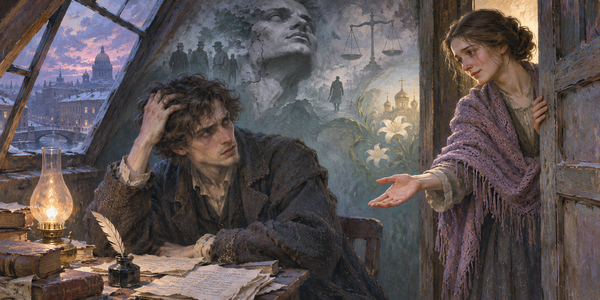
In Crime and Punishment, Rodion Raskolnikov develops a theory according to which extraordinary individuals have the right to transgress established moral restrictions in the name of a higher purpose. He is not satisfied with discussing this possibility intellectually. He turns his own action into a test of the theory.
After the crime, his world does not acquire the clarity he anticipated. Instead of liberating himself from moral restrictions, Raskolnikov finds himself torn apart by fear, alienation, and an inability to restore his relationships with others. His theory is organized around the abstract category of the extraordinary individual, but reality confronts him with the concreteness of human life.
Sonya Marmeladova does not defeat him through a more sophisticated theory. Her presence introduces a different way of relating to another person: compassion, loyalty, and a willingness to bear the weight of another’s suffering. The Christian perspective of the novel manifests itself precisely in this possibility of restoring the connection between guilt, responsibility, and love.
In The Brothers Karamazov, Dostoevsky raises the problem to an even deeper level. Ivan Karamazov refuses to accept a harmony of the world that requires the suffering of innocent children as the price of ultimate reconciliation. His rebellion does not arise from a lack of moral sensitivity. On the contrary, his moral sensitivity brings him into conflict with the idea of a divinely justified world order.
This is a decisive point. Ivan challenges the metaphysical foundation of morality through moral indignation. He is not indifferent to good and evil. His problem is how to preserve the absolute seriousness of suffering without subordinating it to an explanation that turns it into a necessary element of someone else’s purpose.
The novel is frequently associated with the formulation that without God, everything is permitted. It summarizes an important thread in its dialogues, but should not be presented as an exact, standalone quotation from Dostoevsky. The question is whether moral restrictions retain their binding force when belief in God and immortality disappears.
Dostoevsky also explores how ideas pass from one person to another. Intellectual reasoning does not necessarily remain confined within the consciousness of its author. Another person can turn it into a justification for an action that the author never intended to perform. The relationship between Ivan and Smerdyakov demonstrates how difficult it is to separate responsibility for an idea from the way it is used.
In Demons, the destruction of authority becomes intertwined with political fanaticism, manipulation, and the subordination of human beings to an abstract future. The characters demonstrate that rejecting inherited values does not guarantee freedom. It can be followed by a new dogmatism that demands even more unconditional obedience.
Dostoevsky writes not philosophical textbooks but novels in which different voices retain their own power. His characters are not merely illustrations of predetermined propositions. They reveal how an idea changes when it passes through love, shame, pride, fear, and responsibility. This is precisely why his work is indispensable to understanding nihilism as a human problem.
Albert Camus and the Absurd: Life Without a Definitive Explanation

In The Myth of Sisyphus, published in 1942, Albert Camus places the question of life’s value at the center of philosophical inquiry. He does not begin by constructing a system concerning the nature of being, but with the tension between the human need for clarity and the silence of the world.
The absurd in Camus is not simply a property of the universe. It arises in the encounter between human beings seeking a definitive explanation and a reality that provides none. Remove either side of this relationship and the absurd in its specific philosophical sense disappears.
Human beings want their lives to form a coherent story. They seek a connection between effort and results, virtue and reward, suffering and some justification. The world, however, guarantees no such correspondence. Natural processes do not distribute events according to human merit. History does not automatically ensure a just conclusion.
Camus refuses to resolve this tension through self-destruction or an intellectual leap toward a definitive metaphysical explanation. His response is the conscious continuation of life without erasing the contradiction. The absurd becomes not a reason to abandon existence but a condition under which human beings must find a way to live.
The mythological Sisyphus is condemned to push a stone up a slope, from which it invariably rolls back down. His labor produces no final result. Camus directs attention toward the moment when Sisyphus descends toward the stone. At that moment, he becomes conscious of his own fate. The punishment does not disappear, but his relationship to it is no longer entirely determined by those who imposed it.
The image of Sisyphus does not mean that every meaningless effort must be accepted without resistance. It explores human freedom under conditions that cannot be completely controlled. The distinction between the inevitable and the changeable remains essential. Camus develops the political and moral consequences of this distinction in his later work.
In The Plague, the city of Oran faces an epidemic. Doctor Rieux cares for the sick without possessing a promise of ultimate victory over suffering. His work acquires significance through the particular person he helps. He requires no cosmic justification to recognize the immediate necessity of action.
This figure offers a different response from one that seeks salvation through an all-encompassing theory. Medical care does not abolish human mortality. It does, however, change the circumstances of a particular person at a particular moment. Refusing to recognize such differences as significant would require an additional argument, not merely an appeal to the ultimate transience of life.
In The Rebel, Camus examines how rebellion against humiliation reveals a boundary that a person refuses to allow others to cross. This boundary points toward solidarity. Yet rebellion can degenerate when it turns future justice into a justification for destroying people in the present. Camus defends moderation and limits against the logic according to which an absolute goal permits any means.
Camus is not a preacher of nihilism. His absurdism is an attempt to live without ultimate guarantees while preserving freedom, human solidarity, and limits on violence. He demonstrates that rejecting metaphysical consolation does not require abandoning moral seriousness.
How Meaning Collapses in Everyday Life

The philosophical crisis takes concrete form when someone discovers that their goals have been organized around other people’s expectations. For a long time, success has meant a particular profession, income, or social position. After attaining these things, a discrepancy emerges between the external result and the internal evaluation. The person has obtained what they pursued, but not what they expected to feel.
The problem deepens when every activity becomes a means to another activity. Work serves income, income serves consumption, consumption serves recovery, and recovery serves further work. There is nothing necessarily wrong with this structure, but if every goal is instrumental, the question remains of the ultimate value that organizes the chain.
A person can value their work because of the mastery they develop, the relationships they establish, or the benefit they provide. It is then more than a means to a future result. When these dimensions disappear, everyday life readily becomes a sequence of tasks whose necessity is clear but whose significance has been lost.
The loss of a loved one reveals a different aspect of the problem. The relationship had organized memories, plans, and everyday actions. After its interruption, the world continues to function, but part of its personal structure collapses. Places remain the same while their significance changes. This demonstrates how deeply meaning is connected with relationships rather than abstract convictions alone.
In contemporary society, people encounter an enormous number of opportunities for comparison. Other people’s successes, travels, and achievements are constantly present on screens. If personal evaluation depends entirely on one’s relative position, every achievement remains unstable. There is always someone with more recognition, resources, or influence. Comparison has no natural endpoint.
Here the nihilistic experience does not necessarily result from reading philosophy. It arises from the inability of a particular system of goals to provide a stable basis for action. Philosophy allows this inability to be analyzed rather than concealed through the continual addition of new goals of the same kind.
It is also important not to confuse an existential crisis with clinical depression. Depression can involve a loss of interest, energy, and the ability to experience pleasure. These symptoms do not prove a philosophical thesis about the nature of the universe. Persistent suffering and impaired everyday functioning deserve professional care regardless of a person’s convictions.
Without Absolute Morality, Is Everything Permitted?

One of the most serious questions associated with nihilism is whether moral restrictions can be defended without a transcendent lawgiver. The answer requires distinguishing between the origin of moral norms, their justification, and the motives for which people observe them.
Religious ethics can ground moral obligations in divine will, the nature of God, or a particular conception of creation. Secular ethical theories offer other foundations. Kantian ethics investigates the rational universalizability of principles and the dignity of the person. Utilitarianism evaluates consequences for well-being. Virtue ethics concerns itself with character and the conditions of a flourishing human life.
These theories are not identical, and profound disagreements exist between them. Their very existence, however, demonstrates that rejecting religious metaphysics does not logically entail moral nihilism. Defending such nihilism requires examining and rejecting the independent arguments of alternative positions.
In the twentieth century, John Leslie Mackie formulated moral error theory. According to him, ordinary moral judgments claim objectivity, but the world contains none of the objectively prescriptive properties they presuppose. This is a specific metaethical thesis, distinct from the claim that people have no reasons to keep promises or avoid causing harm.
Even when objective moral facts are rejected, human interests, dependencies, vulnerabilities, and opportunities for cooperation remain. Violating trust has consequences for relationships. Causing pain changes the experience of the person affected. These facts do not resolve every metaethical dispute by themselves, but neither do they disappear because such disputes exist.
On the other hand, simply appealing to social consensus is also insufficient. Societies have accepted unjust practices and transformed them into law. If morality is identified entirely with majority opinion, criticism of established injustice loses its independent foundation. Philosophical discussion therefore seeks criteria through which social norms themselves can be evaluated.
Here Raskolnikov’s literary experiment acquires renewed significance. He does not simply break a rule. He arrogates to himself the right to decide unilaterally that another person’s life can be subordinated to his theory. Camus later recognizes a related danger in political ideologies that sacrifice concrete human beings in the name of a promised future harmony.
Moral responsibility requires more than confidence in one’s own purpose. It requires consideration of those who bear the consequences of our decisions. The absence of definitive agreement concerning the nature of morality does not release human beings from the necessity of justifying their actions to others.
Can Science Answer the Question of Meaning?

The natural sciences reveal the history of the universe, the evolution of life, and the mechanisms of human behavior. These discoveries transform our understanding of our place in nature. Earth occupies no privileged position in the observable cosmos, and the human species belongs to the history of biological evolution.
These facts, however, do not entail that human existence has no value. Spatial magnitude and moral significance are different categories. A star is incomparably more massive than the human brain, but mass is not a criterion for evaluating friendship, knowledge, or suffering.
Evolutionary biology explains how particular capacities and behavioral tendencies have developed within populations. It does not automatically provide a normative command concerning how we should use those capacities. Explaining the origins of aggression does not justify aggression. Explaining the origins of cooperation does not resolve every question of justice.
David Hume draws attention to the transition from statements about what is to statements about what ought to be. Such a transition requires an additional foundation. Scientific facts can be decisive for moral decisions because they reveal their consequences, but choosing which consequences matter involves a value judgment.
Neurobiology investigates motivation, learning, and the systems involved in evaluating rewards. Dopamine, for example, participates in motivational and learning processes rather than simply being a happiness chemical. The existence of biological mechanisms behind human aspirations does not turn their objects into illusions. Neural activity is a condition for reading a book, but it does not replace the analysis of its content.
Scientific knowledge itself exemplifies a human practice organized around values: accuracy, verifiability, intellectual honesty, and willingness to accept correction. The researcher accepts that it matters whether a claim corresponds to the evidence. The radical denial of all value would call into question even the grounds for preferring a true explanation to a false one.
Science does not have to provide a cosmic purpose to possess extraordinary significance. It expands our ability to understand reality and act within it. The philosophical question remains how we use that understanding and which goals deserve our efforts.
Beyond Nihilism: Discovering, Creating, and Affirming Meaning

Existentialism offers an important alternative to the conclusion that the absence of a predetermined purpose renders human life meaningless. Jean-Paul Sartre defends the idea that, in human beings, existence precedes essence. A person is not born with a completely predetermined task that they must simply fulfill. They participate in shaping themselves through their choices.
This freedom does not mean omnipotence. Nobody chooses the historical period into which they are born, every characteristic of their body, or every circumstance that affects them. Choice takes place within a concrete situation. Existential responsibility concerns the way a person acts within these conditions.
Simone de Beauvoir develops an ethics of ambiguity in which human freedom is inseparably connected with the freedom of others. Affirming oneself does not require turning another person into an object. On the contrary, a world in which other people’s freedom is systematically destroyed undermines the conditions for the full exercise of one’s own freedom.
Viktor Frankl emphasizes discovering meaning in concrete tasks, relationships, and attitudes toward unavoidable suffering. His logotherapy does not require a person to experience constant happiness. It regards orientation toward meaningful responsibilities as distinct from the pursuit of a pleasant psychological state.
Creating meaning does not consist in arbitrarily declaring everything desirable to be valuable. If someone dedicates their life to music, they encounter the demands of the art itself: discipline, technique, listening, and the capacity for cooperation. The chosen activity begins to impose conditions of its own. Meaning takes shape through a relationship between human freedom and a reality that does not entirely submit to human desires.
The philosopher Susan Wolf proposes an influential conception according to which a meaningful life involves active engagement in projects of positive value. This position combines subjective engagement with the question of whether the object of that engagement deserves attention. It avoids both the idea that personal satisfaction is the sole criterion and the idea that someone must serve a valuable purpose without any personal connection to it.
Meaning does not necessarily require a single task encompassing the entirety of existence. Human life contains different relationships and activities whose significance cannot be reduced to a common unit of measurement. Caring for a child, making a scientific discovery, maintaining a friendship, and creating art are not competing quantities of the same substance.
Transience is likewise insufficient grounds for devaluation. A musical composition ends, but its ending does not cancel its sound. A conversation with a loved one does not have to continue forever to possess significance. Requiring every valuable thing to be infinite would devalue almost every form of human experience before we had even examined it.
Nietzsche, Dostoevsky, and Camus offer different responses to the crisis. Nietzsche seeks a revaluation and affirmation of life. Dostoevsky explores human restoration through love, responsibility, and faith. Camus defends lucidity, rebellion, and solidarity without ultimate metaphysical reconciliation. There is no easy synthesis between them, but all three refuse to reduce the human problem to indifference.
Nihilism compels human beings to examine the foundations of their convictions. It destroys the illusion that a purpose deserves obedience merely because it is inherited, popular, or promises recognition. Negation, however, is not the final word of critical thought. What remains is the difficult work of distinguishing what deserves loyalty from what merely demands obedience.
The question of life’s meaning is not exhausted by discovering a sentence that explains everything. It manifests itself in the way a person distributes their limited time, assumes responsibility for their actions, and acknowledges the reality of other people. The absence of a definitive answer does not eliminate these decisions. It makes awareness of them even more necessary.
Author: Vasil Stoyanov