
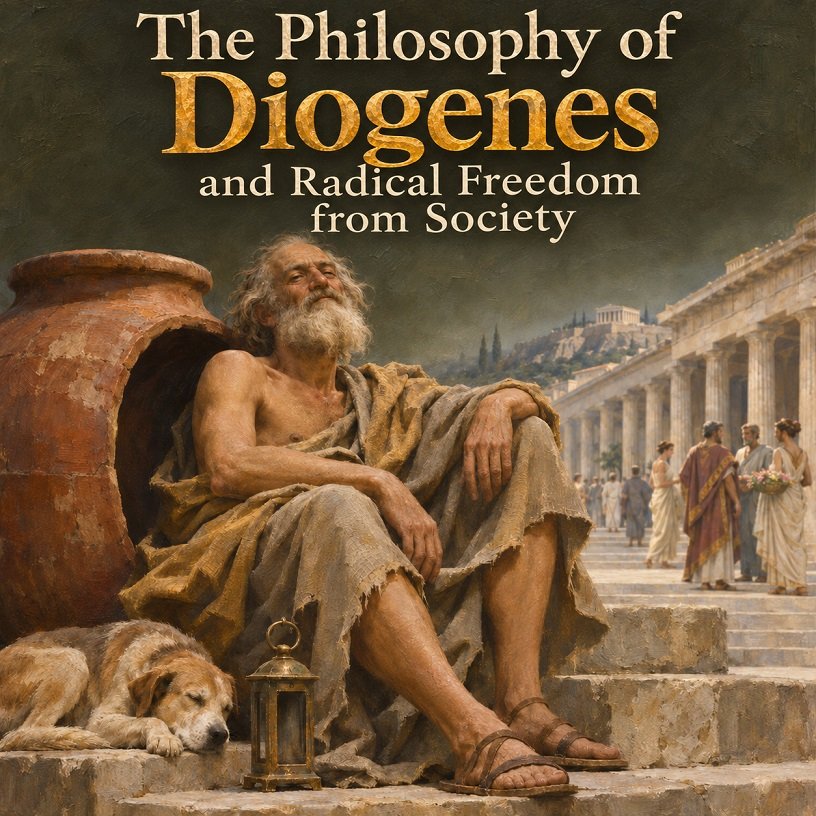
Alexander the Great arrives in Corinth. The ruler before whom generals and statesmen bow wishes to meet a philosopher famous for possessing almost nothing. Diogenes is lying in the sunlight. Alexander approaches him and offers to grant him a wish. Instead of wealth, patronage, or an honorary position, the philosopher asks for only one thing: that the king move aside because he is blocking the sunlight.
Plutarch recounts this celebrated story in his biography of Alexander. Its philosophical power arises from the unusual distribution of power between the two men. One commands an army, possesses immense wealth, and can alter the destinies of entire peoples. The other needs nothing the ruler offers. In this brief conversation, two radically different conceptions of freedom collide: the freedom to acquire and the freedom not to depend on acquisition.
Diogenes of Sinope made the second understanding the foundation of his existence. His life was a philosophical experiment conducted not within the protected confines of an academy, but among the streets, marketplaces, and public squares of ancient Greece. To understand Cynicism, we must examine not only the ideas of its representatives but also the actions through which they confronted society with its own contradictions.
The Birth of Cynicism and the Exile from Sinope
Cynicism emerged in the fourth century BCE, during a period of profound political and intellectual transformation. The Peloponnesian War had shaken the power of Athens, Socrates had been sentenced to death in 399 BCE, and Macedonian expansion was gradually changing relations between the Greek city-states. The question of the good life acquired particular urgency in a world where belonging to a city no longer provided the same political security.
Antisthenes, a pupil of Socrates, occupies an important place in the intellectual prehistory of Cynicism. He placed virtue above wealth, social standing, and external distinctions. For him, moral excellence manifested itself through actions rather than the accumulation of eloquent arguments. Ancient biographers portray Diogenes as his pupil, although the historical relationship between the two remains disputed. What matters is the continuity in their understanding of philosophy as moral exercise.
Diogenes came from Sinope, a Greek city on the southern coast of the Black Sea. Biographical information about his early life is scarce. Diogenes Laertius recounts different versions of a scandal involving the defacement of currency, after which the philosopher left his native city. Some accounts attribute responsibility to his father, others to Diogenes himself. Numismatic discoveries attest to the invalidation of coins in Sinope during the relevant period, but do not establish the philosopher’s personal guilt.
The expression concerning the revaluation or defacement of currency acquires a second meaning in his biography. The Greek word nomisma, meaning currency, is related to nomos, meaning custom and law. Just as a coin receives its value through collective recognition, many human aspirations acquire significance through established notions of prestige. Diogenes subjects precisely this system of valuation to radical examination.
Exile deprived him of the security that citizenship provided in the ancient polis. Yet the loss became the foundation of a new identity. Instead of devoting his life to recovering his former position, he questioned the necessity of that position itself. This is the decisive turning point in his philosophy: external circumstances must not determine a person’s moral worth.
The Cynics acquired a name associated with the Greek word for dog. Ancient authors also suggest a connection with the Athenian gymnasium of Cynosarges. The canine image, however, became the movement’s most recognizable symbol. A dog cares nothing for ancestry, ceremonial titles, or precious vessels. It recognizes its immediate needs and does not conceal its natural behavior behind an elaborate system of pretenses.
Diogenes embraced the nickname as a philosophical emblem. In stories about him, the dog distinguishes friends from enemies, gives warnings, and bites those deserving reproach. Cynic sharpness is not simply a bad temper. It is a method of exposing moral deficiencies that society conceals behind good manners.
Here lies the essential difference between ancient Cynicism and modern cynicism. The modern cynic often assumes that people act exclusively out of self-interest and that moral ideals disguise personal advantage. The ancient Cynic, by contrast, believes in virtue so strongly that he refuses to accept society’s substitutes for a virtuous life. His distrust is directed toward false values, not toward the possibility of moral excellence.
Cynicism was not organized around a single institution with a detailed curriculum. Its representatives were recognized by their way of life, freedom of speech, voluntary simplicity, and criticism of conventions. Philosophical allegiance was demonstrated through behavior. This is precisely why Diogenes remains the central figure of the movement despite the absence of a surviving body of his writings.
Living According to Nature and Reassessing Human Needs
At the heart of Cynic ethics lies the distinction between nature, physis, and established social conventions, nomos. Human beings need food, water, sleep, and protection from extreme weather. Society adds demands for prestige, outward respectability, competition, and recognition. Gradually, the boundary between what is necessary and what is desired becomes blurred.
Diogenes does not deny that people can establish useful customs. His criticism targets the transformation of custom into an unconditional criterion of goodness. If a practice contributes neither to virtue nor to human independence, its popularity is insufficient reason to follow it.
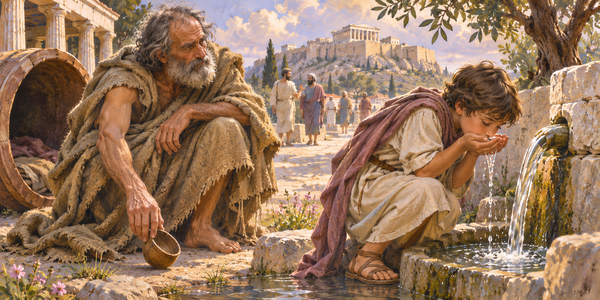
Diogenes Laertius recounts how the philosopher observed a child drinking water directly from his cupped hands. Diogenes threw away the cup he carried because the child had surpassed him in simplicity. The story is remarkable for its immediacy. The philosopher needs no elaborate theory to recognize an unnecessary possession. An ordinary gesture reveals that an object considered indispensable actually has an accessible alternative.
The cup itself is not a moral problem. The problem arises when a person loses the ability to manage without it. The Cynic assessment of possessions rests on the question of what they do to their owner. Do they make life easier, or do they create new conditions without which the owner can no longer feel satisfied?
This question is particularly understandable in everyday life. A person purchases an object that initially brings pleasure. Over time, it becomes an ordinary part of life, and the next improvement appears necessary. Yesterday’s luxury becomes today’s minimum standard. Cynic discipline interrupts this continual shifting of the boundary.
The simplicity of Diogenes must not be confused with involuntary poverty. A poor person can suffer from a lack of basic resources, whereas the Cynic voluntarily reduces dependencies. The difference lies in choice and the actual ability to satisfy fundamental needs. Deprivation does not acquire moral value merely because it is painful.
Diogenes is famous for inhabiting a large earthenware vessel known as a pithos. The popular depiction of the philosopher inside a wooden barrel is a later visual interpretation. The ancient vessel was intended for storing goods, and its dimensions allowed it to serve as a primitive shelter. Adapting it to this purpose demonstrates the ability to use what is available rather than pursue a socially approved form of housing.
A home has a practical function, but it also carries symbolic significance. Society reads the wealth, origins, and success of its inhabitants through it. Diogenes separates these two functions. Shelter should provide protection; it need not prove human significance. In this way, the philosopher attacks not architecture but the dependence of identity on material representation.
The Cynic return to nature is not a call to abandon reason and imitate animals in every respect. Reason is precisely the faculty through which needs are evaluated and the useful distinguished from the superfluous. Animals serve as a contrast because they do not construct elaborate hierarchies of prestige around the objects they use. The human task is to achieve through conscious discipline an independence that requires no philosophical argument among animals.
Ascetic Training, Self-Sufficiency, and Freedom from Fear
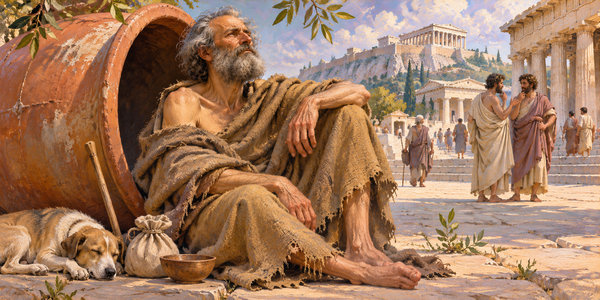
Cynic freedom has a specific practical mechanism: askesis, meaning exercise or training. The word was originally associated with the practical development of skills. Just as an athlete develops strength through systematic exertion, the philosopher develops resilience by voluntarily exercising the ability to endure discomfort.
Ancient accounts portray Diogenes exposing himself to summer heat and winter cold, wearing a coarse cloak, and accepting simple food. These actions form part of a philosophical pedagogy aimed at reducing fear of change. Someone who has never experienced discomfort can easily make its avoidance the principal objective of life.
Diogenes Laertius recounts the story of the philosopher begging a statue for alms. When asked why he was addressing an object incapable of responding, he explained that he was practicing being refused. This brief scene contains an entire theory of psychological independence. Rejection cannot be eliminated from life, but a person can change their relationship with it.
Someone excessively afraid of disapproval begins adapting words and actions to the expectations of others in advance. Difficult conversations are avoided, disagreements remain unspoken, and conditions that would otherwise be rejected are accepted. Diogenes trains precisely the ability to endure an unpleasant response without allowing it to govern his behavior.
The goal of this exercise is autarkeia, or self-sufficiency. This does not mean absolute biological independence from other people. Diogenes uses public spaces and receives food from those around him. Self-sufficiency is primarily moral: the ability not to grant external circumstances ultimate authority over one’s good life.
In this respect, Cynicism contains a tension. The philosopher reduces his material needs but relies on a society that produces food and maintains shared spaces. His lifestyle is not a model of an independent economy. It functions as a critical practice within the existing social order.
Self-sufficiency does not require emotional insensitivity either. A person can love others, enjoy friendship, and participate in a community without making approval a condition of personal dignity. Cynic independence opposes subordination, not every human relationship.
Voluntary ascetic training must be distinguished from self-punishment. Not every pain develops character, and not every deprivation leads to freedom. The philosophical value of an exercise is determined by its ability to expand the possibilities for rational action. Systematically damaging one’s health, for example, can create new dependencies rather than eliminate old ones.
This distinction also helps explain the contemporary relevance of the Cynic idea. Someone who practices spending time without constant entertainment, accepting constructive criticism, or postponing an unnecessary purchase develops the ability to regulate impulses. There is no need to reproduce the harsh conditions of the ancient philosopher. The essence lies in acquiring freedom from habit.
The Lantern of Diogenes and the Art of Speaking the Truth
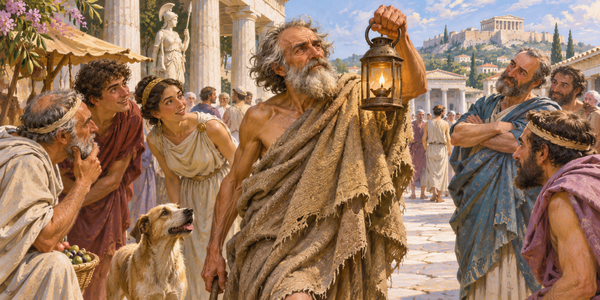
In broad daylight, Diogenes walks around carrying a lit lamp. Asked what he is looking for, he replies that he is looking for a human being. The anecdote, preserved by Diogenes Laertius, is often retold as a search for an honest man. Its power lies in the distinction between biological membership in the human species and the moral realization of human nature.
The square is crowded, yet the philosopher demonstrates that the presence of human bodies does not guarantee the presence of humanity. The lamp transforms abstract criticism into a visible scene. Every passerby can understand the provocation without having studied logic or metaphysics.
This way of philosophizing is connected with parrhesia, meaning frank and courageous speech. Freedom of speech in the Cynic sense is not simply the right to say whatever one wishes. It involves a willingness to express an uncomfortable truth before someone who possesses the power to punish or reject the speaker.
Material independence supports such courage. A courtier dependent on a ruler’s favor has reason to avoid criticism. A philosopher who desires no courtly privileges risks losing none. A simple life therefore has political and moral dimensions: it reduces opportunities for bribery through promises.
In a well-known anecdote, Diogenes sees someone behaving servilely before powerful people and draws attention to the price of such behavior. Other stories contrast his modest food with the comforts obtained through serving a ruler. The underlying principle is that privilege is not free when it demands the surrender of moral independence.
Frankness, however, has a different value from insult. A person can speak harshly out of irritation, a desire for attention, or an urge to humiliate someone. Cynic parrhesia claims a higher purpose: exposing error and directing people toward virtue. Without that purpose, provocation loses its philosophical justification.
Diogenes uses humor to overturn established relationships. A joke disrupts the solemn atmosphere in which power and prestige appear untouchable. Rather than arguing at length with someone who considers himself superior, the philosopher exposes the absurdity of the claim through a brief remark or action.
This method requires keen observation. A good philosophical provocation is not arbitrary. It identifies the specific contradiction between professed values and actual behavior. When society praises moderation but rewards extravagance, the Cynic places the two side by side. When it praises justice but assigns different worth to people according to their origins, he attacks precisely that inconsistency.
Diogenes Against Plato: Philosophy as Action
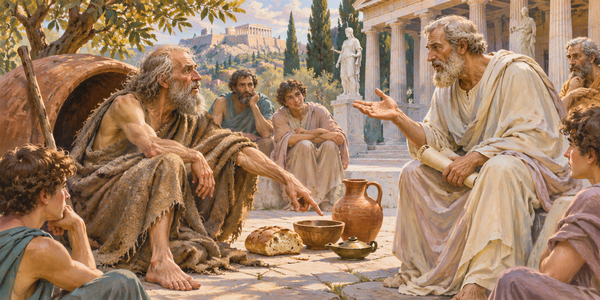
Athenian philosophy in the fourth century BCE developed extraordinarily diverse methods of investigating truth. Plato founded the Academy and constructed a philosophy in which definitions, dialectic, and the investigation of enduring forms of knowledge occupied a central position. Diogenes represents a different emphasis: philosophical ideas must withstand the test of immediate life.
Diogenes Laertius recounts how Plato’s school defined a human being as a featherless biped. Diogenes plucked a rooster, brought it in, and announced that this was Plato’s human being. According to the anecdote, the characteristic of broad nails was subsequently added to the definition.
The scene is more than an amusing mockery. It demonstrates a classic logical problem: a definition must encompass every member of the class being defined without including inappropriate cases. The plucked rooster functions as a counterexample. Through an object and an action, Diogenes demonstrates what a logician would express through formal argument.
The story does not exhaust Plato’s philosophy or prove that definitions are useless. It reveals the danger of intellectual overconfidence. An elegant formulation is insufficient if it cannot withstand an encounter with the concrete cases it claims to explain.
Another anecdote portrays Diogenes stepping on Plato‘s carpets and declaring that he is trampling on his pride. Plato replies that he is doing so with another kind of pride. This response is particularly valuable because it directs Cynic criticism back toward the Cynic himself. Renouncing wealth can become a source of superiority just as wealth can.
Someone proud of possessing little is not necessarily freer than someone proud of possessing much. Both can construct their identities around comparison with others. If simplicity becomes a means of demonstrating moral superiority, it begins reproducing the mechanism it originally opposed.
Diogenes also questions the tendency toward philosophizing that fails to transform behavior. Knowing definitions of courage does not make someone courageous if they continually avoid necessary actions. The ability to speak about moderation does not free someone from dependence on pleasures. Between knowledge and moral skill stands practice.
This idea has Socratic roots. Socrates examines the lives of his interlocutors by compelling them to recognize inconsistencies in their own beliefs. Diogenes extends this examination to public behavior as a whole. His body, clothing, diet, and dwelling become parts of his argument.
Cynic philosophy therefore does not reject thinking. It rejects the claim that thinking alone is sufficient for a good life. Theory acquires moral weight when a person can act in accordance with it under unfavorable circumstances.
Shamelessness and the Limits of Social Convention
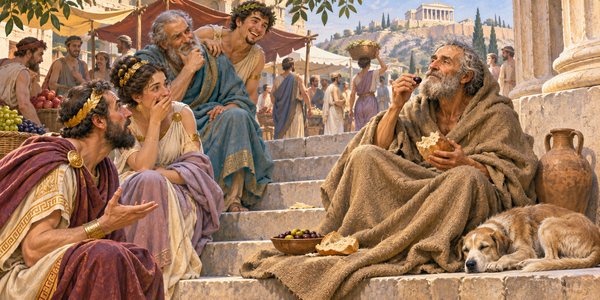
One of the most radical aspects of Cynicism is anaideia, the rejection of conventional shame. Ancient biographies describe Diogenes publicly performing actions considered inappropriate for public places. These provocations raise the question of why natural bodily functions generate shame while greed, cruelty, and hypocrisy are frequently accepted without serious objection.
Shame is a powerful mechanism of social regulation. Through it, communities encourage certain behaviors and discourage others. It can protect human dignity, but it can also sustain prejudices and arbitrary hierarchies. Diogenes refuses to accept society’s reaction as definitive proof of the moral value of an action.
When reproached for eating in the marketplace, he replies that this was precisely where he became hungry. The response reveals a collision between immediate need and the rule concerning an appropriate location. For the Cynic, satisfying a natural need is not degrading merely because it occurs before witnesses.
Yet the natural origin of an impulse is insufficient to justify every expression of it. Anger, sexual desire, and the drive for self-preservation also have natural foundations. Moral evaluation must consider the consequences for other people. Otherwise, criticism of convention becomes a justification for arbitrary behavior.
This is an important limit of Cynic provocation. Rules concerning personal space, consent, and public safety are not equivalent to rules determining prestigious clothing or an honorary place at the table. The former protect genuine human interests. The latter often serve to maintain symbolic distinctions.
Diogenes confronts society with the necessity of justifying its prohibitions. Calling a behavior indecent is insufficient. It is necessary to establish whether it causes harm, violates the rights of others, or merely unsettles customary notions of propriety. This critical question remains relevant far beyond the ancient context.
Cynic shamelessness is not equivalent to a lack of conscience. On the contrary, it seeks to relocate shame from external appearance to moral substance. A person should be ashamed of injustice, not modest clothing; of deception, not low social rank. This reversal of criteria is one of the movement’s most essential ideas.
Power, Wealth, and the Citizen of the World
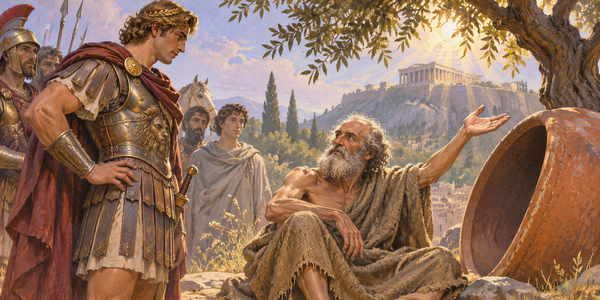
The encounter with Alexander the Great acquires additional significance against the background of Cynic self-sufficiency. The ruler can offer the philosopher almost everything society considers desirable. Diogenes refuses to participate in this exchange. He seeks no favor and does not recognize political power as evidence of moral superiority.
Plutarch adds that Alexander expresses admiration for the philosopher and declares that, were he not Alexander, he would wish to be Diogenes. The anecdote contrasts the conqueror who expands the boundaries of his power with the man who narrows the boundaries of necessity. One seeks independence through control over the world, the other through control over his own needs.
Another celebrated account portrays Diogenes as a captive sold into slavery. When asked what he can do, he replies that he knows how to govern people. He identifies the Corinthian Xeniades as someone in need of a master. In the biographical tradition, the philosopher subsequently takes responsibility for educating his children.
The story does not erase the actual violence of slavery. It uses the contrast between legal status and moral competence. A person can possess formal authority without knowing how to govern their own desires. Another can be deprived of external freedom yet retain the ability to reason and act with dignity within the limits of what is possible.
This distinction does not mean that inner freedom renders political freedom unnecessary. External coercion limits actual human possibilities. The Cynic idea is that moral worth is not exhausted by the position imposed by law or circumstances.
Asked where he comes from, Diogenes replies that he is a citizen of the world, a kosmopolites. In ancient Greece, where citizenship determined political rights and a substantial part of social identity, this was a radical declaration. The philosopher refuses to restrict his belonging to a particular polis.
Cynic cosmopolitanism is not a detailed program for a world state. It expresses moral liberation from the claim that local origins determine a person’s ultimate worth. Reason and the capacity for virtue do not belong exclusively to citizens of a particular city.
This idea prepares the ground for important developments in Stoic philosophy. The Stoics would develop a more systematic conception of a community of rational beings. In Diogenes, the emphasis remains on rejecting restrictive identities and on the philosopher’s ability to live with dignity regardless of location.
Crates and Hipparchia: Cynicism as a Shared Life
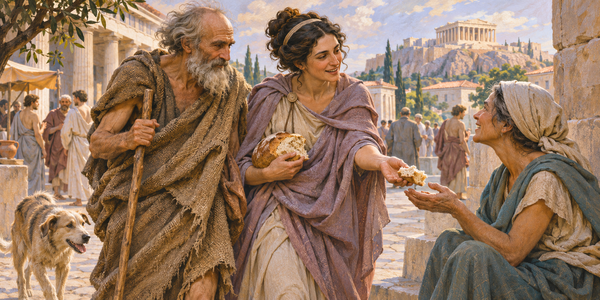
Cynic philosophy does not end with Diogenes. Crates of Thebes, one of his most famous followers, came from a wealthy family and relinquished substantial property. Ancient authors provide different details about the disposal of his wealth, but agree in presenting voluntary simplicity as a fundamental moment in his philosophical journey.
Crates is distinguished by a gentler and more sociable image. He was known as the door-opener because he visited people’s homes and offered advice. In him, Cynic independence combines with direct concern for others. This demonstrates that the sharp sarcasm of Diogenes is not an obligatory form of every Cynic practice.
Hipparchia of Maroneia became one of the most remarkable women in the history of ancient philosophy. She chose to share the life of Crates despite her family’s opposition and social expectations. She relinquished the privileges associated with her origins and embraced philosophical simplicity as a conscious choice.
Diogenes Laertius recounts how the philosopher Theodorus reproached her for abandoning traditional women’s occupations. Hipparchia defended her decision to devote the time she would have spent weaving to education. Her response challenges the belief that gender determines the boundaries of intellectual activity.
Hipparchia’s significance is not exhausted by her unusual marriage. She demonstrates that the Cynic criticism of conventions can affect the very distribution of social roles. If virtue depends on reason and character, there is no justification for reserving philosophical education exclusively for men.
Crates and Hipparchia also demonstrate that self-sufficiency is compatible with partnership. Two people can share a life without basing their relationship on competition for property and social standing. Their community provides a practical answer to the notion that radical freedom necessarily requires solitude.
Other representatives of the movement include Monimus, Menippus, and Bion of Borysthenes. They developed different forms of critical discourse, satire, and moral instruction. Cynicism spread not through a unified dogmatic system but through a recognizable set of practices and literary forms.
From Cynicism to Stoicism and Late Antiquity
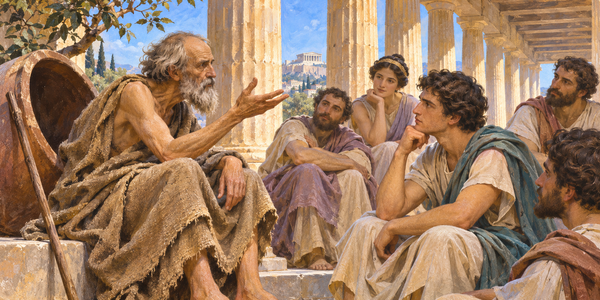
Zeno of Citium, the founder of the Stoic school, studied philosophy under Crates. This connection explains several features shared by the two movements: the central importance of virtue, living according to nature, and the independence of moral goodness from wealth and fame.
Stoicism, however, develops an extensive system of logic, physics, and ethics. It regards human beings as part of a rationally organized cosmos and devotes considerable attention to social obligations. While the Cynic demonstrates freedom through radical rejection of conventions, the Stoic can participate in politics, family life, and professional activity without treating external success as the supreme good.
The Stoic concept of preferred indifferents allows health, material security, and other external conditions to be reasonably preferred without regarding them as moral goods in themselves. This position offers a more flexible attitude toward material resources than the characteristic Cynic radicalism.
Epictetus devotes a substantial section of his Discourses to the ideal Cynic. In Book III, Chapter 22, he presents the Cynic vocation as an exceptionally demanding moral mission. The Cynic must be capable of serving as an example and instructing people without being governed by personal advantage. The philosopher’s outward appearance is insufficient for fulfilling this task.
During the Roman period, Cynicism continued to feature in public life. Philosophers such as Demetrius became renowned for their independence, while others used Cynic clothing and speech as a means of attracting attention. The distinction between genuine moral discipline and theatrical imitation became a subject of criticism.
Lucian presents both attractive and repellent images of philosophical behavior. His satires demonstrate how easily the external signs of asceticism can become a professional pose. In the fourth century CE, Emperor Julian likewise distinguished idealized ancient Cynicism from the behavior of people who used its name without corresponding moral preparation.
Parallels between Cynic simplicity and later religious ascetic practices appear in the voluntary restriction of possessions, criticism of wealth, and itinerant ways of life. These similarities do not imply identical philosophical foundations. Christian asceticism, for example, is connected with theological conceptions of salvation and the relationship with God, whereas ancient Cynicism emphasizes virtue and independence according to nature.
Radical Freedom in the Modern World
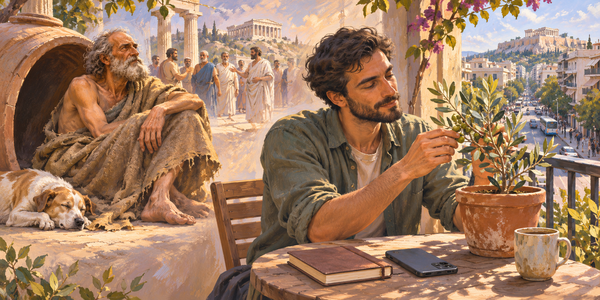
Modern human beings live within incomparably more complex material and informational systems than those of ancient Athens. Nevertheless, the Cynic criticism of dependency remains intelligible. Consumer culture transforms numerous objects into signs of success. Social media provides continual opportunities for comparison. Professional prestige frequently becomes the foundation of identity.
Cynicism asks what remains of human dignity when these signs disappear. If a person considers themselves significant exclusively because of income, position, or public attention, any change in those circumstances threatens their entire relationship with themselves. Independence begins by distinguishing personal worth from indicators of external success.
This is not an argument against professional development. Work can express competence, creativity, and contribution to the community. The Cynic examination concerns motivation: whether someone pursues an activity for its substance or solely for the recognition received through it.
The same principle applies to material security. Savings can increase freedom by reducing dependence on an employer or unforeseen circumstances. But continuous accumulation without a clear purpose can transform security into an endlessly postponed condition. Cynic philosophy requires a person to determine what is genuinely sufficient for their life.
Freedom of attention is particularly important. A device that continually demands checking for new messages can turn external reactions into the organizing principle of the day. The question is not whether technology is good or bad, but whether the individual retains the ability to determine when and for what purpose to use it.
Contemporary minimalism shares part of the Cynic criticism but is not equivalent to it. An aesthetically arranged home containing a few expensive objects can remain entirely subordinate to prestige. Cynicism does not measure virtue by counting possessions. It evaluates one’s relationship with them and the readiness to lose them without destroying one’s moral orientation.
Radical simplicity also has practical limits. Parents bear responsibility for their children’s needs. A person with a chronic illness requires appropriate care. Social institutions require resources and coordination. Voluntarily restricting one’s own desires does not confer the right to neglect the needs of those who depend on us.
Cynicism is most fruitful as a method of critical examination rather than a compulsory universal model of housing, diet, and professional activity. It reveals how much human energy is spent maintaining an image with no direct relationship to virtue. From this perspective, freedom includes the ability to refuse participation in a competition that serves no meaningful purpose.
Diogenes did not leave posterity a conquered empire or a monumental philosophical institution. His legacy consists of one of the most provocative examinations of human values. When someone fears losing something, Cynic philosophy asks what authority that person has granted it. When someone pursues social recognition, it asks whether that recognition reflects genuine virtue. When someone obeys a custom, it demands that the custom be justified.
In this sense, the sunlight in the story of Alexander is more than a natural good. It marks the boundary beyond which the offer of power ceases to be attractive. Diogenes does not need to defeat the ruler. It is enough that he does not need the ruler’s favor. This independence transforms the apparently destitute philosopher into one of the most striking symbols of freedom in the history of Western thought.
Author: Vasil Stoyanov