
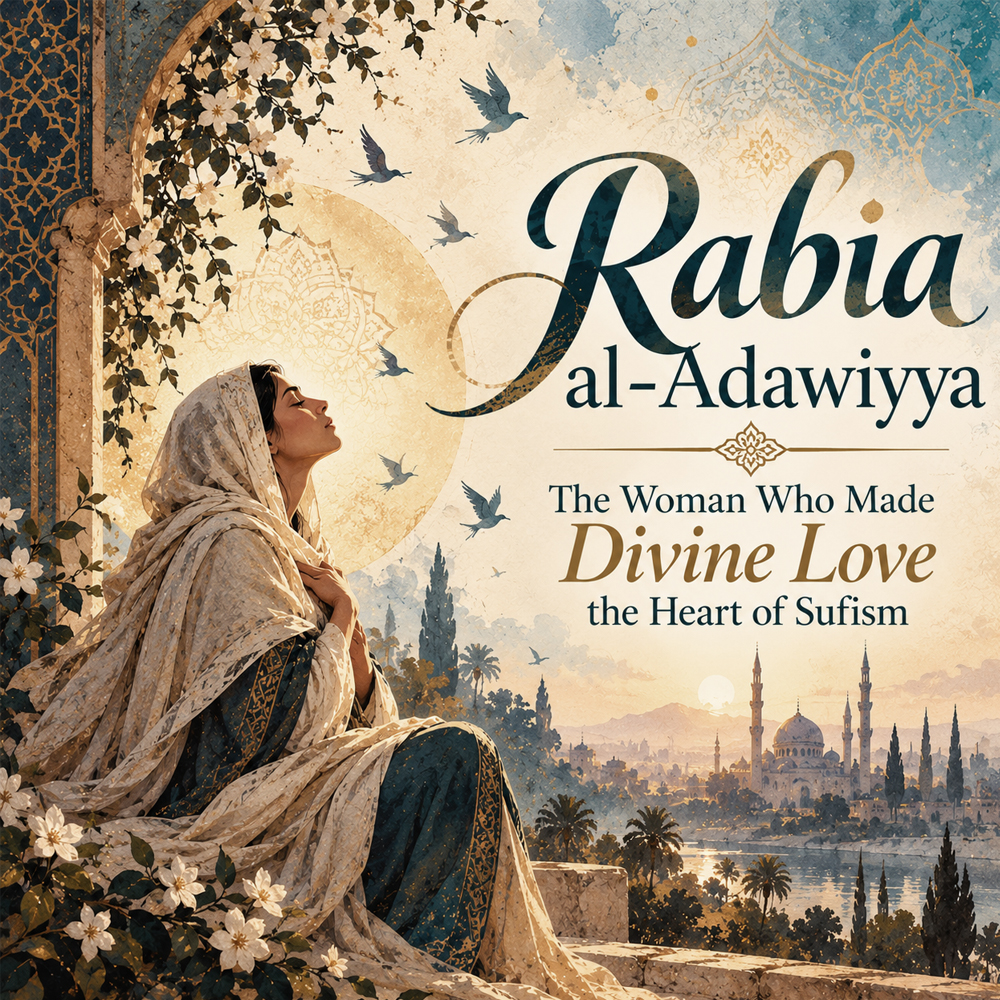
In the history of Sufism, there are figures who left behind books, schools, disciples, and elaborate philosophical systems. But there are others whose presence seems to have been preserved not so much in what they wrote as in the very spirit of the tradition itself. Rabia al-Adawiyya belongs to the latter. More than twelve centuries after her lifetime, her name remains associated with one of the boldest ideas in Islamic mysticism: that a human being can love God not out of fear of Hell, not in hope of Paradise, and not for the sake of any reward, but simply because God is worthy of being loved.
At first glance, the idea seems simple. Yet in the religious world of the eighth century, it was spiritually radical. Rabia did not reject Paradise, Hell, prayer, or the Islamic faith, as some modern retellings occasionally suggest. Instead, she posed a deeper question: if we worship God only because we fear punishment or desire a reward, whom do we truly love – God, or our own well-being?
This is where the real story of Rabia begins. It is not merely the story of a poor woman from Basra who became one of the most revered figures of early Sufism, but the story of a gradual liberation of love from everything that is not love. In the spirituality associated with Rabia, God ceases to be a means of reaching something else. He becomes the destination itself.
Eighth-Century Basra – The World Into Which Rabia Was Born
To understand Rabia al-Adawiyya, we must imagine, if only for a moment, Basra in the eighth century. Located in what is now Iraq, the city was one of the great intellectual, commercial, and religious centers of the early Islamic world. Merchants and travelers passed through its markets, while its religious circles were alive with discussions about the Qur’an, morality, free will, sin, divine justice, and the proper way to live.
Yet beneath the wealth of the expanding Islamic civilization there was also a profound spiritual tension. Some believers watched as the simplicity associated with the earliest generations gradually gave way to political power, wealth, and social prestige. In response, ascetics emerged who sought a return to inner purity through fasting, prayer, voluntary poverty, and renunciation of worldly pleasures. It was from this environment that the traditions later known collectively as Sufismwould gradually develop.
Among the most famous representatives of early Islamic asceticism was Hasan al-Basri, whose name later Sufi tradition frequently connects with Rabia. Historically, we must be cautious with such accounts because many of the meetings and conversations attributed to the earliest mystics were recorded generations after their deaths. This does not make them meaningless, however. Even when we cannot know whether a particular conversation occurred word for word, the legends reveal how generations of Sufis understood Rabia’s spiritual character.
It was in this Basra – wealthy and poor, religious and politically turbulent, ascetic and commercial at once – that tradition places the life of Rabia al-Adawiyya. Her birth is generally dated to the beginning of the eighth century, often around 714–718, although the precise year remains uncertain. That uncertainty itself reminds us of something important: between the historical Rabia and the Rabia of Sufi tradition lies a vast landscape of legend.
The Poor Girl History Could Almost Have Forgotten
According to later biographical traditions, Rabia was born into an extremely poor family. Her name, “Rabia,” is commonly connected with the Arabic word for “fourth,” because tradition remembers her as the fourth daughter of her parents. Her family was said to have been so poor that accounts describe their home as almost entirely devoid of anything that could be called a possession.
One of the best-known legends says that on the night of her birth, there was not even enough oil in the house to light a lamp. There was hardly any cloth in which to wrap the newborn child. Rabia’s father was said to be a deeply devout man who refused to beg from others because he had vowed to ask nothing from anyone except God. His wife asked him to go to the neighbors and request a little oil, but he returned empty-handed.
According to the legend, Rabia’s father fell asleep that night and saw the Prophet Muhammad in a dream, who told him not to grieve because the newborn girl would one day become a great spiritual figure. A historian can hardly verify such a story, and it appears in hagiographical traditions written much later. Yet for the Sufi storyteller, its meaning is unmistakable: the world sees a poor infant in a darkened room, while spiritual history sees someone whose inner light has yet to be revealed.
This is a theme that appears again and again throughout Sufism. A human being’s true worth is not measured by social position, wealth, or the way others perceive them. Sometimes what the world considers insignificant proves to be immeasurably precious from the perspective of the spiritual life.
Loss, Slavery, and the Beginning of the Legend
The traditional accounts of Rabia’s youth become even more dramatic after the death of her parents. Basra, according to the stories, was struck by a severe famine, and Rabia and her sisters were separated from one another. Left alone amid the chaos, she was abducted and eventually sold into slavery.
Once again, we have to distinguish firm historical knowledge from later spiritual biography. The sources for Rabia’s life are relatively late, and some of the most beautiful stories about her reach us through authors who lived centuries after her death. Particularly influential was the Persian poet and mystic Farid al-Din Attar, who included Rabia in his celebrated work on Sufi saints and helped transform her image into one of the most unforgettable in Sufi literature.
According to tradition, her master forced her to perform exhausting work. Rabia fulfilled her duties during the day, but when night came and everyone else had gone to sleep, she turned to prayer. This is one of those moments in her story that seems to contain the whole future of Rabia’s Sufism within it: outwardly, she was enslaved to another human being, yet inwardly she refused to belong to anyone except God.
One night, the story goes, her master saw her praying. She spoke to God with such intimacy that her prayer sounded less like an obligation and more like a conversation between lovers. According to the legend, a mysterious light appeared around her, illuminating the room without the aid of a lamp, and her master realized that the woman he considered his property possessed an inner freedom that he himself had never known.
The next day, he set her free. Whether the event actually occurred in precisely this way, we will never know. But the Sufi meaning of the story is beautiful: you may hold a person’s body in chains and still possess no power whatsoever over their heart.
The Freedom Rabia Sought Was Not the Freedom of the World
After gaining her freedom, Rabia is said to have chosen a life of extreme simplicity. She could have sought security, family life, or material stability, but instead she gradually devoted herself to prayer, contemplation, fasting, and spiritual discipline. Her asceticism, however, should not simply be understood as hatred of the world.
Early ascetics often spoke about the danger of attachment. The problem is not necessarily that a person possesses something, but that eventually the thing possessed begins to possess the person. Rabia takes this idea almost to its absolute limit: the heart must become so free that no master remains within it except God.
Traditions describe her room as nearly empty. She owned few possessions and showed little interest in wealth. When wealthy people offered her assistance, she was often said to refuse it because she did not want her heart to begin depending upon human patrons.
This does not mean that poverty itself was her ultimate goal. If a person becomes proud of being poor, they may be just as attached to poverty as the wealthy person is to gold. The deeper goal is freedom of the heart – a state in which one’s inner life is no longer constantly governed by fears, desires, possessions, and losses.
From the Fear of God to the Love of God
Early Islamic asceticism often placed tremendous emphasis on fear of divine judgment. Stories about death, the afterlife, and human accountability played an enormous role in spiritual life. Figures such as Hasan al-Basri are remembered for their profound seriousness and their constant awareness of the transience of earthly existence.
Rabia does not destroy this tradition; she seems instead to shift its center of gravity. In her spirituality, the question gradually ceases to be merely, “How can I escape punishment?” and becomes, “How can I love God without any hidden self-interest?” It is here that the idea of selfless divine love emerges – the idea with which her name would remain associated for centuries.
One of the most famous prayers in the history of Sufism is attributed to Rabia. It survives in different formulations, but its meaning is striking: if she worships God out of fear of Hell, let her be cast into it; if she worships Him in hope of Paradise, let her be deprived of it; but if she loves Him for His own sake, let her not be deprived of His presence.
This is far more than a beautiful mystical phrase. Within it lies a merciless spiritual question addressed to every believer: what would we do if every promised reward were removed from the spiritual life? If there were nothing to gain, would our love remain?
The Torch and the Bucket of Water
Perhaps the most famous story about Rabia portrays her walking through the streets of Basra carrying a torch in one hand and a vessel of water in the other. People asked her what she intended to do. According to the story, she replied that she wanted to extinguish the fires of Hell with the water and burn Paradise with the torch.
This, of course, is not a call for the literal destruction of religious ideas about Heaven and Hell. Rabia wants to destroy not them, but the bargain that human beings continually attempt to make with God. She wants Paradise and Hell to disappear from the human imagination for just a moment so that we might discover whether anything genuine remains behind them.
If a person does good only because they expect an eternal reward, their goodness still contains self-interest. If they avoid evil solely because they fear punishment, their morality is still being governed from outside. Rabia seeks something far more difficult – a love that never asks what it will receive in return.
That is precisely why the image of the torch and water has survived for more than a millennium. There is something almost scandalous about it, yet at the same time something extraordinarily pure. Rabia seems to be saying: “Remove everything standing between the human being and God – even spiritual reward itself – and see whether the human being still reaches toward Him.”
When Prayer Ceases to Be a Bargain
Rabia’s prayer is different from the prayer of someone presenting God with a list of desires. She does not deny human need, nor does she claim that a person should never ask for help. But in the highest form of spiritual life, prayer for her becomes transformed from asking into presence.
This is a profound shift. Ordinarily we say, “God, give me this,” or “God, protect me from that,” but the mystic gradually begins to discover that their deepest thirst is not actually for individual gifts. Behind all desires lies a deeper thirst – the longing for the Source itself.
Rabia turns this intuition into the center of her life. God is not a means to peace, success, security, or even salvation. If a person seeks God only for the sake of peace, then what they truly seek is peace; if they seek Him only for Paradise, then their true destination is Paradise.
Here her spirituality becomes almost merciless toward the human ego. The ego is capable of turning even religion into an instrument for its own continuation. It can renounce earthly riches only to demand heavenly riches instead; it can abandon worldly prestige only to begin dreaming of spiritual prestige.
For Rabia, true love begins where this commerce ends.
Two Loves – The Love of Desire and the Love Worthy of God
Among the most beautiful texts traditionally attributed to Rabia is a poem in which she speaks of two forms of love for God. One is a love connected with her own longing and desire, while the other is the love that belongs to God because He Himself is worthy of it. Although the precise history of these verses is difficult to establish, they beautifully express the spiritual image that generations of Sufis have associated with her.
The first love still contains an “I.” I love, I long, I seek, I experience closeness. There is nothing wrong with this – in fact, this is where the path begins, because a person must first experience thirst before they can understand what they are truly seeking.
But the second love begins to dissolve the very center of that thirst. God is no longer loved because of the experience He gives to the human being. Love becomes contemplation of the Divine for the sake of the Divine itself.
Here we can already sense the seed of ideas that later Sufi thinkers and poets would develop with extraordinary depth. Centuries after Rabia, Rumi would write about the disappearance of the lover in the Beloved, while Ibn Arabi would make divine love part of a magnificent metaphysics of existence. With Rabia, however, everything is still almost bare – there is no vast philosophical system, only a human heart refusing to place anything between itself and God.
Rabia and Hasan al-Basri – The Story Behind the Legendary Conversations
Sufi literature loves to place Rabia in conversation with great male ascetics and scholars. The most famous among them is Hasan al-Basri. Chronology makes some of the popular stories involving the two problematic, or at least historically uncertain, but this did not prevent generations of storytellers from using their encounters as spiritual parables.
In these stories, Rabia is often the one who possesses the deeper insight. This is remarkable, especially when we remember the society in which these traditions developed. A woman with no political authority, wealth, or formal religious office is portrayed as a spiritual authority capable of correcting celebrated male ascetics.
In a typical Sufi story, miracles and extraordinary abilities turn out to be far less important than inner purity. Whenever someone becomes proud of a spiritual accomplishment, Rabia brings the focus back to what matters. What use is it for a person to display miracles if they still desire to be regarded as holy?
This attitude would become a recurring theme throughout Sufism. The true mystic does not seek the extraordinary merely because it is extraordinary. The greatest miracle is the transformation of the human heart.
Why Rabia Had No Need for Miracles
Over time, numerous miraculous stories accumulated around Rabia’s life. This is common in medieval literature about saints, both within the Islamic world and in other religious traditions. The more deeply a figure was revered, the more later generations tended to express their greatness through symbolic and miraculous narratives.
Yet the paradox is that Rabia’s spirituality hardly needs miracles at all. If we remove every story about supernatural lights, visions, and extraordinary events, something far more impressive remains – a human being attempting to free her love from her own self-interest. And that may prove far more difficult than any miracle.
Walking on water may astonish people. Spending the entire night in prayer may inspire admiration. But observing your own heart honestly enough to realize how often even your love is a disguised form of desire – that is an entirely different kind of spiritual work.
Rabia continually directs attention there. Not toward how a person appears on the outside, but toward what is actually happening within.
A Love That Leaves No Room Even for Hatred
Various conversations are attributed to Rabia in which she is questioned about her love for God and her attitude toward Satan. In one of the best-known accounts, the idea is that her love for God is so all-consuming that there is neither time nor space left in her heart for hatred. As with many sayings associated with her, we cannot confidently claim that the historical Rabia spoke these exact words.
Yet the spiritual principle is entirely consistent with the way she has been remembered. We ordinarily imagine spirituality as a struggle – we must love the good and hate evil, move toward one and flee from the other. With Rabia, attention becomes so completely directed toward God that even hatred begins to look like a distraction.
This does not mean indifference toward evil or a rejection of morality. Rather, it means that the spiritual life should not be built upon hatred. If our entire religiosity consists of whom we despise, whom we fear, and whom we fight against, then perhaps we have never reached the essence of what Rabia was pointing toward.
For her, love is not sentimentality. It is a fire that gradually burns away everything unnecessary – fear, spiritual greed, the desire for recognition, and even pride in one’s own righteousness.
Why Rabia Remained Alone
One of the most intriguing aspects of Rabia’s traditional image is her refusal to marry. In various legends, respected and prominent men propose marriage to her, but she refuses. The reasons attributed to her differ from one account to another, yet they revolve around the same idea – her heart has already been consumed by another love.
This should not necessarily be interpreted as a claim that marriage is an obstacle to spiritual life. The Sufi tradition is filled with great mystics who had families. Rabia’s celibacy belongs to her particular path rather than representing a universal rule.
For her, solitude becomes a space in which nothing interrupts the inner conversation. She does not seek a human relationship to fill an emptiness because she gradually comes to experience emptiness itself as the place in which the Divine may be discovered. This is one of the most difficult aspects of the mystical path: what an ordinary person experiences as absence, the mystic may gradually begin to experience as vastness.
And yet Rabia does not become someone who despises other people. On the contrary, seekers are said to have gathered around her for guidance, and later tradition remembers her as a teacher. Her solitude is not an escape from humanity but a refusal to use another human being as a substitute for what she seeks in God.
The Night as a Secret Space Between the Human Being and God
Night holds a special significance in the stories about Rabia. While the city sleeps, she remains awake in prayer. As the noise of daily life fades, the inner life becomes louder.
This image would become almost archetypal within Sufi spirituality. Night is the time when the social personality temporarily disappears. There is no audience, no need to prove one’s devotion, no watching eyes ready to reward us for appearing spiritual.
Only the human being remains, together with whatever truly lives within the heart.
This is precisely why night prayer is so important in the image of Rabia. During the day, we can still play roles. We can be teachers, believers, ascetics, sages, or simply people whom others consider virtuous, but when we are alone and no one is watching, the true quality of our search begins to reveal itself.
For Rabia, this is where love becomes real. Not when it is seen, not when it is rewarded, and not when it becomes a reputation. It becomes real when a person would continue to love even if no one ever knew about it.
When God Is No Longer Distant
Perhaps the deepest change Rabia brings to early mystical sensibility is a transformation in the very experience of God. The God of fear can easily be experienced as a distant ruler who watches, judges, and rewards. The God of Rabia remains majestic and absolute, yet at the same time becomes intimately close.
She speaks to Him as the Beloved.
That form of address changes everything. When God is only a ruler, the central question is obedience; when He is only a judge, the central question is guilt; when He is merely the source of reward, the central question is merit. But when God is experienced as the Beloved, the central question becomes closeness.
Here we find one of the gateways into later Sufism. The lover, the Beloved, wine, intoxication, separation, longing, and reunion would become part of an immense symbolic language of mystical poetry. Hafez, Rumi, and countless other poets would develop this language with extraordinary beauty.
But centuries before them, the same fire was already burning in the image of an ascetic woman from Basra.
Rabia was not so interested in explaining God.
She wanted to love Him.
And that difference would turn her life into one of the most powerful symbols of the Sufi tradition.
The Fire That Cannot Be Extinguished
Perhaps this is precisely why Rabia al-Adawiyya continues to move people more than twelve centuries after her death. She did not leave behind an elaborate philosophical system or a vast theological work that must be studied page by page. She left us something far more uncomfortable – a question from which it is difficult to escape: if God promised us nothing, would we still love Him?
If there were no Paradise to gain and no Hell to fear, what would remain of our spirituality? If prayer brought us no comfort, if no one could see our good deeds, and if we received no feeling that we were more righteous, wiser, or more spiritual than others, would we continue to seek God? Rabia seems to take away, one by one, every reward behind which the human ego can hide until only two things remain – the human being and the Beloved.
And it is then that her famous image with the torch and the water reveals its true meaning. She does not merely want to burn Paradise and extinguish Hell. She wants to burn away the hope of reward and extinguish the fear of punishment so that we can discover what remains in the human heart after they are gone. Because only when there is nothing to gain and nothing to lose can we discover whether what we call love is truly love.
In this sense, Rabia is astonishingly close to the modern human being. We may no longer constantly think about Paradise and Hell, yet we continue to make our own small bargains with life. We love because we want to be loved; we give because we secretly expect recognition; we seek spirituality because we desire peace; we meditate because we want to feel better; we pray when we need something to change. Even when we seek God, sometimes what we are truly seeking is what we hope God will give us.
Rabia places before us a far more dangerous possibility – to seek without wanting to possess what we find. To love without turning love into a transaction. To draw closer to God not because we expect life to become easier, but because in the very act of drawing closer we discover a meaning that requires no other reward.
That is why behind the legends of the poor girl from Basra, the slave, the night prayers, the miraculous light, the torch, and the bucket of water lies something far greater than the biography of one extraordinary woman. There begins one of the most beautiful revolutions in the history of mysticism – the movement from a religion of fear toward a spirituality of love. The fire Rabia kindles is not meant to destroy Paradise, but to burn away everything within the human being that prevents us from loving freely.
And that fire would not die with her.
It would pass through generations of Sufis, become the longing for the Beloved, resound through mystical poetry, and centuries later blaze with extraordinary force in the words of figures such as Attar and Rumi. But to understand how a poor woman from Basra became a symbol of this unconditional love, we must go even deeper into her inner world – into her prayers, her legendary encounters with other mystics, her relationship with suffering and death, and the legacy she left behind.
Because Rabia did not merely speak about the love of God.
She tried to turn her entire life into proof that when love is true, the Beloved Himself is enough.
A Love That Does Not Depend on What Happens to Us
To love God when life brings peace, health, and joy does not seem particularly difficult. The true test comes when life begins to take things away. This is where the spirituality of Rabia al-Adawiyya becomes far deeper than a beautiful idea about divine love, because according to the stories, she did not understand that love as a feeling that must constantly bring comfort.
The life tradition attributes to her can hardly be called easy. The loss of her parents, poverty, slavery, solitude, asceticism, and physical deprivation create the image of a person who discovered God not because life was comfortable, but despite the absence of comfort. And this is precisely what gives her words their weight – she did not speak about detachment from within a palace, but from a world in which she had almost nothing to possess.
In Sufi tradition, Rabia reaches an extraordinary degree of acceptance of the Divine will. This is not passivity in the sense of indifference toward life, nor is it a belief that suffering should be sought for its own sake. Rather, it is a refusal to make love for God conditional: “I will love You as long as my life goes well.”
It is precisely this condition that she seeks to remove. If God is loved only when He gives us what we desire, then love once again becomes a transaction. But if love remains even when our desires are not fulfilled, something begins to emerge within it that no longer depends on external circumstances.
Suffering as a Mirror of Spiritual Sincerity
Many stories surrounding Rabia speak of illness and physical suffering. In some of them, friends visit her and ask why she does not pray for God to take away her pain. The answers attributed to her vary from one account to another, but they generally express the same idea: if what is happening is part of the Divine will, how could her love consist solely in wishing for that will to be replaced by her own?
This is one of the most difficult aspects of mystical spirituality, and it can easily be misunderstood. Rabia should not be turned into an argument that people should refuse medical treatment or make no effort to change unjust circumstances. The Sufi stories are concerned primarily with the mystic’s inner attitude – with the moment when suffering no longer determines the quality of her relationship with God.
Suffering becomes a mirror. When everything unfolds according to our wishes, it is easy to believe that we have achieved spiritual peace. Only when we lose something important do we discover how much of that peace actually depended upon the conditions around us.
Rabia seeks freedom even from this dependence. Not freedom from pain itself, but freedom from allowing pain to decide whether love will continue to exist. This is an enormous difference, because the human being no longer says to God: “I will remain with You only if my life looks the way I want it to.”
Spirituality Without an Audience
One of the reasons Rabia’s image is so powerful is the absence of any apparent desire for religious prestige. She did not establish a political movement, build an institution around herself, or turn spirituality into an instrument of social power. At least this is how tradition remembers her – as a woman whose authority came almost entirely from the way she lived.
This becomes especially interesting when viewed through the Sufi ideal of sincerity. A person may renounce money and still begin to feed upon the admiration of others. They may wear poor clothing, fast, and pray throughout the night while secretly wishing for everyone to notice how holy they are.
The ego is capable of surviving even asceticism. Sometimes it merely changes its clothes.
Rabia is remembered as almost the opposite of such spiritual display. Her relationship with God is portrayed as something so intimate that human recognition begins to appear almost like an obstacle. If you do something for the sake of being seen by others, then in a sense you have already received your reward from them.
This is why true prayer is at its purest when no one sees it. True generosity has no need to be announced. And true love of God requires no witnesses, because the Beloved is already the witness.
Rabia as a Woman in a World of Male Spiritual Authorities
There is something else remarkable about Rabia’s story that can easily be overlooked if we focus only on her mystical teachings. She was a woman living in the eighth century whom later generations of Muslim mystics placed alongside some of the greatest male spiritual authorities of her age. In many legends, she does not merely stand among them – she surpasses them in spiritual insight.
This is profoundly significant for the way Sufi tradition understands spiritual authority. Nearness to God is not determined by wealth, social rank, or gender. A person whose heart has been purified may stand spiritually beyond someone who possesses a far higher position in society.
Farid al-Din Attar, who centuries later recounts her life, clearly recognizes the question some readers might raise about placing a woman among the great spiritual authorities. Yet from the mystical perspective, biological sex does not determine the degree of closeness to God. On the path toward the Divine, a person’s worth is measured by the quality of the heart.
Rabia therefore becomes far more than a “famous female Sufi.” She is a spiritual teacher whose gender does not diminish her authority. And the fact that male authors preserved and celebrated her image for centuries reveals just how profound an impression her figure left upon the mystical memory of Islam.
Between the Historical Rabia and the Rabia of Legend
The deeper we go into Rabia’s life, the more important it becomes to acknowledge one difficulty. We know far less about the historical Rabia than popular biographies sometimes suggest. Many of the detailed stories about her life were written down long after the period in which she most likely lived.
This means that we cannot simply accept every story as a word-for-word record of an actual event. Conversations with famous ascetics, miracles, particular prayers, and dramatic scenes may have been expanded, transformed, or even created by later generations. Historical caution, however, does not destroy the significance of these stories.
Because legend, too, has a history.
When generations of mystics repeatedly portray a figure in a particular way, they reveal what they recognized in that person. Even if we cannot prove that Rabia literally walked through the streets of Basra carrying a torch and a vessel of water, the fact that this story became inseparable from her image tells us how Sufi tradition understood her message.
Perhaps the wisest way to read her life, then, is on two levels at once. On one side stands the historical woman of the early Islamic period, about whom our information is limited. On the other stands the Rabia of spiritual memory – the mystic through whom generations of Sufis expressed the ideal of love without self-interest.
Both matter.
Not the Miracle, but the Transformation of the Heart
Sufi literature is filled with stories of karamat – extraordinary gifts and miracles associated with saints. Yet the great teachers repeatedly warned that miracles could become a trap if a person began to regard them as proof of their own spiritual importance. To seek God for supernatural experiences may ultimately turn out to be nothing more than a subtler form of the desire for pleasure and power.
The spirit associated with Rabia stands remarkably close to this idea. If a person seeks visions, ecstasies, and miracles because these experiences make them feel special, they are still seeking themselves. God has once again become a means to an end.
The true miracle is far quieter.
It happens when greed begins to weaken, when pride ceases to govern our choices, when the need to be admired loses its power, and when love becomes more important than reward. No one looking from the outside may even notice such a transformation, yet for the Sufi, this is precisely the transformation that matters.
In this sense, Rabia does not offer an escape from human nature. She offers its purification.
What It Means to Love God
The word “love” is used so frequently that it can easily lose its force. For Rabia, however, love is not merely a warm religious feeling. It demands the gradual removal of everything that pretends to be love while actually being a desire to possess.
Human love often says: “I love you because you make me feel a certain way.” If the other person stops giving us that feeling, our love begins to tremble. In the mystical love toward which Rabia points, the direction is gradually reversed – the Beloved is not precious because of the state He creates within us.
He is precious in Himself.
This explains why Paradise and Hell occupy such an important symbolic place in the stories about her. Paradise represents the greatest imaginable reward, while Hell represents the greatest imaginable punishment. If love can be freed even from these two extremes, then what could possibly buy it or frighten it?
That is where freedom begins.
From “I Love God” to the Disappearance of the “I”
Yet the mystical logic of love contains another step. At the beginning, a person says: “I love God.” Two clearly separate sides still remain – the “I” who loves and God who is loved.
As time passes, however, the mystic’s attention becomes increasingly absorbed in the Beloved. Personal desires, merits, fears, and spiritual achievements begin to lose their importance. The question is no longer, “What am I experiencing?” but rather, “What remains when I stop placing myself at the center?”
This direction would later receive a far more developed vocabulary within Sufism. Concepts such as fana – the passing away or dissolution of the ego-centered self – would become central to various mystical teachings. It would not be historically accurate simply to attribute the entire later Sufi system to Rabia, but within her spiritual image we can already sense movement in this direction.
As long as a person constantly asks what they are receiving from God, their “I” remains at the center of the spiritual life. Rabia reverses the direction. God is not there to serve the human ego; rather, the ego must gradually cease to be the measure of everything.
Love as Fire
It is no coincidence that fire becomes such a fitting symbol for Rabia. Fire gives light, but it also burns. And the love she speaks of has precisely these two faces.
On one side there is intimacy, tenderness, and longing for God. On the other lies the painful burning away of everything that prevents that intimacy. Pride, fear, greed, self-satisfaction, and the need to be rewarded do not disappear easily.
Mystical love, therefore, is not merely a pleasant state. It can be destructive to the image a person has built of themselves. The more the Beloved becomes the center, the less space remains for the small empire of the ego.
Perhaps this is why the metaphor of burning Paradise is so perfect. Rabia wants to burn even the noblest form of spiritual greed. If a person desires God only because they expect an eternal reward, then the fire of love has not yet completed its work.
From Rabia to Attar and Rumi
Rabia lived centuries before the great flowering of Persian Sufi poetry. Between her and Rumi stood generations of mystics, theologians, poets, and spiritual teachers who developed different dimensions of Sufi thought. It would therefore be far too simplistic to claim that the later poetry of divine love originated from Rabia alone.
And yet the spiritual kinship is impossible to miss.
When later Sufis speak of God as the Beloved, when they describe the human soul as a lover unable to find peace in separation, and when they contrast the immediate experience of love with dry external piety, they move within a spiritual landscape upon which Rabia had already left an indelible mark. In her, we encounter one of the earliest and most vivid personifications of this language of divine love.
Attar plays an especially important role in preserving her image. In his world, Rabia is no longer merely a historical ascetic from Basra. She becomes proof that the path toward God belongs to no particular gender, social class, or institution.
Rumi would later transform love into something almost cosmic, describing the entire universe as a movement of longing toward its Source. With Rabia, the scale is different and more intimate. There is no need for an immense cosmology – a room in the middle of the night is enough, a single person in prayer, and a heart gradually freeing itself from everything except the Beloved.
The Death of Rabia
Just as with her birth, the precise date of Rabia’s death is not entirely certain. The year 801 is frequently given, although other dates appear in different traditions. The uncertainty surrounding the final years of her life is another reminder of how difficult it is to separate the historical figure from the spiritual legend.
Yet if we follow the inner logic of her teachings, death could hardly be understood merely as a catastrophe. For a mystic who spends her life longing for the Divine, the boundary of death may also be understood as the final falling away of everything that separates the lover from the Beloved. This does not mean contempt for life, but rather a transformation in the way its ending is understood.
Human beings ordinarily fear death because it takes away everything they call “mine.” The body, possessions, social position, relationships, and eventually the very image of the individual self must be surrendered. But someone who spends a lifetime practicing detachment is, in a sense, preparing for this final release.
Rabia spends her spiritual life trying to remove every condition standing between herself and God. Death, at least in the mystical reading of her life, becomes the final condition that must fall away.
How a Poor Woman from Basra Became an Immortal Spiritual Figure
If we look at Rabia’s life only from the outside, such a legacy would have been almost impossible to predict. She was not a ruler, she commanded no armies, she left behind no vast institution, and she possessed no fortune. Even the authenticity of many texts associated with her name today cannot be established with certainty.
And yet her name survived.
The reason may be that Rabia embodies an idea larger than the details of her biography. A human being can reach a point at which they stop asking God, “What will You give me?” and begin asking only, “How can I be near You?”
The change seems small, but it overturns the entire structure of spiritual life. As long as we expect a reward, we remain at the center. When the Beloved becomes enough, the center shifts.
That is what makes Rabia immortal within the memory of Sufism.
What Rabia Can Say to Us Today
More than twelve centuries separate eighth-century Basra from our world. We live among technologies, social networks, a constant flow of information, and possibilities that Rabia could never have imagined. Yet the basic human mechanism against which her spirituality is directed seems almost unchanged.
We continue to turn everything into an exchange.
We work to receive recognition. We post in order to be noticed. We help others and sometimes secretly wait for gratitude. We love and expect that love to be returned in the same form.
Even spirituality can easily fall into the same logic. Meditation can become a tool for productivity, prayer a means of obtaining what we desire, and good deeds a way of constructing a pleasing image of ourselves. A person can even turn enlightenment into one more object the ego wishes to add to its collection.
This is where Rabia sounds astonishingly contemporary.
She asks a simple question: can you do something without constantly asking what you will receive from it?
To Love Without Possessing
This question does not apply only to religion. There is something universal within it. Almost every form of human suffering connected with relationships contains some degree of attachment to a particular outcome.
We love someone, but we want them to stay. We help, but we want to be appreciated. We give, yet part of us keeps an invisible account.
Rabia presents the extreme image of another possibility – a love that does not attempt to turn the beloved into a possession. In her case, this is the love of God, but the spiritual intuition behind it can also be understood beyond its specific religious context. The more love depends upon control, the more fear it carries within itself.
True detachment does not mean feeling nothing. On the contrary, it may mean feeling so deeply that we no longer need to close our hand around what we love. It is love as an open palm rather than a clenched fist.
Rabia’s Most Difficult Question
Imagine for a moment that every reward were removed from the spiritual life. There is no promise that you will become calmer. There is no guarantee that your prayers will be answered, that suffering will disappear, or that others will consider you a good person.
Now imagine that fear is removed as well.
There is no spiritual life driven by panic over punishment. There is no bargain. There is no system of points through which a person attempts to purchase eternity.
What remains?
For Rabia, the answer is love.
But this is love in an almost frighteningly pure form. There can be no ulterior reason behind it, because if another reason exists, then that reason becomes the true destination. God must be loved for God’s own sake, or love has not yet reached its ultimate freedom.
The Torch Is Still Burning
This is why the image of Rabia carrying a torch in one hand and water in the other is far more than a beautiful Sufi legend. It represents one of the most powerful spiritual experiments a human being can perform upon themselves. Burn the reward, extinguish the punishment, and see what remains.
Perhaps we would discover that much of what we have called love was actually fear. Another part was hope. Another was the desire to receive something in return.
But if, after all of that, even a small flame remains that asks for nothing in return, it is precisely that flame that Rabia would call love.
She does not necessarily ask us to live exactly as she did. We do not have to abandon our homes, choose extreme poverty, or spend every night in prayer. Copying the external lives of mystics is often far easier than understanding the inner reason they lived as they did.
The real challenge is something else.
To discover how many of the things we do are hidden transactions.
And then, gradually, to become free of them.
Rabia al-Adawiyya and the Heart of Sufism
If we had to reduce Rabia’s spiritual legacy to a single idea, it might be this: God must not become a means of reaching something else. Not Paradise, not peace, not spiritual prestige, and not even the comforting belief that we are good people. The moment God becomes a means, something else has already taken His place as the true destination.
This idea would echo through centuries of Sufism. We encounter it in different forms in the poetry of Attar, in the ecstatic language of later mystics, and in the verses of Rumi, where the lover gradually loses himself in the Beloved. Each of these figures, of course, has his own philosophy and historical context, but through them runs the same ancient thirst – to remove everything standing between the heart and the Divine.
Rabia became one of the purest symbols of that thirst.
Perhaps this is why it is not ultimately so important whether every legend about her happened exactly as it was recorded centuries later. Historical truth demands caution and requires us to acknowledge the limits of our knowledge, but the spiritual power of her image lies elsewhere. Generations of people saw in Rabia not merely a woman from the past, but the embodiment of a possibility within the human heart.
The possibility of loving without bargaining.
When Only the Beloved Remains
At the beginning of her life, according to the legends, Rabia has almost nothing. She is born into poverty, loses her family, passes through slavery, and eventually chooses a life in which possessions hold almost no importance. Seen from the outside, her story appears to be one long process of things being taken away.
But from within, it can be read in an entirely different way.
With every loss, there is less for the heart to grasp. With every deprivation comes the question of whether anything exists that cannot be lost. And Rabia’s entire life, as Sufi tradition remembers it, becomes one long answer.
A person begins the spiritual path with countless desires. They want help, security, meaning, forgiveness, comfort, Paradise, knowledge, and an experience of God. There is nothing strange about this – almost every search begins in this way.
But love gradually asks a deeper question.
What if one day you no longer want anything from the Beloved?
What if His presence is enough?
Then prayer is no longer a request. It becomes an encounter. Silence is no longer emptiness, but a space in which nothing needs to be added.
And perhaps this is precisely where Rabia can be found.
Not in the legends of miracles. Not in the torch. Not in the vessel of water. Not even in the words that generations have attributed to her.
But in that almost impossible moment when a human being stops saying to God:
“Give me.”
And only this remains:
“You.”
That is why a poor woman from Basra was not forgotten.
Because more than twelve centuries after her lifetime, her question still stands before us with the same force: if we extinguish Hell, if we burn Paradise, if we remove reward, fear, recognition, and every hope of receiving something in return – will love remain?
For Rabia al-Adawiyya, the answer was her entire life.
And perhaps that is precisely why her fire is still burning.
Author: Vasil Stoyanov