
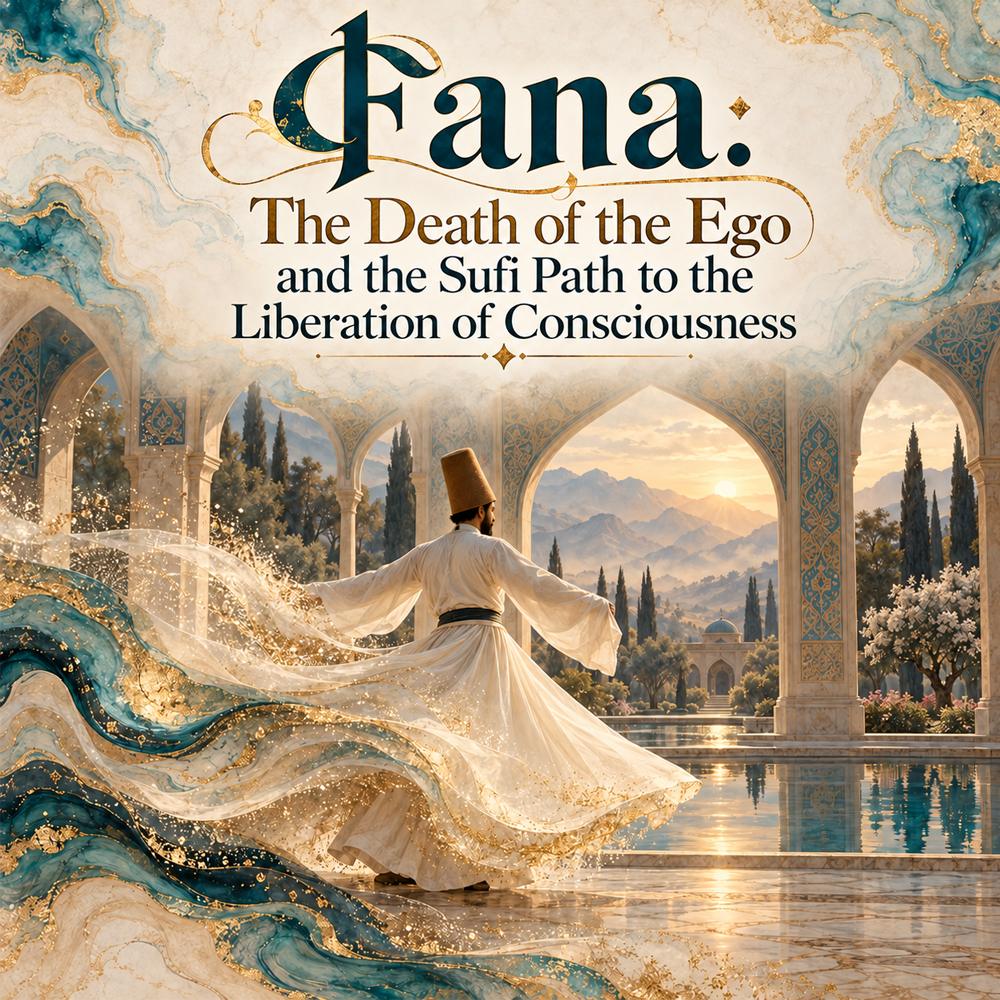
Part One: The Illusion of the Self and the Journey Toward Its Dissolution
Imagine a man who has spent his entire life searching for something, unaware that the very one conducting the search stands in the way of its discovery. He has crossed deserts, studied sacred scriptures, listened to wise teachers, and spent countless sleepless nights contemplating the nature of existence. He has learned the names of God in different languages, mastered intricate philosophical teachings, and accumulated knowledge that inspires admiration in those around him. Yet deep within himself, he senses that something essential continues to elude him.
One evening, he arrives at the home of an elderly Sufi master who is said to have penetrated beyond the illusions of the human mind. The traveler knocks on the door, and a calm voice from within asks who is standing outside. „It is I,“ the man replies, convinced that the question requires no further explanation. But the master does not open the door, telling him that there is no room for two in this house.
Confused, the traveler walks away, unable to understand the meaning of those words. He has come seeking wisdom, only to encounter a closed door and a riddle that feels almost insulting. Months pass as he reflects upon the encounter, until he gradually begins to notice something he has never questioned before. Behind every desire to discover the truth stands an invisible center that insists on being the one who will possess it.
When he finally returns to the master’s home, he knocks once again and hears the same question. This time, however, his answer is different: „It is You.“ The door opens, for the man who once insisted on his separateness has begun to recognize the limitations of his own identity. This is not a story about someone who has lost his memory or personality, but about someone who has ceased to place his separate existence at the center of truth.
This tale, found in different forms within the Sufi literary tradition and famously associated with the poetry of Jalaluddin Rumi, reveals one of the most paradoxical ideas in the history of spirituality. The person who wishes to discover his true nature must first relinquish what he mistakenly believes himself to be. The journey is not about acquiring a new identity, perfecting one’s personality, or accumulating ever greater knowledge. It concerns a transformation in which the sense of being an independent, self-sufficient self gradually loses its authority over consciousness.
In Sufism, this transformation is associated with fana, an Arabic term commonly translated as passing away, annihilation, or extinction of the self. Behind this word lies one of the most profound explorations of human identity in religious and philosophical thought. Fana raises a question as unsettling today as it was a thousand years ago: What remains of a person when identification with thoughts, desires, fears, and self-images begins to dissolve? For the Sufis, the answer is not the destruction of the human being, but a transformation of one’s relationship to God, existence, and the limits of personal identity.
Fana: Why the Deepest Spiritual Discovery Begins with Loss
In everyday life, almost everything we do is connected to the idea of acquisition. We study to know more, work to achieve more, build relationships to enrich our lives, and seek experiences that expand our understanding of the world. Even when we turn toward spirituality, we often preserve this same logic, hoping to become wiser, calmer, more conscious, or closer to the truth. Beneath these aspirations lies the assumption that there is a stable self that will gradually become something greater.
The Sufi understanding of fana challenges this assumption at its foundation. Spiritual liberation is not presented as the ultimate achievement of an individual personality, but as freedom from the personality’s claim to be an independent center of existence. The difficulty is not simply that human beings possess insufficient knowledge, but that they mistake their limited perspective for the whole of reality. As long as this assumption remains unquestioned, even the most extraordinary spiritual experiences can become additional possessions of the ego.
The Arabic word fanāʾ derives from a root associated with passing away, disappearance, and impermanence. Within Islamic thought, it acquires particular significance through the distinction between the transience of created existence and the enduring reality of God. The Quran speaks of the passing nature of created things and the abiding reality of the Divine, a distinction that Sufi thinkers developed into a profound spiritual framework. Human beings exist as created and dependent beings, yet the ego continually behaves as though it possesses ultimate authority over its own existence.
For this reason, fana does not mean physical death, the loss of reason, or the destruction of psychological functioning. In classical Sufi teachings, it primarily concerns the passing away of selfish attachments, self-importance, and the illusion of spiritual independence before the awareness of God. Different authors describe its meaning in different ways, ranging from the disappearance of blameworthy qualities to the fading of self-consciousness in the experience of divine nearness. What unites these interpretations is the conviction that the spiritual path does not culminate in the glorification of the separate individual.
This is where an important distinction emerges between fana and the contemporary expression ego death. In modern psychology and research into altered states of consciousness, ego dissolution often refers to a temporary weakening or disappearance of the ordinary boundaries of self-experience. In Sufism, however, fana belongs to a religious path shaped by devotion to God, ethical discipline, spiritual training, and the purification of intention. The two concepts share an interest in the limits of personal identity, but they cannot be treated as interchangeable.
This distinction is particularly relevant to the modern spiritual seeker. Fana does not promise an extraordinary experience that can be added to a collection of personal accomplishments. Instead, it questions the very desire for spiritual exceptionalism that often hides behind the pursuit of awakening. From the Sufi perspective, the decisive question is not what unusual state of consciousness a person can experience, but how that person lives when pride, selfishness, and the illusion of self-sufficiency no longer govern their actions.
The Invisible Ruler: How the Ego Constructs the World We Inhabit
From early childhood, human beings begin constructing a story about who they are. At first, this story consists of a name, a family, familiar faces, voices, and memories, but gradually it develops into a complex network of beliefs, fears, ambitions, and expectations. The child learns which behaviors bring approval, which qualities inspire admiration, and which weaknesses should remain hidden. Over time, these experiences become so deeply intertwined that the individual ceases to recognize them as acquired interpretations and begins to experience them as an unchanging essence.
An inner image gradually emerges, one that constantly seeks confirmation. It wants to be respected, understood, loved, and recognized, while simultaneously fearing humiliation, rejection, and the loss of control. Every encounter with another person becomes a kind of mirror in which this image searches for evidence of its own worth. A compliment can elevate it, criticism can wound it, and indifference can fill it with anxiety.
Within Sufi spiritual psychology, the concept of nafs plays an important role in understanding this struggle. The word has a broad range of meanings, including soul, self, and person, but in the context of spiritual discipline it often refers to the dimension of human nature governed by passions, selfish impulses, and the desire for self-assertion. Nafs is not simply an equivalent of the modern psychological ego, nor is it a foreign force imprisoned within the body. It belongs to a complex religious vocabulary through which Sufi thinkers describe the struggle between lower inclinations and orientation toward God.
Consider a man who regards himself as generous and virtuous. He helps the poor, supports his friends, and strives to be useful, yet when his efforts go unnoticed, he experiences deep disappointment. Outwardly, his actions are noble, but inwardly there is a hidden expectation that goodness should be rewarded with recognition. A Sufi teacher would direct his attention not toward the charitable act itself, but toward the invisible need for admiration that has attached itself to the action.
Another person takes pride in his humility. He avoids wealth, shows little interest in social prestige, and condemns vanity, yet secretly feels superior to those who live differently. His rejection of worldly distinctions has become a new source of self-importance. The ego thus demonstrates one of its most elusive abilities: it can turn even the rejection of pride into another reason to feel proud.
Sufi thinkers considered this tendency particularly dangerous when it entered religious and spiritual life. A person begins to regard himself as more awakened than others, as the possessor of hidden knowledge, or as someone who has reached a state inaccessible to ordinary people. The more deeply he identifies with this image, the harder it becomes for him to recognize his own errors. The spiritual journey that was supposed to free him from vanity quietly becomes its most sophisticated expression.
The significance of this observation extends beyond the religious context in which it originated. Human beings are capable of turning almost any valued quality into a source of identity, whether intelligence, kindness, independence, discipline, or even indifference to public recognition. Once a quality becomes essential to our self-image, we begin defending the image rather than examining whether our actions truly embody that quality. The resulting conflict is not simply between selfishness and goodness, but between our desire to appear good and our willingness to confront the truth about ourselves.
The Mirror That Cannot See Itself
There is a simple feature of human consciousness that rarely attracts our attention in everyday life. We can observe our thoughts, recognize our emotions, and revise our opinions about ourselves, yet we continually identify with the very experiences we observe. When fear arises, we say, „I am afraid,“ and when anger appears, we experience it as something inseparable from our identity. A temporary inner reaction acquires the power to define the whole person.
Sufi spiritual traditions developed various practices intended to reveal these patterns of attachment. Through self-examination, prayer, remembrance of God, and guidance from a spiritual teacher, the practitioner gradually becomes more attentive to the motives shaping inner life. Hidden desires for control, recognition, and superiority begin to emerge beneath apparently ordinary thoughts and actions. This process requires more than intellectual understanding, because recognizing one’s limitations often means surrendering a comforting image of oneself.
Imagine a mirror covered with so much dust that it can no longer clearly reflect anything placed before it. The person looking into it begins to mistake the stains and distortions for properties of the world itself. Instead of cleaning the surface, he continually rearranges the objects, changes the lighting, and adjusts his position, hoping to obtain a clearer reflection. Yet the source of the distortion lies not in the things being observed, but in the condition of the mirror.
The image of the heart as a mirror has deep roots in Islamic spiritual literature. In the writings of thinkers such as al-Ghazali, the human heart can become obscured by passions and attachments that prevent it from properly apprehending spiritual truth. Purification does not create the truth, but removes obstacles to its recognition. From this perspective, the human being does not become the source of the Divine, but cultivates an inner condition receptive to divine guidance.
This metaphor also reveals why Sufi spirituality cannot be reduced to positive thinking. Positive thinking often seeks to replace unpleasant beliefs about oneself with more encouraging ones, whereas Sufi self-examination questions the attachment to such images in the first place. If a person replaces the belief „I am weak“ with „I am extraordinary,“ the content of the self-image has changed, but dependence upon that image may remain untouched. The issue is not whether the image is flattering or humiliating, but whether it continues to govern the person’s relationship with reality.
At this point, an even more difficult question emerges. If a person can observe thoughts, emotions, and desires, what exactly is the nature of the one who observes them? If the descriptions through which we define ourselves are constantly changing, on what foundation does our sense of identity rest? Sufi thinkers approach these questions within a religious framework in which self-knowledge is inseparable from knowledge of one’s dependence upon God.
Bayazid Bastami: The Mystic Who Lost Himself in the Search for God
During the ninth century, in the Persian town of Bastam, lived a mystic whose name would become one of the most significant in the early history of Sufism. Abu Yazid al-Bistami, commonly known as Bayazid Bastami, became associated with radical experiences of self-effacement and extraordinarily bold mystical expressions. Unlike systematic theologians who organized their ideas into carefully structured treatises, his legacy survives primarily through sayings, anecdotes, and accounts preserved by later writers. The stories surrounding his life therefore belong as much to the spiritual memory of Sufism as to the recoverable history of the man himself.
One well-known tradition associated with Bayazid describes his long search for God. In the narrative, the mystic speaks of years spent striving for divine nearness before recognizing that the obstacle was not a distance separating him from God, but his own sense of independent selfhood. The seeker had placed himself at the center of the spiritual effort without recognizing how this very claim limited his understanding. His journey changed when the desire to possess divine knowledge gave way to a deeper surrender of self-assertion.
The accounts of Bayazid also preserve statements that appear scandalous when removed from their mystical context. Some employ language that seems to attribute divine qualities to the speaker himself. In Sufi literature, such expressions are known as shathiyat, ecstatic utterances associated with states of overwhelming spiritual experience. They provoked serious controversy among Muslim scholars because a literal interpretation could conflict with the fundamental distinction between Creator and creation.
For some Sufi interpreters, these statements were not claims that a human being had literally become God. Instead, they expressed a condition in which ordinary self-awareness had receded so completely that the speaker no longer experienced himself as an independent center. This interpretation was never universally accepted, and the religious legitimacy of such language remained contested throughout Islamic intellectual history. Bayazid’s importance lies partly in the way his legacy exposes the difficulty of translating extraordinary spiritual experience into ordinary speech.
Human language depends upon distinctions between speaker and listener, subject and object, self and world. The experiences attributed to Bayazid place these distinctions under extraordinary pressure. Words that function clearly in everyday communication become unstable when used to describe a consciousness no longer organized around familiar forms of self-reference. His sayings must therefore be approached with attention to their literary, religious, and historical context rather than treated as straightforward philosophical definitions.
Bayazid eventually became a symbol of what later Sufi writers described as spiritual intoxication. This term refers to states in which the intensity of mystical experience exceeds the boundaries of ordinary composure and restrained expression. Yet Sufi history also developed a contrasting ideal of spiritual sobriety, emphasizing clarity, self-command, and continued fidelity to religious obligations. The tension between intoxication and sobriety would become one of the most consequential debates within the Sufi tradition, raising questions about the relationship between inward experience and outward conduct.
When the Desire for Enlightenment Becomes Another Prison
There is a peculiar paradox within spiritual seeking that becomes apparent only when a person begins examining the motives behind the search. At first, the individual seeks relief from suffering, confusion, and the inner contradictions of ordinary life. Later, after discovering philosophy, meditation, or religious practice, a new identity begins to take shape: that of someone devoted to truth and higher understanding. This identity appears nobler than earlier ambitions, yet it can remain dependent upon the same desire for personal distinction.
Previously, the person wanted to be wealthy, influential, or admired; now he wants to be enlightened. Previously, he compared himself with others through material possessions; now he compares people according to their supposed level of spiritual development. Previously, he took pride in worldly achievements; now he takes pride in his ability to renounce them. The object of desire has changed, but the underlying need for superiority remains.
Sufi authors recognized this danger long before contemporary spiritual culture began speaking of the spiritual ego. Al-Ghazali devoted considerable attention to the dangers of ostentatious piety, self-satisfaction, and the pursuit of social recognition through religious activity. For him, the spiritual life required persistent examination of intention because human beings were capable of concealing the love of status beneath apparently virtuous actions. Genuine sincerity could not be measured by outward behavior alone, but had to be understood through the inner orientation from which the behavior arose.
Consider a student who spends years practicing meditation and gradually becomes capable of remaining calm in situations that once disturbed him. At first, he feels grateful for the change and recognizes the value of his efforts. Eventually, however, he begins admiring himself for this ability and looking down upon people who continue to struggle with anger or anxiety. The calmness that should have loosened his attachment to self-importance has become another justification for feeling superior.
This example reveals why outward discipline is insufficient on its own. A person can transform habits, restrict desires, and develop impressive self-control without abandoning the need to feel exceptional. Even renunciation can become a hidden source of pleasure when the individual begins enjoying the image of being someone who has risen above ordinary attachments. The Sufi response is not to dismiss discipline, but to insist that it must be accompanied by sincerity and careful attention to the motives that sustain it.
A deeper problem emerges when the seeker begins treating liberation itself as a possession. Every spiritual achievement becomes another chapter in the story of personal greatness, and every unusual experience becomes evidence of having advanced beyond others. Under these conditions, the language of awakening can reinforce precisely the self-centeredness it was intended to challenge. The danger lies not in the desire to understand spiritual truth, but in the transformation of that desire into a demand for personal superiority.
The question therefore becomes more demanding than simply learning to recognize obvious vanity. It requires distinguishing between the genuine pursuit of truth and the desire to be known, even privately, as someone who possesses it. This distinction is difficult because the two motives can coexist within the same action, concealed beneath identical outward behavior. The Sufi emphasis on intention emerges from the recognition that the most consequential struggles of spiritual life are often invisible to everyone except the person undergoing them.
The Threshold of the Unknown: What Are We Really Afraid to Lose?
Human beings usually assume that their deepest fears concern the loss of life, health, loved ones, or security. Yet beneath these fears lies another anxiety that is more difficult to name: the fear of no longer being the person we believe ourselves to be. Identity provides a sense of continuity amid the constant changes of existence, and even a painful self-image can feel safer than the uncertainty of radical inner transformation. The familiar story of our suffering can become something we protect, precisely because it tells us who we are.
Consider someone who has spent years understanding his life primarily through an experience of injustice. His memories, decisions, and relationships gradually become organized around the conviction that he has been wronged and that others owe him recognition for what he endured. When an opportunity arises to move beyond this identification, he may experience unexpected resistance because doing so would require relinquishing the story through which he has interpreted his existence. This does not diminish the reality of his suffering, but illustrates how deeply personal identity can become intertwined with our interpretations of the past.
The same process occurs with positive identities. Someone who has always been regarded as intelligent may fear situations in which ignorance becomes visible. A person who takes pride in independence may experience shame when needing help, while someone whose identity rests upon being kind may struggle to acknowledge destructive impulses. In each case, a valued self-description becomes something that must be defended against experiences that threaten its coherence.
Identity can therefore function as a system for protecting a particular narrative. We do not merely experience events; we interpret and organize them in ways that preserve a relatively consistent understanding of who we are. When reality challenges that understanding, anger, denial, and rationalization often arise as defensive responses. What is being protected is not always a specific belief, but the deeper sense that our identity must remain intact.
The Sufi understanding of fana opens the possibility of loosening the absolute authority of these self-definitions. This does not require forgetting the past, denying psychological needs, or abandoning responsibility for one’s life. Rather, it involves recognizing that no personal narrative can exhaust the full reality of human existence and that one’s deepest spiritual orientation cannot be reduced to a social role or psychological image. Within Sufism, this recognition is inseparable from awareness of the human being’s dependence upon God.
Yet when familiar forms of identification begin to lose their unquestioned authority, another problem emerges. If a person no longer defines himself primarily through achievements, failures, fears, and desires, how will he continue to act in the world? If self-importance is overcome, what will motivate his decisions, and how can humility be distinguished from passivity? These questions reveal that fana cannot be understood solely as a process of disappearance, because its meaning also depends upon what follows.
In the Sufi tradition, the answer is closely associated with another essential concept: baqa, or abiding. It points toward a transformed mode of existence in which the overcoming of self-centeredness does not end in emptiness, but in a renewed relationship with God, the world, and other human beings. Understanding this distinction requires turning toward the mystics who placed the question of self-annihilation at the center of their lives and, in some cases, paid an extraordinary price for the language they used to describe it. Among them stands one of the most controversial figures in Islamic mystical history: Mansur al-Hallaj, whose words would become inseparable from the enduring debate over the nature of divine union.
Part Two: Beyond the Death of the Ego - What Remains When the Self Disappears
In the year 922, Baghdad was among the greatest intellectual and cultural centers of the medieval world. Its streets carried the voices of merchants, scholars, theologians, and travelers from distant lands, while its libraries and gatherings reflected the extraordinary diversity of thought flourishing under the Abbasid Caliphate. Yet beneath this intellectual brilliance lay a world of religious controversy, political rivalry, and competing claims to authority. It was in this atmosphere that one of the most controversial figures in the history of Islamic mysticism was brought to his execution.
His name was Husayn ibn Mansur al-Hallaj, a wandering preacher and mystic whose teachings had attracted both devoted followers and powerful enemies. He had traveled extensively, spoken publicly about divine love, and challenged conventional expectations about how mystical knowledge should be communicated. Unlike teachers who reserved their most profound insights for carefully prepared disciples, al-Hallaj brought the language of spiritual intimacy into the public sphere. His words fascinated some listeners and alarmed others, especially when they appeared to cross the boundaries separating human beings from God.
Among the expressions associated with his legacy, one became particularly famous: Ana al-Haqq, commonly translated as „I am the Truth.“ In Islamic theology, al-Haqq, the Truth or the Real, is one of the divine names, making the statement extraordinarily provocative. Taken literally, it could be understood as a human being claiming divine identity, a proposition fundamentally at odds with the Islamic affirmation of God’s uniqueness. Yet later Sufi interpreters offered a different explanation, arguing that the statement emerged from a mystical condition in which ordinary self-awareness had been overwhelmed by the experience of divine reality.
For these interpreters, the central issue was not a man declaring himself supreme, but the difficulty of expressing an experience in which the familiar distinction between the one who speaks and the reality being contemplated had become radically transformed. The phrase was understood as an ecstatic utterance rather than a carefully formulated theological doctrine. Nevertheless, this interpretation was never universally accepted, and the legitimacy of such expressions remained contested among Muslim scholars. The controversy revealed a profound tension between the language of mystical experience and the conceptual precision demanded by religious theology.
Al-Hallaj’s historical fate was considerably more complex than the popular story of a mystic executed for a single sentence. His public preaching, religious influence, and connections within the politically unstable Abbasid world contributed to a prolonged conflict with authorities. He endured imprisonment and judicial proceedings before his execution, and historians continue to examine the interaction of theological, social, and political factors surrounding his case. Reducing his death to the punishment of one mystical declaration obscures the historical circumstances that made his position so dangerous.
Over the centuries, however, al-Hallaj became more than a historical figure. In Persian and Arabic mystical literature, he emerged as a symbol of uncompromising devotion, a man whose love of God could not be separated from his willingness to suffer. Later accounts of his final moments acquired dramatic details intended to reveal the depth of his spiritual commitment. Although many of these episodes cannot be verified as historical events, they illuminate the way generations of Sufi writers understood the relationship between love, suffering, and fidelity to truth.
The most enduring philosophical significance of al-Hallaj lies in a paradox concealed within his famous declaration. How can someone speak of the disappearance of individual selfhood while still using the word „I“? Ordinary language requires a speaker, yet the mystical experience being described challenges the speaker’s familiar sense of separateness. The moment the experience is expressed, it enters a world of grammar, interpretation, and judgment that cannot fully reproduce the consciousness from which the words emerged.
This difficulty helps explain why the history of Sufism contains both extravagant mystical expressions and powerful warnings against them. An experience can be deeply meaningful to the person undergoing it without every interpretation of that experience being theologically or philosophically justified. The intensity of conviction does not remove the need for discernment, and the language of divine intimacy can become dangerously ambiguous when separated from its context. Al-Hallaj’s legacy therefore confronts us with a question that extends far beyond his own life: How can a person communicate an experience that appears to exceed the very categories through which communication becomes possible?
Al-Junayd and the Secret of Spiritual Sobriety
While al-Hallaj became associated with the dramatic language of mystical union, another influential Sufi master offered a different vision of spiritual maturity. Abu al-Qasim al-Junayd, who lived in ninth-century Baghdad, became one of the most important representatives of the sober approach to Islamic mysticism. His authority rested upon a combination of spiritual insight, religious discipline, and restraint in expressing extraordinary experiences. Later generations would regard him as a foundational figure in the development of a form of Sufism that emphasized the integration of mystical knowledge with responsible human conduct.
Al-Junayd’s importance becomes clearer when we consider the difference between having an extraordinary experience and being permanently transformed by it. A moment of overwhelming spiritual intensity can alter a person’s perception, but it does not automatically provide the wisdom required to live well afterward. Human relationships, moral obligations, and the demands of ordinary existence remain, regardless of what has occurred in the depths of consciousness. The question is therefore not simply how far mystical experience can carry someone beyond familiar awareness, but how that experience changes the way the person returns to life.
In teachings associated with al-Junayd, the overcoming of self-centered awareness does not imply that a human being becomes identical with God. The distinction between Creator and creation remains essential, even when the mystic experiences an extraordinary sense of divine nearness. What changes is the person’s awareness of dependence, agency, and the ultimate source of existence. Spiritual realization is not a license to claim divine authority for personal opinions or desires.
This approach became closely associated with the ideal of sahw, or spiritual sobriety. Unlike mystical intoxication, which emphasizes overwhelming experience and spontaneous expression, sobriety points toward composure, clarity, and the ability to remain grounded in religious responsibility. The sober mystic does not need to continually announce the extraordinary nature of his inner life. His understanding is reflected in the consistency of his character and the care with which he fulfills his obligations.
Imagine a physician who has spent decades mastering the art of healing. His knowledge has become so deeply integrated that he no longer needs to demonstrate his expertise at every opportunity, and his attention can remain focused on the suffering person before him. The value of his mastery is revealed through sound judgment, restraint, and effective action rather than through constant declarations of superiority. This provides an analogy for the spiritual maturity emphasized in the sober Sufi tradition, although its religious meaning extends beyond professional skill.
Al-Junayd’s legacy offers an important corrective to the assumption that the highest spiritual condition must be the most spectacular. An experience that leaves someone unable to fulfill ordinary responsibilities cannot be judged solely by its emotional intensity. The deeper question concerns whether spiritual insight has become compatible with wisdom, compassion, and sound judgment. In this perspective, the extraordinary is not rejected, but it is no longer treated as the ultimate measure of spiritual attainment.
Baqa: The Life That Follows Self-Annihilation
The concept of baqa introduces one of the most significant developments in the Sufi understanding of spiritual transformation. Commonly translated as abiding, subsistence, or permanence, it is frequently discussed alongside fana as part of a larger spiritual process. If fana concerns the passing away of qualities and attachments that obstruct divine nearness, baqa points toward the transformed condition in which the human being continues to exist in conscious dependence upon God. The relationship between these concepts varies among Sufi authors, but together they prevent mystical self-annihilation from being understood as an end in itself.
Baqa does not describe the reappearance of a personality after a literal period of nonexistence. Nor does it suggest that someone who has undergone fana becomes permanently incapable of error, temptation, or emotional disturbance. Rather, it expresses a new orientation in which human life is understood through its dependence upon divine reality. The individual remains a created being, with responsibilities and limitations, but the meaning of existence is no longer defined by claims of spiritual independence.
To understand one aspect of this transformation, consider a musician who has devoted many years to mastering an instrument. During the early stages of learning, every movement requires conscious effort, mistakes provoke frustration, and successful performances may awaken a powerful desire for admiration. Gradually, technique becomes so deeply integrated that attention can shift away from the mechanics of performance toward the music itself. The musician has not lost his abilities or individuality; rather, he has become capable of expressing them without constantly placing his self-image at the center of the performance.
This analogy illustrates a change in the relationship between self-consciousness and action, but the theological meaning of baqa goes considerably further. In Sufi thought, abiding through God concerns the orientation of human will, awareness, and conduct toward the Divine. It is not merely a psychological state of effortless concentration or a heightened capacity for spontaneous behavior. Its significance arises from the religious understanding that human existence receives its ultimate meaning through its relationship with God.
Baqa also challenges the assumption that spiritual realization must be accompanied by permanent emotional ecstasy. Ordinary life continues to involve fatigue, uncertainty, disappointment, and difficult decisions. The transformed person still encounters these realities, but their presence does not invalidate the spiritual path. What matters is the way the individual responds to them within an enduring commitment to truthfulness, devotion, and ethical responsibility.
This is why the distinction between temporary mystical experience and sustained spiritual transformation matters so much. A powerful moment of unity can become an important turning point, but its significance cannot be established by intensity alone. The long-term consequences of the experience must also be considered, including its influence upon relationships, judgment, and moral conduct. Baqa directs attention toward this continuing dimension of spiritual life, where insight is no longer confined to an isolated moment.
Rumi and the Moth That Flew into the Flame
Few images in mystical literature express the relationship between love and transformation as powerfully as the moth drawn toward the flame of a candle. The creature circles the light, captivated by its brilliance, until its attraction carries it toward a boundary from which it cannot return unchanged. The motif has a long history in Arabic and Persian mystical writing and is particularly associated with al-Hallaj’s reflections on knowledge and experience. Later Sufi poets, including Rumi and Attar, developed related imagery of fire, longing, and the transforming power of love.
In a well-known version of this symbolic narrative, several moths attempt to understand the nature of fire. The first observes the flame from a distance and returns with a description of its light, while the second approaches closely enough to experience its heat. The third enters the flame itself and does not return to explain what it has discovered. The story distinguishes between knowledge acquired through observation, knowledge acquired through proximity, and an encounter that transforms the knower so completely that ordinary description becomes inadequate.
The power of this image lies in the distinction between understanding something intellectually and encountering it directly. A person can study love through poetry, psychology, and philosophy without having experienced the vulnerability of loving another human being. Someone can memorize descriptions of grief without knowing what it means to lose a person whose presence shaped an entire life. In the same way, mystical literature distinguishes between speaking about divine nearness and the direct spiritual experience toward which such language points.
The moth’s destruction is a literary metaphor, not an instruction to pursue physical harm or the loss of psychological stability. Its purpose is to dramatize the limits of detached observation when the subject of knowledge transforms the observer. The moth that enters the flame cannot return with a conventional report because the story’s central insight is that some forms of knowledge cannot be separated from a change in the one who knows. This idea appears repeatedly in mystical traditions, although its specific theological meaning differs across cultures.
In Rumi’s poetry, love becomes a force that overturns the ordinary hierarchy of human concerns. Social prestige, intellectual pride, and the desire for certainty lose their unquestioned importance when the lover becomes absorbed in what is loved. Fire, oceans, storms, music, and the movement of the heavens become images through which he explores the overwhelming character of spiritual longing. These symbols are not merely decorative, because their intensity reflects the difficulty of describing a love that exceeds ordinary calculation.
Yet the love celebrated in Sufi literature cannot be reduced to romantic attachment. It is fundamentally oriented toward God, even when the language of human affection provides the imagery through which it is expressed. The beloved may appear in poetry through familiar human forms, but the symbolic movement of the verse often points beyond the immediate image. This is one reason Sufi poetry can be emotionally intimate while simultaneously addressing profound theological and metaphysical questions.
The moth and the flame also reveal something about the limitations of purely detached knowledge. Observation allows us to classify, compare, and describe, but it does not exhaust every dimension of human understanding. Certain realities become meaningful through participation, commitment, and transformation rather than through external description alone. The Sufi poet uses the language of love to explore this difference, inviting the reader to consider whether the deepest truths of existence can be approached as objects to be examined from a safe distance.
Ibn Arabi: When the Question „Who Am I?“ Becomes a Question About Reality Itself
By the beginning of the thirteenth century, the Islamic world possessed a rich tradition of mystical teachings, spiritual practices, and philosophical inquiry. Yet one thinker would develop the relationship between God, humanity, and existence with such extraordinary metaphysical depth that his influence would extend across centuries. His name was Muhyiddin Ibn Arabi, born in 1165 in Murcia, in Muslim Spain, and deceased in Damascus in 1240. His writings became among the most influential and challenging works in the history of Islamic mysticism.
Ibn Arabi approached the question of human identity within a comprehensive vision of existence. For him, created things cannot be properly understood as entirely independent realities possessing existence through themselves. Everything that exists is dependent upon God, who is not merely another being among beings, but the ultimate source of their existence. Human perception, however, ordinarily encounters the world as a collection of separate entities whose dependence upon that source remains concealed.
Later intellectual traditions frequently associated Ibn Arabi’s teachings with the expression wahdat al-wujud, usually translated as the unity of existence or unity of being. It is important to recognize that this phrase does not function as a simple, comprehensive label for his entire philosophy in his own writings. His thought is considerably more intricate than the popular assertion that everything is God, and it cannot be reduced to an uncomplicated identification of Creator and creation. Instead, he investigates the relationship between divine reality and the multiplicity of created existence through a sophisticated metaphysical vocabulary.
Within this framework, human identity acquires a distinctive significance. If a person regards individual existence as entirely self-sufficient, that person misunderstands the deeper conditions upon which existence depends. Individuality is not simply dismissed as unreal in every possible sense, but neither does it possess the absolute independence that ordinary consciousness often attributes to it. The human being is therefore called to recognize a reality more fundamental than the limited perspective of individual selfhood.
An especially important element of Ibn Arabi’s thought concerns the human being as a locus through which divine names and attributes become manifest. Qualities such as mercy, knowledge, justice, and generosity acquire profound significance within his account of the relationship between humanity and the Divine. Human perfection is connected with the capacity to manifest these qualities in an integrated manner, without confusing their manifestation with independent possession of divinity. The human being’s significance is thus inseparable from dependence upon the source of existence.
This perspective gives the question of self-annihilation a metaphysical depth that extends beyond the psychology of attachment. It asks not only why human beings become trapped in self-centered patterns, but what it means for any finite being to exist at all. The familiar distinction between a self-contained observer and an external world becomes philosophically insufficient when both are understood through their relationship to the Divine. Questions of identity, knowledge, and spiritual transformation are brought into a single inquiry concerning the structure of reality.
Ibn Arabi’s philosophy also raises difficult problems that cannot be resolved through poetic language alone. If existence is radically dependent upon God, how should human freedom and responsibility be understood? If divine reality is manifested through creation, how are distinctions between truth and error, goodness and evil, to be maintained? Such questions help explain why his legacy inspired both extensive philosophical commentary and intense theological criticism.
The lasting importance of Ibn Arabi lies partly in his refusal to treat the human being as an isolated psychological subject. Our understanding of ourselves is shaped by assumptions about the world, causality, dependence, and the ultimate nature of existence. To investigate the self deeply enough is therefore to encounter questions that extend far beyond individual personality. In his work, the search for self-knowledge becomes inseparable from the attempt to understand reality itself.
Ego Dissolution and the Modern Science of Consciousness
During recent decades, expressions such as ego dissolution and ego death have moved beyond mystical literature into mainstream discussions of psychology, meditation, and consciousness. Particular attention has been directed toward altered states in which the ordinary sense of personal identity becomes weakened, transformed, or temporarily disrupted. Participants in scientific studies sometimes describe experiences of unity, diminished boundaries between self and world, or a temporary absence of the familiar sense of being a separate observer. Such reports resemble certain descriptions found in mystical traditions, but similarities in language do not establish that the underlying experiences or their interpretations are identical.
In cognitive science, the sense of self is often investigated as a complex process involving memory, bodily awareness, attention, social cognition, and the capacity to construct a narrative about one’s life. Rather than treating selfhood as a single unchanging object, researchers examine the interacting mechanisms that contribute to its continuity. This does not mean that science has conclusively demonstrated the nonexistence of the self or solved the philosophical problem of subjective experience. It means that our ordinary sense of being a unified individual involves multiple processes that can be studied separately.
One frequently discussed subject is the default mode network, a set of interacting brain regions associated with functions such as autobiographical memory, thinking about oneself and others, and internally directed cognition. Research has identified changes in the activity and connectivity of this network during certain forms of meditation and psychedelic experience. However, it would be inaccurate to describe the network simply as the physical location of the ego. Neither can a reduction in its activity be equated automatically with spiritual liberation.
Psychedelic research has contributed substantially to contemporary interest in ego dissolution. Under certain conditions, substances such as psilocybin can produce profound alterations in self-experience, sometimes described by participants as mystical or deeply meaningful. Researchers have also investigated potential therapeutic applications, although outcomes depend upon numerous factors and the experiences can involve serious distress, disorientation, or adverse psychological reactions. An intense subjective experience does not, by itself, establish lasting ethical or spiritual transformation.
The comparison with Sufism becomes especially revealing when we examine the questions each approach seeks to answer. A neuroscientist may investigate which brain processes accompany changes in self-referential awareness, while a Sufi teacher is concerned with the purification of intention and the person’s relationship with God. The first inquiry is empirical and relies upon observation, measurement, and experimental evidence. The second belongs to a religious and ethical framework concerned with the meaning and direction of human existence.
These approaches need not be regarded as mutually irrelevant, but neither should their differences be erased. Scientific research can help explain how self-experience changes and why certain states feel exceptionally convincing to those who undergo them. Sufi thought offers a framework for interpreting spiritual significance and evaluating the place of such experiences within a larger religious life. Yet neuroscience does not establish the truth of Sufi metaphysical claims, just as mystical testimony cannot replace empirical investigation.
An additional distinction is essential when discussing the disappearance of ordinary self-boundaries. Ego dissolution should not be casually equated with dissociation, depersonalization, or other conditions that can involve distress and impaired functioning. Losing the familiar sense of self is not a universal indication of spiritual progress, and unusual experiences are not inherently beneficial. The value assigned to an experience depends upon its context, consequences, and interpretation rather than upon its strangeness alone.
Fana, Buddhist Anatta, and Nondual Awareness: Different Paths Beyond the Ordinary Self
When modern readers encounter the idea of fana, they often recognize similarities with teachings from other philosophical and spiritual traditions. Buddhism explores anatta, or non-self, while certain schools of Hindu philosophy investigate the relationship between individual consciousness and ultimate reality. Contemporary spiritual writing frequently presents these teachings as alternative expressions of one universal insight. Yet such interpretations risk overlooking profound differences in their metaphysical foundations, religious commitments, and understandings of liberation.
In early Buddhism, the teaching of anatta challenges the assumption that a permanent, independent, and unchanging self can be found within the changing constituents of experience. Form, feeling, perception, mental formations, and consciousness are examined as conditioned and impermanent processes. Attachment to these processes as though they constituted an enduring essence is associated with suffering, because the individual attempts to secure what cannot remain fixed. Liberation involves insight into this conditioned nature of experience and the overcoming of craving and ignorance.
Advaita Vedanta, one of the most influential nondual schools of Indian philosophy, approaches the question differently. Its central concern involves the distinction between limited personal identification and the true nature of Atman, understood in classical Advaita as identical with Brahman. Ignorance leads the individual to identify with a restricted personality, while liberating knowledge reveals the deeper reality of the Self. This metaphysical framework cannot be reduced to a general teaching about the disappearance of the ego, because it makes specific claims about consciousness and ultimate existence.
Sufi fana develops within a different religious horizon. Its foundation is the relationship between the human being and the one God, and its spiritual meaning is shaped by devotion, worship, sincerity, and the purification of the heart. Even when certain Sufi authors employ language that resembles nondual philosophies, their teachings remain connected to questions of Islamic theology and the distinction between Creator and creation. Fana, anatta, and Advaitic liberation therefore cannot accurately be treated as identical doctrines expressed through different cultural vocabularies.
Nevertheless, these traditions illuminate a shared philosophical problem. Each challenges, in its own way, the immediate confidence with which human beings assume that ordinary self-experience reveals the complete truth of their nature. They examine the limitations of attachment, mistaken identification, and habitual interpretations of experience. This common concern makes meaningful comparison possible without requiring their differences to disappear.
Such comparisons also reveal something important about philosophy itself. Consciousness is not merely a transparent window through which reality is observed; it participates in shaping the way reality is experienced and understood. Different traditions investigate this condition through distinct methods, concepts, and assumptions about existence. Their value does not depend upon their providing identical answers, but upon their capacity to expose questions hidden beneath what we ordinarily take for granted.
The Dark Side of Spiritual Liberation: When Self-Annihilation Becomes Another Illusion
Every teaching that promises radical personal transformation carries the risk of being misunderstood or misused. When someone hears that the ego must disappear, the idea can be interpreted as a demand to abandon personal boundaries, individual needs, or the capacity for self-protection. Such interpretations become particularly dangerous when combined with the belief that a spiritual teacher possesses unquestionable authority. The language of humility can then be transformed into an instrument of obedience, manipulation, or abuse.
Genuine spiritual discipline does not require the abandonment of moral discernment. If a teacher insists that resistance to humiliation or mistreatment proves the presence of an excessively strong ego, spiritual language is being used to justify domination. Personal responsibility does not disappear through spiritual development, nor does an extraordinary experience grant permission to harm others. Claims of advanced spiritual realization must never be treated as substitutes for accountability.
Classical Sufi communities placed considerable importance on relationships between teachers and disciples, but Sufi literature also contains repeated warnings against false masters, ostentatious holiness, and religious hypocrisy. Authors such as al-Qushayri sought to present Sufism as a disciplined spiritual tradition grounded in ethical norms and religious obligations. For such thinkers, mystical experience could not excuse conduct that violated fundamental moral responsibilities. The credibility of spiritual teaching depended upon the relationship between its claims and the character of those who embodied it.
A subtler danger arises when spiritual concepts become a means of avoiding unresolved psychological difficulties. Someone may claim to have transcended anger while merely suppressing it, or insist upon freedom from attachment while remaining terrified of intimacy. A person may describe ordinary grief as an illusion in order to avoid confronting the pain of loss. In these situations, spiritual language functions as a defense against experience rather than a means of understanding it more deeply.
Contemporary psychology often discusses related patterns through the concept of spiritual bypassing, a term describing the use of spiritual beliefs and practices to avoid unresolved emotional or psychological problems. Although the expression does not originate in classical Sufism, it identifies a difficulty that can arise across many spiritual environments. Someone may speak eloquently about unconditional compassion while refusing to acknowledge the harm caused by personal behavior. Another may proclaim freedom from ego while remaining unable to accept criticism or apologize.
This makes it essential to distinguish self-transcendence from self-degradation. In the Sufi religious context, overcoming selfishness concerns the purification of one’s relationship with God, not the destruction of human dignity. Humility does not require accepting injustice, and surrendering arrogance does not mean surrendering the ability to defend truth. A spiritually meaningful transformation must remain compatible with psychological integrity, ethical judgment, and respect for human worth.
Spiritual Awakening Is Not an Escape from the World
The history of spirituality frequently presents the image of a sage who withdraws from society to discover truth in a mountain cave, desert, or monastery. Forms of solitude also appear within Sufism, where periods of retreat have sometimes served as opportunities for prayer, contemplation, and spiritual discipline. Yet Sufi history cannot be reduced to the lives of hermits and wandering ascetics. It includes artisans, merchants, scholars, poets, rulers, and ordinary people who sought spiritual depth while remaining involved in the responsibilities of society.
This diversity reveals an important feature of the Sufi understanding of religious life. The spiritual significance of an action cannot always be determined by its outward appearance, because similar behavior may arise from very different intentions. Wealth may encourage arrogance or become a means of generosity, just as poverty may cultivate gratitude or become a source of resentment. The moral question concerns not only what a person possesses, but how those possessions shape relationships and decisions.
Imagine a merchant whose business provides a livelihood for dozens of families. He can regard his success as proof of personal superiority, using his position to humiliate those who depend upon him. Alternatively, he can understand his wealth as a responsibility that requires fairness, honesty, and attention to the welfare of others. His occupation remains the same, but the moral significance of his conduct changes through the values governing his decisions.
The same distinction applies to public authority. Power can become an instrument for satisfying vanity, yet it can also be exercised as a difficult obligation requiring restraint and accountability. A person who cannot distinguish personal ambition from the common good may easily confuse private desires with public responsibility. Spiritual self-examination becomes relevant because it draws attention to motives that can remain concealed beneath respectable actions.
In this sense, the spiritual path is tested not only during prayer or contemplation, but also in situations involving disagreement, temptation, and responsibility. It is comparatively easy to imagine oneself patient when no one is provoking anger, or generous when nothing valuable is at stake. The difficulty emerges when one’s interests conflict with the needs of another person. Ordinary life provides a setting in which moral commitments must become more than attractive ideas.
The Sufi tradition’s concern with character therefore prevents spiritual transformation from being reduced to private experience. Love, justice, mercy, and honesty require decisions that affect real people in concrete circumstances. Their value is revealed through conduct rather than through declarations about the purity of one’s inner state. A spiritual life separated entirely from responsibility toward others would leave one of its most important dimensions unexamined.
When No One Is Watching: The Test of Inner Freedom
There are moments when philosophical ideals encounter a test more revealing than any public declaration. A person must choose whether to do what is right when nobody will witness the decision, offer praise, or provide a reward. The action cannot be transformed into a display of virtue, and there is no audience whose admiration can be secured. What remains is the relationship between conscience, intention, and conduct.
Within Islamic spirituality, the concept of ikhlas, or sincerity, occupies an especially important place. It refers to purity of intention in devotion to God, rather than the pursuit of recognition through religious or moral action. Sufi thinkers regarded sincerity as demanding because human motives are rarely transparent even to the people who possess them. The desire for gratitude, prestige, or moral superiority can become entangled with actions that appear entirely selfless.
Consider an employee who discovers that a colleague has made a serious mistake. The employee could use the situation to demonstrate superior competence, publicly exposing the error and strengthening a personal reputation. Alternatively, the mistake could be addressed constructively, protecting others from its consequences without unnecessarily humiliating the colleague. Both responses might solve the immediate problem, but they reveal different relationships between moral responsibility and personal ambition.
An even more difficult test arises when the mistake is our own. Criticism can provoke an immediate defensive reaction because admitting error threatens the image of competence or goodness we wish to preserve. Excuses, counteraccusations, and elaborate explanations may appear before we have seriously considered whether the criticism is justified. The capacity to acknowledge a mistake without treating it as a verdict upon one’s entire worth represents a meaningful form of inner independence.
Such independence does not mean becoming indifferent to the opinions of others. Human beings need relationships, trust, correction, and the perspective that other people can provide. The difference lies in the ability to receive praise without becoming dependent upon admiration and to hear criticism without automatically experiencing it as humiliation. This allows judgment to be guided more closely by the merits of a situation rather than by the immediate need to protect a reputation.
The significance of sincerity becomes especially clear when an action carries no prospect of personal recognition. A person who returns something valuable without expecting gratitude, protects someone who cannot offer repayment, or refuses an unfair advantage when discovery is unlikely demonstrates a form of ethical commitment that does not depend upon an audience. Within the Sufi framework, such conduct acquires its deepest meaning through devotion to God. Yet the philosophical challenge it raises is accessible to anyone: What governs our actions when the rewards of appearing virtuous are removed?
The Final Paradox: Can the Self Overcome Itself Through Its Own Will?
After the stories, philosophical distinctions, and spiritual images, one question remains at the center of fana. If the ego is what must be overcome, how can it serve as the instrument of its own overcoming? Every deliberate effort seems to presuppose someone who intends to achieve a result, while the pursuit of spiritual liberation can itself become another project of personal ambition. The seeker appears caught in a contradiction: the more determinedly he tries to conquer himself, the more importance he may assign to himself as the future conqueror.
This paradox helps explain why classical Sufi teachings do not present fana as a mechanical technique guaranteed to produce a particular state. Spiritual discipline matters, but it does not turn divine nearness into a reward that can be demanded in exchange for effort. Within the religious framework of Sufism, divine grace remains essential and cannot be compelled by human will. Practice prepares the individual, but it does not confer authority over God.
A distinction therefore emerges between spiritual practice as an attempt at control and spiritual practice as the cultivation of receptivity. In the first approach, a person performs certain actions with the expectation that they will produce a desired inner condition. In the second, the emphasis falls upon removing obstacles that prevent recognition of human dependence and limitation. The purpose is not to seize possession of truth, but to become more receptive to it.
The Sufi concept of tawakkul, or trust in God, expresses an important dimension of this orientation. It does not require abandoning action or passively waiting for circumstances to resolve themselves. Classical religious interpretations frequently connect trust with the obligation to make appropriate efforts and fulfill one’s responsibilities. What changes is the conviction that human abilities alone possess ultimate control over outcomes.
For people raised within a culture of achievement and constant self-improvement, this idea can appear deeply counterintuitive. From an early age, we are taught to measure success through effort, planning, discipline, and the ability to control results. Gradually, the same logic is extended to every dimension of life, including love, peace of mind, and spiritual understanding. Yet some of the most meaningful human experiences cannot be produced on command, regardless of how intensely they are desired.
We cannot manufacture genuine love simply by deciding to experience it. Trust cannot be reduced to an act of control, and humility cannot be perfected while we remain absorbed in admiration for our own humility. These qualities involve transformations in our relationship to experience rather than the mechanical production of predetermined outcomes. The Sufi understanding of fana carries this insight into a religious vision in which the human will recognizes the limits of its power.
The final difficulty is therefore not always an obvious desire or weakness. Sometimes it is the conviction that spiritual fulfillment must become an achievement we can personally certify and possess. The longing to announce „I have arrived“ can preserve the very framework of self-importance that the journey was meant to challenge. In Sufi thought, the deepest transformation cannot be separated from relinquishing the demand to become the proud owner of liberation itself.
The Return: The Man Who No Longer Needed to Be the Center of the World
Imagine once again the traveler who stood before the closed door of the Sufi master at the beginning of our story. He had arrived believing that truth was something he needed to discover, acquire, and add to everything he already knew about himself. His journey was shaped by the hope that one day he would become a person who possessed the ultimate answers. Yet the encounter at the door revealed that his understanding of the search was incomplete.
Now imagine the traveler leaving the master’s house and returning to the city. The streets are unchanged, merchants continue bargaining over prices, children run between the buildings, and the world has become neither simpler nor less uncertain. He has not acquired the power to control events, nor has he received a guarantee that fear, anger, and sorrow will never trouble him again. His life remains subject to the limitations and responsibilities of human existence.
Yet something about his way of meeting the world has changed. When praised, he can appreciate the kindness of another person without turning admiration into the foundation of his worth. When criticized, he can examine the words and consider their truth without immediately treating them as an attack upon his entire identity. Success no longer needs to become evidence of superiority, and failure no longer has to become an absolute definition of who he is.
He has not lost his character, memories, abilities, or capacity to make decisions. He continues to speak with his own voice, care for others, and take responsibility for his actions. But his existence is no longer organized around the constant demand that every event confirm a particular image of himself. The world is no longer required to serve as an endless mirror of his personal importance.
This imagined return offers a psychological illustration of one dimension of the Sufi ideal, but it does not exhaust the religious meaning of fana and baqa. For the Sufi, the deepest purpose of transformation is not simply to become calmer, more confident, or less dependent upon social approval. It is to live in conscious relationship with God, allowing that relationship to shape one’s intentions and conduct. The ethical consequences matter profoundly, but they arise within a spiritual framework that cannot be replaced by secular ideas of self-improvement.
Nevertheless, this tradition speaks to a human difficulty that extends far beyond its original religious setting. Nearly everyone knows the exhaustion of constantly trying to establish personal worth through achievement, recognition, or comparison. We have all witnessed how pride can turn a minor disagreement into a lasting conflict, and how fear of humiliation can prevent someone from acknowledging an obvious mistake. Much of human suffering is intensified by the conviction that every event must be interpreted as a personal victory or defeat.
The Sufi response does not consist in promising the final triumph of the individual over the world. It suggests that freedom involves a different relationship to the need for triumph itself. The purpose is not to construct an increasingly impressive identity, but to recognize the limitations of defining existence through such constructions. The spiritual journey becomes a movement away from the assumption that personal greatness is the ultimate measure of a meaningful life.
There is something profoundly challenging about this possibility. Human beings spend much of their lives attempting to become someone more successful, knowledgeable, admired, or spiritually accomplished. Even the pursuit of wisdom can become another competition in which the individual hopes to emerge victorious. Fana confronts this entire pattern by questioning whether the self must always stand at the center of what is considered valuable.
In the Sufi understanding, the answer is inseparable from the reality of God. The human being does not achieve spiritual fulfillment by becoming the ultimate source of truth, but by recognizing the dependence of created existence upon the Divine. The journey does not culminate in the individual’s possession of reality, but in a transformed awareness of the relationship between the finite and the eternal. What passes away is not the human obligation to live, love, and act, but the illusion that the individual possesses absolute independence.
The old story of the closed door now reveals its deeper significance. The master was not demanding that the traveler forget his name, deny his existence, or abandon his humanity. The door opened when the traveler’s answer ceased to place his separate identity between himself and the reality he sought. The change was not the acquisition of some new power, but the recognition of a limitation that had shaped the entire journey.
This is why the language of annihilation in Sufism ultimately points toward a transformation of life rather than a celebration of emptiness. Fana and baqa belong together because the passing away of self-centered claims acquires meaning through a continuing relationship with God. The first names the overcoming of what obstructs spiritual nearness, while the second expresses the abiding life that follows within that relationship. The destination is not a human being stripped of all qualities, but a life no longer governed by the illusion of ultimate self-sufficiency.
And so the journey that began with a question about identity arrives at a question about the nature of freedom. Is freedom the ability to make the entire world conform to our desires, or is there a deeper freedom in no longer requiring the world to revolve around us? Is wisdom the possession of an ever-growing collection of answers, or does it also involve recognizing the limits of the one who demands them? These questions remain compelling because they challenge assumptions woven into the ordinary structure of human ambition.
The traveler who once knocked upon the master’s door believed that the final discovery would make him greater than he had been before. What he encountered instead was the possibility of a life no longer measured by the need for personal greatness. He returned to the same world, but the meaning of his place within it had changed. The door had not opened onto another universe; it had opened onto another way of inhabiting this one.
The deepest paradox of fana lies here: the seeker begins by wanting to find himself, yet discovers that the self he has been defending cannot serve as the ultimate foundation of truth. He pursues liberation, only to confront the possibility that liberation cannot be possessed like an ordinary achievement. He longs to become extraordinary, but the path asks him to recognize something more fundamental than his own exceptional status. The movement is not toward the destruction of humanity, but toward a different understanding of what human existence is for.
In the end, the Sufi vision offers neither a simple psychological technique nor a promise of permanent escape from life’s difficulties. It presents a demanding spiritual philosophy in which self-knowledge, love, humility, and awareness of God are inseparably connected. Its central insight is not that the individual must become worthless, but that individual existence cannot be understood as the ultimate center of reality. What appears at first to be a loss becomes, within this religious vision, the condition for a more profound form of spiritual life.
And perhaps the most enduring question left by this tradition is not whether we can experience the disappearance of the ego for a moment, but whether we can live without continually demanding that everything confirm its importance. The first question concerns an unusual experience; the second concerns the entire direction of a human life. Between them lies the difference between seeking an extraordinary state and undergoing a genuine transformation of character. It is within this distinction that the philosophical depth of fana becomes most apparent.
For the Sufis, the final answer is not found in the triumph of the isolated self, but in its surrender before the Divine. The seeker does not become the master of existence, nor does he escape the conditions of being human. He discovers that the truth he sought was never something his ego could own, command, or contain. And when the demand to possess it falls silent, the spiritual journey reveals its most profound possibility: not the end of human life, but the end of the illusion that the self must stand at the center of everything.
Read more:
- Jalal ad-Din Rumi – “The Poet Who Turned Pain into a Path to God”
- Farid ud-Din Attar – “The Mystic Who Turned the Soul into a Journey”
- Sufism: The Mystical Path to God – History, Secrets, and Great Sufi Teachers
- 15 Wise and Humorous Stories of Nasreddin Hodja
Author: Vasil Stoyanov