

More than two thousand years ago, a man walked the streets of Athens who left behind not a single book, yet changed the history of philosophy forever. He offered no complete system explaining the structure of the universe and did not claim to possess ultimate truth. Instead, he spoke with people, asked uncomfortable questions, and prompted them to reconsider what they took to be obvious. His name was Socrates, and his legacy begins with a seemingly simple admission: human wisdom requires us to recognize the limits of our own knowledge.
Socrates transformed philosophy into an inquiry into human life, character, and virtue. For him, it was not enough to know how to govern a city, acquire wealth, or deliver a persuasive speech. What mattered more was understanding what it means to be just, courageous, reasonable, and good. That is why his story forms a natural beginning to a journey through ancient philosophy, one that will later continue with Plato and Aristotle.
Athens in the Fifth Century BCE: The City That Gave Birth to Questions
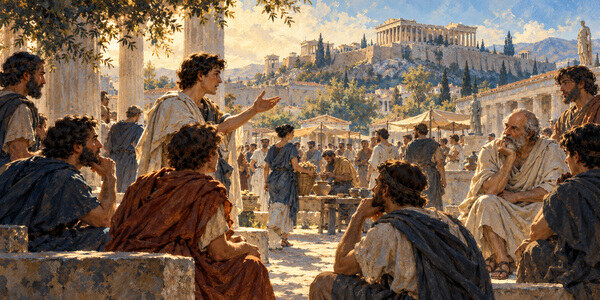
Socrates lived approximately between 469 and 399 BCE, during an era of political and cultural upheaval. Athens experienced a flourishing of democratic life, art, and public debate, but also wars, internal conflicts, and deep social divisions. Citizens discussed laws, justice, and the future of the city-state in public squares, courts, and the assembly. In such an environment, the ability to speak persuasively could become a source of influence, regardless of whether what was said was true.
This was also the world of the Sophists, teachers who, in exchange for payment, instructed young men in rhetoric, argumentation, and the skills of public life. They did not constitute a unified school, and their views differed considerably. Socrates is often associated with them because of his interest in debate and human affairs, but his portrayal in Plato’s dialogues stands apart through his refusal to sell ready-made wisdom. He questioned not only other people’s answers but also his own right to call himself knowledgeable.
What We Know About Socrates and Why the Sources Are Complicated

Socrates left no philosophical writings of his own that we can read directly. We learn about his ideas primarily from Plato’s works, Xenophon’s recollections, and the comic portrayal created by Aristophanes. These accounts have different purposes, genres, and points of view. Historians therefore speak of the “Socratic problem”: the difficulty of distinguishing the historical person from his literary and philosophical representations.
In Plato’s early dialogues, Socrates frequently investigates definitions of virtues without arriving at a final solution. In later works, Plato develops his own metaphysical views, which cannot automatically be attributed to his teacher. Xenophon presents Socrates more practically, as a man concerned with moral education and everyday conduct. Aristophanes, meanwhile, uses comedy to portray a figure who combines different intellectual movements of the period.
This uncertainty does not diminish Socrates’ importance. On the contrary, it reminds us how essential it is to distinguish historical facts from philosophical interpretations. When we speak of his teachings, we are often speaking of Socrates as presented by a particular ancient author. Making that distinction is itself part of the intellectual honesty we associate with his method.
“I Know That I Know Nothing”: What the Famous Saying Really Means

The sentence “I know that I know nothing” is widely circulated as a quotation from Socrates, but it does not appear in this exact form in Plato’s Apology. Closer to the source is the thought that Socrates does not imagine he knows what he does not know. The difference may seem small, but it is significant. He does not claim that all knowledge is impossible; he criticizes the self-confidence that turns unexamined beliefs into apparent truths.
In the Apology, Socrates recounts how his friend Chaerephon asked the Delphic oracle whether anyone was wiser than Socrates. According to the account, the answer was no, and Socrates set out to understand its meaning by speaking with people considered wise. He discovered that many possessed knowledge in particular areas but overestimated their understanding of other questions. He thus arrived at the idea that awareness of one’s ignorance is an important form of human wisdom.
This position is not an invitation to passivity or to abandon the search for truth. It is the beginning of inquiry because it frees us from the need to appear right at all times. When we admit that we do not know enough, we can ask a better question and examine our reasons. Socratic ignorance is therefore not an emptiness, but a discipline of thought.
The Socratic Method: Truth as a Conversation

Socrates is known for conducting conversations through a sequence of questions. Rather than delivering a long lecture about justice, he asks his conversation partner what justice is. After receiving an answer, he introduces cases that test whether the definition is consistent and applicable. If a contradiction emerges, the conversation begins again with a more careful examination of its assumptions.
This approach is often called the Socratic method and, in the history of philosophy, is associated with the concept of elenchus, an examination or refutation through questioning. Its purpose is not necessarily to humiliate the other person or win an argument before an audience. In its strongest philosophical sense, it reveals why seemingly clear beliefs may be internally inconsistent. Conversation becomes a means of shared inquiry rather than merely a contest in eloquence.
Imagine someone declaring, “Courage means never being afraid.” Socrates might ask whether a reckless person who does not understand danger is necessarily courageous. He might then examine whether someone who feels fear but acts wisely for a just cause demonstrates greater courage. The simple definition thus proves inadequate, and a deeper search for meaning begins.
Aporia: Why a Conversation Sometimes Ends Without an Answer

Many of Plato’s early dialogues end in a condition called aporia, meaning perplexity or puzzlement. The participants can no longer confidently defend their original definition, yet they have not found a final solution. At first glance, this may seem like a failure of the conversation. In fact, aporia can be a valuable result because it exposes a problem previously concealed beneath self-confidence.
When someone discovers a contradiction in their beliefs, an opportunity for intellectual change opens before them. They can reject the questions and protect their ego, or they can begin to think more precisely. Socratic dialogue encourages the second choice. Ignorance is no longer a shameful weakness but an honest starting point for philosophical development.
Virtue and the Question of How We Should Live
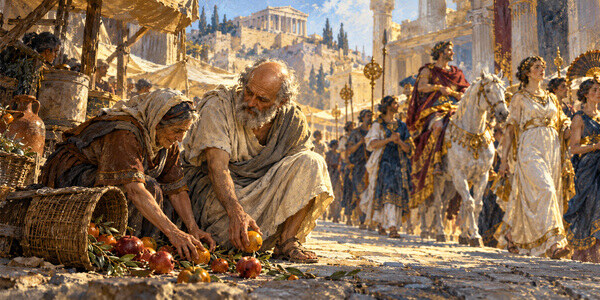
At the center of Socratic philosophy stands the question of the good human life. What does it mean to be just, temperate, courageous, or pious? Can we possess genuine virtue if we do not understand what it is? And is it enough for society to consider us successful if our actions themselves are morally wrong?
In Plato’s dialogues, Socrates repeatedly redirects attention from external possessions toward the condition of the soul. Wealth, reputation, and power can be useful, but they do not in themselves make someone good. What matters more is how we use our opportunities and whether we act reasonably and justly. This shift in focus from possession to character becomes an enduring theme of ancient ethics.
Socrates is often associated with the thesis that virtue is knowledge and that no one does wrong willingly. This idea should not be understood as a simplistic excuse for every harmful action. It points toward the question of whether someone who truly understands the good and its significance for life would knowingly choose their own moral harm. Its interpretation remains a subject of philosophical debate, but it reveals how closely Socrates connects reason and morality.
Care of the Soul: More Important Than Wealth and Fame

One of the strongest themes in Plato’s Apology is the call to care for one’s soul. In the ancient context, this does not necessarily mean exactly what later religious traditions understand by the word “soul.” For Socrates, it is connected with a person’s moral and rational life. Caring for it means examining one’s beliefs, developing one’s character, and refusing to place material benefits above justice.
This view overturns conventional measures of success. A person may hold high social status and still live without inner consistency. Another may be poor and unpopular yet demonstrate dignity and faithfulness to their principles. For Socrates, the real question is not how we appear to others but what we become through our own decisions.
Socrates and Democracy: Between Civic Duty and Criticism
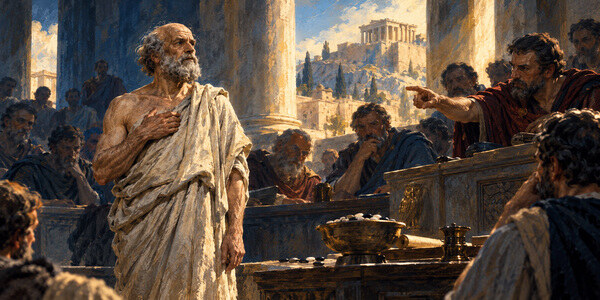
Socrates’ relationship with Athenian democracy is complex and cannot be reduced to a single political position. He criticizes the tendency toward unexamined opinions and questions the claims of influential citizens to possess expertise. At the same time, his life is closely connected with the public space of Athens. His philosophical activity takes place among his fellow citizens rather than in an isolated school removed from society.
According to ancient accounts, Socrates participated in military campaigns as a citizen-soldier and demonstrated personal endurance in dangerous circumstances. In the Apology, he also describes occasions when he refused to carry out actions he considered unjust, regardless of political pressure. These accounts portray a man for whom obedience to authority has moral limits. The philosophical question of justice thus becomes a practical test of character.
The Trial of Socrates: When Questions Become Dangerous
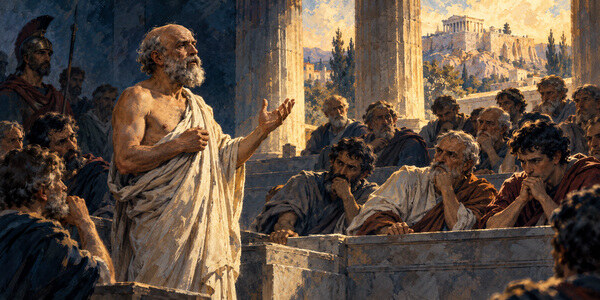
In 399 BCE, Socrates was brought before an Athenian court. The accusations concerned failing to honor the gods recognized by the city, introducing new divine matters, and corrupting the young. The trial took place in a society that had experienced military defeats and political crises, making its context particularly tense. Even so, we cannot reduce the motives of everyone involved to a single cause.
In Plato’s Apology, Socrates defends his way of life rather than simply renouncing it to gain the judges’ favor. He presents philosophical inquiry as a task he would not abandon even under threat. The court finds him guilty and sentences him to death. The case remains one of the most famous examples of the tension between free critical thought and public authority.
Why Socrates Did Not Escape from Prison

In the dialogue Crito, Plato presents a conversation between Socrates and a friend who urges him to escape from prison. Socrates refuses to accept that the danger of death, by itself, justifies any action. Instead, he examines whether escaping would be just and what the relationship between a citizen and the laws of the city means. The arguments in the dialogue are complex and should not be turned into a universal command to obey every authority unconditionally.
Especially important is the conviction that one should not respond to injustice by committing another injustice. Socrates places moral consistency above immediate advantage and personal survival. This choice can be challenged, but the very possibility of debate makes it philosophically significant. It forces us to ask whether our principles matter only when they require no sacrifice.
The Final Hours and Philosophy in the Face of Death
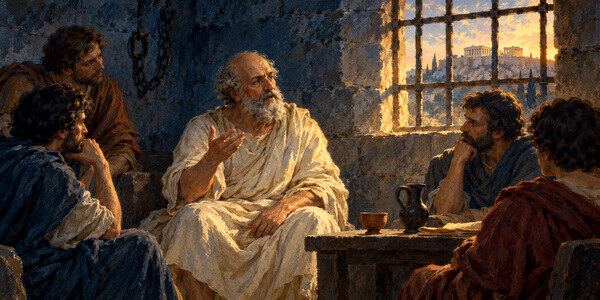
Plato’s Phaedo describes Socrates’ final hours and his conversations with friends about the soul and death. The text contains developed philosophical arguments that cannot unconditionally be accepted as a verbatim historical record. At the end of the account, Socrates drinks the poison prescribed by his sentence. The image of the calm philosopher becomes a symbol of faithfulness to one’s convictions even in the face of death.
This calmness does not mean that death is insignificant or that human life has no value. Rather, it raises the question of how a person can live so that fear does not force them to betray what they believe is just. For Socrates, care of character is not a theory to be used only in safe moments. It must also matter when circumstances become most difficult.
“The Unexamined Life” and the Meaning of Self-Knowledge

One of the best-known thoughts associated with Socrates is the statement in Plato’s Apology that the unexamined life is not worth living for a human being. This is not a condemnation of people who have not studied philosophy, nor a call to doubt every trivial matter constantly. The thought points toward the need to examine our own goals, values, and reasons for acting. Life can be filled with activities and achievements yet still lack a consciously chosen direction.
For Socrates, self-knowledge is not merely a list of personal qualities or preferences. It requires examining whether our actions correspond to the principles we claim to hold. Someone may consider themselves just but behave unjustly when their personal interests are threatened. It is precisely within such contradictions that the real work of philosophical inquiry begins.
From Socrates to Plato: How Questions Become a Philosophical System

The most influential student associated with Socrates’ legacy is Plato. In his dialogues, the teacher is often the main speaker, while questions about virtue and knowledge gradually expand into problems concerning truth, the soul, the state, and being. Plato develops the theory of Forms and creates a philosophical framework that goes beyond what we can confidently attribute to the historical Socrates. Nevertheless, without the Socratic insistence on seeking clear reasons, this transition would be difficult to understand.
Later, Aristotle would construct his own system, critically reworking the Platonic legacy. Thus, an intellectual sequence emerges among the three philosophers rather than merely a list of famous names. Socrates raises the question of how to think and live well, Plato investigates the broader foundations of truth and reality, and Aristotle develops detailed analyses of nature, causation, logic, and ethics. This line of thought is one of the most important starting points for understanding the Western philosophical tradition.
What Socrates Can Teach Us Today

In the modern world, information is available faster than ever, but access to information is not the same as understanding. We can confidently repeat someone else’s opinion without examining the arguments behind it. We can also mistake confidence for knowledge and popularity for truth. The Socratic approach reminds us to ask exactly what we are claiming, what reasons we have for believing it, and how we would recognize our own mistakes.
This approach is useful in education, public discussion, and personal relationships. Instead of immediately arguing, we can first clarify the meaning of words and look for shared assumptions. Instead of treating every disagreement as a threat, we can view it as an opportunity for more precise understanding. Of course, asking questions does not automatically guarantee truth, but it creates the conditions for more responsible thinking.
Socrates also offers us a more uncomfortable lesson: exposing other people’s mistakes is not enough. We must be willing to subject our own beliefs to the same examination. Otherwise, philosophical conversation becomes a tool for asserting superiority rather than achieving self-knowledge. Genuine intellectual humility begins when we admit that we ourselves may be mistaken.
The Beginning of a Philosophical Journey

Socrates does not leave us a ready-made map of reality that we need only memorize. He leaves us a more difficult task: to examine our own beliefs and not confuse apparent knowledge with wisdom. His life shows that philosophy is not merely an occupation with abstract concepts but a question of how we live among other people. That is why his legacy remains relevant even when the specific answers of ancient thinkers are challenged.
From here begins the path toward Plato, who transforms many Socratic questions into a broader investigation of truth, Forms, and the soul. After him, Aristotle will offer a different approach to knowledge, nature, and the causes of things. But the first step remains the same: having the courage to ask whether we truly know what we think we know. Sometimes the most important beginning of wisdom is not a ready answer, but an honest question.
Author: Vasil Stoyanov
Socrates, Plato, and Aristotle – The Path to a Meaningful Life
Test your knowledge
Answer every question correctly to complete the journey and unlock your badge.
Mark the core articles as read to unlock the test. Supplemental Premium reading is optional.