
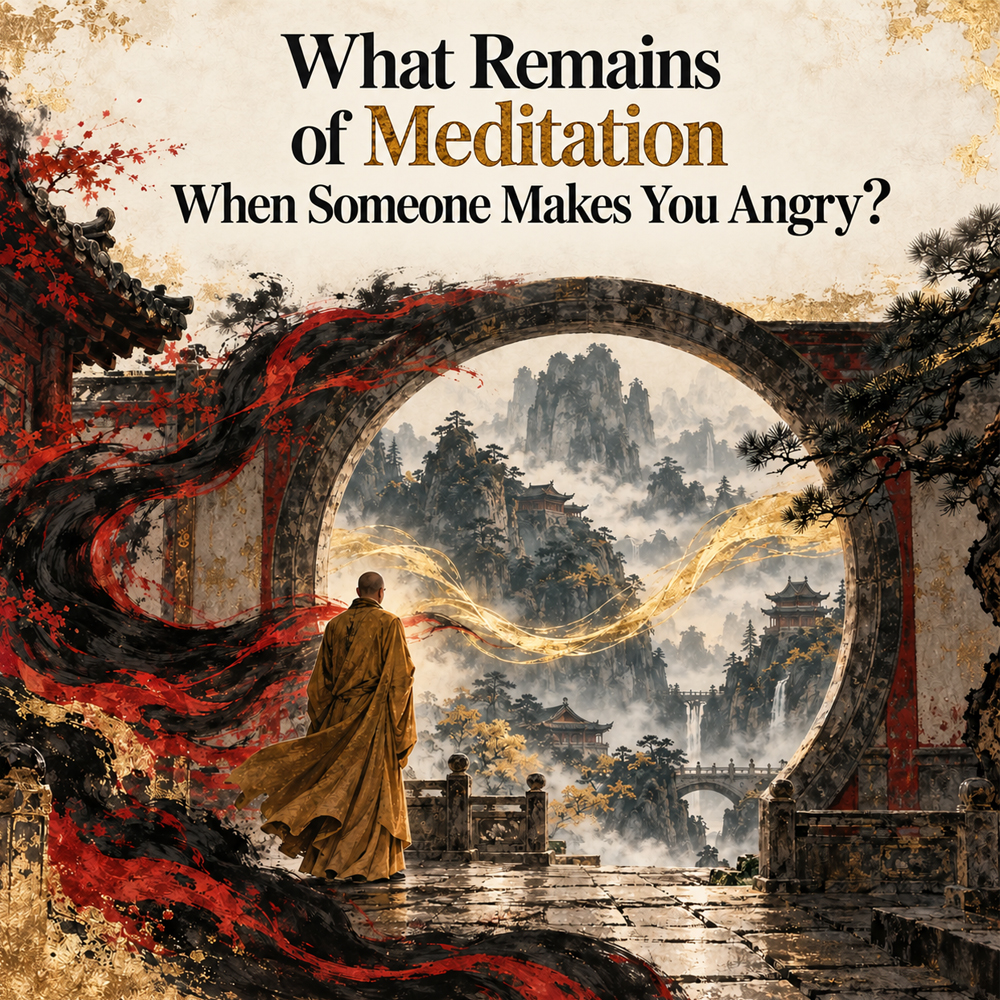
Part One: The Calm That Disappears at the First Test
Every morning, before the city had fully awakened, a man would sit on a small cushion beside his window and close his eyes. Meditation had become an inseparable part of his life, as natural as washing his face or taking his first sip of water after waking. For forty minutes, he observed his breathing, felt the air moving through his nostrils, and allowed thoughts to pass through his awareness without chasing after them. Over time, he had discovered a particular kind of peace in those early morning hours, when no one demanded anything from him, no one challenged his opinions, and no one disturbed the silence. He felt more balanced, more aware, and closer to that state of inner freedom he had read about in the writings of Eastern spiritual teachers.
One morning, after an especially pleasant meditation session, he rose from his cushion with the feeling that he had accomplished something significant. His mind was quiet, his body relaxed, and the world seemed unusually harmonious. As he prepared breakfast, he remembered the words of a Buddhist teacher who had said that true peace does not depend on external circumstances. He smiled, because it seemed to him that he was finally beginning to understand this teaching not merely intellectually, but through direct experience. He was convinced that he was gradually freeing himself from his old reactions and from the irritation that had once overwhelmed him so easily.
Later that same day, a colleague made a dismissive remark about his work in front of the other employees. The comment was brief, delivered almost casually, but it carried enough irony to provoke an uncomfortable laugh among those present. The man felt his face growing hot, his jaw tightening, and a familiar tension rising in his chest. Before he realized what was happening, he was already responding sharply, reminding his colleague of his own mistakes and shortcomings. The conversation turned into an argument, the argument into an exchange of accusations, and the peace of his morning meditation vanished so suddenly that it seemed never to have existed.
That evening, when he returned home, he sat down on his cushion again, but this time he could not immediately close his eyes. The scene from the office kept replaying in his mind, accompanied by new arguments he could have used and imaginary conversations in which he finally proved himself right. What troubled him most was not his colleague’s behavior, but the contradiction between the person he believed himself to be and the person who had emerged in that moment. How was it possible to spend so much time meditating, to understand the principles of mindfulness, and still lose control because of a few words? For the first time, he asked himself a question far more important than how long he could remain motionless with his eyes closed: what is the value of inner peace if it exists only when no one disturbs it?
Silence Is Not Proof of Freedom
There is a fundamental difference between the calm that arises under favorable conditions and the freedom a person develops in relation to their own reactions. The first is a state that emerges when distractions diminish, attention settles, and the body gradually releases its habitual tension. The second is the ability to remain aware even when circumstances provoke powerful emotions, when someone accuses us unfairly, or when the words of a loved one touch a painful place within us. Meditation can support the development of both, but one does not automatically lead to the other. A person can achieve remarkable concentration in silence and still remain helpless in the face of their own wounded pride.
Imagine someone who spends hours studying navigation, learns every rule of sailing, and can explain with impressive precision how to respond during a storm. While standing safely on land, his knowledge appears complete, because no wave threatens his balance and no sudden gust of wind demands an immediate decision. But when he ventures into the open sea for the first time and the horizon disappears behind towering waves, he discovers the difference between knowing the principles and being able to apply them. The sea does not invalidate what he has learned; it reveals which parts of that knowledge have become genuine skill. In the same way, difficult relationships do not make meditation meaningless; they reveal how deeply it has penetrated beyond the protected environment of practice.
This is one reason spiritual traditions do not regard meditation merely as a technique for producing pleasant experiences. In Buddhism, mindfulness, ethical conduct, and wisdom are interconnected aspects of the path, rather than separate achievements that can exist independently of one another. In Zen, everyday actions carry particular importance because understanding is not measured solely by experiences during seated meditation. The way a person speaks, listens, works, and responds to discomfort also belongs to the field of spiritual practice. If the mind remains peaceful only when life conforms to its preferences, it is still dependent on the very conditions it seeks to transcend.
Here, a subtle trap appears, one into which people who have devoted years to inner work can easily fall. They gradually begin to identify with the idea that they are calm, patient, and spiritually mature individuals. This image becomes part of their identity and begins demanding protection just as insistently as their professional authority or social standing. When someone questions their wisdom, they do not experience those words merely as an opinion, but as a threat to the image they have constructed of themselves. Thus, a practice intended to weaken attachment to the ego quietly becomes yet another reason for the ego to feel important.
Why Can an Ordinary Remark Shake Us So Deeply?
Two people can hear exactly the same words and react in completely different ways. One accepts the remark calmly, considers it, and continues with the day, while the other feels anger rising within them, an anger that remains long after the conversation has ended. The difference lies not only in the words themselves, because their meaning is filtered through personal history, expectations, fears, and self-perceptions. A criticism can deeply affect someone who has spent an entire lifetime trying to prove that they are capable enough. The same criticism will have a different impact on someone who does not connect their personal worth so strongly to the approval of others.
Imagine a woman who has spent years striving to be flawless in everything she does. As a child, she received the most attention when she achieved excellent results, and gradually began to perceive mistakes as evidence of personal inadequacy. As an adult, she is responsible, disciplined, and respected, but beneath that apparent confidence remains the fear of disappointing others. One day, her partner points out that she has forgotten something entirely insignificant, and she reacts as though she has been accused of complete incompetence. His words belong to the present moment, but the intensity of her reaction comes from a meaning that began taking shape long before this conversation.
This does not mean that every irritation originates in childhood or that every unpleasant emotion conceals a deep psychological trauma. People become angry for entirely understandable reasons, when their boundaries are violated, when they are treated unfairly, or when they encounter open disrespect. Yet the intensity, duration, and direction of a reaction often reveal more than the immediate situation. Particularly revealing are those moments when we continue arguing internally with someone who left the room long ago. The external conflict has ended, but the mind continues to sustain its emotional life.
It is precisely in these moments that meditation can acquire a significance extending far beyond calming the nervous system. Instead of trying to eliminate an unpleasant feeling immediately, the practitioner learns to investigate how it arises and develops. They begin to notice how a sentence produces a thought, how the thought becomes a judgment, how the judgment awakens physical tension, and how that tension creates the desire to act. Gradually, they discover that between what happened and their reaction lies an entire internal process that usually goes unnoticed. This discovery matters because it is difficult to change what we cannot see.
The Moment We Stop Listening
At the beginning of many conflicts, people are still discussing a specific problem. One believes a particular decision was wrong, the other defends the reasons behind it, and both have an opportunity to understand something new. But at a certain point, the actual subject of the conversation fades into the background, and another, stronger need emerges. What matters is no longer so much what actually happened, but who will be acknowledged as right, who will preserve their dignity, and who will give in first. Two people who were discussing a problem just a minute earlier suddenly begin defending themselves.
This transition is often so rapid that it goes unnoticed. A person continues to hear the other person’s voice, but is no longer listening with the intention of understanding what is being said. Instead, they prepare their next argument, search for weaknesses in the other person’s words, and wait for the right moment to interrupt. Even when the other person makes a reasonable point, it is perceived as an obstacle to overcome rather than information worthy of consideration. The conversation takes on the structure of a competition in which understanding seems less important than victory.
The body also participates in this transformation, often before the person has consciously recognized its significance. Breathing becomes faster or shallower, muscles tighten, the voice grows louder, and attention narrows around whatever is perceived as a threat. During intense emotional arousal, the ability to consider different perspectives and choose a thoughtful response can weaken. A person begins to experience their own interpretation as immediate reality rather than as one possible way of understanding what has happened. The more deeply they become involved in defending their position, the harder it becomes to notice that they are no longer reacting only to the words, but also to the story they are telling themselves about them.
This is where the practical value of mindful awareness becomes apparent. It does not require a person to stop feeling anger or pretend that an insult does not affect them. Its purpose is to make the process of reacting sufficiently visible so that the reaction itself is no longer the only possible course of action. When we notice tension in our jaw, the acceleration of our breathing, or the insistent desire to prove ourselves right, we receive information about the state we are in. If we can remain with that information even briefly, the conversation is no longer governed entirely by the initial impulse.
The Story of the Monk and the Empty Boat
In the Daoist text Zhuangzi, there is a parable about a man crossing a river in a boat. As he travels, another boat approaches and collides with his own, disturbing his peaceful journey. If he notices that the approaching boat is empty, he has no one to blame and generally does not experience the same irritation. But if he sees another person sitting inside it, he begins shouting for that person to be more careful, and when he receives no response, his anger grows. The collision is exactly the same, but the experience changes depending on whether the event is perceived as someone’s deliberate or negligent action.
The parable reveals a characteristic of human consciousness that easily remains hidden in everyday life. We react not only to events, but also to the intentions we attribute to the people behind them. When someone interrupts us, we assume they do not respect us; when someone arrives late, we decide that our time means nothing to them; and when someone fails to answer our message, we conclude that they are deliberately ignoring us. Sometimes these conclusions are justified, but at other times they are hasty interpretations of behavior whose actual causes we do not know. Nevertheless, our bodies and emotions react as though we have already established the truth.
The Daoist story does not teach that people bear no responsibility for their actions or that we should accept every violation without objection. It directs our attention toward the way our perception of another person’s intentions changes our inner state. Someone can inconvenience us through carelessness, exhaustion, misunderstanding, or deliberate disregard, and our reaction often begins before we have distinguished between these possibilities. The moment we decide that someone has intentionally humiliated us, we have already added an entire story about our own position in relation to that person. This story intensifies the emotion and frequently pushes us toward actions we later regret.
In relationships with loved ones, this happens especially often because familiar people carry the accumulated significance of countless previous experiences. A remark from a stranger may be forgotten within minutes, while the same words spoken by a parent or partner can awaken memories of years of misunderstanding. The present conversation becomes burdened with the weight of other conversations, some of which were never truly resolved. A person stops responding only to what they are hearing now and begins reacting to the entire history of the relationship. This is why the most difficult tests of mindfulness often appear not among strangers, but within our own homes.
Why Do the People Closest to Us Disturb Our Peace Most Easily?
A man may be patient with his colleagues, polite to strangers, and remarkably composed in tense public situations, yet lose his temper after a brief conversation with his mother. All it takes is for her to ask a familiar question about the way he lives, and he suddenly begins speaking with an irritation he does not entirely understand himself. If the same question came from a casual acquaintance, he would answer calmly or brush it aside with a smile. But when it comes from someone with whom he shares a long history, the question acquires a meaning that goes far beyond the literal words. In it, he hears not simply curiosity, but every previous occasion when he felt that his decisions were not accepted.
Close relationships have the power to activate deeply established patterns of behavior that have developed over many years. Within the family, a person learns early ideas about how attention is earned, how conflict is avoided, how disagreement is expressed, and what it means to be loved. Some of these ideas remain active long after the circumstances in which they developed have changed. This is why an adult who is completely independent in professional life can suddenly feel powerless again when speaking with a parent whose approval once seemed essential. They know they now have the right to make their own choices, yet their emotional response continues to follow the old pattern.
With romantic partners, another kind of vulnerability emerges, connected to the desire to be seen, understood, and accepted. The more important someone is to us, the more strongly their behavior can influence our sense of security. A forgotten promise, a careless tone, or a lack of interest in something meaningful can be experienced not merely as an isolated disappointment, but as evidence that we are not sufficiently valued. Then an argument about taking out the trash, a missed phone call, or arriving late becomes, in reality, an argument about recognition, closeness, and trust. The visible cause remains small, but the emotional stakes are enormous.
It is precisely here that we begin to understand why spiritual practice cannot be separated from the way we treat other people. It is easy to feel goodwill toward humanity as an abstract idea when no particular person is violating our expectations. It is far more difficult to maintain respect for the person standing before us when they refuse to agree with us, repeat a mistake, or fail to meet our needs. Abstract compassion does not require us to listen to unpleasant words, acknowledge our own shortcomings, or change comfortable habits. Real relationships demand all of these things, and that is why they reveal the limits of our understanding with such merciless precision.
The Spiritual Ego: When We Begin Taking Pride in Our Peacefulness
One of the greatest ironies of spiritual life is that a person can turn the pursuit of freedom from the ego into a new form of self-importance. They begin reading spiritual literature, attending practices, learning a new language for describing consciousness, and gradually constructing the belief that they see the world more deeply than others. Instead of openly considering themselves more intelligent or more successful, they begin to regard themselves as more aware, more peaceful, and freer from ordinary human weaknesses. The difference appears significant because their new self-image uses words such as humility, acceptance, and nonattachment. Yet the underlying need to feel special and stand above others remains untouched.
This condition becomes especially visible during conflicts, when spiritual concepts begin serving as weapons. Instead of listening to criticism, a person declares that the other is speaking from their ego. Instead of acknowledging that they have hurt someone, they explain that the other person simply lacks the awareness necessary to avoid taking offense. When confronted with anger, they present it as evidence of low spiritual development, without examining their own contribution to the situation. In this way, the language of inner freedom becomes a means of avoiding responsibility.
Imagine two friends, one of whom has practiced meditation for years, while the other has never shown much interest in spiritual teachings. During a conversation, the second friend explains that he felt neglected when his companion failed to keep an important promise. Instead of discussing what happened, the meditator calmly replies that suffering arises from attachment to expectations and that his friend must learn to accept reality. His words sound philosophical and his tone remains gentle, but behind this apparent composure lies a refusal to acknowledge that his own behavior has had consequences. He does not raise his voice, does not display irritation, and yet shows no genuine understanding.
Situations like this reveal why outward calm is not a sufficient measure of spiritual maturity. A person can speak softly and still be cruel, use polite words while humiliating someone, or maintain a smile while dismissing another person’s feelings. Conversely, someone can express anger clearly and firmly without losing respect or seeking to cause pain. The difference is determined not only by the intensity of the emotion, but by the intention, awareness, and responsibility with which it is expressed. Maturity does not consist of never appearing upset, but of remaining honest and humane when we are upset.
This raises an uncomfortable question that spiritual practice sooner or later places before every serious practitioner. Do we meditate to understand our own consciousness more deeply, or to become the person we want others to believe we are? Does our calmness make us more capable of hearing another person’s pain, or do we use it as proof that we stand above that pain? Are we willing to acknowledge our own mistakes when they contradict our image as conscious and enlightened individuals? The answers are not found in the beautiful thoughts that arise during meditation, but in the actions that follow when someone tells us something we do not want to hear.
The First Real Discovery: Anger Is Not Failure
After the incident with his colleague, the man from the beginning of our story continued meditating, but his relationship with the practice gradually began to change. Previously, he had measured his progress through the duration of his concentration, the pleasant sensation of silence, and his ability to let thoughts pass without following them. Now he began noticing other things he had previously dismissed as unwanted disturbances. He discovered his impatience when meditation did not unfold according to his expectations, his irritation when someone interrupted his practice, and the hidden satisfaction he felt when comparing himself to people who could not sit quietly for even ten minutes. For the first time, he began seeing not only the states he was striving to achieve, but also the mechanisms through which he created suffering for himself.
The most significant change occurred when he stopped treating anger as proof that his meditation had failed. He understood that the emotion itself did not cancel out the awareness he had been developing, just as the appearance of pain does not prove that someone lacks understanding of their own body. Anger is part of human emotional life and can signal violated boundaries, injustice, unmet needs, or perceived threats. The problem arises when a person fails to distinguish the feeling from the action and allows the first impulse to determine their behavior. Feeling anger and being controlled by anger are two different things.
This distinction allowed him to look at his reaction in the office from a new perspective. Instead of blaming himself again for not being spiritual enough, he began investigating what exactly he had experienced at the moment of the remark. He discovered that beneath the anger lay a fear of appearing incompetent in front of his colleagues, and beneath that fear was a powerful need to be respected. He had been defending his professional dignity, but he had done so in a way that further damaged his relationship with the other person. This understanding did not excuse his behavior, but it showed him where his attention truly needed to be directed.
He also realized something else he had overlooked in his pursuit of constant peace. Genuine inner work does not mean replacing every unpleasant emotion with a pleasant one, nor does it mean reaching a state in which other people’s words can never affect us. It means developing enough clarity to understand what is happening within us, enough courage to acknowledge our weaknesses, and enough freedom not to turn every feeling into an action. Anger was no longer an enemy to be destroyed, but an experience that could be understood without being blindly followed. And just as he began to accept this truth, the next and far more difficult challenge appeared before him: how to remain aware not after the conflict, when everything has already ended, but in the very moment when someone presses the most painful buttons within him.
Part Two: Between Anger and the Freedom to Choose
The following week, the man from our story once again found himself in an unpleasant situation. He had prepared a detailed proposal for a new project and was presenting it to his colleagues when the same person with whom he had argued a few days earlier interrupted him with a critical remark. This time, the comment was not particularly harsh, but its tone carried the familiar condescension that had provoked his intense reaction before. He felt his stomach tighten, and an answer immediately formed in his mind, sharp enough to put his colleague in his place. For a moment, all his attention was drawn toward the desire to strike back.
But this time, something different happened. As his colleague continued speaking, he noticed the tension in his shoulders, his accelerated breathing, and the persistent thought that someone was once again trying to humiliate him. He could not eliminate the irritation or transform the unpleasant experience into calmness. Instead, he remained still for a brief moment and allowed the feeling to be present without immediately turning it into words. When he finally responded, his voice still carried some tension, but he asked a question about the specific objection rather than attacking the person who had raised it.
At first glance, what happened did not seem like a significant spiritual achievement. There was no sudden enlightenment, no feeling of boundless compassion, and no mystical experience of unity with all living beings. There were only a few seconds during which the man managed to notice his own reaction before it became an action. Yet those few seconds contained something that forty minutes of morning silence could never guarantee on their own. For the first time, he had carried his awareness from the meditation cushion into the very heart of conflict.
This change reveals one of the most essential practical meanings of mindfulness. A person does not acquire the freedom to choose their reactions simply by wishing to remain calm, because powerful emotions often arise before conscious decisions can be made. But they can gradually learn to recognize the early signs of emotional arousal and create the conditions for a more thoughtful response. Sometimes this means remaining silent, sometimes asking a question, and at other times firmly stating that certain behavior is unacceptable. Freedom does not consist of a single correct reaction, but of the ability not to be limited to the initial impulse.
Why Suppressed Anger Is Not Inner Peace
In a Buddhist monastery, a young novice decided that the time had come to free himself completely from anger. He had read extensively about compassion and patience and had concluded that a truly spiritual person should never experience irritation. So he began carefully monitoring every reaction, and whenever he felt dissatisfaction, he immediately tried to replace it with a noble thought. When other monks interrupted his work, he smiled, and when he was assigned unpleasant duties, he bowed his head and assured everyone that he was grateful for the opportunity to practice patience. Gradually, he began taking pride in the fact that no one could make him angry.
One day, an older monk noticed that the young novice seemed unusually tense despite his constant smile. When he asked whether something was troubling him, the young man replied that he had overcome anger and no longer allowed such feelings to arise in his consciousness. The older monk continued asking questions, gradually challenging the novice’s understanding of spiritual practice. The novice insisted that he was completely calm, but his voice grew increasingly sharp and his face slowly turned red. Finally, when the elder once again questioned his achievement, the young monk exploded and accused him of deliberately trying to provoke him.
This illustrative story reveals a distinction that is often lost behind the outward appearance of calmness. Not showing anger does not necessarily mean understanding it, and refusing to allow unpleasant feelings into consciousness is not the same as becoming free from their influence. Suppression requires a continuous effort to deny or conceal inner experience, while mindfulness involves a willingness to see that experience without immediately resisting it. A person who constantly forbids themselves from becoming angry often begins to feel additional shame about the very fact that anger arises. Thus, the original irritation is joined by a new internal conflict between the actual experience and the ideal image toward which the person is striving.
In everyday relationships, suppressed anger rarely remains completely invisible. It can manifest through coldness, sarcasm, withdrawal, passive resistance, or seemingly polite remarks that carry hidden accusations. A person assures their partner that everything is fine, but for the next several hours refuses to engage in conversation, responds with single words, and creates an atmosphere of tension. When asked what is wrong, they insist that they are not angry, because they themselves do not want to acknowledge the feeling. As a result, the conflict does not disappear; it simply moves from open conversation into a space where it becomes even more difficult to understand.
Meditation offers a different approach, one in which emotion is not treated as a moral deficiency requiring immediate correction. The practitioner learns to observe anger as a combination of bodily sensations, thoughts, judgments, and impulses that change over time. They may feel heat in their face, tension in their abdomen, or the urge to raise their voice without concluding that these sensations define who they are as a person. This attitude does not justify destructive behavior; it creates the possibility of preventing it. To take responsibility for how we express our anger, we must first acknowledge that we feel it.
When the Body Understands Before the Mind
On the evening after his second confrontation with his colleague, the man decided to reconstruct the experience in his memory, but this time he did not focus on the words. He tried to remember what he had felt immediately before the desire to retaliate appeared. The first thing he discovered was a slight tightness in his chest, followed by tension in his neck and a sensation of warmth around his ears. Only after these bodily signals had appeared did the clear thought emerge that his colleague was once again trying to humiliate him. This observation showed him that an emotional reaction does not necessarily begin with a fully formed sentence in the mind.
The human nervous system continuously processes information about the surrounding environment and the condition of the body. When a situation is evaluated as threatening or significant, changes may occur in heart rate, muscle tension, breathing, and the distribution of attention. These processes are not entirely separate from thinking, but much of their activity unfolds without conscious intention. This is why a person can sense that they are upset before being able to explain precisely what has affected them. The body does not possess a mystical ability to know the truth, but it provides important information about how we are experiencing a situation.
Within this lies a practical opportunity that is often overlooked. When an argument has already reached its most intense point, it becomes difficult to assess all our thoughts and motives clearly. But if we are accustomed to noticing the bodily signs of emotional arousal, we can recognize rising tension while it is still developing. Consciously relaxing the shoulders, taking a few slower breaths, or briefly interrupting the conversation can help reduce the automatic nature of the reaction. This is not a magical technique that eliminates every powerful emotion, but a way of supporting our capacity for self-regulation.
It is especially important not to turn this process into yet another demand for perfection. There is no guarantee that we will notice every change in our bodies or always respond in the most reasonable way. Sometimes anger will move faster than awareness, and sometimes accumulated exhaustion, anxiety, or prolonged stress will make self-control considerably more difficult. But every recognition of our own state creates an opportunity to learn, whether it happens before the reaction, during it, or immediately afterward. Gradually, practice changes not the fact that we experience emotions, but our relationship with them.
Patience Does Not Mean Allowing Others to Hurt You
Among the most widespread misunderstandings surrounding spiritual teachings is the idea that an aware person must accept every kind of behavior with endless calmness. According to this interpretation, every objection is a sign of ego, every boundary indicates insufficient compassion, and every firm response proves that a person is still controlled by anger. Such an interpretation turns spirituality into an exercise in helplessness and creates the dangerous impression that kindness requires abandoning self-respect. But there is a fundamental difference between nonviolence and passivity. A person can refuse to be humiliated without humiliating someone else.
Imagine a woman who works under a manager known for his harsh treatment of employees. For months, she tries to remain calm when he raises his voice, makes unfair accusations, or belittles her work in front of others. She is convinced that meditation should help her remain unaffected by other people’s words, and therefore interprets every feeling of irritation as a personal failure. Instead of recognizing her manager’s behavior as a problem requiring action, she directs all her attention toward her own inability to remain undisturbed. Gradually, she begins using spiritual practice to adapt to conditions that are genuinely hurting her.
One day, she realizes that her pursuit of calmness has deprived her of something essential: the right to express her boundaries clearly. The next time her manager raises his voice, she does not respond in the same tone, but states that she is willing to discuss her mistakes only in a conversation based on mutual respect. He reacts with irritation, and she feels intense tension because she is not accustomed to standing up to authority figures. Nevertheless, she manages to remain consistent and later documents what happened, seeking assistance through the appropriate procedures. Her calmness no longer means enduring everything, but acting reasonably without allowing fear or the desire for revenge to determine her decisions.
This distinction is especially important when interpreting Buddhist patience, which in classical teachings is not reduced to unconditional submission. Patience includes the ability to endure difficulties, refrain from nurturing destructive hatred, and preserve clarity under unfavorable circumstances. It does not require a person to approve of injustice or remain in relationships that systematically violate their dignity and safety. Compassion for others does not cancel compassion for oneself, just as nonviolence does not eliminate the need for protection. The real challenge is to distinguish decisive action from the impulse to inflict pain in response to our own pain.
Compassion for the Person Who Irritates Us
In spiritual literature, compassion is often portrayed through images of sages who meet the suffering of others with boundless kindness. Such stories are inspiring, but they can easily create the impression that compassion is a natural state of someone who has reached a certain level of development. In real relationships, however, compassion requires effort, because the other person is not always pleasant, grateful, or willing to respond with the same understanding. Sometimes they are irritable, unfair, arrogant, and convinced that we are the cause of all their problems. At that point, compassion ceases to be a beautiful feeling and becomes a difficult question of how to see the human being behind unpleasant behavior.
Consider the story of two brothers who have maintained a tense relationship for years. The older brother has always been regarded as the successful and responsible one, while the younger has often felt that he lives in his brother’s shadow. At family gatherings, their conversations easily turn into competitions, with one displaying his achievements and the other responding with sarcastic remarks. Both are convinced that the problem lies in the other’s character, and every new conflict reinforces this belief. Over time, they stop meeting as two grown men with different life experiences and begin seeing each other only through the familiar roles of childhood.
During one family gathering, the older brother once again hears a cutting remark about his work and feels the familiar urge to respond with superiority. But this time, he notices something that had previously remained hidden behind his irritation. He remembers how often their parents compared them and how praise directed toward one brother sounded like criticism of the other. For the first time, he manages to see his brother’s sarcasm not only as an attempt to hurt him, but also as part of a lifelong struggle for recognition. This does not make the remark any more pleasant, but it changes the way he understands the person standing before him.
Compassion begins precisely with such a change in perspective, without requiring us to deny our own experience. Instead of seeing only the person who has offended us, we begin to recognize someone who carries their own fears, limitations, and unspoken needs. This does not mean that we must accept every explanation as an excuse or assume responsibility for someone else’s behavior. It means that we can understand the causes of an action without agreeing with it. When we manage to make this distinction, hatred no longer appears to be the only possible response to the pain we have experienced.
But compassion has another side that is often overlooked. Sometimes the most compassionate action is not to remain close to someone, but to end a destructive pattern of relating. If we continually accept another person’s insults, manipulation, or violations of our boundaries, we are not necessarily helping them change. In certain situations, clear disagreement, refusal to participate, or distance is more responsible than endless patience. Compassion is not an obligation to maintain relationships at any cost, but the ability to act without unnecessary cruelty, even when the decision is difficult.
Why Does the Need to Always Be Right Make Us Unhappy?
There is a particular kind of satisfaction that a person experiences when they prove they were right. It appears at the moment when the other person runs out of arguments, when the facts confirm our position, or when someone acknowledges their mistake. Within reasonable limits, the pursuit of truth is necessary, because without it conversations become arbitrary exchanges of opinions. But when being right begins to determine our personal worth, every disagreement becomes a threat that must be eliminated. At that point, we are no longer searching for truth, but for confirmation of our own importance.
This attachment appears even in the smallest everyday situations. Two partners argue about who left the window open, who forgot to buy something, or what exactly was said the previous evening. The original problem is insignificant and could be resolved in minutes, but the conversation gradually acquires enormous emotional importance. Neither wants to give in, because yielding begins to feel like an admission of weakness. In the end, they may spend an entire evening in silence over an issue they will barely remember the following day.
In such moments, people rarely realize the price they are paying for victory. They may prove that they were factually correct, but lose the closeness they shared before the conversation. They may force the other person into silence, but that silence does not mean they have achieved understanding. They may win an argument that leaves both people feeling humiliated, exhausted, and even more distant from each other. When the need to be right becomes stronger than the desire to understand one another, relationships gradually begin to resemble a continuous struggle for dominance.
Meditation can help us recognize this mechanism because it teaches us to observe thoughts without automatically identifying with them. A thought can appear completely convincing and still contain incomplete information, an incorrect judgment, or personal bias. When we learn to see our own opinions as mental content rather than as an untouchable part of our identity, disagreement becomes less threatening. This does not mean abandoning our convictions or treating all perspectives as equally valid. It means preserving the ability to examine our own conclusions even when the ego insists that we already know everything necessary.
The Art of Listening When You Disagree
An elderly teacher once gave his student an unusual exercise. Instead of increasing his meditation time, the student was to spend the following days speaking with people whose views differed sharply from his own. The condition was simple: he had to listen to each person until they had finished speaking before beginning to formulate a response. The student accepted the task confidently, believing that years of practice had already given him mastery over his attention. But during his very first extended conversation, he discovered how difficult it was to listen to someone when every sentence provoked the desire to object.
As the other person spoke, arguments, judgments, and comparisons continually arose in the student’s mind. He noticed inaccuracies in the other person’s words, recalled examples that contradicted them, and impatiently waited for the opportunity to demonstrate his own understanding. Although he remained outwardly silent, inwardly he was engaged in a fierce debate that left almost no room for truly receiving what was being said. Only when he recognized this process did he understand why his teacher had assigned precisely this exercise. Its purpose was not to change his beliefs, but to reveal how strongly the desire to defend himself controlled his attention.
True listening requires more than physical silence. It involves a willingness to temporarily set aside our own conclusions in order to understand how another person arrived at theirs. This does not mean accepting their opinion or abandoning critical thinking. It means refusing to let a prepared response replace genuine understanding. When we listen in this way, we sometimes discover that fear lies behind harsh words, insecurity behind insistence, and an experience we have never considered behind disagreement.
Such listening also has practical value in resolving conflicts. A person who feels genuinely heard often becomes more capable of listening to another perspective, although this does not happen in every situation. When, instead of responding with an accusation, we ask a question about the other person’s specific experience, the conversation can shift from mutual defensiveness toward clarifying the problem. Sometimes it turns out that the two people are using the same words with different meanings, or that each has made mistaken assumptions about the other’s intentions. The conflict then begins to lose some of its intensity, not because someone has won, but because both have understood more.
The most difficult part of this exercise, however, appears when the person facing us does not show the same willingness. They may interrupt us, distort our words, or continue insisting on their position regardless of how attentively we listen. At that point, the temptation arises to conclude that our effort was pointless and that the only reasonable response is to return to our old way of arguing. But the value of mindful listening is not determined solely by the other person’s behavior. It is also an exercise in our own ability to remain clear, recognize the limits of a conversation, and decide when continuing it serves a meaningful purpose.
Admitting Your Mistake Without Losing Your Dignity
A few days after the second conflict at the office, the man from our story had an opportunity to speak privately with his colleague. They needed to discuss a specific work-related issue, but the tension from their previous encounters still lingered between them. As they talked, the man realized that part of the criticism he had interpreted as a personal attack had actually been justified. There really was a weakness in his proposal that he had failed to notice, and his desire to protect his authority had prevented him from examining it calmly. This discovery confronted him with a choice that proved more difficult than controlling his anger.
He could remain silent about the mistake, minimize its importance, or redirect the conversation toward his colleague’s unpleasant tone. Each of these approaches would allow him to preserve at least part of the feeling that he had been entirely right. Instead, he acknowledged that the objection had merit and explained how he intended to revise his proposal. He then calmly added that the way the criticism had been expressed in front of the others had made a constructive discussion more difficult. To his surprise, his colleague also admitted that he could have approached the situation more respectfully.
The conversation did not suddenly turn them into close friends or eliminate all the differences between their personalities. But it changed something essential in the way they perceived each other. Instead of defending their images as flawless professionals, they managed to separate the specific problem from their personal dignity. The man discovered that admitting a mistake did not make him less capable, just as someone else’s criticism did not automatically make him incompetent. He had been protecting an image of himself that turned out to be considerably more fragile than his actual worth.
This is one of the most difficult insights that serious inner work can bring. A person spends an enormous part of life constructing an identity through abilities, beliefs, achievements, and relationships. When someone questions a single part of that identity, it can feel as though their entire being is under threat. But a mistake in one decision does not mean failure as a person, just as ignorance about a particular subject does not invalidate everything one has learned. The less dependent someone is on the need to always appear right, the more easily they can learn from their own shortcomings.
In this sense, humility is not the belief that we are less valuable than others. It is the ability to let go of the constant need to prove our importance without losing respect for ourselves. A humble person is not required to agree with everyone, accept unfair accusations, or minimize their achievements. They simply do not need constant confirmation that they are more intelligent, more aware, or more worthy than the people around them. It is precisely this inner independence that makes it possible to acknowledge the truth even when it does not flatter our image of ourselves.
Meditation Begins Again After the Argument Ends
Despite his progress, the man continued to have days when he reacted impulsively, raised his voice, or said things he later regretted. The difference was that he no longer used these moments as reasons for endless self-blame. Instead, he began paying attention to what happened after a conflict, when the immediate emotion gradually weakened and clearer judgment became possible. He discovered that this was precisely when the mind often created new justifications, exaggerated the other person’s mistakes, and rearranged memories so that his own behavior appeared entirely reasonable. If he failed to notice this process, he could spend hours reinforcing the same hostility that had originally arisen in just a few seconds.
One evening, after an unpleasant conversation with a close friend, he sat in silence, but this time he did not try to push what had happened out of his mind. Instead of returning to his breathing whenever a memory of the argument appeared, he began carefully observing what happened when he recalled particular words. He noticed that remembering one specific remark brought the anger back, while imagining his own behavior from an outside perspective produced discomfort. Gradually, he realized that throughout the conversation he had wanted his friend to acknowledge how much he had done for him. Beneath the accusations and irritation lay a feeling of disappointment that he had been unable to express openly.
The following day, he contacted his friend and suggested that they talk again. This time, he did not begin by presenting evidence that he had been right, but by acknowledging that their previous conversation had gotten out of control. He explained what had hurt him without presenting his feelings as unquestionable proof of the other person’s guilt. His friend also shared his own experience, which turned out to be different from the assumptions formed during the argument. They did not resolve all their differences, but they managed to restore something more important than agreement: the willingness to meet each other without constant defensiveness.
In this way, the man began to understand that spiritual practice does not end the moment we lose our composure. Even when we fail to remain aware during a conflict, we can examine what happened afterward and take responsibility for the consequences. An apology, when sincere, does not erase the pain caused, but it can be the first step toward rebuilding trust. Acknowledging a mistake does not eliminate the need for change; it demonstrates a willingness to begin. In this sense, mindfulness manifests not only in the ability to prevent a destructive reaction, but also in the way we repair relationships after we have already allowed one to occur.
Over time, he stopped dividing his day into spiritual and ordinary moments. Conversations with colleagues, family misunderstandings, waiting in line, noisy neighbors, and disappointments involving loved ones gradually became situations in which he could observe his own mind. This did not mean that he began seeking conflicts or treating other people as instruments for his personal development. It meant that he no longer regarded difficult experiences as interruptions of spiritual practice, but as part of the reality in which that practice had to find its application. The silence of the meditation cushion remained valuable, but its meaning was gradually finding expression in the way he lived.
And yet, a deeper question remained before him, one that could not be resolved through techniques of self-control alone. Even when he managed to notice his anger, listen to others, and acknowledge his own mistakes, he continued to feel a powerful need for people to behave according to his expectations. He wanted his loved ones to understand him, his colleagues to be fair, strangers to show respect, and life to stop constantly testing his patience. Gradually, he began to realize that behind many of his disappointments lay not only the behavior of others, but also his own insistence that the world should be different from what it was. This question led him toward one of the deepest themes in Buddhist and Daoist philosophy: what does it mean to live among other people without turning our expectations into a constant source of suffering?
Part Three: True Meditation Begins When Life Refuses to Follow Our Wishes
One morning, the man from our story was running late for an important meeting. He had woken up on time, meditated for half an hour, and left home with a pleasant sense of clarity and inner order. But at the first major intersection, he found himself trapped in a traffic jam that seemed endless. The cars barely moved, drivers leaned on their horns, and the minutes continued slipping away. He glanced at his watch more and more frequently, feeling his calmness gradually give way to irritation.
At first, he blamed the other drivers, then the traffic management system, and finally his own decision to take that particular route. Thoughts about the unfairness of the situation filled his mind, along with judgments about how irresponsible people were for creating such problems. But as he sat motionless among the cars, he suddenly noticed something unusual about his own experience. The traffic jam was an unpleasant circumstance, yet a large part of his tension came from his continuous inner insistence that it should not be happening. He did not simply want the traffic to start moving; he was mentally fighting against the fact that, at that very moment, it had stopped.
Then he remembered something he had read in Buddhist teachings about suffering and attachment. Human beings do not suffer only because they encounter unpleasant circumstances; they often intensify their suffering through resistance to those circumstances. His desire to arrive on time was entirely reasonable, just as it was reasonable to look for another route or notify someone that he would be late. But his internal insistence that the present moment was unacceptable did not move the traffic forward by a single inch. It merely transformed an inconvenient situation into a prolonged psychological struggle.
This realization did not make the traffic jam pleasant, nor did it eliminate the consequences of being late. He still had to make a phone call, explain the situation, and deal with the inconvenience he had caused. But he stopped adding to the objective problem an endless stream of accusations, irritation, and imaginary arguments with people he did not even know. For the first time, he understood how often he tried to impose an invisible contract upon reality, according to which life was supposed to unfold in accordance with his preferences. And how much anger arose whenever reality refused to sign that contract.
The Difference Between Pain and the Suffering We Add to It
In the Buddhist tradition, there is a well-known teaching about the two arrows, presented in the Sallatha Sutta. The first arrow symbolizes the painful experiences that human beings encounter in life and cannot always prevent. The second arrow represents the additional suffering that arises through mental resistance, anxiety, and the reactions that accumulate around the original pain. The teaching does not claim that all suffering is imaginary or that people are responsible for the unpleasant events that happen to them. Instead, it directs attention toward the possibility of not transforming every painful experience into an even more prolonged inner torment.
Imagine someone who receives a harsh remark from a loved one. The initial pain arises from the words, the disappointment, and the feeling that trust between them has been damaged. But after the conversation ends, the person begins imagining what they should have said, remembering other occasions when they were hurt, and gradually developing the conviction that nobody ever understands them. A single unpleasant moment becomes evidence of the overall unfairness of their life. The first pain is connected to a specific event, while the additional suffering is sustained by the way the mind continues to expand upon it.
This does not mean that we should forget the harm done to us or abandon necessary action. If someone systematically humiliates us, the problem cannot be solved merely by changing our internal attitude. Sometimes an honest conversation, clear boundaries, support from others, or ending the relationship is necessary. But even when we take such actions, we can observe whether our thoughts help us understand the situation or simply reproduce the same pain over and over again. The difference between consciously examining a problem and endlessly reliving it is essential.
The man from our story began noticing this distinction most clearly in the evenings, when he was alone with the memories of his day. Sometimes he realized that a conversation had ended hours earlier, yet an entire imaginary courtroom proceeding was still taking place in his mind. He simultaneously played the roles of prosecutor, defense attorney, and judge, invariably reaching the conclusion that he had been treated unfairly. He then began asking himself whether his current thinking was leading toward a solution or merely keeping his anger alive. This question gradually helped him distinguish necessary reflection from the fruitless repetition of the same grievance.
When Acceptance Proves More Difficult Than Resistance
The word „acceptance“ often provokes distrust because it is easily associated with resignation. If we accept injustice, it seems as though we approve of it, and if we accept someone’s unpleasant behavior, it appears that we are giving them permission to continue. But in the context of mindfulness, acceptance has a different meaning. It represents a willingness to acknowledge the actual situation before deciding what to do about it. We cannot respond wisely to a reality whose existence we stubbornly refuse to recognize.
For years, a woman had been trying to change her father’s character. He was a reserved man who struggled to express affection and almost never spoke openly about his feelings. During every visit, she hoped that this time he would show interest in her life, ask a personal question, or express appreciation for something she had accomplished. But their conversations invariably returned to practical matters, household problems, and brief comments about the weather. After each visit, she returned home disappointed because she had once again failed to receive the closeness she longed for.
Over time, the woman began to understand that her suffering had two distinct sides. One came from the real emotional distance between her and her father, which she could not simply eliminate through positive thinking. The other arose from her continuous expectation that he would suddenly become the person she had always needed him to be. She could not force her father to become more emotionally open, but she could stop building every encounter around the hope of his immediate transformation. This did not remove her sadness, but it gradually freed their relationship from some of the tension that had accompanied it.
Her acceptance also allowed her to recognize possibilities that had previously remained hidden behind disappointment. Instead of constantly waiting for her father to initiate difficult emotional conversations, she began expressing her own feelings and needs more clearly. Sometimes he responded awkwardly, other times he changed the subject, but on certain occasions he showed care in ways she had previously been unable to recognize. She realized that accepting his limitations did not mean abandoning her own needs. It meant relating to the actual person standing before her rather than constantly speaking to the image of the person he was supposed to be.
Within this lies one of the most difficult forms of inner freedom. We have the right to desire change, express our needs, and decide which relationships are good for us. But we do not possess control over the character, thoughts, and decisions of other people. The more intensely we try to control what does not depend on us, the more easily we turn closeness into a struggle. Acceptance begins where we stop confusing our own desires with promises that the world is obligated to fulfill.
The Mirror Nobody Wants to Look Into
In a Zen-style story, retold in various modern versions, a student complained to his teacher that the people around him constantly disturbed his peace. He spoke about noisy neighbors, rude merchants, and fellow monks who did not follow the rules as carefully as he did. The teacher listened attentively and asked whether he would be peaceful if all those people disappeared. The student replied that only then would he finally be able to devote himself to genuine practice. The teacher pointed out that peace requiring the entire world to be removed was still not free from dependence on the world.
The meaning of such a story is not that people must live amid constant noise, tension, or mistreatment. It raises the question of how much our inner state depends on the belief that others are obligated to behave according to our preferences. A person can leave one place, change jobs, or end relationships, yet often carries the same internal patterns into the next environment. If they encounter nothing but incompetent, ungrateful, and unreasonable people everywhere they go, it becomes necessary to examine their own participation in these experiences. Not because they are necessarily wrong in every judgment, but because the persistence of a pattern deserves attention.
Everyday relationships function as a mirror precisely because they reveal qualities that can easily remain invisible in solitude. Someone who considers themselves generous discovers their attachment to possessions when another person asks for something valuable. Someone convinced of their own patience notices their impatience when a loved one repeats the same mistake. A person who believes they do not care about the opinions of others may experience intense pain when publicly disregarded. In such moments, the behavior of others does not necessarily create all our weaknesses, but it provides the conditions under which those weaknesses become visible.
This mirror, however, must not become a reason for endless self-blame. If someone behaves cruelly, the fact that we experience pain does not prove spiritual immaturity. If we are lied to, betrayed, or humiliated, we are not obligated to search exclusively for our own attachment as the cause of our suffering. Mindfulness requires us to see both our internal reactions and the actual behavior of others. It loses its clarity when it is used to deny injustice or to make the person who has been harmed solely responsible for what happened.
True self-knowledge emerges when we can hold these two truths simultaneously. The other person is responsible for their words and actions, while we are responsible for the way we choose to respond to them. Sometimes we discover that we have overreacted; at other times, we realize that we have tolerated something unacceptable for far too long. In both cases, awareness helps us distinguish the actual problem from the story that fear, pride, or old habits construct around it. It is precisely this ability that transforms relationships into a space for growth rather than merely a series of trials we must endure.
You Do Not Have to Like Everyone to Be Free
There is another idealized image of spiritual life according to which a truly aware person feels equal love toward everyone. In this vision, there is no room for personal preferences, irritation, or the desire for distance, because every difference in attitude is interpreted as a sign of insufficient development. But human relationships are far more complex than such an ideal. Some people inspire us, others exhaust us, with some we share values, while with others we struggle to find common ground. Acknowledging these differences does not necessarily mean experiencing hatred or contempt.
In the Buddhist tradition, loving-kindness, known as metta, does not require us to feel the same personal closeness toward everyone. Its purpose is to cultivate the intention that other beings be free from unnecessary suffering, even when we dislike them or do not wish to maintain close relationships with them. This is an essential distinction because it frees compassion from the obligation to become friendship. We can wish someone well without approving of their behavior, trusting them, or allowing them into our personal lives. Loving-kindness does not eliminate the need for sound judgment.
The man from our story gradually discovered this truth in his relationship with an old acquaintance whom he had continued meeting out of habit for years. Every conversation between them turned into a competition filled with mockery, comparisons, and concealed accusations. For a long time, he tried to remain calm and change the dynamic of their relationship, but his efforts produced no meaningful results. Eventually, he realized that he did not need to maintain the same degree of closeness merely to prove that he was capable of accepting difficult people. He began limiting their meetings without seeking revenge or turning his acquaintance into an enemy.
This decision brought him a different kind of peace from the one he experienced during meditation. It did not arise from the pleasant feeling that all his relationships were harmonious, but from the willingness to acknowledge that some relationships could not be that way. He stopped trying to obtain understanding from someone who showed no desire for mutuality. At the same time, he felt no need to constantly condemn the person or prove to others how badly he behaved. He had found a way to step back without turning distance into a continuation of the conflict.
This freedom is especially significant because much of human suffering arises not only from attachment to the people we love, but also from our inability to stop dwelling on those we dislike. We can spend hours thinking about someone’s arrogance, injustice, or foolishness, as though constant internal condemnation will somehow change their character. In this way, the person we do not want in our lives continues occupying an enormous amount of space in our minds. Freeing ourselves from this obsession does not mean forgetting what happened or excusing their behavior. It means no longer giving the conflict more attention than is necessary for its reasonable resolution.
The Day Meditation Stopped Being a Refuge
Months passed, and the man continued sitting every morning on the cushion beside his window. Outwardly, his life had not changed very much, because he still worked with the same people, encountered the same everyday difficulties, and occasionally found himself in unpleasant conversations. But his relationship with meditation had become different. Previously, he had regarded it as a place where he could withdraw from the complexity of the world and discover a state that everyday life continually disturbed. Now he was beginning to understand it as an exercise in seeing clearly, one that mattered precisely because life was not continuously peaceful.
One evening, he returned home after an especially difficult day during which he had made a professional mistake and had an unpleasant conversation with someone close to him. He felt exhausted, disappointed, and somewhat irritated by his own behavior. Out of habit, he sat down to meditate, hoping to free himself from the unpleasant feelings, but soon noticed that he was trying to use the practice as a way to escape what had happened. Instead of observing his mind, he was insistently demanding that it become peaceful. Then he understood that even the pursuit of inner peace could become another form of resistance to the present moment.
This time, he did not try to change his experience. He remained seated, feeling the exhaustion in his body, the unpleasant thoughts, and the desire for the day to have unfolded differently. He did not blame himself for being insufficiently aware, but neither did he excuse the words he had spoken. He simply observed how different feelings appeared, changed, and gradually lost some of their intensity. On that ordinary evening, he discovered that meditation did not require him to become a different person before he could begin understanding himself.
The following morning, he called the person close to him and acknowledged that their previous conversation had been painful for both of them. He did not use spiritual concepts, explain his behavior through psychological mechanisms, or attempt to present his mistake as a necessary lesson in personal development. He simply took responsibility for what he had said and listened to how the other person had experienced the situation. The conversation was awkward and at times difficult, but it contained more sincerity than many of their previous attempts to maintain superficially good relations. At that moment, the man understood that the most important result of meditation does not always manifest in the silence of the mind, but in the willingness to be honest when the truth is uncomfortable.
Enlightenment Is Not an Escape from Being Human
In many spiritual traditions, there is a danger that profound teachings will be interpreted as a promise of a state in which a person will no longer experience ordinary human difficulties. The seeker imagines that after enough years of practice, they will stop feeling fear, anger, disappointment, and pain caused by the behavior of others. They begin measuring their progress by how rarely they experience unpleasant emotions, as though spiritual development were the gradual elimination of everything human. But such an ideal can easily become a new source of dissatisfaction. The more intensely a person strives never to be upset, the harder it becomes to accept the inevitable moments when they actually are upset.
Buddhist teachings on nonattachment do not require us to stop loving, feeling, or participating in life. They direct our attention toward the way we cling to experiences, identities, and expectations, turning them into conditions for our own well-being. Being unattached to peace does not mean ceasing to value it, but refusing to fall into despair whenever it is disturbed. Being unattached to our own correctness does not mean abandoning truth, but remaining capable of recognizing it even when it contradicts our beliefs. Being unattached to a particular image of ourselves means allowing self-knowledge to become more important than self-defense.
This transformation has consequences that extend far beyond personal calmness. Someone who is not constantly afraid of appearing weak is more capable of admitting a mistake. Someone who does not perceive every disagreement as a personal threat can participate in difficult conversations without turning them into struggles for dominance. A person who understands their own fears and vulnerabilities can more easily recognize similar experiences in others. In this way, inner work gradually becomes an ethical relationship with the world rather than remaining confined to personal experience.
Here, one of the deepest meanings of spiritual maturity becomes apparent. It is not measured by the ability to always appear calm, nor by the number of hours spent meditating. It manifests in the way we treat people when we are tired, disappointed, offended, or in disagreement with them. It appears in the willingness to listen when we would rather interrupt, to acknowledge a mistake when we want to justify ourselves, and to establish a boundary when fear urges us to remain silent. These are not spectacular spiritual experiences, but it is precisely through them that inner understanding begins to acquire genuine value.
What Remains When Calmness Disappears?
One day, long after the first conflict at the office, the man from our story was once again interrupted during an important conversation. The person speaking to him was impatient, challenged his words, and clearly showed no desire to listen until he had finished. He felt the familiar irritation, the tension in his body, and the impulse to respond in a way that would put the other person in their place. Nothing about that moment resembled the peace he experienced in the morning with his eyes closed. And yet something essential was different.
He was no longer afraid of anger itself arising. He did not regard it as proof of failure, did not try to forcefully eliminate it, and felt no need to pretend that he was unshakable. He recognized the emotion as part of his present experience and understood that it did not oblige him to follow every impulse it produced. So he managed to express his disagreement clearly, ask not to be interrupted, and continue the conversation without turning the other person into an enemy. His calmness had been disturbed, but his ability to choose had not disappeared along with it.
This was the answer to the question that had troubled him at the beginning of his journey. What remains of meditation when someone makes you angry, when they insult you, or when life refuses to unfold according to your expectations? What remains is the ability to notice what is happening within you before turning the experience into an irreversible action. What remains is the possibility of listening to another person without abandoning your own position, and defending your boundaries without seeking revenge. What remains is the willingness to acknowledge your mistakes, repair the harm you have caused, and continue learning without demanding impossible perfection from yourself.
But something even deeper remains, something that cannot be reduced to techniques for managing emotions. Gradually, a person begins to understand that others do not exist to maintain their peace, confirm their beliefs, or fulfill their expectations of proper behavior. They have their own fears, desires, weaknesses, and limitations, just as we do. This understanding does not eliminate conflicts, but it changes their meaning, because instead of constantly seeing the other person as an obstacle to our own happiness, we begin recognizing an encounter between two complex human beings. In such an encounter, there is room for disagreement, pain, and disappointment, but also for respect, responsibility, and understanding.
On the final evening of our story, the man once again sat beside the window, just as he had done hundreds of times before. Outside, the city continued to hum, cars passed along the street, and somewhere in the neighboring apartment, a lively conversation could be heard. He closed his eyes and directed his attention toward his breathing, without expecting any special experience and without setting himself the goal of becoming a better person than he had been that morning. He knew that the following day would bring new difficulties, that someone would disappoint him, and that he himself would not always act correctly. But he no longer regarded this imperfect reality as an obstacle to his practice.
Because he had understood something that cannot be revealed through long hours of silence alone. The true value of meditation does not lie in the promise that no one will ever make us angry again, but in the freedom not to transform every irritation into suffering for ourselves and those around us. It does not free us from the necessity of living among differences, disagreements, and unpredictable circumstances, but teaches us to be present within them with greater clarity. And when someone once again touches the most painful place within us, the question is no longer whether we will feel anger, but what we will do with it. For meditation does not reach its deepest meaning when the world falls silent, but when, amid its noise, we manage to remain awake to our own actions.
And then a person understands that the most important part of the practice was never limited to the cushion, closed eyes, or peaceful breathing. It was present in every conversation in which they had to choose between pride and understanding, between revenge and dignity, between automatic reaction and conscious action. All the people who had made them angry, all the situations that had disrupted their plans, and all the moments in which they had confronted their own weaknesses had shown them something that silence alone could not reveal. They had brought them face to face with that part of themselves that still needed attention, honesty, and understanding. And in that encounter, imperfect, uncomfortable, and profoundly human, meditation had finally ceased to be merely something they practiced and had begun to become a way of life.
Author: Vasil Stoyanov