
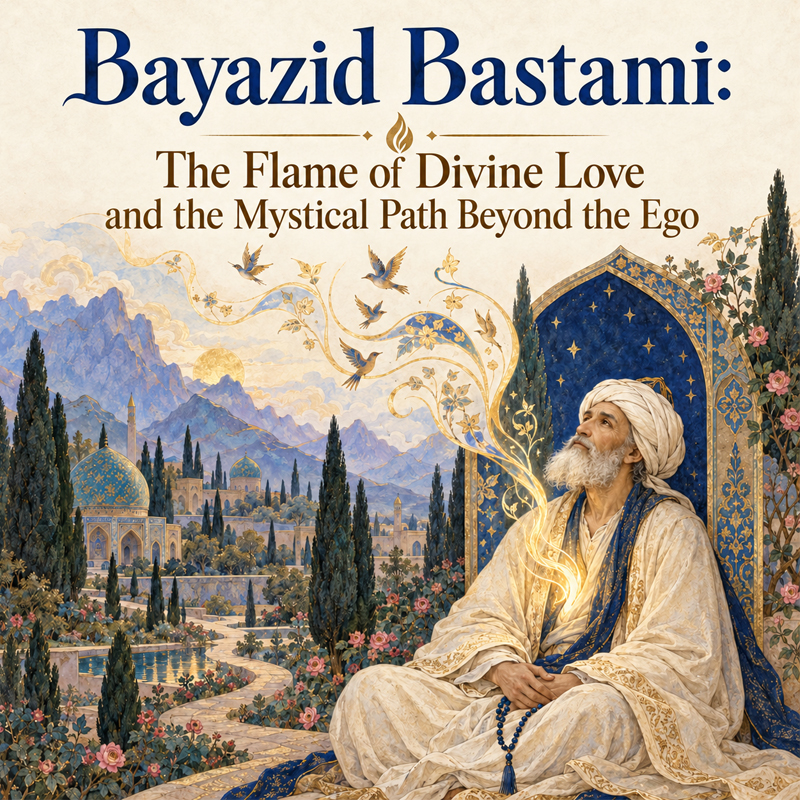
In the history of Sufism, there are figures whose words resound like thunder and whose lives resemble a flame consuming everything false. Among them, Bayazid Bastami occupies an extraordinary place. He did not leave behind a systematic philosophy written in treatises of his own. He left something harder to forget: traditions about a man who turned his entire existence into a longing for God, and sayings that continue to inspire admiration, astonishment, and profound reflection.
Abu Yazid Tayfur ibn Isa al-Bistami, known as Bayazid Bastami or Bayazid Bistami, was one of the great early Persian mystics of Islam. His name is associated with the town of Bistam, in the historical region of Qumis, in present-day Iran. His life is traditionally placed in the ninth century. In Sufi memory, he is called Sultan al-Arifin - the Sultan of the Knowers of God. This title does not signify worldly authority. It expresses reverence for the depth of his spiritual experience.
To write about Bayazid is to enter a world in which language repeatedly reaches its limits. His paradoxical exclamations, rigorous self-discipline, devotion to his mother, and stories of his encounters with others form the portrait of a mystic for whom the greatest obstacle between the human being and God is the self-absorbed ego. Historical evidence and later Sufi narratives belong to different kinds of testimony. By distinguishing them, we can appreciate both the man of history and the grandeur of his spiritual image.
Bistam: The Town Where an Extraordinary Name Arose

Bistam lies in the northeastern Iranian world, a region where, during the first centuries of Islam, a rich local culture encountered religious scholarship, ascetic movements, and new forms of spiritual inquiry. It is here that Sufi tradition places the beginning of Bayazid’s journey. Later writers describe him as a man whose name became inseparable from the quest for immediate awareness of the divine presence.
The lives of early mystics are not documented in the same way as those of modern public figures. Accounts of Bayazid have reached us through later Sufi writings, biographical collections, and transmitted narratives. Among the important authors who preserved his image are Abu Nasr al-Sarraj, al-Qushayri, al-Hujwiri, and Farid al-Din Attar. They wrote in different periods and for different purposes. The sayings attributed to Bayazid must therefore be read as part of a transmitted mystical tradition, not as verbatim transcripts of his conversations.
The historical man and the spiritual image do not cancel each other out. The first belongs to the ninth century; the second continues to live in Sufi memory. A community preserves such stories not simply to report events. It tells them to illuminate the meaning of humility, sincerity, love, and freedom from vanity.
The Sultan of the Knowers: Greatness Without an Earthly Crown

The title Sultan al-Arifin sounds majestic, yet it contains a remarkable paradox. In Bayazid’s spiritual world, greatness is not measured by power over other people. It is measured by the depth of a person’s freedom from the desire to be praised. The knowledge spoken of by the Sufis is not merely the ability to recite religious concepts. Marifa - spiritual knowledge or gnosis - denotes a transforming relationship with God, associated with inward awareness and experience.
Bayazid became a symbol of this radical transformation. His words offer no convenient way to decorate the personality with spiritual prestige. They demand the opposite: a person must recognize how insistently the ego intrudes even into the most devout actions. It wishes to be seen, acknowledged, and elevated above others. That desire itself becomes a barrier.
Bayazid’s greatness lies in the uncompromising honesty of this vision. He does not turn spirituality into a collection of beautiful ideas. He presents it as a trial of the very feeling of personal importance. In Sufi tradition, his image reminds us that the most difficult adversary does not always stand before us. It speaks from within, often in the voice of our pride.
The Most Difficult Journey: From the Self Toward God

One of the well-known sayings attributed to Bayazid expresses the entire drama of his path. It describes years of searching as a process in which the seeker discovers that his own self has become the obstacle to what he seeks. The motif appears in different forms across Sufi sources and translations. Its central meaning remains the same: liberation from the self-absorbed ego is the essential spiritual labor.
“For twelve years, I was the blacksmith of my own self.”
The image of the blacksmith is extraordinarily powerful. Iron does not take shape without fire, blows, and perseverance. In the same way, character is not transformed simply through admiration for beautiful teachings. It demands work with habits, with the impulse to justify ourselves, and with the constant desire to occupy the center of every event. In Sufi vocabulary, this struggle is associated with the training of the nafs - the ego or lower inclinations, understood within the spiritual anthropology of Islam.
Here Bayazid reveals exceptional psychological insight. Pride can hide behind humble words. The desire for recognition can dress itself in the garments of service. Even the aspiration toward holiness can become another form of self-admiration. Genuine discipline does not end when a person begins to appear spiritual. At that point, it becomes more necessary than ever.
His Mother’s Cup of Water: The Holiness of a Small Act

Among the most moving traditions about Bayazid is the story of his mother. It is told that one cold night she asked him for water. Bayazid went to fetch it, but when he returned, she had fallen asleep. Rather than wake her, he stood beside her with the cup in his hand until morning. In some versions, the cold was so severe that the water froze or his hand became numb. The significance of the story does not lie in that physical detail, but in his decision to place care above personal comfort.
All night, Bayazid stood with a cup of water beside his sleeping mother. He would not disturb her rest. He greeted the dawn still standing, for his care for her was stronger than his exhaustion.
This story places spiritual greatness in the most ordinary domestic scene. There is no miraculous display, no ecstatic speech before a crowd. There is a son, a mother, and a cup of water. That is precisely where its beauty resides. The tradition reminds us that devotion to God does not cancel our duties toward other people; it gives those duties greater weight.
Respect for parents holds a special place in Islamic ethics. The story of Bayazid expresses this value through an unforgettable image. It is also a warning against a spirituality that dreams of heavenly mysteries while neglecting the needs of the person nearby. True greatness is not recognized only in extraordinary words. It is revealed in the willingness to remain beside someone when no one is watching.
Shathiyat: When Mystical Experience Shakes Language

Bayazid is particularly famous for his shathiyat - paradoxical mystical exclamations that sound daring and disrupt ordinary religious language. The most celebrated among them is the expression “Glory be to me!”, transmitted in Arabic tradition as Subhani. It causes astonishment because praise, in Islam, belongs to God. Taken as ordinary personal boasting, the words would contradict the very idea of humility.
“Glory be to me! How great is my majesty!”
Sufi interpreters understand such exclamations within the context of spiritual intoxication - sukr - and an experience in which ordinary self-awareness recedes. In this interpretation, the speaker is not glorifying his earthly personality but expressing a state in which the personal ego has lost its customary dominance. This is an interpretation within the Sufi mystical tradition, not a literal assertion that a human being becomes God.
It is precisely the tension between the language of religious norms and the language of mystical experience that makes Bayazid so significant. His words raise a question that crosses the centuries: how can an experience be expressed when the very concepts of speaker and speech appear to have been shaken? One of the great themes in the history of mysticism is that the most intense experience often gives rise to the most extraordinary language.
Fana: The Passing Away of the Ego, Not the Destruction of the Human Being

In Sufi thought, the concept of fana refers to the passing away, disappearance, or effacement of certain qualities of ordinary self-awareness in the relationship with God. Different authors explain it differently, and it cannot be reduced to a single psychological technique. Bayazid became one of the emblematic figures of this radical relinquishment of self. In the traditions surrounding him, the personal desire to possess spiritual experience appears as the final obstacle.
Fana does not mean that the human body ceases to exist or that moral responsibility disappears. In classical Sufi discussions, it is connected with a transformation in the relationship to one’s own actions and with the overcoming of self-admiration. Later authors frequently discuss baqa - abiding in God - as a complementary concept. Different schools developed distinct interpretations of these states.
Our admiration for Bayazid rests on the uncompromising force with which he confronts the question of the ego. A person can renounce possessions, honors, and comforts while retaining the most concealed possession of all: the image of oneself as exceptional. The Sufi path embodied in Bayazid’s image does not allow that image to remain untouched.
The Story of the Knock at the Door

Sufi literature contains parables about a seeker who stands before the divine door and must overcome the very notion of “I” before being admitted. Such narratives have circulated in different forms and have been associated with more than one mystic. They are not verifiable episodes from Bayazid’s biography, but they illuminate the spiritual theme with which his name is closely connected.
The seeker knocked at the door. “Who is there?” asked a voice. “It is I,” he replied. The door remained closed. When he returned, he no longer carried the proud “I” before him.
The parable is poetic rather than a description of a physical door. It reveals the paradox that the seeker’s greatest obstacle is the insistence on being separate, important, and acknowledged. As long as a person wishes to stand before God displaying personal merits like trophies, the spiritual quest remains bound to vanity.
The strength of this story lies in its brevity. It does not settle every theological question surrounding mystical union. Instead, it offers an image that penetrates directly into human experience. How often do we seek love, knowledge, and recognition while actually demanding that the world confirm our own greatness? Bayazid compels us to face this question without comfortable excuses.
Miraj: The Heavenly Journey of Mystical Language

In some narratives associated with Bayazid, his spiritual experience is presented through images of ascension and passage through heavenly spheres. This literary language belongs to the broader Islamic context of the Prophet Muhammad’s night journey and ascension, yet Sufi authors also employ it to describe inward states. In the traditions about Bayazid, the journey is not an ordinary account of movement through space. It is a dramatic picture of leaving behind everything that confines a human being within a limited conception of the self.
These accounts are important as mystical literature. They are not geographical descriptions of heaven or historical diaries of a physical journey. Their purpose is to convey, through images, an experience represented as surpassing everyday language. Heavenly heights, light, and the crossing of barriers therefore become symbols of inner transformation.
In the traditions of his heavenly journey, Bayazid passes beyond the images of earthly greatness. The higher the spiritual narrative rises, the less room remains for the glory of the traveler.
Bayazid is majestic precisely because his image allows Sufi tradition to speak of spiritual courage through the language of a cosmic adventure. His journey is not the conquest of foreign worlds. It is liberation from the desire to possess the world - and even from the desire to possess one’s own holiness.
The Search for Sincerity: When Devotion Becomes a Test
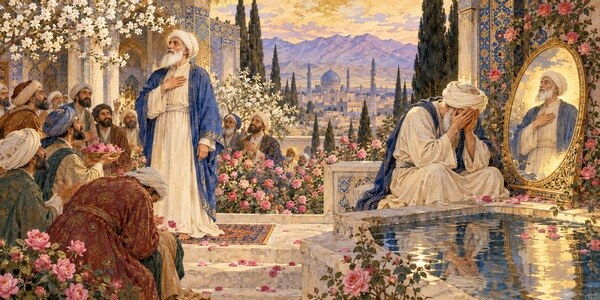
One of the most demanding themes in early Sufism is sincerity, known as ikhlas. A person can perform religious acts, speak beautifully about humility, and observe outward forms while inwardly seeking the admiration of others. In that case, devotion becomes an instrument for affirming the ego. The traditions about Bayazid repeatedly return to the danger of such spiritual complacency.
This theme is remarkably contemporary. In a world where every achievement can easily be transformed into a public image, spiritual discipline can also become a stage. Bayazid reminds us that the true value of an action is not exhausted by how it appears to others. Intention, inward honesty, and the consequences for those whom the action concerns are what matter.
Admiration for him does not arise from the idea that he stood beyond human weakness. It arises from the way Sufi memory portrays him as a man relentlessly attentive to it. His spiritual ideal is not to appear holy. It is to stop using holiness as evidence of personal superiority.
Why His Words Disturb and Inspire at the Same Time
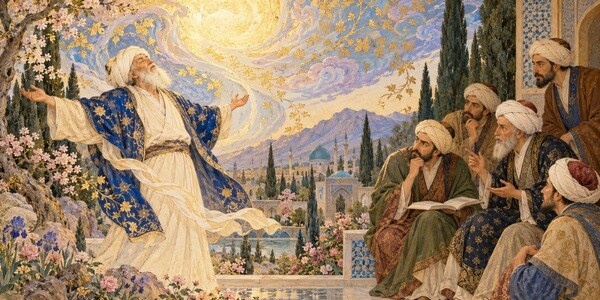
Bayazid’s mystical language has always required interpretation. On the one hand, Islamic tradition clearly distinguishes the Creator from creation. On the other, Sufi descriptions of spiritual intoxication employ expressions in which the ordinary sense of a separate “I” seems to dissolve. Here lies the tension that makes his exclamations so famous.
Some authors explain such words as spoken in a state of ecstasy, when the speaker no longer commands ordinary means of expression. Others insist that mystical language must remain subject to religious norms. This is no minor disagreement. It reveals how early Sufism developed its own boundaries and sought to reconcile profound inward experience with Islamic theology and practice.
To admire Bayazid does not mean concealing this tension. On the contrary, it reveals his historical significance. His words are not harmless ornaments of a spiritual biography. They belong to a serious conversation about the limits of human language, the meaning of humility, and the possibility of an experience that exceeds the concepts through which we try to describe it.
Bayazid and Junayd: Intoxication and Sobriety

The history of Sufism often contrasts two ideal ways of expressing spiritual experience. Bayazid became an emblem of sukr - mystical intoxication - while Junayd of Baghdad is associated with sahw - spiritual sobriety. This distinction does not mean that one lacked discipline or the other lacked depth. It describes different styles through which Sufi tradition understands the relationship between experience and its expression.
In Bayazid, language erupts in paradox. In Junayd, the spiritual state is associated with the recovery of clarity and measure. Later Sufi writers use this comparison to discuss how a mystic should live among people after an intense inward experience. The question is not merely what he has seen, but how he treats others, how he speaks, and how he bears responsibility for his words.
This comparison reveals the richness of Sufism. It is not a single stream of ecstatic exclamations. It contains different temperaments, methods, and theological emphases. Bayazid holds his unique place not because everyone must speak as he did, but because his image demonstrates one of the most extreme possibilities of mystical language.
Attar and the Immortality of the Spiritual Story
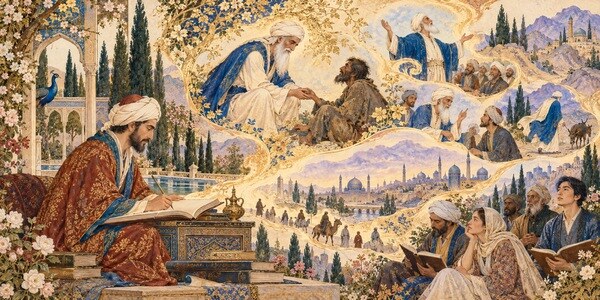
The Persian poet and mystic Farid al-Din Attar played an enormous role in preserving the images of the early Sufi saints. In his Tadhkirat al-Awliya, commonly known as Memorial of the Saints, Bayazid appears as one of the most compelling spiritual exemplars. Attar did not write modern critical biography. He created spiritual literature in which episodes were selected and narrated to convey moral and mystical truth.
This explains why the traditions about Bayazid often contain brief dialogues, unexpected answers, and actions that overturn the reader’s expectations. What appears outwardly great proves insignificant, while an unnoticed act of mercy acquires enormous weight. Such stories educate the imagination. They compel us to reconsider what we call success, strength, and spiritual achievement.
Attar and the other authors did not merely preserve Bayazid’s name. They gave him a literary life that extended beyond his hometown and his century. In this sense, Bayazid belongs not only to the history of Islamic spirituality but also to the history of world mystical literature.
Humility That Seeks No Witnesses

The more extraordinary Bayazid’s ecstatic words sound, the more important the traditions about his humility become. Without them, his image would remain incomplete and could easily be misunderstood as a celebration of personal greatness. Sufi tradition, however, continually draws attention to the opposite: the genuine seeker must free himself from the desire to be placed above others.
In various instructive stories associated with early mystics, extraordinary abilities and miracles prove less important than moral honesty. Performing something that astonishes people is not the same as attaining spiritual perfection. What matters is whether one has become less proud, more compassionate, and more sincere. This hierarchy of values lies at the heart of Sufi ascetic literature.
Here Bayazid stands as a powerful challenge to every age that confuses the visible with the true. The deepest transformation does not always have an audience. It often occurs in the way a person responds to an insult, keeps a promise, or cares for someone from whom there is nothing to gain.
Love of God and the Limits of Human Speech
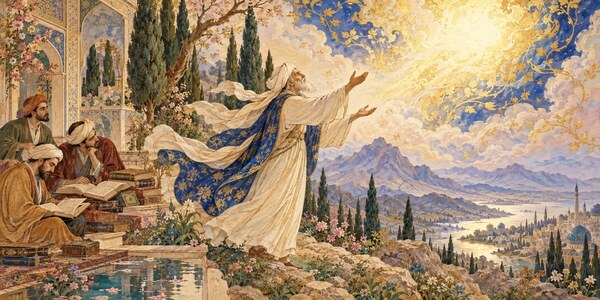
At the heart of Bayazid’s mystical image lies a longing for God that cannot be satisfied by outward knowledge alone. For him, as Sufi memory portrays him, spiritual seeking requires a person to be transformed in the deepest intentions. He does not merely seek information about the divine. He seeks a life in which his own pride no longer stands between him and the object of his devotion.
This is why his utterances often sound paradoxical. Ordinary language is designed to distinguish the speaker, the object, and the action. Mystical literature sometimes describes states in which these boundaries are experienced differently. Words no longer function as dry philosophical definitions. They become traces of a state that tradition portrays as exceeding ordinary self-awareness.
This is one reason Bayazid remains so compelling. He reminds us that spiritual texts should not always be read as lists of literal propositions. Some statements are prayers, others are exclamations, and still others are symbolic narratives. Distinguishing these genres is essential if we are to understand their power without distorting their meaning.
The Tomb and the Living Memory of Bayazid
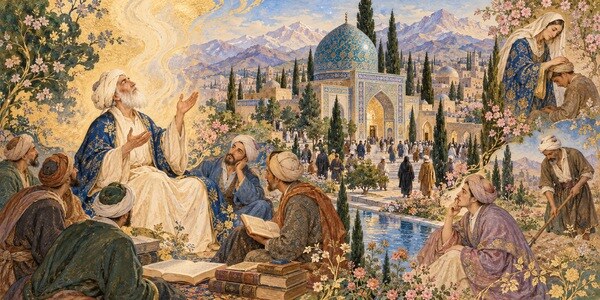
Bayazid’s name remains associated with Bistam, where a revered memorial and tomb complex stands. For generations of believers and visitors, this place has formed part of Iran’s spiritual geography. Architecture, memory, and local traditions turn the mystic’s name into a presence that continues to live centuries after his era.
Yet his true monument is not made of stone alone. It exists in books, oral narratives, poetry, and the unending discussion of his words. Some readers are drawn to the audacity of his mystical exclamations. Others discover in him an example of humility. Still others return to the stories about his mother and his rigorous work upon the ego.
This many-sided character is the mark of an extraordinary spiritual legacy. Bayazid cannot be exhausted by one quotation or confined within a single legend. He is a figure through whom Sufi tradition repeatedly asks what it means to love God without turning that love into another ornament of the self.
What Does Bayazid Teach Us Today?

In modern life, almost everything encourages us to construct an image of ourselves. We display our successes, defend our opinions, and constantly compare our worth with the achievements of others. Against this background, Bayazid appears both distant and astonishingly close. His path does not offer a new technique for building a more impressive “I”. It questions the very need to turn life into proof of personal importance.
The story of the cup of water reminds us that spirituality is tested through care. The image of the blacksmith teaches that character is forged through perseverance. The accounts of mystical intoxication reveal the limits of language and the danger of reducing complex spiritual experience to an easy slogan. The comparison with Junayd reveals the need to unite inward fire with responsibility for words and actions.
The most important lesson is simple but far from easy: humility is not the denial of human dignity. It is freedom from the constant need to be the center of everything. When that need weakens, more space remains for love, attention, service, and genuine knowledge. This is what makes Bayazid so worthy of admiration.
A Flame That Never Goes Out
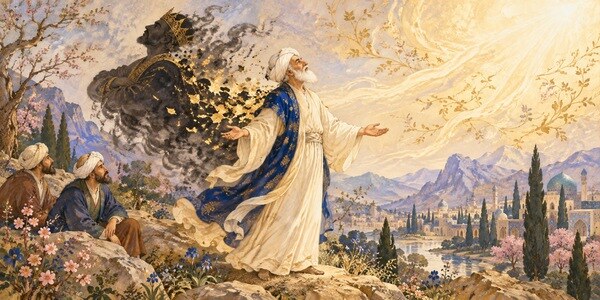
Bayazid Bastami belongs to those rare spiritual figures who do not allow the reader to remain indifferent. His words challenge, his stories move us, and his paradoxes refuse to submit to superficial understanding. He is a mystic of uncompromising effort and devotion - a man whose image in Sufi memory is built around one great task: to remove the proud “I” from the path of love for God.
Historical testimony and later legends must be read with different kinds of attention. The former lead us into the world of early Islamic mysticism, while the latter reveal how generations of Sufis understood his greatness. By distinguishing them, we do not lose the enchantment of the story. We discover its true depth: every tradition becomes a window into the spiritual values of those who preserved it.
His legacy is not an invitation to repeat daring exclamations without understanding their context. It is an invitation to something more difficult: to be sincere, to serve without display, to recognize self-love even when it disguises itself as virtue, and never to turn the spiritual path into a contest for superiority. This is why Bayazid continues to shine in the history of mysticism - not as an earthly ruler, but as the Sultan of those who placed the knowledge of God above their own glory.
Author: Vasil Stoyanov