
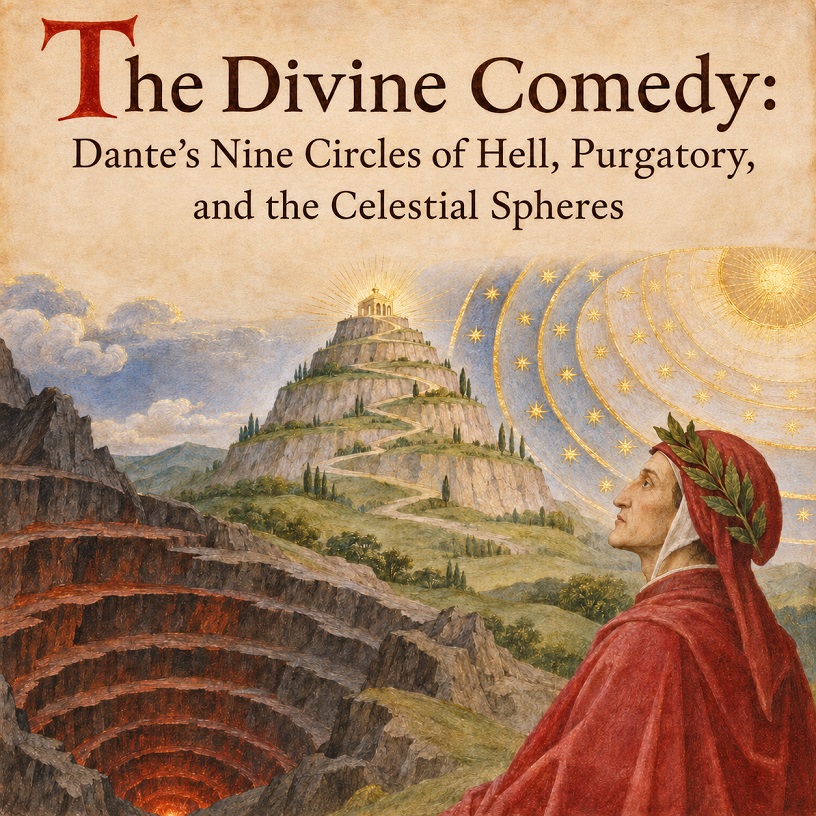
In the middle of his life’s journey, a man finds himself in a dark forest, having lost the straight path. From this simple and unforgettable image begins one of the most magnificent journeys in world literature. Before Dante Alighieri open the abysses of Hell, the mountain of Purgatory, and the radiant expanses of Paradise. Every encounter along this path reveals something about human will, love, sin, hope, and the striving for absolute truth.
The Divine Comedy is far more than a description of the afterlife. It is a grand poetic architecture in which history, theology, philosophy, astronomy, politics, and personal destiny become a single narrative. Dante creates a world whose spaces possess moral meaning: the deeper the descent into Hell, the more distorted love becomes; the higher the soul ascends, the more clearly its freedom emerges. And in the final cantos, language reaches a boundary beyond which only the radiance of the divine remains.
This is a journey through three realms and through the human being itself. Its true drama lies not only in monsters, flaming tombs, and heavenly lights. It arises from the question of whether a creature capable of cruelty and delusion can be transformed through knowledge, responsibility, and love.
Dante and the Creation of a Universe: Florence, Exile, and Sacred Poetry
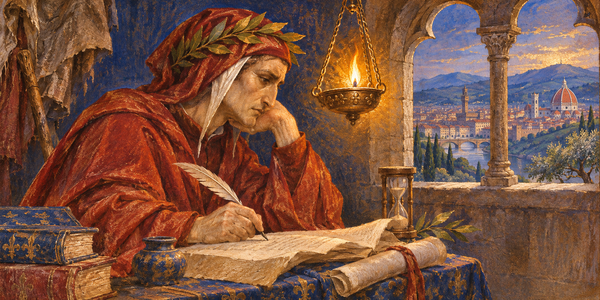
Dante Alighieri was born in Florence in 1265, when Italian cities were shaken by political struggles, commercial expansion, and intense intellectual life. Florence was at once a wealthy city, a theater of bitter rivalries, and a center of new literature in the vernacular. This environment shaped Dante as a poet, thinker, and participant in public conflict. His poetry never exists in the airless space of abstract mysticism. It bears the marks of the streets, councils, families, and political passions of his native city.
In his youth Dante became associated with the poetic movement known as dolce stil novo, the sweet new style, in which love for a woman acquired spiritual and philosophical significance. Especially important was Beatrice, who became a central presence in his early work Vita Nuova, or New Life. She was not simply a beloved woman praised according to literary convention. In Dante’s writing, her image gradually became a sign of grace, spiritual insight, and the possibility that earthly love could direct a person toward a higher reality.
The poet’s fate changed dramatically in 1302, when political conflicts led to his exile from Florence. Dante never again returned as a free citizen to his native city. Exile meant the loss of home, political standing, and immediate belonging. Yet it also created an extraordinary perspective. Removed from Florence, the poet began to see its struggles as part of a broader moral crisis affecting Italy, the Church, and humanity as a whole.
The Comedy was composed during the first decades of the fourteenth century, and Dante died in Ravenna in 1321. The designation Divine became established later in the work’s history. The term comedy did not mean an amusing story in the modern sense. It pointed toward a work beginning amid suffering and confusion but ending in a fortunate resolution. From the dark wood to the vision of God, the composition follows a movement from error toward truth.
The choice of the Tuscan vernacular was historically decisive. At a time when Latin retained immense authority in scholarship, Dante created a universal poem in the language of a living community. This choice contributed to the later development of the Italian literary language. It also possessed profound artistic meaning: the highest philosophical and theological questions could be expressed through speech capable of naming both the stars and ordinary human pain.
The poem is divided into three parts-Inferno, Purgatorio, and Paradiso-known as cantiche. Each contains thirty-three cantos, while Inferno has an additional introductory canto, bringing the total to one hundred. The number three appears everywhere: in the three realms, the verse form called terza rima, and numerous compositional correspondences. This mathematical harmony reflects the medieval Christian vision of a world ordered by divine reason.
The narrative is symbolically set in the spring of 1300, when Dante is about thirty-five years old. This age marks the midpoint of the traditionally understood human lifespan. The poet turns his own biography into a universal scene. Dante the traveler is a particular Florentine with his own fears and political loyalties, but he also represents anyone who has lost direction and must seek the path toward the true good.
One of the great secrets of the Comedy’s power is the encounter between the personal and the universal. Actual historical figures, mythological heroes, philosophers, rulers, friends, and enemies of the poet appear within it. Their destinies are placed inside an otherworldly system, yet their voices remain recognizably human. Dante does not write an impersonal catalog of sins. He creates dramatic encounters in which each soul defends, laments, or reveals its own life.
The Dark Wood and the Gates of Hell: The Beginning of the Descent
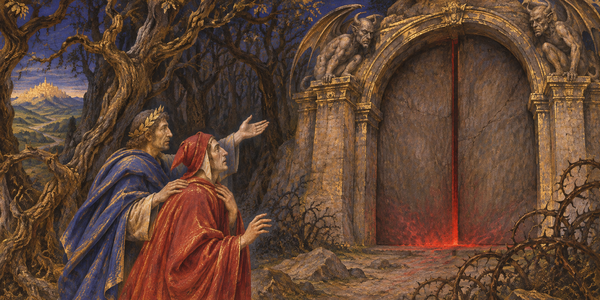
The opening scene is among the most famous in European literature. Dante stands in a dark wood, having lost his way. The forest has no geographical name. It is a space of spiritual disorientation in which a person no longer understands how he arrived there. Error does not necessarily begin with one spectacular crime. It can begin with gradual deviation, a weakening of attention, and an inability to distinguish the right direction.
When the poet sees an illuminated hill and attempts to climb it, three beasts block his path: a leopard, a lion, and a she-wolf. They have received different interpretations throughout the long commentary tradition, as images of sinful tendencies, social vices, and spiritual obstacles. Their shared function matters most: they make an immediate ascent impossible. Dante cannot simply choose the light and reach it. First he must understand the nature of his own confusion.
Then Virgil appears, the great Roman poet and author of the Aeneid. In the Comedy he is simultaneously a historical literary predecessor, a symbol of human reason, and a guide familiar with the lower realms. His presence expresses Dante’s immense respect for classical culture. The Christian poet does not destroy the ancient inheritance; he incorporates it into his spiritual architecture while also defining the limits of knowledge attainable without revelation and grace.
Virgil explains that the road to salvation passes through Hell and Purgatory. He has been sent through heavenly intervention involving Beatrice and other blessed figures. This is essential: the journey does not begin as a self-confident conquest of unknown territories. It is a response to help arriving from beyond the lost person’s own strength. Reason will guide him, but love and mercy have prepared the saving movement itself.
Above the gates of Hell stands an inscription ending with the famous warning that those who enter must abandon hope. From this point onward, space follows a different logic. Hell is not a chaotic cavern filled with arbitrary punishments. It is a rigorously organized moral world in which each location expresses a particular distortion of the human will.
Before the river Acheron lies Hell’s vestibule, inhabited by those who never decisively chose either good or evil. They pursue an empty banner endlessly while insects torment them. Their punishment expresses the spiritual emptiness of a life without responsible commitment. Dante does not place them among the grand rebels but in a realm of obscurity. Indifference does not produce genuine freedom; it leaves a person without a face or direction.
The ferryman Charon carries souls across Acheron. His image comes from ancient mythology but serves the poem’s Christian vision of the afterlife. This synthesis characterizes Dante: pagan myths, Roman history, and medieval theology participate in one poetic system. The river’s boundary separates the living world from the place where human choices have acquired their final moral form.
Dante’s descent also serves a purpose of knowledge. He must learn to witness suffering without confusing compassion with approval of destructive choices. His reactions change from canto to canto. Sometimes he weeps, sometimes he feels horror, and sometimes anger. Virgil instructs, corrects, and leads him onward. Inferno is therefore not only a gallery of punishments but a school of moral vision.
The First Five Circles: From Limbo to the River of Wrath
The first circle is Limbo, the dwelling of virtuous non-Christians and those who, within the medieval theological system, did not receive baptism. Here there are none of the bodily torments characteristic of the lower circles. Instead, there is deprivation of the fullness of divine presence. The souls live with dignity and nobility, but without hope of attaining heavenly bliss. For modern readers this image raises difficult questions about justice and the boundaries of religious belonging. For Dante it forms part of the theological horizon of his time.
In Limbo Dante encounters great figures of antiquity, including Homer, Horace, Ovid, Lucan, Aristotle, and other thinkers and poets. They inhabit a noble castle surrounded by symbolic defenses. The scene reveals Dante’s double attitude toward classical culture: it is a source of greatness and reason, yet within the poem’s religious framework it does not possess the fullness of saving revelation on its own.
The second circle contains the lustful. Here souls are carried without rest by a violent wind, just as in life they allowed passion to carry them beyond reason’s authority. Among them Dante encounters Francesca da Rimini and Paolo. Their story of love awakened through reading a chivalric romance is among the most moving episodes in the poem. Francesca speaks with elegant eloquence, and her tragedy inspires such intense sympathy that the traveler faints.
This scene reveals the danger of beautiful self-justification. Francesca describes love as a force that seems to remove personal responsibility. Her words are emotionally persuasive, but precisely here Dante raises the distinction between powerful feeling and free choice. Human tragedy is not erased by moral judgment. The poem allows readers both to sympathize and to recognize the destructive consequences of passion.
The third circle is reserved for gluttons. Beneath an unending filthy rain they lie in mud while the monstrous Cerberus tears at them. Pleasure transformed into life’s sole purpose is reduced to degrading materiality. Dante speaks with Ciacco, who discusses political conflict in Florence. Thus even the circle of bodily excess becomes a place for reflection on the disintegration of civic community.
The fourth circle brings together hoarders and squanderers. They push enormous weights against one another and exchange accusations. These opposing extremes have a common root: a disordered relationship with material goods. Some refuse to use wealth according to its proper purpose; others waste it without measure. Through colliding burdens, Dante shows how opposite vices can arise from the same inability to maintain rational order.
Here the question of Fortune also arises-the power distributing earthly goods and altering the positions of individuals and nations. Virgil explains its place in the divine order. People frequently treat wealth and authority as lasting proofs of their own importance. Yet political and material circumstances change. Dante employs the medieval conception of Fortune to reveal the instability of happiness built upon possession.
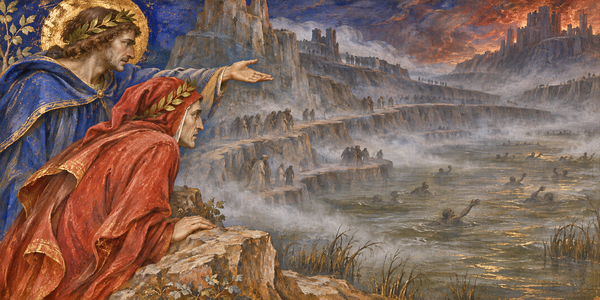
The fifth circle is associated with wrath and sullen resentment. In the swamp of Styx, the wrathful attack one another on the surface, while those who turned anger inward remain submerged in the mire. These forms reveal different manifestations of destructive passion: aggression directed at others and the inner suffocation of life through persistent bitterness. Wrath is not simply an intense emotion; here it is a lasting deformation of one’s relationship with the world.
The encounter with Filippo Argenti at Styx raises questions about Dante himself as a participant in the moral drama. Commentators have interpreted his sharp response to the condemned man differently. Does the traveler express righteous indignation, or does he still carry earthly hostility? The power of the scene lies in the poem’s refusal to portray its hero as an infallible observer. He must learn to distinguish personal passion from just judgment.
The first five circles reveal Dante’s immense psychological richness. Love, appetite, wealth, and anger are familiar to everyone. They are not in themselves alien to human nature. The problem arises when they lose their measure and proper direction. Hell begins with sins in which passion and weakness play a significant role before descending into more deliberate forms of evil.
The Sixth and Seventh Circles: Heresy, Violence, and the Destruction of Natural Order
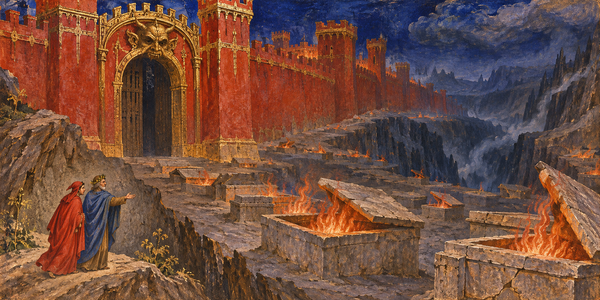
Beyond Styx rises the city of Dis, whose walls mark the passage toward the more serious regions of Hell. The scene is filled with demonic resistance, but the road opens through heavenly intervention. This episode has dramatic and theological significance. Reason, represented by Virgil, is an indispensable guide, but cannot overcome every obstacle through its own power. The journey requires assistance exceeding human capacities.
The sixth circle is a vast cemetery of burning tombs. Here Dante places heretics, among whom he encounters Farinata degli Uberti and Cavalcante de’ Cavalcanti. The conversation with Farinata is especially important to the poem’s political dimension. Even amid flaming sepulchers, Florentine conflicts continue to determine how souls speak of themselves. Farinata’s proud bearing preserves an impression of earthly grandeur but does not remove his tragic limitation.
The sixth circle also reveals the peculiar knowledge of the condemned. They can perceive certain distant events, yet their understanding of the present is limited. This unusual perspective underscores the incompleteness of their existence. They are fixed in a condition that permits no free development. Even knowledge, when separated from spiritual fullness, becomes a partial and painful gift.
The seventh circle is devoted to violence and divided into three rings. The first contains those violent against their neighbors: murderers, tyrants, and robbers, submerged in the boiling river Phlegethon. Centaurs guard them and shoot anyone who tries to rise above the assigned depth. The depth of immersion corresponds to the gravity of violence. The river of blood turns suffering inflicted on others into the very environment of punishment.
The second ring is a dark wood in which suicides have been transformed into trees and shrubs. Harpies tear their branches, and voices emerge from the wounds. Among these souls is Pier della Vigna, whose account of disgrace and despair lends the scene profound human sorrow. Here the poem expresses a medieval theological view of suicide that should not be transferred as a verdict upon people experiencing mental-health crises today. The episode’s artistic force lies in the image of a shattered relationship between the person and their own body.
Also in this ring are squanderers who violently destroyed their own resources and are pursued by savage dogs. Dante thus juxtaposes forms of destruction directed against the self and what has been entrusted to a person. Violence is not restricted to striking another human being. It includes acts that destroy one’s own existence or the means of responsible living.
The third ring is a burning desert beneath a rain of fire. Different groups are placed here according to the medieval classification of violence against God, nature, and human work. Among the figures encountered is Brunetto Latini, whom Dante respects as an intellectual mentor. The encounter demonstrates the poem’s complexity: its moral structure does not erase gratitude, memory, or personal attachment.
The seventh circle ends with preparations for the descent into the regions of fraud. Geryon appears, a monstrous creature with an apparently benign face and a dangerous body. His form anticipates the next level of evil. Violence operates through brute force; fraud uses the appearance of goodness to conceal destructive intentions. In this distinction Dante follows a philosophical logic in which the abuse of reason represents a particularly serious distortion of human nature.
The Eighth and Ninth Circles: Fraud, Betrayal, and the Frozen Heart of Hell
The eighth circle is called Malebolge and consists of a vast system of ten ditches. Here Dante places different forms of fraud, each accompanied by astonishing imagery. The first ditches contain pimps and seducers, then flatterers. Next come simoniacs, who traded in sacred offices; diviners and soothsayers; corrupt officials; hypocrites; thieves; fraudulent counselors; sowers of discord; and falsifiers. Their arrangement reveals the diversity of evil that employs intellect as an instrument of manipulation.
Especially powerful is the scene of the simoniacs, placed upside down in stone holes while flames burn their feet. Their punishment reverses the symbolism of spiritual service. Those who turned the sacred into an object of commerce are represented through humiliating inversion. Dante levels fierce accusations against corruption in the Church institutions of his time. His religious poem is not an uncritical celebration of authority; it is merciless toward those who exploit spiritual office for earthly gain.
In the ditch of the diviners, souls have their heads twisted backward and are forced to walk looking in the opposite direction. The image is directly related to their desire to penetrate the future improperly. In Dante, punishment often follows the principle of contrapasso-a correspondence, contrast, or ironic reversal between sin and consequence. This is not a mechanical formula applied identically everywhere but an artistic principle through which moral choice becomes visible.
In the thieves’ ditch, human bodies intertwine with snakes and undergo horrifying transformations. The boundaries of personal identity become unstable. Those who violated another’s property and identity now lose their own stable form. Dante turns metamorphosis into a poetic means of depicting the disintegration of human wholeness. The body is no longer a reliable foundation of personhood but a field of endless alienation.
Among the greatest episodes of Inferno is the encounter with Odysseus, whom Dante calls Ulysses. The hero is among the fraudulent counselors, enveloped in flame. He recounts his final voyage beyond known boundaries, driven by an insatiable desire for knowledge and experience. His speech is elevated, filled with appeals to human dignity and understanding. Yet the story ends in shipwreck. Dante does not condemn knowledge itself; he explores the tragedy of an ambition that disregards the limits of responsibility and spiritual order.
In the ditch of the sowers of discord, bodies are cut apart and restored, only to be wounded again. The destruction of community becomes the destruction of bodily wholeness. The poem includes depictions of religious and political figures marked by the polemics of medieval Europe. They belong to Dante’s historical and artistic construction, not to a universal model for treating living religious communities today.
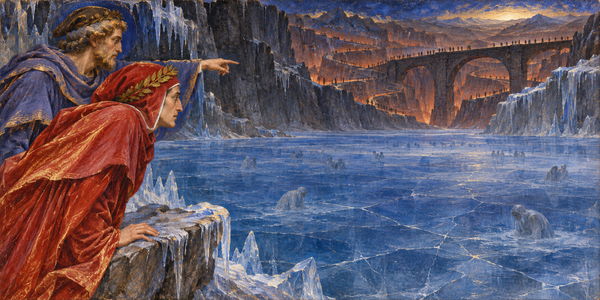
After the ten ditches, the travelers reach the well of the giants, who embody ancient rebellious power. From there they descend into the ninth circle: Cocytus, the frozen lake of betrayal. This final image overturns the popular assumption that the deepest Hell must be the hottest. At the center of evil, ice reigns. Betrayal is presented as the final cooling of love and the severing of bonds of trust.
The ninth circle has four regions. Caina is associated with betrayal of relatives; Antenora with betrayal of country and political community; Ptolomea with betrayal of guests and those who trusted hospitality; and Judecca with betrayal of benefactors and lords. The arrangement shows the enormous importance Dante gives to trust. The gravest evil is not merely inflicting pain, but knowingly destroying a relationship that created an obligation of loyalty.
Among the most disturbing scenes is the story of Count Ugolino, who gnaws the head of his enemy Archbishop Ruggieri. His narrative of imprisonment and the deaths of his children is filled with horror, silence, and what remains unsaid. Dante leaves some of the most terrible elements in the space between words. This restraint makes the episode so powerful: the reader faces suffering that cannot be exhausted through graphic description.
At Hell’s bottom stands Lucifer, immense and motionless, imprisoned in ice. He has three faces-a monstrous distortion of the triple harmony permeating the poem. His wings produce the freezing wind that keeps him trapped. In his three mouths are tormented Judas, Brutus, and Cassius, figures of betrayal against Christ and Caesar according to Dante’s moral and political system.
Lucifer is not the majestic ruler of an independent kingdom capable of rivaling God. He is the ultimate image of spiritual impotence, a creature whose rebellious will has become a motionless prison. Dante reaches one of his most original images here: absolute evil is not a free creative force but deprivation, stagnation, and disintegration. At the deepest point of Hell there is no triumphant energy, only endless sterility.
Virgil and Dante climb down Lucifer’s body and pass through the center of the Earth. Then their direction reverses: downward movement becomes ascent. This spatial change is one of the poem’s most beautiful compositional discoveries. The bottom of Hell proves to be the place where the exit begins. The travelers pass through an underground passage and once again behold the stars. After all the suffering of the first cantica, this final image restores the horizon of hope.
The Mountain of Purgatory: Repentance as an Ascent Toward Freedom
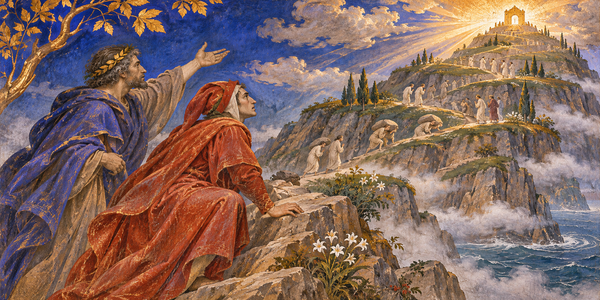
After the darkness of Hell, the world of Purgatory opens toward air, sea, and morning light. On the opposite side of the Earth rises an immense mountain whose summit reaches the earthly paradise. This space is fundamentally different from Hell. Here souls suffer, but their suffering has a direction and an end. They are not permanently imprisoned in their own choices. Purification is possible because their wills have already turned toward the good.
The guardian of the approaches is Cato of Utica, the Roman Stoic whose image Dante associates with freedom. His presence is one of the poet’s unusual decisions and has inspired numerous theological and literary interpretations. Dante does not construct the afterlife by mechanically repeating ready-made lists. He employs historical figures as bearers of complex moral meanings, sometimes surprising even within his own system.
At the foot of the mountain and in the regions of Ante-Purgatory are souls whose repentance came late or whose circumstances delayed their spiritual turning. Among them are rulers, warriors, and ordinary people. Their conversations differ from those in Hell. The souls ask the living to remember and pray for them. Memory no longer serves only earthly glory or self-justification. It becomes a sign of communion between the living and the dead.
Purgatory proper begins beyond a symbolic gate, through which Dante passes after preparation. An angel marks seven letters upon his forehead, corresponding to the seven capital sins. As he ascends through seven terraces, these marks are gradually erased. The mountain’s architecture turns moral transformation into physical movement. The higher the traveler climbs, the lighter his burden becomes.
The first terrace is devoted to pride. Souls walk bent beneath heavy stones. The walls display examples of humility, while the ground depicts punished pride. Pride is an improper exaltation of the self; its healing begins with recognition of dependence on others and on the divine order. The stone pressing upon the back is not only punishment but an exercise in humility.
The second terrace belongs to the envious, whose eyes are sewn shut so they cannot look with hostility upon another’s good fortune. Envy suffers from another person’s happiness as though goodness were a limited resource. Purification directs the soul toward joy in the neighbor’s well-being. Dante presents moral healing as a transformation of perception itself: what formerly caused pain must become an occasion for love.
The third terrace concerns wrath and is enveloped in dense smoke. Souls learn to overcome the passion that clouds rational vision. The fourth is devoted to sloth or spiritual sluggishness: souls run eagerly, reversing their former inactivity. These terraces reveal different disorders of love-excessively destructive energy and insufficient readiness to pursue the good.
The fifth terrace concerns greed and wastefulness. Souls lie face down upon the earth that once consumed their attention. The sixth purifies gluttony through hunger and thirst amid trees bearing unreachable fruit and water. The seventh concerns lust and passage through purifying fire. In each case punishment is both a memory of wrongful direction and a means of restoring freedom.
Virgil explains the mountain’s moral logic through the doctrine of love. Every human action is moved by some form of love, but love can be directed toward an improper object, be insufficient, or be expressed without measure. Purgatory does not destroy the capacity to desire. It orders that capacity. A person is not meant to become unfeeling but to learn how to love rightly.
Especially significant is the encounter with the poet Statius, who joins Dante and Virgil. It turns the ascent into a conversation about poetry, influence, and spiritual development. Classical literature again appears as a force capable of preparing the mind for higher truths. Statius expresses gratitude to Virgil, whose work has profoundly shaped him. Thus the poem creates a chain of teachers and students in which artistic language has moral influence.
At the summit lies the earthly paradise, the garden of humanity’s original innocence. Here Dante meets Matelda, followed by Beatrice’s appearance in a solemn procession filled with biblical and symbolic imagery. Her arrival is both sublime and painful. She does not greet the poet with tenderness alone. She confronts him with his deviations after her earthly death and demands genuine acknowledgment. Love here is not flattery but a force requiring truth.
Virgil disappears when Beatrice takes over as guide. This is among the saddest moments in the work. Human reason has brought Dante to the highest point it can reach in its own role, but the road toward direct contemplation of the divine requires another guide. The farewell does not diminish Virgil. It shows that great knowledge has limits and that the spiritual journey passes through different forms of understanding.
After purification Dante passes through the waters of Lethe and Eunoe, associated with forgetting sin and restoring memory of the good. This ending is extraordinarily subtle. Salvation is not simply the erasure of the past. It is the transformation of memory so that a person is no longer imprisoned by guilt. Purgatory ends with a restored capacity for ascent. Dante is ready to turn toward the stars.
The Nine Celestial Spheres: From the Moon to the Primum Mobile
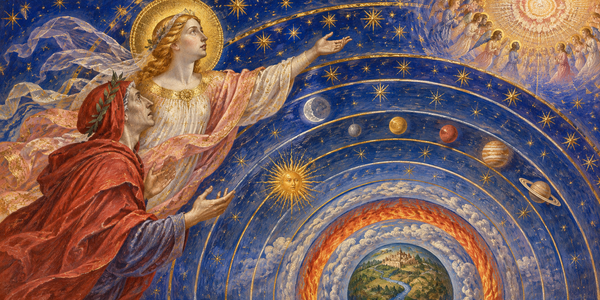
Paradiso is the most challenging part of the Divine Comedy because it describes a reality continually exceeding the capacities of sensory images and human language. Dante ascends with Beatrice through the heavens, organized according to the medieval geocentric cosmological model. The Earth stands at the center of this structure, surrounded by planetary and stellar spheres. The poet uses the astronomy of his time as the basis of a spiritual architecture in which movement toward heaven corresponds to deeper knowledge.
The first heaven is the Moon. Here Dante meets souls associated with broken vows under the pressure of external circumstances. Among them is Piccarda Donati, whose peaceful speech reveals the nature of heavenly bliss. The blessed do not envy those who enjoy higher degrees of glory. Their wills are fully aligned with divine order. This is one of the great differences between Paradise and the earthly world: difference does not generate rivalry.
The second heaven is Mercury, associated with souls who performed good deeds but were also motivated by a desire for earthly fame. Here Dante meets Emperor Justinian, who unfolds a magnificent account of Roman history and the symbolism of the imperial eagle. Political themes do not disappear with the ascent toward heaven. They acquire a broader perspective: history is examined in relation to providence, justice, and human responsibility.
The third heaven is Venus, where souls appear whose earthly lives were especially connected with love. In heavenly light, love is transformed and freed from its limited expressions. Dante converses with individuals whose biographies show that spiritual evaluation is not simply a mechanical tally of earthly successes and failures. Each soul participates in bliss according to its own history and the fullness of divine order.
The fourth heaven is the Sun, the realm of wisdom and theological knowledge. Great teachers shine here, among them Thomas Aquinas and Bonaventure. Remarkably, Dante has representatives of different spiritual traditions praise figures outside their own communities. The poem thus offers an image of harmony transcending earthly rivalry. True wisdom does not fear recognizing another’s greatness.
In the Sun, knowledge is not a cold accumulation of concepts. It is radiance, movement, and communion. Souls form circles of light and participate in harmonious dance. Intellectual life reaches its fullness when truth is no longer used for superiority but becomes shared joy. Dante turns theology into music and light because the pursuit of knowledge is inseparable from love.
The fifth heaven is Mars, where warriors and martyrs associated with spiritual courage appear. Souls form a luminous cross. Here Dante meets his ancestor Cacciaguida, who speaks of old Florence and foretells the hardship of exile. This encounter is a personal center of Paradiso. The poet gains perspective on his own suffering and on the purpose of the work he is creating. His destiny acquires meaning as testimony rather than merely political loss.
The sixth heaven is Jupiter, associated with just rulers. Lights form the figure of an eagle that speaks with a unified voice. The image is crucial: justice is not the private possession of a single ruler but harmony among many individuals united within a higher order. Here Dante raises difficult questions concerning divine justice, salvation, and the limits of human judgment.
The seventh heaven is Saturn, the dwelling of contemplatives. Dante sees a golden ladder rising beyond his sight. Among the souls are Peter Damian and Benedict of Nursia. Music, so characteristic of other heavens, gives way here to a particularly reverent silence. Contemplation is presented as movement toward truth requiring concentration, rejection of vanity, and inner discipline.
The eighth heaven is the sphere of the fixed stars. Here Dante beholds the triumph of Christ and the Virgin Mary and undergoes examinations concerning faith, hope, and love. The apostles Peter, James, and John participate in these scenes. The poet is no longer merely an observer of others’ destinies. He must articulate his own spiritual understanding. The ascent becomes a test of everything he has learned along the way.
The ninth heaven is the Primum Mobile, the first mover, which in medieval cosmology accounts for the movement of the lower celestial spheres. Here Dante sees a radiant point surrounded by nine angelic circles. The magnificent vision overturns earthly ideas of center and periphery. The true center is not defined by physical distance but by proximity to divine love and knowledge. The angelic hierarchies express different degrees of participation in this light.
The celestial spheres should not be understood as places dividing the blessed in the same way Hell divides the condemned. Dante gradually learns that the souls of the saved belong in the Empyrean, while their appearances in different heavens serve his human understanding. The spatial sequence is a pedagogical and poetic form through which invisible spiritual reality becomes accessible to the imagination.
The passage through the heavens is accompanied by continually increasing light and by Beatrice’s growing beauty. Her gaze directs Dante upward, while her smile marks new degrees of understanding. This is an exceptionally tender artistic idea: love does not distract from truth but leads toward it. The earthly encounter with Beatrice is transformed into spiritual guidance through which the poet learns to see the world as a manifestation of higher harmony.
The Empyrean, the Celestial Rose, and the Final Vision of Divine Love
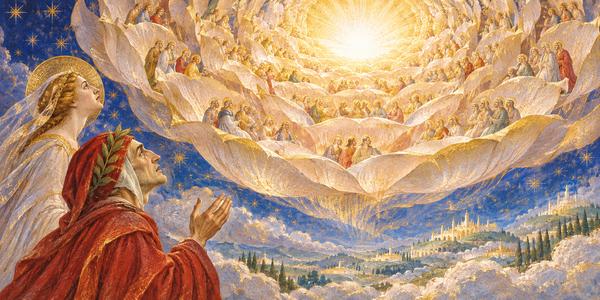
After the nine celestial spheres, Dante reaches the Empyrean, a realm not belonging to physical space and time in the same way as the previous heavens. Here the movement of stars yields to the immediate presence of eternity. The poet must find a new language because the images that served him before are no longer sufficient. Light is not merely a visible phenomenon but a sign of truth, love, and existence in their highest fullness.
In the Empyrean unfolds the image of the celestial rose. The blessed are arranged like petals of an immense luminous flower, while angels move among them like bees. It is one of the most beautiful visions in world poetry. The rose unites stable order and living movement, individual persons and perfect community. No soul loses its uniqueness, yet all participate in harmony free from envy and struggles for superiority.
Beatrice takes her place among the blessed, and Dante’s final guide becomes Saint Bernard of Clairvaux. This change continues the logic of earlier transitions. Virgil represents human reason; Beatrice, spiritual insight directed by love and grace; Bernard, contemplative prayer and mystical longing for God. The journey does not invalidate its previous guides. It reveals different degrees of spiritual approach.
Bernard offers a prayer to the Virgin Mary so that Dante may receive the strength for the final vision. The prayer culminates the theme of grace present from the poem’s beginning. The traveler has covered an immense distance, learned to distinguish sin, undergone purification, and contemplated the heavenly hierarchies. Yet the final step is not the product of his effort alone. It is a gift beyond the human capacity to demand.
In the last canto, Dante contemplates divine unity through images that continually acknowledge their own inadequacy. He sees three circles associated with the mystery of the Trinity and attempts to understand the relationship between divine and human nature in Christ. Intellect reaches the limit of its powers. The poet does not present this as the defeat of reason but as the moment when reason is brought to its highest boundary and requires transformation.
The final verses end with the love that moves the Sun and the other stars. This ending gathers together the entire architecture of the Comedy. The cosmos, which initially appears as an immense system of punishments, movements, and distances, is revealed as ordered through love. This is not sentimental feeling but the fundamental principle of spiritual order. In Hell love is distorted and closed upon itself; in Purgatory it is purified; in Paradise it reaches free participation in divine harmony.
Here Dante’s extraordinary craftsmanship as a poet becomes evident. He is not content merely to declare that God is love. He creates one hundred cantos in which every encounter, river, circle, and light prepares this conclusion. The reader has passed through the horror of betrayal, the tears of repentance, and the joy of heavenly knowledge. Final love has acquired the weight of the entire journey.
The celestial rose also answers the loneliness with which the poem begins. In the dark wood Dante is lost, separated from the path, and unable to orient himself. In the Empyrean he sees a community in which every being has a place. The difference between these states is not merely spatial. It is the difference between fragmented desire and harmonious love, between self-enclosure and participation in a higher meaning.
The final vision does not cancel earthly life. On the contrary, it gives it a new perspective. All the historical figures, political conflicts, family tragedies, and personal sufferings encountered along the road were part of the question of how a human being should live. The Divine Comedy does not invite readers to despise the world. It insists that actions in the world carry spiritual weight because every decision shapes the direction of love and will.
The Hidden Philosophy of the Journey: Free Will, Justice, and Human Transformation
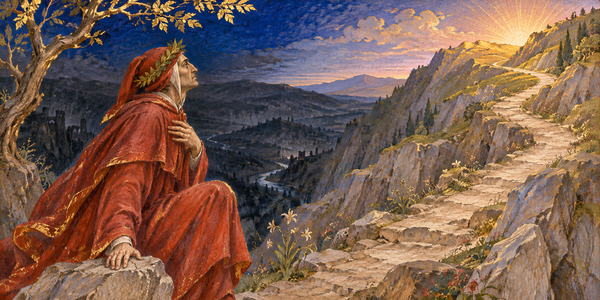
Behind the spectacular spaces of the Divine Comedy stands a coherent philosophical drama. Its protagonist is not simply a visitor to the afterlife collecting extraordinary impressions. He is a person who must learn to desire rightly. In this sense the journey through the three realms is a story of the transformation of the will. Hell shows how choices can imprison a person in destructive patterns. Purgatory shows how freedom is restored through repentance and discipline. Paradise shows a freedom that no longer struggles against goodness because it has recognized goodness as its deepest goal.
Free will is decisive to the poem’s moral architecture. Without the capacity to choose, neither punishment nor purification would possess the same meaning. Dante inherits complex philosophical debates about divine foreknowledge, human decisions, and the operation of grace. In the Comedy these questions do not remain abstract. They appear in the stories of people who used their talent, power, love, or intellect in different ways.
One of the most important ideas is that evil possesses no perfect independent form. It distorts capacities that could otherwise serve the good. Love becomes obsession; the desire for security becomes greed; the longing for justice becomes revenge; intellect becomes fraud; and loyalty is transformed into betrayal when deliberately destroyed. Dante thus constructs a moral psychology in which human nature is not composed of two utterly alien substances, good and evil. Tragedy arises from the wrongful ordering of the forces that move life.
This explains why Inferno is so psychologically convincing. Souls frequently continue to speak as they lived. The proud retain their pride, deceivers continue to manipulate, and passionate lovers present desire as destiny. Punishment is not simply pain imposed from outside. It reveals the inner structure of a choice that has become a final identity. In Dante’s artistic world, a person becomes what they have repeatedly chosen to be.
Purgatory offers a different answer to the same problem. Its souls do not deny the need for transformation. They participate in it. Suffering has meaning because it is connected with the restoration of love. This contrast is essential: two conditions can look painful from the outside yet differ completely in their inner direction. Without hope, pain is a prison; with hope and purpose, it can become part of moral growth within the poem’s artistic logic.
Heavenly freedom, in turn, is not the arbitrary ability to choose anything whatsoever. It is a condition in which the will agrees with the good it knows. This idea differs from modern conceptions that sometimes define freedom primarily as the absence of restrictions. For Dante the deepest unfreedom is enslavement to destructive passions, while the highest freedom is the capacity to participate in truth and love without inner division.
The poem’s political philosophy is equally significant. Dante experiences corruption, factional struggles, and abuses of power as manifestations of spiritual disorder. His judgments of popes, rulers, and citizens are connected with particular historical convictions and personal conflicts. Beyond these stands a universal question: what happens when institutions created to serve the common good are subordinated to private interest? In the Comedy, political evil is not secondary. It affects the conditions under which people can live justly.
Memory also plays an important role. The condemned attempt to preserve their names and impose a particular account of the past. Souls in Purgatory ask for prayer and communion. The blessed perceive earthly history within a broader order. The three realms present three different relationships with what has been experienced: fixation, purification, and enlightened understanding. Human identity is not separate from memory, but people can relate to memory in profoundly different ways.
Poetic form contributes to this philosophy. The interlocking triple rhyme creates movement in which each stanza is connected with the next. The narrative continually advances without losing its sense of inner order. Numbers, symmetries, and recurring images of stars are not merely decoration. They suggest that human life is woven into relationships extending beyond the immediate moment. Composition itself becomes an image of order.
Yet the work is not a dry philosophical scheme. It lives through concrete voices. Francesca speaks of love, Ugolino of hunger and loss, Ulysses of the hunger for knowledge, Piccarda of the serenity of the heavenly will, and Cacciaguida of exile and destiny. Every encounter changes the emotional tone. Dante understands that truth about humanity cannot be expressed through definitions alone. It must be experienced through stories.
That is precisely why the Divine Comedy remains alive today. Its medieval cosmology differs historically from the contemporary picture of the universe, but its questions about choices, responsibility, social corruption, love, and meaning have lost none of their force. Readers need not share every theological assumption of Dante to be struck by the image of a person who has lost his way and must find it again.
At the beginning of the poem the dark wood is a space of confusion. At the end, heavenly light is an image of fullness. Between them lies an immense labor of understanding: to see the consequences of evil, acknowledge the need for change, and discover the joy of truth. This movement is the heart of Dante’s journey. It turns the map of the afterlife into a map of moral existence.
Dante’s greatness lies not only in describing the nine circles of Hell, seven terraces of Purgatory, and nine celestial spheres. He created a universe in which every space poses a question about the human soul. Hell asks what happens when love becomes selfishness and betrayal. Purgatory asks whether a person can overcome their own habits and guilt. Paradise asks what existence looks like when knowledge, freedom, and love no longer contradict one another.
The final answer is not a formula but a vision. After the monsters, flames, ice, mountain paths, angelic songs, and radiant circles, love remains-the love that moves the stars. In this conclusion Dante brings together his personal destiny, the history of the world, and the longing of the human heart. The Divine Comedy continues to move readers because it reminds us that the path toward light does not begin with the certainty that we already know everything. It begins with the honest recognition that we have lost our direction and with the determination to pass through truth, however difficult that passage may be.
Author: Vasil Stoyanov