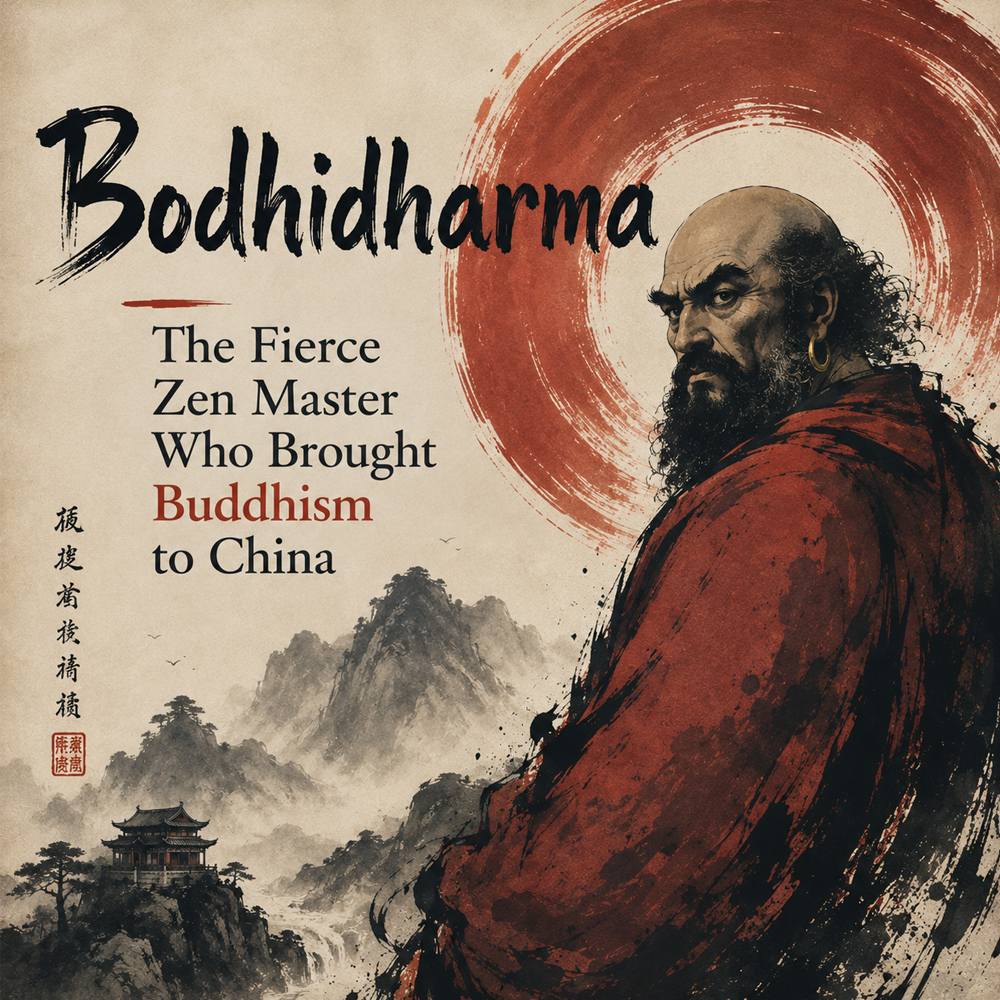
Bodhidharma was the twenty-eighth successor in the lineage of the Buddha and the first patriarch of Chan (Zen) Buddhism. In this context, the word „successor“ does not refer to anything material, nor to some secret knowledge reserved for a chosen few. The inheritance consisted of the direct transmission of the One Mind. What the Buddha transmitted to his first successor, Mahākāśyapa, was the Mind completely free from birth and death. This transmission was not an act of giving something away, but an act of recognition – a confirmation that Mahākāśyapa had realized the very same state that is Nirvana itself. Each person must walk the path alone; the teacher merely acknowledges the student’s realization and grants permission for them to become a teacher in turn. As a symbol of this recognition, the Buddha handed Mahākāśyapa his begging bowl and robe. In this way, he demonstrated that his disciple had attained the same realization. This act became a tradition passed from teacher to student for centuries, serving as a means of preserving the purity of the teaching. Every such transmission was a confirmation that the recipient had realized the same Mind.
After three years of travel, Bodhidharma arrived in China, and news quickly spread that a descendant of the Buddha himself had come. At that time, the Chinese emperor had already built numerous Buddhist temples, erected statues, and translated sacred texts from Sanskrit into Chinese. When he heard of Bodhidharma’s arrival, he invited him to the palace.
During their meeting, the emperor asked:
– „I have translated many sacred texts, built countless temples and statues. Thanks to me, Buddhism has flourished in China. Have I accumulated enough merit to attain Nirvana?“
Bodhidharma replied:
-„You have no chance of tasting Nirvana. You will burn in the deepest levels of hell.“
The emperor was shocked.
– „But do not the teachings say that spreading Buddhism brings immense merit?“
Bodhidharma answered:
– „There is nothing holy. Everything is empty.“
The emperor failed to understand that within these words lay the very essence of Nirvana. He continued to believe that liberation was achieved through external actions rather than inner realization. As long as one clings to the notion of „good“ deeds, one remains trapped in duality – good and evil – and thus moves further away from the truth.
After this conversation, Bodhidharma left the palace and settled in a cave near the Shaolin Monastery, where he spent nine years meditating while facing a wall.
In the ninth year, a man named Shen Guang wished to become his disciple but was rejected. One winter night, he remained outside the cave. By morning, he was buried in snow up to his waist. Bodhidharma told him he would accept him only when the snow turned red.
In response, Shen Guang cut off his left arm and waved it through the snow, staining it with blood. According to another version of the story, Bodhidharma’s criticism of his weak determination inspired the act.
After six years of training, Shen Guang – later known as Huike – experienced awakening through the following exchange:
– „My mind is troubled. Please calm it.“
– „Bring me your mind, and I will calm it.“
– „I have searched for it, but I cannot find it.“
– „There – you see? I have already calmed it.“
Later, while climbing a mountain together, Bodhidharma asked:
– „Where are we going?“
Huike replied:
– „We are simply moving forward.“
Bodhidharma said:
– „If you keep moving straight ahead, you will not be able to take a single step.“
At those words, Huike attained complete enlightenment.
When Bodhidharma decided to leave China, he gathered his disciples and asked them to express their understanding.
Dao Fu said:
– „It is neither bound by words nor separate from them.“
Bodhidharma replied:
– „You have attained my skin.“
The nun Zong Chi said:
– „It is like a glimpse of Akshobhya Buddha’s realm – once seen, it need not be seen again.“
Bodhidharma answered:
– „You have attained my flesh.“
Dao Yu said:
– „The four elements are empty; the five aggregates have no true existence.“
Bodhidharma replied:
– „You have attained my bones.“
Finally, Huike stepped forward, bowed silently, and stood upright.
Bodhidharma said:
– „You have attained my marrow.“
And he handed Huike the robe and begging bowl.
Through the expressions „skin,“ „flesh,“ „bones,“ and „marrow,“ Bodhidharma indicated the depth of each disciple’s realization – from the most superficial understanding to the deepest.
After Huike, the lineage continued for four more generations, eventually reaching the Sixth Patriarch, Huineng. After him, the formal practice of transmitting the robe and bowl was discontinued, and people were expected to recognize genuine teachers for themselves.
Yet the teaching did not disappear. It continued to flourish, especially in Japan, where Zen reached one of its greatest peaks. For the first time in history, a remarkable number of awakened teachers appeared within a relatively short period.
Among them were masters such as Bankei Yōtaku, Ikkyū Sōjun, Hakuin Ekaku, Bassui Tokushō, Matsuo Bashō, and Dōgen. Although the tradition of transmitting the robe and bowl vanished, the spirit of Zen remained alive through their teachings.
Author: Vasil Stoyanov