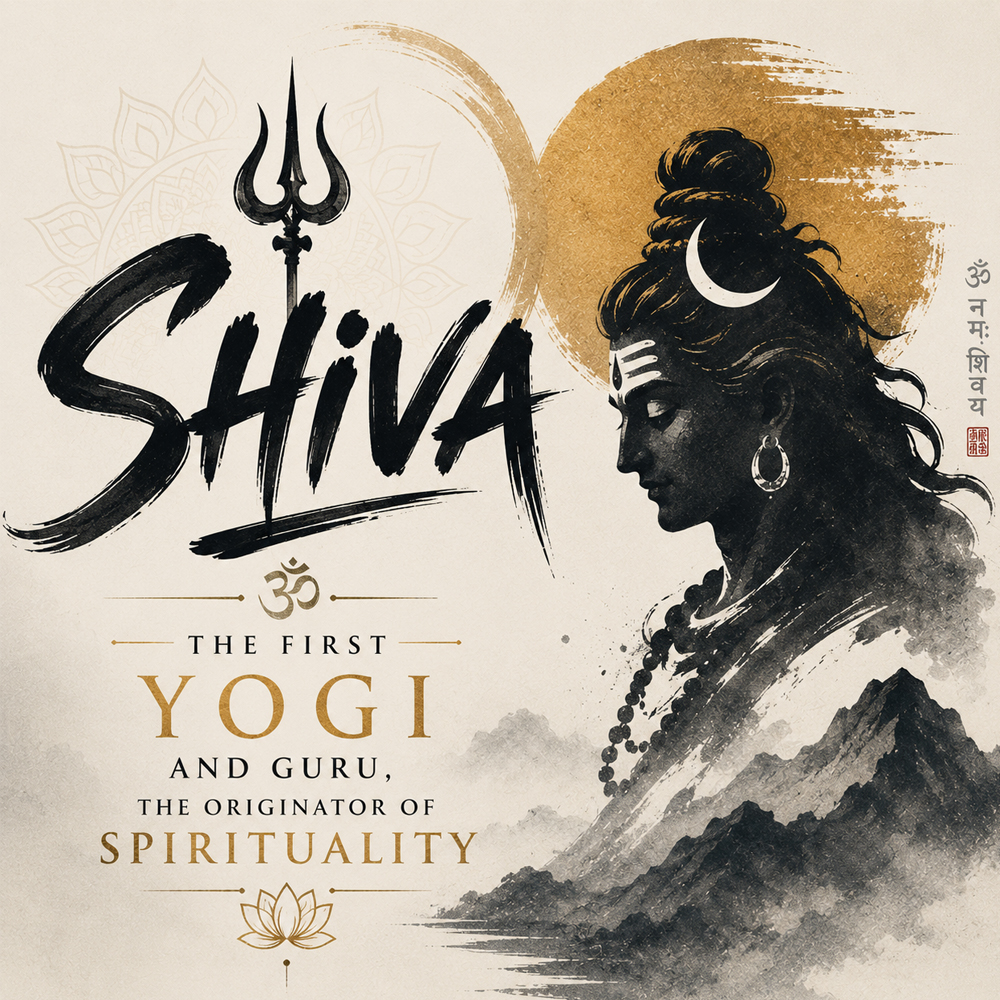
The term Shiva carries many different meanings. Sometimes it symbolizes God, sometimes one aspect of the cosmic duality (Shiva and Shakti), and at other times it refers to a being regarded as the first yogi to walk the Earth – the first guru (Adiyogi) who initiated the very process of spirituality within humanity.
It is extremely difficult to clearly distinguish which stories about Shiva as a being represent historical events, which are symbols, myths, and legends intended to explain the nature of the Divine, and which may have been embellished over time.
Shiva, as a „human being“ who dwelt on Earth, is considered the most accomplished yogi – one who possessed complete mastery over all the chakras, or states of consciousness.
Thousands of Years Ago
According to certain spiritual and yogic traditions in India, Shiva lived approximately 12,000–15,000 years ago. Many yogis, however – including the most well-known among them today, Sadhguru – say that Shiva’s work on human consciousness dates back nearly 40,000 years.
It is possible that enlightened beings existed before Shiva. However, the people around them may not have been sufficiently conscious to receive or transmit a spiritual process. While physical evolution had already done its work, human awareness and understanding had not yet broken through the barriers of instinctive and impulsive existence.
Shiva became the first spiritual teacher and the first yogi not necessarily because he was the first enlightened being, but because there were people conscious enough to recognize something extraordinary in him and desire to understand it.
For a person to become a teacher or guru, there must be others who carry within themselves a longing to learn. It is the students who make the teacher.
According to legend, Shiva was „self-born“ or „self-created“ – without mother, father, or lineage. He is said to have used his mastery over life energy to materialize and dematerialize on Earth in accordance with planetary movements. The physical body through which he manifested was believed to stand between 2.5 and 3 meters tall.
The First Sages
Legend tells that Shiva remained motionless in deep meditation for days, while tears of ecstasy streamed from his eyes. Local people noticed him and began gathering around, waiting for him to open his eyes. Everyone sensed that there was something extraordinary about him. Yet Shiva remained absorbed in his trance, paying no attention to anyone.
Over time, everyone eventually gave up and left – except for seven individuals. They remained despite the cold, the harsh conditions, and the complete absence of any sign that he would emerge from his meditative state. When Shiva finally opened his eyes, he saw that these seven people were willing to die, if necessary, in order to understand what he carried within himself.
Moved by compassion, he decided to reveal to them the entire spiritual process available to human beings. He transmitted all 112 methods for attaining complete liberation from the cycle of life and death – without uttering a single word.
This was said to be the first direct transmission of the enlightened mind.
The knowledge they received became the system known as Yoga – meaning Union. These seven individuals are known today as the Saptarishis, the Seven Great Sages.
The Birth of Religions
After receiving this knowledge, the seven sages spread throughout the world to share yoga.
Depending on the cultures and people they encountered, they used different methods and approaches. Over time, these methods gradually evolved into distinct religious traditions.
When a person attains enlightenment through a particular method, they themselves become the embodiment of that method and inspire others to follow it. Eventually, their words and actions are transformed into systems and philosophies as others attempt to express their realization in language.
Religion, in this view, becomes more an embodiment of an enlightened individual than of the original method itself. It gradually shifts toward following the person rather than the path, which inevitably leads to divisions and conflicts among followers.
For thousands of years, these methods were transmitted from teacher to student. All religions – past, present, and future – may be viewed as branches of Yoga, which encompasses all 112 methods.
According to Hindu tradition, Shiva is the only being who completely mastered every one of these methods.
He is simultaneously creator and destroyer, matter and spirit, time and timelessness, God and creature.
Read More:
- Yoga: Karma, Life, Death, and Rebirth
- The Life of Jiddu Krishnamurti and His Legacy to Humanity
- Sadhguru: The Story of His Enlightenment, Vijji, and the Mission of the Dhyanalinga
Author: Vasil Stoyanov