Introduction to the Figure of Tilopa
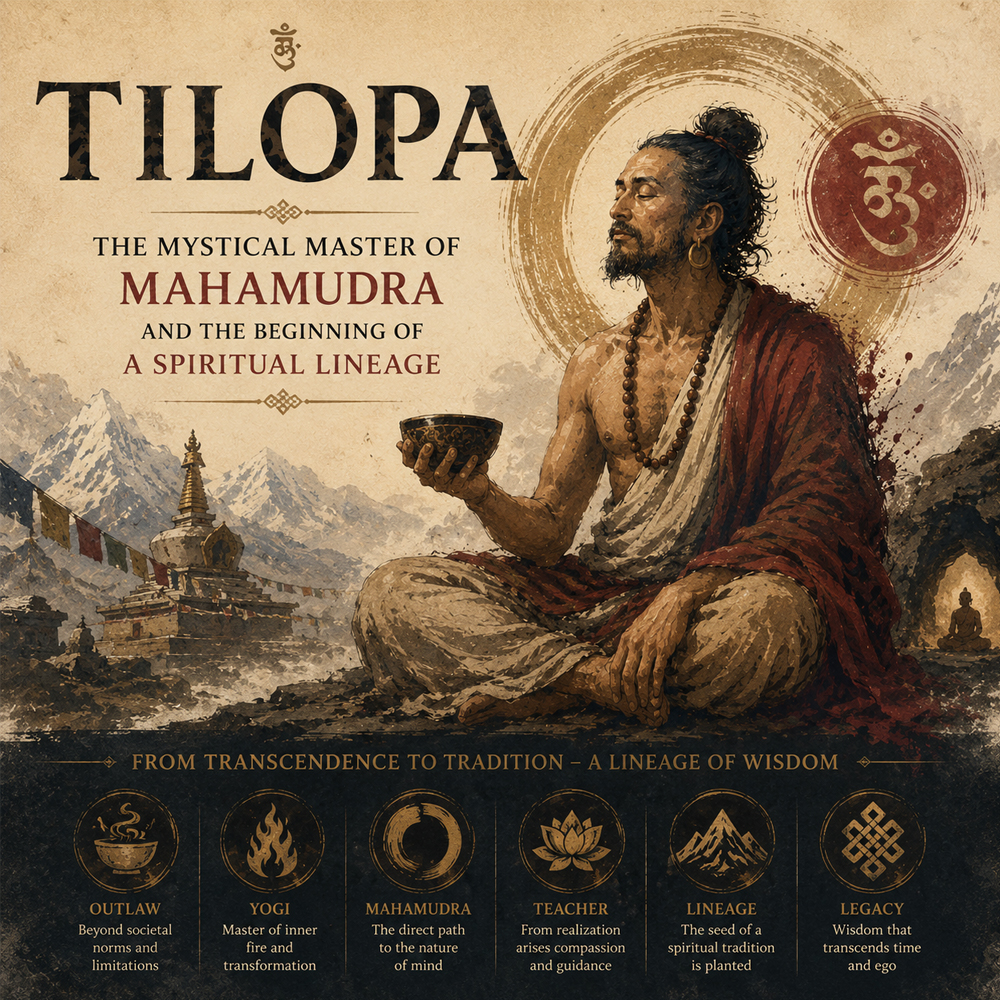
The history of human spirituality knows figures who stand at the boundary between mythology and historical reality. One of the most mysterious and influential among them is Tilopa, an Indian tantric master of the 10th–11th century whose impact on Tibetan Buddhism is difficult to overstate. He is regarded as one of the 84 Mahasiddhas – enlightened yogis who, through direct experience, realized the essence of reality and transmitted their insights beyond the boundaries of orthodox religion.
Tilopa’s life is wrapped in legend, symbolism, and spiritual parables. Historical information about him is scarce and often contradictory, and most accounts come from hagiographies – spiritual biographies that emphasize his inner development more than historical facts. This makes Tilopa not merely a historical person, but an archetype of the awakened spiritual being.
Historical Context and Era
Tilopa lived approximately between the late 10th and early 11th century, during a period of intense spiritual exploration in India. It was a time when Buddhism, Hinduism, and various tantric traditions coexisted and influenced one another. Within this environment emerged the phenomenon of the Mahasiddhas – spiritual practitioners who rejected established institutional frameworks and chose direct experience as the primary means of attaining enlightenment.
These individuals often lived outside conventional society, practiced in cremation grounds or remote places, and employed unconventional methods of spiritual realization. It is within this context that Tilopa should be understood – not as a scholar or philosopher in the classical sense, but as a radical explorer of consciousness.
Origins and Early Years
According to traditional accounts, Tilopa was born into a Brahmin family in the Bengal region, an area that today spans parts of India and Bangladesh. This meant that he belonged to the highest social class, associated with knowledge, ritual, and religious authority. From an early age he displayed exceptional intellectual abilities and quickly mastered the sacred texts.
Over time, he took monastic vows and devoted himself to the Buddhist path. At first glance, this appeared to be a natural continuation of his social and spiritual development. Yet it was precisely here that the first major turning point in his life occurred – one that would completely alter his direction.
The Encounter with the Dakini – The Beginning of Transformation
One of the most pivotal moments in Tilopa’s life was his mystical encounter with a dakini – a feminine divine being who, in Tantric Buddhism, symbolizes wisdom and enlightenment. This encounter was not merely an external event but a profound inner experience that transformed his entire perspective.
According to tradition, the dakini initiated him and instructed him to abandon monastic life. This decision was extraordinarily radical, as it meant renouncing social status, security, and an established spiritual path. Instead, Tilopa was directed toward a life outside conventional norms, where he was to behave like a madman, separate himself from society, and practice in secret.
This apparent “madness” was not random. It served as a method for dismantling the ego and social identities. Through this process, Tilopa moved closer to a direct experience of reality beyond concepts and dualistic thinking.
The Period of Wandering and Training
After leaving the monastery, Tilopa embarked on a long period of wandering throughout India. This was not merely a physical journey but a profound spiritual quest during which he encountered various teachers and received diverse instructions.
Among his spiritual mentors were figures such as Saraha and Nagarjuna, both renowned for their deep insights into the nature of reality. From them, Tilopa absorbed different aspects of tantric practice, including methods related to inner heat (tummo), dream practices, the illusory nature of the body, the luminous clarity of mind, and the processes that occur between life and death.
This training was not simply an accumulation of knowledge. Tilopa underwent a process of deep integration in which these teachings became direct experience. Eventually, he became the holder of multiple tantric lineages, which he unified into a single, comprehensive spiritual path.
Life Beyond Convention – “The Mad Saint”
One of Tilopa’s most memorable characteristics was his unconventional way of life. In various stories, he appears in roles that seem incompatible with spirituality. He is said to have worked as a servant to a prostitute, performed hard physical labor pounding sesame seeds for oil – a task from which his name is believed to derive – and spent time in cremation grounds or behaved in ways society considered insane.
These actions were neither random nor chaotic. They formed part of his spiritual discipline and served to dismantle attachment to social roles, moral categories, and conceptual thinking. In this sense, Tilopa’s “madness” was not a sign of disorder but an expression of profound enlightenment that could not be confined within conventional patterns of behavior.
Enlightenment and the Encounter with Vajradhara
After years of practice and inner transformation, Tilopa attained enlightenment. One of the most significant moments in this process was his encounter with Vajradhara – the celestial Buddha who symbolizes the primordial source of tantric teachings.
From this encounter, Tilopa received the direct transmission of Mahamudra, regarded as the highest expression of Buddhist wisdom. This event not only established his spiritual authority but also initiated an unbroken lineage that would continue for centuries.
Interestingly, tradition holds that Tilopa claimed to have had no human teacher and that his teacher was the Buddha himself. This emphasizes the idea of direct, immediate realization that does not depend upon external authorities.
The Teaching of Mahamudra
Mahamudra, meaning “The Great Seal,” is a teaching that describes the ultimate nature of reality. It is not a philosophical system to be understood through intellectual analysis but rather a state of direct experience.
At the heart of this teaching lies the understanding of emptiness (śūnyatā), which does not mean nothingness but the absence of an independent, fixed essence. This leads to the realization of non-duality, a state in which the separation between subject and object dissolves. In such a state, spontaneous action arises naturally, and the mind is freed from conceptual limitations.
Tilopa emphasized that genuine understanding cannot be reached through analysis or logic but only through direct experience of reality as it truly is.
The Song of Mahamudra
One of the most famous texts associated with Tilopa is his “Song of Mahamudra,” which tradition says he delivered on the banks of the Ganges River. In this text, he employs poetic yet direct language to convey the essence of his teaching.
He stresses that intellectual speculation is useless when it comes to the true nature of mind. Instead, he encourages practitioners to free themselves from attachment to thoughts, concepts, and even the idea of attaining enlightenment itself.
Naropa – The Most Important Disciple
Tilopa’s most renowned disciple was Naropa, whose story is inseparably linked with that of his teacher. Their relationship became a central element of Buddhist tradition, particularly within the Kagyu lineage.
Naropa, originally a highly educated scholar and monk, underwent a series of demanding trials imposed by Tilopa. These trials were not punishments but methods designed to dismantle ego and intellectual pride. Through them, Naropa arrived at a direct realization of truth.
Tilopa transmitted to him the teachings of Mahamudra, as well as a collection of practices known as the Six Yogas of Naropa, which involve profound methods for working with body and mind.
The Founding of the Kagyu Lineage
Tilopa is regarded as the founder of the Kagyu lineage, one of the principal schools of Tibetan Buddhism. This lineage is transmitted through an unbroken chain of teachers and disciples: from Tilopa to Naropa, then to Marpa, who carried the teachings into Tibet, followed by Milarepa, one of Tibet’s most celebrated yogis, and Gampopa, who systematized the teachings.
This tradition emphasizes direct transmission of experience, meaning that wisdom is conveyed not merely through texts but through living contact between teacher and disciple. Meditation occupies a central role, while tantric practices are integrated with profound insight and wisdom.
Symbolism and Philosophy
Tilopa did not leave behind systematic philosophical treatises. His teachings were transmitted through concise instructions, poetic expressions, and at times paradoxical actions. He employed shocking or unconventional methods to disrupt habitual patterns of thinking and direct students toward immediate experience.
This mode of transmission underscores the idea that truth cannot be fully expressed in words. It must be realized personally.
Legends and Myths
Tilopa’s life is filled with legends involving encounters with deities, displays of supernatural abilities, and various miracles. These stories often appear fantastical, but their purpose is not to be interpreted literally.
Rather, they serve as symbols of inner processes and spiritual transformations. Through them, teachings are conveyed that would be difficult to express in any other way.
Relevance in the Modern World
Today, Tilopa continues to inspire practitioners around the world. His teachings remain relevant because they offer a direct path to understanding that is not dependent upon institutions or cultural limitations.
In a world overflowing with information and concepts, his message of immediate experience and freedom from mental constructs seems more timely than ever.
Conclusion
Tilopa is a figure who cannot easily be reduced to an ordinary biography. He is simultaneously a mystic, a revolutionary, a teacher, and a symbol of spiritual freedom.
His legacy is found not merely in texts or traditions but in the living transmission of experience – from teacher to disciple, from consciousness to consciousness.
Perhaps the most important lesson he leaves behind is that enlightenment is not something that must be attained, but something that is already present and simply needs to be recognized.
Read More:
- Naropa – Life, Teachings, and the Six Yogas | The Path to Enlightenment
- The Life of the Great Yogi, Tantric Master, and Teacher – Milarepa
- What Are Yoga and Tantra: Differences, Philosophy, and the Role of “Sexual Energy”
Author: Vasil Stoyanov