
Have you ever seen a “shooting star” streak across the sky in a fraction of a second, leaving a thin glowing trail behind it? Or perhaps a celestial object moving slowly through the heavens over days or even weeks, with a long luminous tail stretching behind it? Both of these natural phenomena occur on a cosmic scale, and they are closely connected.
Comets are celestial bodies that typically range in size from a few hundred meters to around 20 kilometers in diameter, although some of the largest known comets may exceed 100 kilometers.
The Formation of a Solar System
Almost all the comets in our Solar System formed shortly after the Sun and planets came into existence. Around 4.5 billion years ago, our Solar System completed its formation. Before that, it existed as a vast cloud of gas and dust containing hydrogen, oxygen, silicon, carbon, iron, helium, and other simple elements.
These enormous clouds, known as solar nebulae, are capable of giving birth to entire planetary systems. The nebula that formed our Solar System is estimated to have been about one light-year across – approximately 9.46 trillion kilometers. Despite being composed of extremely diffuse material, a cloud of such immense size possesses tremendous gravitational potential and exists on the verge of gravitational collapse.
An event such as the explosion of a nearby star may be sufficient to disturb the balance of a nebula and trigger its collapse. Whether this was the cause of our own Solar System’s formation remains a matter of scientific investigation.
Whatever the trigger may have been, the cloud eventually began collapsing inward under its own gravity. As particles fell toward the center, the cloud became denser. The denser it became, the stronger its gravitational pull grew, accelerating the collapse even further.
This compression generated enormous pressure and temperature. Under sufficiently extreme conditions, nuclear fusion began. During this process, lighter elements fused into heavier ones, releasing vast amounts of energy in the form of light and heat. This is the same process that powers the Sun today.
While the Sun was forming, the remaining material in the cloud began rotating around it at tremendous speeds. This rotation gradually flattened the cloud into a disk, much like a ball of dough becomes flattened when spun rapidly.
Within this rotating disk, particles collided and stuck together. Over time, these growing clumps of matter became the planets of our Solar System.
Smaller bodies that never accumulated enough mass to become planets remained in distant orbits around the Sun. These objects are known today as comets and asteroids.
What Are Comets Made Of?
Comets are composed primarily of various forms of ice because they spend most of their existence far from the Sun, where temperatures remain extremely low.
These ices commonly include frozen water, ammonia, carbon dioxide, methane, and carbon monoxide. Each substance has a different evaporation temperature. Methane, for example, begins to vaporize at approximately −182.5°C, far below water’s freezing point of 0°C.
As a comet approaches the Sun, different components of its icy composition begin to vaporize at different distances. These escaping gases create the characteristic features of a comet:
- Nucleus – the solid central body of the comet.
- Coma – a cloud of gas and dust surrounding the nucleus.
- Tail – material streaming away from the comet due to solar radiation and the solar wind.
The particles within the tail reflect sunlight, making the comet visible from Earth as a glowing object with a bright head and an extended tail.
Cometary Orbits
Comets typically follow highly elongated elliptical orbits that often cross the paths of planets.
Unlike planetary orbits, which lie roughly within the same plane, cometary orbits can be oriented in almost any direction. A comet may approach the Sun from virtually any region of space.
Every orbit contains two important points:
- Aphelion – the farthest point from the Sun.
- Perihelion – the closest point to the Sun.
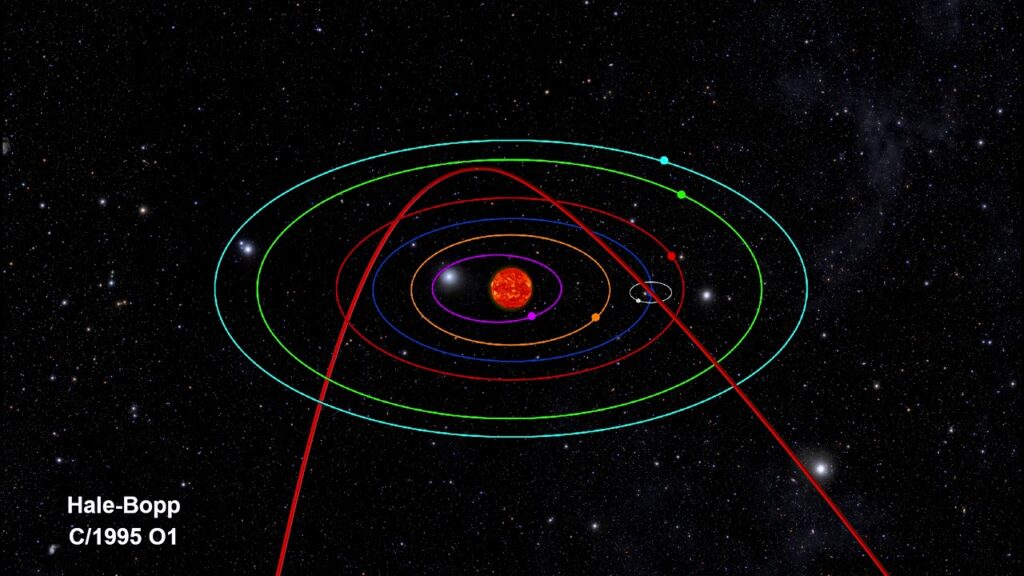
As a comet approaches perihelion, solar heating causes increasing amounts of ice to evaporate, producing its tail. After passing near the Sun, the comet travels back toward aphelion, often disappearing into the outer reaches of the Solar System for centuries, millennia, or even tens of thousands of years.
Because there are believed to be more than a trillion comets within our Solar System, the chances of seeing one during your lifetime are quite high.
Each trip around the Sun gradually erodes a comet, since part of its icy material is lost during every perihelion passage.
Meteor Showers
As comets travel through the inner Solar System, they often leave behind streams of dust and small fragments. These particles continue to follow roughly the same orbit as the parent comet.
When Earth passes through one of these debris streams, the particles enter our atmosphere at extremely high speeds. Friction with the atmosphere causes them to heat up and burn, creating the bright streaks of light commonly known as shooting stars.
These particles are called meteoroids while in space and meteors when they burn in the atmosphere. Most are completely destroyed before reaching the ground.
Because Earth crosses certain cometary debris streams every year, many meteor showers occur on a predictable annual schedule.
One of the most famous examples is the Perseid meteor shower, which is active from mid-July through late August and reaches its peak around August 12. During peak activity, observers may witness dozens of meteors per hour under favorable conditions.
Many other meteor showers occur throughout the year, each associated with the remnants of a different comet.
Conclusion
Solar systems form from immense clouds of gas and dust that collapse under gravity, giving birth to stars, planets, asteroids, and comets. Comets, composed largely of ice and dust, travel through highly elongated orbits and develop spectacular tails as they approach the Sun.
Over time, they leave behind streams of debris that Earth periodically encounters. When these tiny fragments burn up in our atmosphere, they create the beautiful displays we know as meteor showers.
In this way, the fleeting streak of a “shooting star” and the majestic appearance of a comet are both part of the same cosmic story – one that began billions of years ago with the birth of our Solar System.
Read more:
- Black Holes: What They Are and Why They Hold the Greatest Secrets of the Universe
- Dark Matter and Dark Energy: The Invisible Architecture of the Universe
- The Big Bang and the Different Theories About the End of the Universe
Author: Vasil Stoyanov