
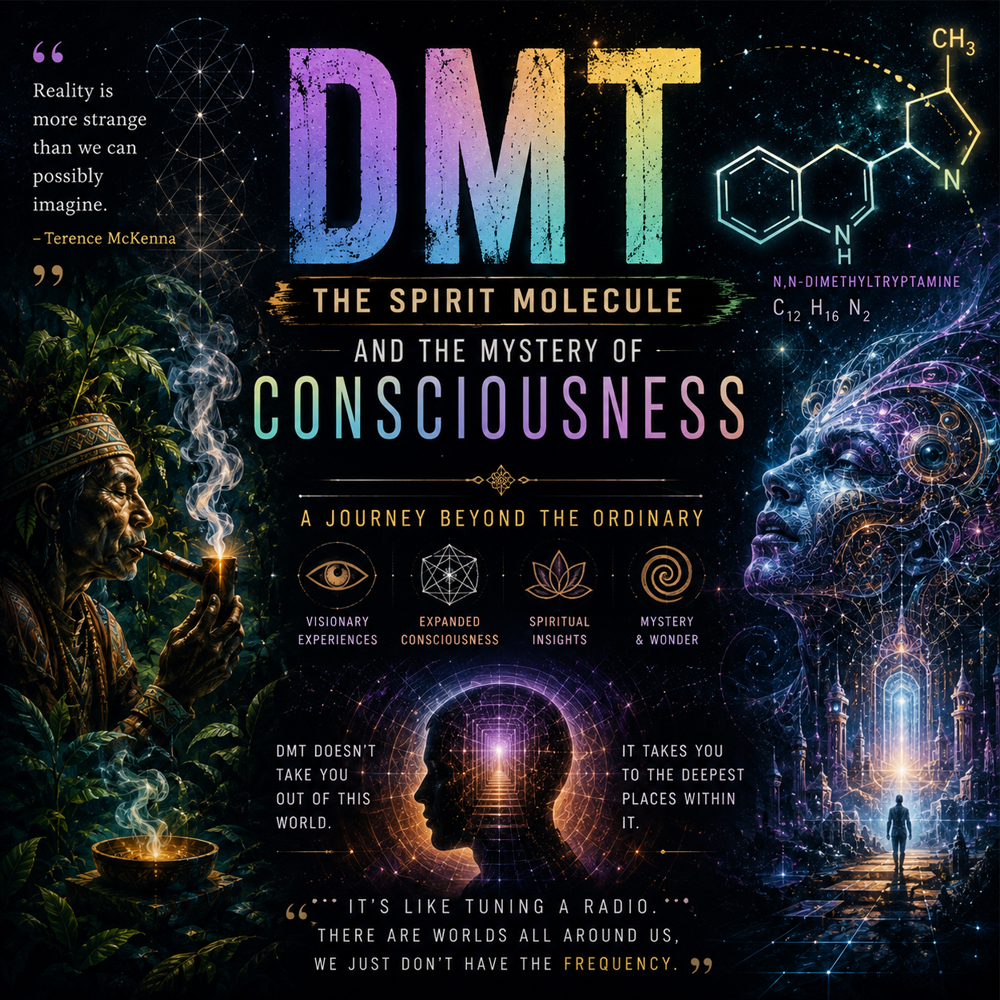
The prevailing scientific view of dimethyltryptamine (DMT) describes it as a powerful naturally occurring psychedelic compound belonging to the tryptamine family. DMT is often classified as a natural psychedelic because it can be found in numerous plant species and has also been detected in the bodies of humans and other animals.
Although DMT has been identified in human tissues, its precise biological role remains uncertain. It is often claimed that the pineal gland is the primary source of DMT production in the human body, but current scientific evidence does not conclusively support this claim. Researchers have identified enzymes capable of producing DMT in several tissues, suggesting that its production may be more widespread than previously believed.
One of the most influential modern investigations into DMT was conducted by psychiatrist and clinical psychopharmacology researcher Dr. Michael „Rick“ Strassman between 1990 and 1995. A graduate of Stanford University and the Albert Einstein College of Medicine, Strassman became widely known for his pioneering research on DMT and later published the bestselling book DMT: The Spirit Molecule, which brought the subject to public attention.
Experiments
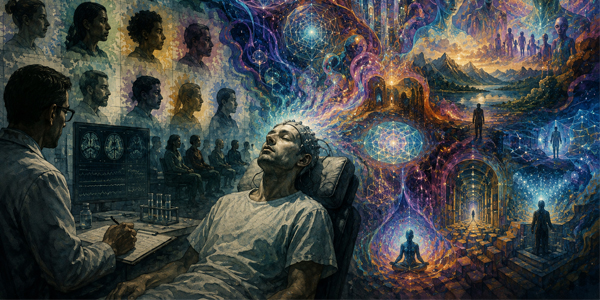
During his research, Strassman administered approximately 400 doses of DMT to around 60 volunteers under controlled clinical conditions. The reports provided by participants were often extraordinary and, in many cases, deeply transformative.
Many volunteers described encounters with seemingly autonomous entities or intelligences. Some participants claimed that these experiences felt more real than ordinary waking life. Others reported entering environments that appeared entirely unfamiliar and unlike anything they had previously imagined.
Strassman explored various psychological explanations for these experiences, including the possibility that they were internally generated hallucinations. However, many participants strongly rejected this interpretation, insisting that what they encountered felt independent of their own imagination. Several volunteers reported seeing structures, beings, or environments that seemed completely foreign to their personal memories, cultural background, and expectations.
Perhaps one of the most intriguing aspects of the study was the degree of similarity found among many of the reports. Participants from different cultural, religious, and educational backgrounds often described comparable geometric patterns, landscapes, sensations, and entity encounters. While significant differences existed in the details, the broader structure of the experiences frequently appeared remarkably consistent.
Many participants initially described encountering geometric forms, luminous patterns, or seemingly formless intelligences. As the experience unfolded, these forms often appeared to take on characteristics shaped by the individual’s personal beliefs, cultural symbolism, or psychological framework.
In other words, the human mind seemed to interpret and translate the experience into symbols and images that were familiar enough to be understood. Regardless of the specific forms perceived, the underlying nature of the experience often remained strikingly similar across participants.
Ayahuasca, Cultural Traditions, and Spiritual Interpretations
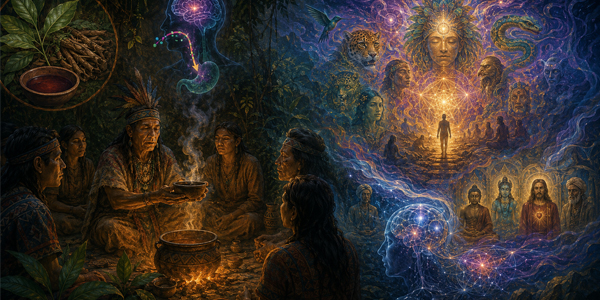
Long before DMT became a subject of modern scientific research, indigenous peoples of the Amazon basin had been working with DMT-containing plants for centuries, and possibly millennia. One of the most well-known examples is Ayahuasca, a traditional psychoactive brew used by numerous indigenous groups throughout regions of modern-day Peru, Brazil, Colombia, Ecuador, and Bolivia.
Ayahuasca is typically prepared by combining plants that contain DMT with others that contain compounds known as monoamine oxidase inhibitors (MAOIs). These MAOIs prevent the digestive system from breaking down DMT before it reaches the brain, allowing the compound to become active when consumed orally. Without these additional compounds, DMT is normally destroyed by enzymes in the digestive tract and produces little to no psychoactive effect when swallowed.
For many indigenous cultures, Ayahuasca is not viewed as a drug in the modern sense of the word. Instead, it is regarded as a sacred medicine, a tool for healing, spiritual growth, and communication with dimensions of reality that are believed to exist beyond ordinary perception. Ceremonies are traditionally conducted under the guidance of experienced shamans who are considered responsible for navigating and interpreting the experience.
One of the most intriguing aspects of Ayahuasca traditions is the remarkable consistency of certain themes reported by participants. Across different tribes and cultures, people frequently describe encounters with intelligent entities, ancestral spirits, divine beings, animals, geometric structures, and vast interconnected realms of consciousness. Similar motifs have also appeared in modern reports from individuals with little or no prior exposure to indigenous beliefs.
Some indigenous traditions interpret these encounters literally, viewing them as genuine interactions with spiritual beings or non-physical dimensions. Others see them as symbolic manifestations of deeper aspects of consciousness. In many cases, the distinction between the inner and outer world is not considered as important as it is in Western thought. What matters most is whether the experience leads to healing, wisdom, or personal transformation.
The similarities between DMT experiences and certain mystical states described in religious traditions have also attracted considerable attention. Researchers, philosophers, and spiritual practitioners have noted parallels between DMT experiences and accounts found in shamanism, Hinduism, Buddhism, Christian mysticism, Sufism, and other contemplative traditions. Reports of overwhelming light, feelings of unity, encounters with seemingly transcendent intelligences, and the dissolution of personal identity appear across many cultures and historical periods.
At the same time, mainstream science remains cautious regarding these interpretations. While the experiences themselves are undeniable from the perspective of the individuals who undergo them, there is currently no scientific consensus about whether they represent contact with external realities, internally generated psychological phenomena, altered states of brain activity, or some combination of these factors.
This tension between scientific skepticism and spiritual interpretation is one of the reasons DMT continues to fascinate researchers and the public alike. It occupies a unique position at the intersection of neuroscience, psychology, philosophy, religion, and the enduring human desire to understand the nature of consciousness itself.
DNA, Evolution, and DMT
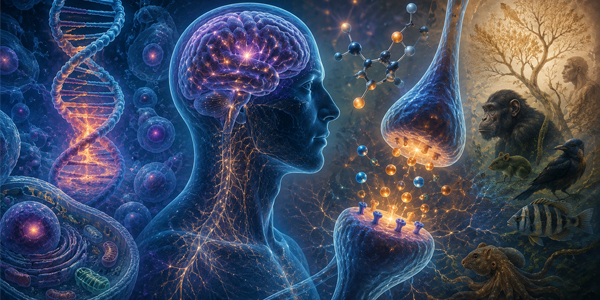
Every cell in the human body contains DNA, which stores the genetic instructions responsible for building and maintaining life. Active genes determine the functions of cells, influence how they respond to their environment, and guide the production of proteins necessary for survival.
Cells communicate through complex networks of receptors that detect chemical signals and electrical activity. DMT is known to interact with certain receptors in the brain, particularly serotonin receptors, which are involved in perception, mood, cognition, and consciousness.
The fact that both humans and many other organisms respond to DMT has led some researchers to speculate about the evolutionary origins of these receptor systems. Since various animals possess receptors capable of interacting with DMT-like compounds, the biological mechanisms involved may have very ancient evolutionary roots.
However, it is important to note that the existence of these receptors does not necessarily imply that they evolved specifically for responding to DMT. Most scientists believe that DMT interacts with receptor systems that originally evolved for other essential biological functions, particularly those involving serotonin and related neurotransmitters.
Some commentators have argued that if DMT were merely a hallucinogen, natural selection would likely have eliminated the biological pathways involved in its production and reception. Evolutionary biology, however, provides a more nuanced perspective. Biological systems are often preserved because they serve multiple functions, and compounds may persist even if their complete purpose is not yet understood.
At present, scientists know relatively little about the endogenous role of DMT within the human body. The limited amount of research available makes it difficult to determine whether DMT serves a specific physiological purpose, contributes to normal brain function, or is simply a byproduct of other metabolic processes.
What Does Current Science Suggest?
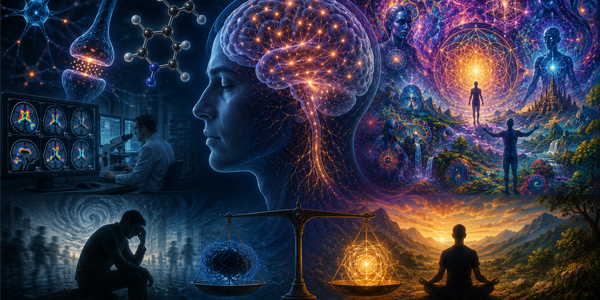
Current evidence suggests that the effects of DMT share many characteristics with those produced by other psychedelic compounds, particularly through their interaction with serotonin receptors in the brain. These effects can include profound alterations in perception, changes in the sense of self, vivid visual phenomena, altered emotional states, and experiences often described as mystical or transcendent.
Many users report a temporary reduction in ordinary patterns of thinking and self-referential mental activity. This can create a feeling of stepping outside one’s usual identity and experiencing reality in a radically different way. For some individuals, these experiences are deeply meaningful and life-changing, while for others they can be confusing, overwhelming, or psychologically challenging.
The psychedelic state can therefore be viewed as a double-edged sword. On one hand, it may offer insights, emotional breakthroughs, and a sense of connection that participants find valuable. On the other hand, it can impair judgment, distort perception, and create situations that would be dangerous without appropriate supervision and preparation.
While DMT is often compared to other psychedelics such as LSD and psilocybin, it is distinguished by its extremely rapid onset and intense effects. Despite decades of fascination surrounding the compound, many fundamental questions remain unanswered. Whether DMT plays a deeper biological role, contributes to extraordinary states of consciousness, or simply represents one of nature’s most powerful psychedelic substances continues to be a subject of ongoing scientific investigation.
Read More:
- Why the Brain Searches for Meaning in Everything – The Scientific Explanation
- How Consciousness Emerged: Why Humans Developed It and What It Means
- The Truth About Meditation: Scientific Facts, Benefits, and How to Begin
Author: Vasil Stoyanov