Introduction to the Mystery of Hermeticism
Among the countless spiritual traditions that have left their mark on human history, few are shrouded in such profound mystery and sacred silence as Hermeticism. It is neither merely a philosophical school nor an ordinary religious system. Hermeticism represents an ancient stream of knowledge that seems to flow from the very dawn of civilization and continues to whisper its secrets to those who are ready to hear them.
For thousands of years, this tradition has inspired alchemists, mystics, philosophers, magicians, scholars, and seekers of truth. Its ideas have permeated different cultures and eras, influencing Western esotericism, Renaissance philosophy, occult movements, and even certain aspects of modern psychology. Whether one views Hermeticism as a spiritual path, a symbolic system, or a metaphysical map of reality, it is difficult to remain indifferent to its depth.
Hermeticism does not offer easy answers. Instead, it invites individuals to become explorers of their own consciousness and of the invisible forces that govern existence. It teaches that behind the visible world lies a deeper reality and that every human being carries within a spark of the Divine that can be awakened through knowledge, inner transformation, and spiritual realization.
Who Is Hermes Trismegistus?
At the heart of the Hermetic tradition stands the enigmatic figure of Hermes Trismegistus. His name means “Thrice-Great Hermes” and represents a fusion of the Egyptian god Thoth and the Greek god Hermes. Thoth was revered as the god of wisdom, writing, magic, and cosmic order, while Hermes was regarded as a messenger between worlds, a guide of souls, and a guardian of secret knowledge.
According to ancient traditions, Hermes Trismegistus was no ordinary man. Some considered him an enlightened sage who lived in a distant age, while others viewed him as a symbolic figure embodying divine knowledge itself. Regardless of historical truth, his name became a symbol of universal wisdom and of the ability to understand the laws that govern both heaven and earth.
Legends tell that Hermes possessed knowledge of the creation of the world, the nature of the soul, the power of words, and the mysteries of spiritual transformation. He was said to be a teacher of kings, priests, and initiates. Many of the texts associated with him were preserved as sacred treasures and transmitted only to worthy disciples.
Over the centuries, the image of Hermes Trismegistus acquired almost mythical dimensions. To some, he was an ancient prophet; to others, a symbol of eternal wisdom; and to still others, the archetype of the enlightened human being who had attained perfect understanding of the relationship between matter and spirit.
The Origins of the Hermetic Tradition
The roots of Hermeticism can be traced to the cultural interaction between ancient Egypt and the Hellenistic world following the conquests of Alexander the Great. In Alexandria, one of the greatest intellectual centers of antiquity, Egyptian, Greek, Persian, Jewish, and other spiritual traditions converged. It was there that the texts later known as the Hermetic Corpus began to take shape.
These writings consist of dialogues between Hermes and his disciples. They explore questions concerning the origin of the universe, the structure of reality, the nature of the human soul, and the possibility of spiritual liberation. Unlike many religious systems that emphasize faith, Hermeticism highlights the importance of direct knowledge and inner experience.
The Hermetic texts describe a world that is neither chaotic nor accidental. The universe is portrayed as an intelligent and harmonious structure permeated by divine intellect. Everything that exists is connected through invisible threads, and every element of reality reflects higher principles. Humanity is not separate from this cosmic network but is a living part of it.
This perspective transforms Hermeticism into a philosophy of unity. It teaches that behind apparent diversity lies a single source from which all forms of life and consciousness emerge. The task of the human being is to overcome the illusion of separation and realize their true nature.
The Fundamental Goal of Hermeticism
At its deepest level, Hermeticism is a path of awakening. Its purpose is not merely the accumulation of knowledge but inner transformation. According to Hermetic teachings, human beings live in a state of spiritual forgetfulness. They identify with their bodies, desires, and fears without recognizing the divine spark they carry within.
The process of spiritual awakening begins with the realization that the material world is not ultimate reality. Visible existence is only a reflection of subtler and deeper levels of being. As a person begins to understand this truth, their perception gradually changes. They start to perceive symbols, patterns, and hidden connections that previously remained unseen.
Hermeticism teaches that true freedom comes through knowledge. Yet this is not intellectual knowledge in the ordinary sense. It is the direct realization of one’s own divine nature. This experience is often described as a second birth, an inner resurrection, or an awakening of consciousness.
When a person reaches such a state, they cease to be a prisoner of external circumstances. Their consciousness rises above the limitations of fear, attachment, and ignorance. They begin to live in harmony with cosmic laws and gradually become a conscious participant in the divine plan of existence.
“As Above, So Below”
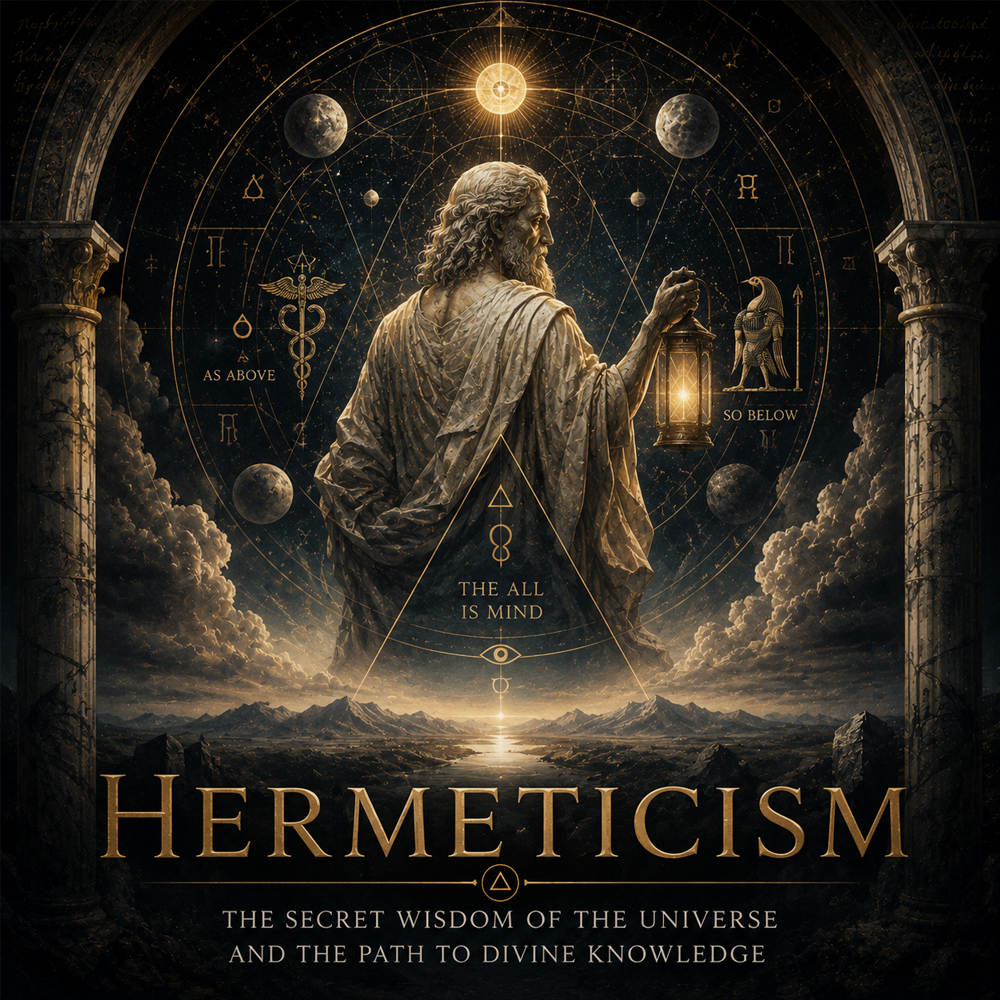
Among all Hermetic ideas, none is more famous than the principle “As above, so below; as below, so above.” These words, attributed to the Emerald Tablet of Hermes, have become a key to understanding the entire tradition.
This principle expresses the idea that there is a profound correspondence between different levels of reality. The cosmos, nature, and the human soul are not separate phenomena but reflections of the same universal truth. Laws that operate in the macrocosm find their reflection in the microcosm of the human being.
Thus, the stars are not merely distant celestial bodies but symbols of forces and processes that also operate within the human being. The same applies to natural cycles, the elements, and even the movements of the planets. The entire universe is viewed as a vast living organism in which every part reflects the whole.
This worldview changes the way a person perceives reality. Instead of seeing the world as a collection of random events, one begins to recognize the hidden order behind apparent chaos. Every symbol, every coincidence, and every experience can become a gateway to a deeper understanding of universal laws.
The Emerald Tablet and the Secret of the Great Transformation
Among all the texts associated with the Hermetic tradition, none has inspired as much admiration, controversy, and mystical reverence as the legendary Emerald Tablet. Although its text is relatively brief, its influence on the spiritual history of humanity has been immense. For centuries, alchemists, philosophers, and occultists devoted their lives to deciphering the hidden messages they believed were encoded within its enigmatic lines.
Legends tell that the Emerald Tablet was crafted from emerald stone and contained the most ancient wisdom in the world. Some traditions claim that it was discovered in a secret tomb beneath an Egyptian pyramid, while others connect it to lost civilizations that existed before recorded history. Whether these stories are historically accurate or symbolic, the text itself has attained an almost sacred status among followers of Hermeticism.
The Emerald Tablet describes the process of the Great Transformation. On the surface, this may appear to be the alchemical transmutation of base metals into gold, but according to most mystics, its true meaning is far deeper. Gold symbolizes the perfected state of the human soul, while the alchemical process represents spiritual purification through which a person overcomes limitations and attains a higher state of consciousness.
The text emphasizes the unity between heaven and earth, between spirit and matter. According to the Hermeticists, the true sage does not reject the material world but understands its hidden spiritual dimension. It is through the proper understanding of this relationship that the Great Work becomes possible, what alchemists called the Magnum Opus-the Great Work of Creation.
The Hermetic Corpus and the Sacred Dialogues
The Hermetic Corpus is a collection of texts that form the philosophical and spiritual foundation of Hermeticism. These writings were composed between the first and fourth centuries CE and contain a series of dialogues between Hermes Trismegistus and his disciples. Although written during a specific historical period, these works claim to transmit knowledge far older than themselves.
One of the most famous texts in the Corpus is the Poimandres, in which Hermes experiences a mystical vision of the creation of the universe. In this revelation, he is shown how the various levels of reality emerge from the primordial Divine Mind. The world is not presented as the result of a random process but as the manifestation of a universal intelligence that permeates all existence.
These texts portray the human being as a creature of dual nature. On one hand, humanity belongs to the material world and is subject to its limitations. On the other hand, within each person resides a divine spark that originates from the very source of existence. It is this inner spark that enables human beings to rise above the earthly realm and attain spiritual knowledge.
The Hermetic Corpus continually emphasizes the necessity of inner awakening. A person cannot discover truth solely through external teachings or authorities. True knowledge arises when the soul begins to recognize its own connection to the Divine Mind. This is a process of gradual unveiling in which illusions fall away one by one until only pure awareness remains.
The Seven Hermetic Principles
At the beginning of the twentieth century, a book known as The Kybalion appeared, presenting seven fundamental principles of Hermeticism. Although historians debate the extent to which these principles derive directly from ancient texts, they have become some of the most widely recognized ideas associated with Hermetic philosophy.
The first principle is the Principle of Mentalism. According to this teaching, the universe is mental in nature and exists within the consciousness of the All-encompassing Mind. This means that thought is not merely a byproduct of matter but a fundamental aspect of reality. The world we perceive is a manifestation of deeper levels of consciousness.
The second principle is the Principle of Correspondence. It is expressed through the famous phrase, “As above, so below.” All levels of reality are interconnected and reflect the same underlying patterns. By studying one realm, a person may gain insight into another.
The third principle is the Principle of Vibration. Everything in the universe is in constant motion, and nothing remains completely still. Even matter, which appears solid and stable, consists of complex energetic processes. Different states of existence differ not in essence but in the frequency of their vibrations.
The fourth principle is the Principle of Polarity. Every phenomenon has its opposites, yet these opposites are not entirely separate from one another. They represent different degrees of the same thing. Light and darkness, love and hatred, heat and cold are manifestations of common forces that can transform into one another.
The fifth principle is the Principle of Rhythm. Everything moves in cycles and waves. Life passes through periods of rise and decline, birth and death, growth and decay. The wise person does not resist these movements but learns to understand and work with them.
The sixth principle is the Principle of Cause and Effect. Nothing happens by chance. Every event has its cause, and every cause produces corresponding effects. This does not mean that human beings are powerless before fate. On the contrary, by understanding these laws, one can gradually move from being an effect to becoming a cause.
The seventh principle is the Principle of Gender. This principle does not refer solely to biological sex but to the universal interaction between the active and passive aspects of existence. These forces are present on every level of reality and participate in the processes of creation and development.
The Hermetic Concept of God
Hermeticism offers a unique conception of the Divine. Rather than describing God as an anthropomorphic being seated outside the world, it speaks of an infinite and ineffable source from which all existence arises. This source transcends all forms, concepts, and definitions.
According to Hermetic teachings, God is both transcendent and immanent. The Divine surpasses the universe while simultaneously being present within every particle of it. There is no place where the Divine is absent, because reality itself is its manifestation. Every form of life bears the imprint of this primordial source.
This idea leads to a profound sense of the sacredness of existence. The world is not viewed as fallen or meaningless but as a living book written by the Divine Mind itself. Mountains, stars, rivers, and the human soul are pages of this cosmic book waiting to be read.
For the Hermeticist, spiritual development does not mean escaping from the world but penetrating more deeply into its true nature. The more a person understands the laws of existence, the more clearly they begin to perceive the presence of the Divine in everything around them.
The Soul and Its Journey
One of the central themes of Hermeticism is the nature of the human soul. According to the ancient texts, a human being is far more than a physical body and a temporary personality. At the deepest level of one’s being resides an immortal spiritual principle that originates from the very source of existence.
The soul enters the material world in order to gain experience and awareness. In the process of incarnation, it often forgets its true origin and begins to identify with temporary forms of existence. It is precisely this state of forgetfulness that becomes the source of suffering, fear, and spiritual confusion.
The Hermetic path is a process of remembrance. Through contemplation, self-knowledge, and spiritual discipline, a person gradually restores the connection with their true nature. This is not an easy process, as it requires overcoming numerous illusions and inner limitations.
The ultimate goal of this journey is union with the Divine. This state does not imply the destruction of individuality but its transformation and expansion. The soul becomes aware of its eternal connection to the source of life and begins to participate consciously in the harmony of the cosmos.
Alchemy as a Spiritual Science
When most people hear the word „alchemy„, images of medieval laboratories, strange retorts, and scholars attempting to turn lead into gold come to mind. Although such experiments did indeed exist, the Hermetic tradition views alchemy in a much deeper way. For initiates, it was never merely a primitive form of chemistry, but rather a symbolic map of humanity’s inner transformation.
Alchemists believed that a hidden connection existed between material processes and spiritual development. Metals purified through fire symbolized the human soul passing through trials in order to attain perfection. Lead represented ignorance, fear, and the limitations of ordinary consciousness, while gold symbolized enlightenment, wisdom, and spiritual wholeness.
The Great Work, known as the Magnum Opus, described the process of inner transformation through a series of stages. Each stage carried both material and spiritual significance. Dissolution, purification, union, and rebirth represented different phases of the soul’s journey toward perfection. Alchemical texts often employed mysterious language filled with symbols and allegories because their authors believed that true knowledge should not be accessible to everyone.
One of the most important symbols in alchemy was the Philosopher’s Stone. According to literal interpretations, it was a substance capable of transforming base metals into gold. For Hermeticists, however, the Philosopher’s Stone symbolized awakened consciousness. It represented a state in which a person had achieved inner wholeness and overcome the division between spirit and matter, between the earthly and the divine.
Hermetic Magic and the Hidden Forces of Nature
One of the most misunderstood aspects of Hermeticism is its connection to magic. In popular culture, magic is often portrayed as a supernatural ability to violate the laws of nature. The Hermetic tradition, however, offers a very different perspective. According to its teachings, magic is the knowledge of nature’s laws and the ability to consciously interact with them.
For the ancient Hermeticists, the universe was filled with invisible forces and interconnections. Everything was part of a unified network of energies and influences. A person who understood these principles could direct certain processes and achieve results that appeared miraculous to others. Magic was not an opposition to nature but a profound understanding of it.
Particular importance was given to the power of consciousness. Hermeticists believed that thought was not a passive process but a creative force capable of influencing reality. When willpower, imagination, and knowledge worked in harmony, a person began to actively participate in shaping both their own life and the world around them.
Rituals, symbols, and sacred formulas were regarded as tools for directing attention and consciousness. Their power did not come from the objects or words themselves, but from their ability to connect a person with specific archetypal forces and spiritual principles. In this way, magic became the art of consciously interacting with the deeper layers of reality.
Astrology and Cosmic Influences
Hermeticism has traditionally been closely associated with astrology. For the ancient sages, the stars were not merely physical objects scattered throughout space. They were perceived as visible manifestations of universal forces that exert influence upon life on Earth.
It is important to understand that within the Hermetic context, planets are not viewed as mechanical causes of human destiny. Rather, they serve as symbols of particular principles and energies. The movements of celestial bodies reflect deeper processes occurring both in the cosmos and within the human soul.
Astrology was regarded as the sacred language of nature. By observing the stars, the wise sought to understand the hidden rhythms of existence. This practice was not aimed solely at predicting the future but at realizing humanity’s place within the cosmic order.
Hermetic astrologers believed that true wisdom does not consist of submitting to fate but of understanding the forces that act upon us. Human beings can transcend the limitations of external influences when they become aware of their inner divine nature. For this reason, the stars were viewed as teachers rather than masters.
The Relationship Between Hermeticism and Gnosticism
Among the various spiritual currents of antiquity, many parallels exist between Hermeticism and Gnosticism. Both traditions emphasize the importance of inner knowledge and regard spiritual awakening as the key to human liberation. Nevertheless, significant differences also separate them.
Gnostics often viewed the material world as imperfect or even as a prison for the soul. They believed that humanity must free itself from the influence of matter in order to return to its divine origin. Hermeticism, however, offers a more positive view of the cosmos. The world is not an evil creation but a reflection of the Divine Mind.
Both traditions speak of spiritual awakening through gnosis, meaning direct knowledge of truth. This knowledge cannot be obtained solely through books or doctrines. It arises as an inner revelation that transforms consciousness itself.
This closeness between Hermeticism and Gnosticism had a profound influence on the development of Western esoteric thought. Many later mystical movements combined elements of both traditions, creating new systems of spiritual development and symbolic knowledge.
Hermeticism and Kabbalah
During the Middle Ages and the Renaissance, many philosophers began to discover similarities between Hermetic teachings and Jewish Kabbalah. Gradually, a tradition known as Hermetic Kabbalah emerged, combining ideas from various mystical systems into a unified framework.
Kabbalah describes creation as a process of the gradual manifestation of the Divine through different levels of reality. This resembles the Hermetic view of the universe as a hierarchy of worlds originating from a single source. In both traditions, the human being is regarded as a microcosm reflecting the structure of the entire cosmos.
Particular importance is given to the Tree of Life, a complex symbolic diagram representing the various aspects of existence and the path of spiritual ascent. Many Hermeticists use this system as a map for meditation, self-discovery, and mystical development.
The combination of Hermeticism and Kabbalah had an enormous influence on Western occultism. It became the foundation for numerous secret societies, mystical schools, and esoteric orders that emerged over the following centuries.
Hermeticism During the Renaissance
After the fall of the ancient world, much of the Hermetic literature remained unknown in Europe. The situation changed dramatically during the fifteenth century when manuscripts from the Hermetic Corpus reached Italy. These texts generated tremendous interest among Renaissance scholars and philosophers.
At that time, many believed that the Hermetic writings contained the most ancient wisdom of humanity. They were regarded as evidence of a universal spiritual tradition that predated all known religions. This belief inspired numerous thinkers to seek a new synthesis between science, philosophy, and spirituality.
Renaissance humanists saw in Hermeticism an opportunity to revive ancient knowledge. Rather than opposing reason and mysticism, they sought to unite them within a higher understanding of the world. For them, the study of nature was a form of spiritual quest, and science and mysticism represented different paths toward the same truth.
This atmosphere of intellectual and spiritual renewal created the conditions for the development of many ideas that would later influence modern science, philosophy, and culture.
The Rosicrucians and Secret Brotherhoods
In the seventeenth century, Europe was shaken by the appearance of mysterious texts describing a mystical brotherhood of initiates known as the Order of the Rosicrucians. According to legend, its members possessed ancient knowledge capable of transforming humanity and bringing about the spiritual renewal of the world.
Although the historical reality of this brotherhood remains a matter of debate, its symbolism exerted a profound influence on the esoteric tradition. The rose and the cross became symbols of spiritual awakening and the union of the earthly and the divine.
Rosicrucian ideas were heavily influenced by Hermeticism, alchemy, and Kabbalah. They portrayed the human being as a potential bearer of higher knowledge and emphasized the necessity of inner transformation. According to these teachings, true revolution does not begin in the external world but in the depths of human consciousness.
Many later occult organizations adopted Hermetic principles as the foundation of their teachings. In this way, the tradition continued to evolve and find new forms of expression throughout different historical eras.
Hermeticism in the Modern World
Although its origins are lost in the mists of antiquity, Hermeticism continues to exert influence today. Its ideas can be found in modern spirituality, psychology, philosophy, and various schools of personal development. Many people are drawn to its message of inner awakening and conscious participation in the processes of life.
In a world dominated by technology and a constant flow of information, Hermeticism reminds us of the importance of inner knowledge. It teaches that true transformation begins within and that human beings possess an inexhaustible potential for growth. Rather than offering rigid dogmas, it encourages personal exploration and direct experience of truth.
Many Hermetic principles are reflected in contemporary ideas about the power of consciousness, the interconnectedness of all phenomena, and the importance of inner harmony. Although the terminology has changed, the fundamental concepts continue to inspire new generations of seekers.
Hermeticism remains one of the most mysterious and influential spiritual traditions in human history. Its whisper continues to echo through the centuries, inviting every individual to look beyond appearances and discover the hidden radiance of their own soul.
Conclusion
Hermeticism is not merely a system of philosophical ideas or a collection of ancient texts. It is a living current of wisdom that seeks to reveal the profound unity behind the apparent diversity of the world. From the temples of ancient Egypt to the secret laboratories of alchemists, from Renaissance academies to modern spiritual quests, its influence continues to be felt today.
At the heart of the Hermetic tradition lies the conviction that human beings are far more than they appear to be. Within every heart burns a spark of the infinite Divine Fire, and every soul carries the potential to awaken to its true nature. The path toward this awakening is not easy, but within it lies the greatest adventure of all-the journey to the very source of existence itself.
For those who dare to cross the threshold of mystery, Hermeticism does not offer final answers. Instead, it opens doors to infinite horizons of knowledge, where every truth becomes the beginning of an even deeper revelation. And perhaps that is why, after millennia of forgetting and rediscovery, the ancient voice of Hermes Trismegistus continues to speak to those who are ready to listen.
- Alchemy – An Understandable Explanation of an Ancient Science
- The Philosopher’s Stone: Alchemy, Transmutation, and the Path to Enlightenment
Author: Vasil Stoyanov