

The Wish-Fulfilling Tree
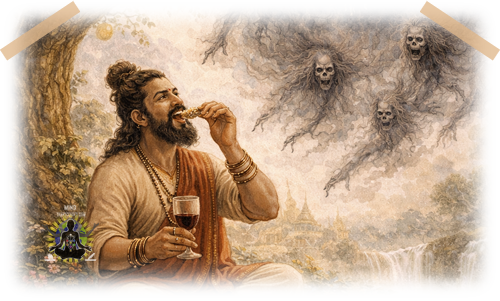
Once, a wandering man accidentally found himself in heaven.
According to Indian tradition, heaven contains a wish-fulfilling tree known as the Kalpavriksha.
All one must do is sit beneath it, make a wish, and it is instantly fulfilled. There is no delay between desire and manifestation.
The traveler was exhausted and fell asleep beneath the tree.
When he awoke, he felt terribly hungry.
„I am so hungry,“ he thought. „I wish I could find some food.“
Instantly, delicious food appeared before him as if it had fallen from the sky.
He was so hungry that he paid no attention to where it had come from. He immediately began to eat. The food was so delicious that he completely lost himself in the experience.
After satisfying his hunger, he looked around.
Feeling content, another thought arose:
„If only there were something to drink.“
Since heaven imposes no restrictions, a magnificent wine appeared at once.
The traveler sat beneath the tree, enjoying the cool breeze and the shade while sipping his wine.
Then a thought entered his mind:
„What is happening? Am I dreaming? Or are spirits playing tricks on me?“
The moment he thought of spirits, they appeared.
Terrible spirits.
Fierce, hideous, and horrifying.
The man trembled with fear.
Another thought arose:
„These creatures are surely going to kill me!“
The tree granted that wish as well.
The Lesson
The Kalpavriksha symbolizes the mind.
The story suggests that reality is often shaped less by external circumstances than by the contents of our own consciousness. The traveler first creates pleasure through his desires, then suffering through his fears. The same power that manifests food and wine also manifests demons.
Many spiritual traditions teach that the mind is not merely a passive observer of reality but an active participant in creating the world we experience. Our hopes, expectations, fears, beliefs, and unconscious habits influence how we perceive life and how we respond to it.
The story also serves as a warning. Most people are careful about what they say, but few are careful about what they repeatedly think. A fearful mind tends to create fearful worlds. An anxious mind finds reasons to worry. A grateful mind discovers reasons to rejoice.
A Tibetan saying expresses a similar idea:
„In life, you create the mind. In death, the mind creates you.“
The saying points to the importance of cultivating awareness while we are alive. According to Tibetan Buddhism, death resembles a dreamlike state in which the ordinary structures of physical reality dissolve. What remains is consciousness itself, encountering the contents it has accumulated throughout life.
Whether understood literally or symbolically, the lesson remains the same: the quality of our experience depends greatly on the quality of our mind.
The traveler did not suffer because of the tree.
He suffered because he did not understand the power of his own thoughts.
When the Birds Stopped Coming
Before the Zen master Gutei Ishi became a master, he was already becoming famous as a student.
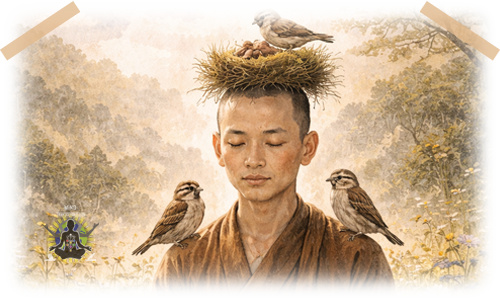
People spoke of him everywhere because birds would come and land on his shoulders and head while he meditated.
On one occasion, a bird even began building a nest in his hair.
Soon, the entire country knew of Gutei. People revered him as a living Buddha.
When his teacher heard about this, however, he became angry.
„What is that bird doing in your hair?“ he demanded. „Stop all this nonsense!“
Gutei felt hurt by his master’s words, but in that very moment he understood.
From that day forward, the birds stopped coming.
People continued to visit him, but they noticed that the birds were gone. The animals no longer gathered around him as they once had.
Confused, they went to his teacher and asked:
„What happened to your student? Birds used to come to him. Animals would sit beside him. Now there is no sign of any of them.“
The master replied:
„Gutei disappeared. He is no longer special.“
„The birds no longer notice him. The animals simply pass him by. He is no longer there.“
„In the beginning, Gutei was still there. He was becoming a special person. A very subtle ego was beginning to grow. He was becoming enlightened.“
The master smiled.
„But now Gutei has abandoned even enlightenment itself. So why should the birds come? Why should the animals gather around him? They can sit anywhere they like. It is all the same.“
„There is nobody there anymore.“
The Lesson
This story points toward one of the deepest paradoxes in Zen: even spirituality can become a form of ego.
Most people imagine that the spiritual path is about becoming something extraordinary. They want to become wiser, more enlightened, more peaceful, more respected, or more spiritually advanced than others. Yet Zen repeatedly warns that the desire to become special is simply the ego wearing a spiritual mask.
At first, Gutei unconsciously enjoyed the attention. The birds became a symbol of his progress. The admiration of others reinforced a subtle sense of importance. Nothing dramatic had happened, yet a new identity was beginning to form-the identity of someone who was enlightened.
His teacher recognized the danger immediately.
The problem was not the birds. The problem was the attachment to what the birds represented.
True awakening, according to Zen, is not becoming extraordinary. It is becoming ordinary again. It is the disappearance of the one who wants recognition, achievement, status, or even enlightenment itself.
When the ego vanishes, there is no longer anyone left to be special.
This is why the birds stopped coming.
Not because Gutei had lost something, but because he had finally let go of it.
Zen suggests that the highest spiritual achievement is not becoming a saint, a sage, or a Buddha in the eyes of others. It is becoming so empty of self-importance that nothing remains to distinguish you from the rest of existence.
The moment you stop trying to be someone, you become free.
Where God Chose to Hide
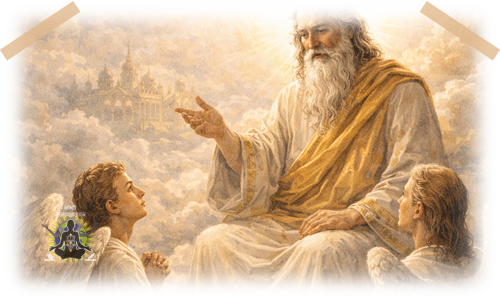
In the beginning, when God created the world, He lived on Mahatma Gandhi Road in Bangalore, India.
As time passed, however, He grew tired.
People constantly bothered Him with complaints and demands.
In the middle of the night, the telephone would ring.
„Why didn’t You do this?“
„Why did You allow that?“
„What is the reason for all this?“
Eventually, God had enough.
He called His advisers together and said:
„Help me. I would like to go somewhere and hide from people.“
Then He confessed:
„In creating humanity, I made my greatest mistake.“
After creating human beings, God no longer wished to create anything else.
One of His advisers suggested:
„You could go to the Himalayas. No one will ever find You there.“
God laughed.
„You know nothing. In only a few thousand years-which for me is merely a few seconds-people like Edmund Hillary and Tenzing Norgay will climb the highest mountains and find me there.“
„And once they do, the entire population of Mahatma Gandhi Road will follow them.“
Another adviser offered a different idea.
„Then why not go to the Moon?“
God shook His head.
„In a few more seconds, they will reach the Moon as well. They will reach everywhere.“
The advisers fell silent.
Then the oldest among them stepped forward and whispered something into God’s ear.
The moment God heard it, His face lit up with joy.
At last, He had found the perfect solution.
The old adviser had said:
„My suggestion is that You hide inside human beings themselves.“
„They will climb mountains, cross oceans, travel to the Moon, journey to Mars, and explore distant stars. They will search everywhere.“
„But one place they will never think to look is within themselves.“
„So hide in the human soul.“
The Lesson
This story is not really about God hiding from humanity. It is about humanity hiding from itself.
People spend their lives searching for fulfillment, meaning, happiness, truth, and even God in the external world. They travel across continents, pursue wealth, chase success, collect knowledge, and seek extraordinary experiences. Yet the deeper they search outwardly, the further they often drift from the one place where genuine understanding can be found.
Many spiritual traditions, despite their differences, point toward the same insight: the ultimate reality we seek is not somewhere else. It is not hidden on mountaintops, in distant galaxies, or behind secret teachings. It is discovered through self-knowledge and direct inner experience.
The humor of the story lies in its irony. Humanity is capable of reaching the highest peaks and the most distant planets, yet often struggles to sit quietly with itself for a few minutes. We explore the outer universe while remaining strangers to our own inner world.
The old adviser’s wisdom suggests that the greatest mystery is not beyond us but within us. The deepest questions cannot be answered merely by moving farther away. Sometimes they are answered by becoming still.
Whether one calls it God, truth, consciousness, enlightenment, or the soul, the story points toward the same possibility:
What we are searching for may already be closer than our next thought.
It may be hidden in the very place we least expect to look.
- 13 Zen Stories That Can Change the Way You See Life
- 5 Zen Stories from Ikkyū Sōjun, the Rebel Monk Who Defied Traditione
- Here and Now: Zen Stories That Reveal the True Nature of Life
- The Story of Nagarjuna and the Thief
Author: Vasil Stoyanov