
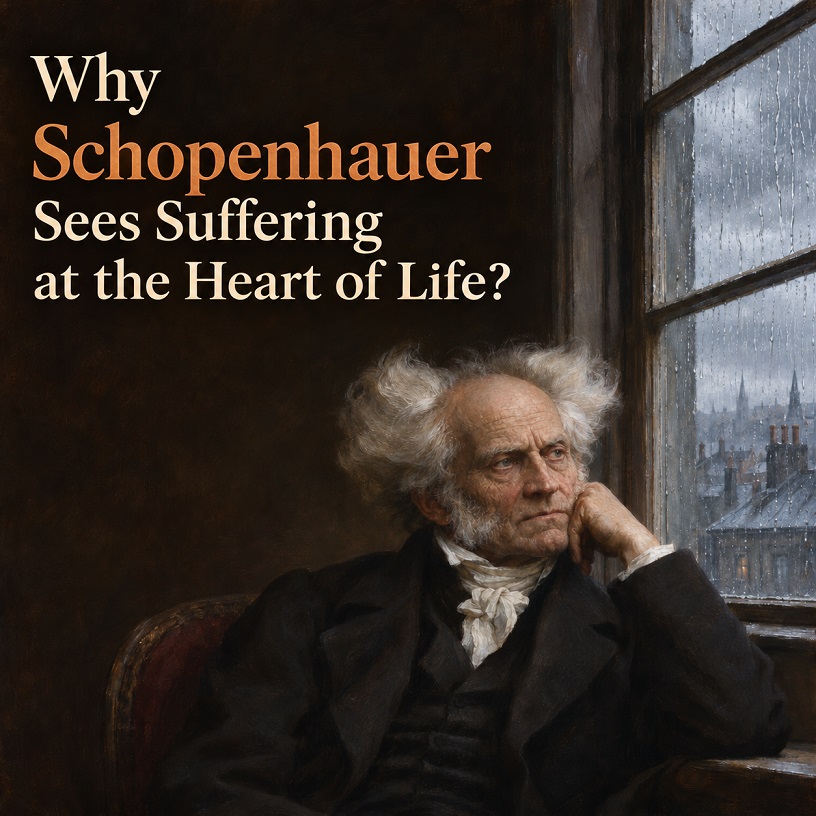
Why do human beings continue to desire even after obtaining what they have long dreamed of? Why does satisfaction so often prove fleeting, followed by another anxiety, another ambition, another sense of something missing? Arthur Schopenhauer placed these painfully familiar questions at the center of one of the boldest philosophical systems of the nineteenth century. His major work, The World as Will and Representation, does not merely assert that life contains suffering. It attempts to explain why dissatisfaction is woven into the very structure of existence, what our bodies and desires disclose about reality, and why art, compassion, and the renunciation of endless pleasure-seeking can transform our relationship with life.
Schopenhauer is celebrated as the philosopher of pessimism, but that label easily conceals the richness of his thought. He is a penetrating observer of human psychology, an original interpreter of Kant, a passionate advocate of music, and the author of a moral philosophy in which the suffering of others is decisive. His world contains ruthless struggle but also beauty; blind impulses but also moments of disinterested contemplation; unavoidable vulnerability but also the possibility of ceasing to be a slave to one’s desires. To understand this remarkable thinker, we must follow the path from the theory of knowledge to the drama of the will, and from there to the question of how to live among beings who suffer.
An Extraordinary Philosophical System and Its Historical World

Arthur Schopenhauer was born in 1788 in Danzig, then a free city and now Gdańsk in Poland. He grew up in a commercially prosperous family with cosmopolitan interests, and his travels through Europe introduced him early to the diversity of human life. Initially directed toward a commercial career, he gradually chose philosophy. He studied in Göttingen and Berlin, completed his dissertation On the Fourfold Root of the Principle of Sufficient Reason in 1813, and developed his thinking during an era when German philosophy was profoundly shaped by Immanuel Kant and the ambitious systems of post-Kantian idealism.
The first edition of The World as Will and Representation appeared in 1818, bearing 1819 on its title page. At first the book received little of the recognition its author expected. Schopenhauer remained for decades in the shadow of Hegel and the academic philosophical movements he despised. Later he published supplementary volumes, essays, and works on ethics. In 1851, Parerga and Paralipomena finally brought him much wider public recognition. He died in Frankfurt am Main in 1860, having witnessed the beginning of his belated fame.
This biography matters, but not because the author’s difficult temperament automatically explains his philosophy. Schopenhauer was combative, frequently unfair toward his rivals, and prone to harsh personal judgments. His system, however, cannot be reduced to his personality. It was conceived as a coherent answer to what the world is when considered both as an object of knowledge and as a reality experienced from within. He was not content with moral complaints about the human condition. He sought a general principle capable of explaining nature, organisms, behavior, and the tragic repetition of desire.
The book’s title contains its central tension. The world is representation because everything we know as an object appears to a knowing subject through particular forms of perception and thought. The world is will because behind appearances Schopenhauer identifies a fundamental striving that is not equivalent to a rational intention. These are not two separate worlds arranged one above the other, but two ways of considering the same reality. The book moves continually between them to demonstrate why the external explanation of things does not exhaust their inner nature.
His most important philosophical predecessor was Kant. In the Critique of Pure Reason, Kant distinguishes appearances, which human knowledge can access, from the thing in itself, which cannot be known as an ordinary object of experience. Schopenhauer accepts the decisive importance of this distinction but believes he has discovered a special route toward reality’s inner nature. That route passes through our own bodies. We know the body externally as an object among objects and internally as immediately experienced willing and acting. This duality becomes the key to his metaphysics.
Alongside Kant, Plato and Indian philosophical traditions were important influences, encountered through translations and European interpretations available at the time. Schopenhauer recognized affinities between his critique of appearances and certain themes in the Upanishads and Buddhism. Historical care is necessary here: his understanding of those traditions was shaped by the limited sources of nineteenth-century Europe and does not fully coincide with their own teachings. Nevertheless, his encounter with non-European thought helped him move beyond the complacent assumption that philosophy possesses an exclusively European history.
Already in this historical setting, the distinctive ambition of his project becomes clear. Schopenhauer does not rigidly separate epistemology, nature, art, and morality. He connects them through one question: what does it mean to be living creatures who desire, know, and suffer? His answer is dark but not superficial. He attempts to explain why reason does not govern life as completely as we like to imagine, and why liberation from restlessness cannot be secured simply by acquiring more possessions.
The World as Representation: The Limits of What We Call Reality
Schopenhauer begins his major work with the famous declaration that the world is his representation. It can sound like the assertion of someone denying the existence of other people, but its meaning is more precise. Every world that can be seen, described, measured, or explained appears within a relationship between subject and object. We never encounter an object wholly detached from the conditions under which it becomes available to knowledge. Perception is not a passive copying of a finished reality. It is organized experience involving the forms of our cognitive capacities.
Space and time are not accidental additions to experience. They are basic forms through which we distinguish things and events. Causality allows us to perceive changes as connected in a determinate order. When we see a stone breaking a window, we do not receive merely two disconnected visual impressions. We understand an event involving action and consequence. Schopenhauer gives causality a central role in perception and seeks to explain how sensations become knowledge of external objects.
He connects these forms with the principle of sufficient reason, the demand that appearances be explained through their appropriate relations of ground and consequence. In his early dissertation he distinguishes several ways this principle operates: in the causal connections of nature, the logical justification of judgments, the relations of space and time, and the motivation of human actions. This distinction matters because not all explanations are of the same kind. The cause of a physical movement is not identical to the logical ground of a mathematical conclusion.
Imagine someone watching a storm. They see clouds, lightning, trees bending, and feel the wind against their skin. Meteorology can describe atmospheric pressure, electrical discharges, and the movement of air masses. Such explanations are real and valuable. Yet they remain within the world as representation: they establish relationships among appearances. By themselves, they do not answer the metaphysical question of why this active nature exists at all, continually producing movement, conflict, and change.
This distinction does not diminish science. On the contrary, Schopenhauer accepts that the sciences provide precise knowledge of the regularities of appearances. His objection concerns the claim that a complete description of causal relationships necessarily discloses the inner essence of the world. However thoroughly we investigate the mechanisms of a living body, one fact remains: we do not experience our own body merely as a machine. We are that body and feel its impulses from within.
The subject of knowledge is not simply another object discoverable among other objects in precisely the same manner. It is the condition under which anything appears as an object. Schopenhauer uses this idea to challenge naive realism, according to which consciousness merely reflects an entirely ready-made world. At the same time, his position does not imply that each individual can arbitrarily change reality through thought. The laws of experience do not depend on an observer’s wishes. The world as representation is a structured and shareable domain of knowledge, not a private fantasy.
Here the philosophical intrigue begins. If everything we know externally is appearance, how can we speak at all about what lies beyond appearance? Kant warns that knowledge has limits. Schopenhauer does not reject that warning; he searches for an exceptional case in which one and the same thing is given to us in two ways. He discovers this case in our bodily existence. From here begins the transition from the world as representation to the world as will, simultaneously the most original and the most disputed move in his entire system.
The World as Will: The Body as a Key to Existence’s Hidden Side

When we raise an arm, the action can be described from outside: muscles contract, joints move, and nerve impulses participate in a complex physiological process. For the person acting, however, this is not merely an observed event. The movement is experienced as their own act of willing. Schopenhauer emphasizes that the volitional act and the bodily movement are not two separate events connected by some mysterious causal thread. They are the same action given in two different ways: immediately from within and as an observable object from without.
From this experience the philosopher develops his audacious metaphysical thesis. If our own body possesses an inner side known as will, we have grounds to seek an analogous inner essence behind other appearances. Schopenhauer extends the concept beyond conscious human decisions. In his view, will manifests itself in animal instincts, plant growth, organic processes, and even the forces of nature. It is not a rational cosmic ruler who has chosen the universe’s goals in advance. It is a blind and tireless striving toward manifestation.
The everyday meaning of the word will is misleading here. Ordinarily we speak of willpower when consciously deciding to do something. For Schopenhauer, conscious decision is only one among many ways in which a deeper striving becomes visible. Hunger does not begin with a philosophical decision to need food. The impulse toward self-preservation acts before we explain it. Sexual desire often precedes the rational justifications we later construct. The organism strives before reason has composed a story about that striving.
Schopenhauer calls the will irrational not because every human desire is foolish, but because the fundamental impulse is not organized around a final, rationally selected objective. It never reaches a condition in which it declares everything accomplished and nothing further necessary. Desire gives rise to action, action encounters resistance, satisfaction lasts briefly, and another lack takes its place. Even when reason carefully plans the means, it frequently serves ends that it has not selected from an entirely independent position.
This conception overturns the popular picture of human beings as creatures governed primarily by rational consciousness. Reason is a powerful instrument, but it is not necessarily the original source of our aims. Someone can offer magnificent arguments for a decision they wanted long before beginning to justify it. They can know that a habit is destructive and nevertheless repeat it. They can swear that a particular desire has ended, only to discover that it still governs them. Schopenhauer sees these contradictions not as accidental failures of reason but as windows into the structure of life.
Will is one in a metaphysical sense, although it appears in numerous separate beings. Space and time distinguish individuals in the world of representation; the inner striving Schopenhauer calls will is not divided in the same manner. He uses this distinction to explain nature’s paradox: the same fundamental force appears in organisms that struggle against one another. Life sustains itself through feeding, competition, and the destruction of other living forms. Nature does not resemble a harmonious theater in which every creature receives a fair share of happiness.
This metaphysics is not a scientific theory demonstrated by experiment. The passage from the immediate experience of our own will to the assertion that will is the essence of all appearances remains philosophically controversial. Knowing our bodies from within does not logically establish, without further argument, that gravity, growth, and human desire share one metaphysical nature. Despite this difficulty, the idea is exceptionally fertile. It places at the center of philosophy what rationalistic pictures often underestimate: life’s unceasing activity and consciousness’s limited authority over its own motives.
The importance of the body extends further. It destroys the comfortable distance between observer and world. We are not disembodied minds watching nature from outside. We participate in it through hunger, fatigue, pain, excitement, fear, and the drive to survive. The body is simultaneously an object of knowledge and a site of experience. In this double position Schopenhauer finds a philosophical resource that would influence later thinkers interested in unconscious motivation, vital impulses, and the bodily foundations of human existence.
Why Desire Produces Suffering: Between Lack, Satisfaction, and Boredom

Schopenhauer’s best-known thesis is that suffering is not merely an unfortunate accident within an otherwise perfectly arranged life. It follows from the very nature of will as striving. To desire is to experience the absence of something toward which one is directed. The hungry person does not possess the calm of someone who has eaten; a lover whose feelings are unanswered cannot simply order those feelings to disappear; someone obsessed with recognition experiences every slight as a wound. Desire reveals the world as insufficient in relation to what we demand from it.
When the goal is reached, tension diminishes. Yet satisfaction rarely closes the circle permanently. New needs replace old ones, circumstances change, and what has been acquired must be protected. Someone dreams of a particular job, then after being hired begins worrying about advancement. They strive for a home, then discover its expenses, maintenance, and the fear of losing it. They want respect, then once it is granted begin monitoring whether it is fading. None of this proves that achievements are meaningless. It shows why no individual achievement can become a final solution to human dissatisfaction.
Schopenhauer describes life as a movement between pain and boredom. While desire remains unsatisfied, we experience lack and tension. When needs temporarily fall silent, the emptiness of an existence without an absorbing purpose comes forward. Boredom is especially important to his argument because it shows that the absence of immediate suffering does not equal positive happiness. Someone can enjoy comfort and abundant free time while still being tormented by purposelessness.
His pessimism differs from an ordinary gloomy mood. He does not merely say that many bad things happen in the world. He argues that there is a structural mismatch between the will’s insatiability and the limits of every possible satisfaction. Every gain is temporary because living beings remain exposed to need, loss, and death. No possession removes an organism from time. No social position eliminates vulnerability. Even the most successful life remains a life that must constantly be maintained.
Schopenhauer reaches striking conclusions about happiness. He frequently treats pleasure as negative in the sense that it removes a preceding lack, while pain is experienced immediately as the positive presence of suffering. This is a philosophical thesis about the asymmetry of experience, not a universally accepted finding of contemporary psychology. Many joys possess a rich positive character that cannot be reduced to the ending of discomfort. Nevertheless, his observation captures something recognizable: we often notice health only after losing it, and take tranquility for granted while anxiety immediately commands attention.
His understanding of adaptation is particularly penetrating. Human beings become accustomed to improved conditions and gradually cease to experience them as exceptional. Yesterday’s ultimate achievement becomes today’s ordinary starting point. Desire measures itself not against an earlier need but against a new and higher objective. This helps explain why material progress does not automatically produce a proportionate increase in satisfaction. Schopenhauer does not deny the benefits of better conditions; he rejects the fantasy that accumulation alone will end restless striving.
Love and sexuality occupy an important place in this picture. Schopenhauer interprets them through the species’ interest in perpetuating life, an interest he believes frequently overrides individual plans. His explanations are marked by the biological knowledge and gender prejudices of his era and should not be accepted as definitive science about human relationships. Yet beneath his provocative formulations lies a serious question: how far do our strongest feelings follow goals we understand, and how far do they draw us into processes whose consequences we never anticipated? Falling in love can bring enormous joy, but also dependence, jealousy, and destructive anxiety.
Schopenhauer does not simply advise abandoning every goal and ceasing to act. He himself wrote, published, argued, and sought recognition. A tension exists between his philosophical diagnosis and his personal behavior, and it should not be concealed. The more important question is what follows from recognizing that desires can never be satisfied once and for all. One possibility is to continue seeking salvation in the next acquisition. Another is to begin distinguishing necessary needs from the endless demands we ourselves sustain.
Here pessimism acquires unexpected practical force. If we accept that happiness cannot be guaranteed by completely subordinating the world to our wishes, we stop demanding the impossible from every relationship, job, and life change. We can value good moments without insisting that they last forever. We can pursue meaningful goals without turning them into promises of final liberation from human vulnerability. Schopenhauer remains more radical than this moderate lesson, but his extremity forces us to recognize how frequently we confuse temporary satisfaction with a permanent answer.
Nature Without a Comforting Mask: Struggle, Individuality, and Inevitable Death

Schopenhauer does not derive his pessimism solely from human disappointments. He looks toward the whole of living nature and sees a world in which organisms exist at the expense of other organisms. Plants compete for light and space; predators feed upon prey; animals face hunger, disease, and danger. Life produces astonishing forms but provides no universal protection for individual creatures. The same nature that creates beauty and diversity also generates destruction and fear.
For the philosopher this is not a moral accusation against animals. A lion does not commit a crime when hunting, and a plant is not malicious when it overshadows another. The issue is a deeper contradiction: will manifests in numerous distinct forms that inevitably obstruct one another. Each being affirms its own existence, but the conditions of that affirmation frequently threaten the existence of another. Struggle is therefore not an accidental flaw in nature’s order. It belongs to the way life manifests itself.
Schopenhauer wrote before Darwin’s On the Origin of Species appeared in 1859, and his metaphysics should not be confused with natural selection. Evolutionary biology explains diversity and adaptation through mechanisms that do not require a metaphysical will. Similarities in observations of competition do not make the explanations identical. The distinction is fundamental: science investigates testable processes, whereas Schopenhauer proposes a general interpretation of reality’s inner nature.
The deepest tension concerns individuality. Each of us experiences ourselves as the center of our world. Our own pain is immediate, our own future seems incomparably important, and our own death arouses a distinctive fear. From the standpoint of the world as representation, this separateness is a genuine feature of experience. According to the metaphysics of will, however, it does not exhaust reality. Numerous individuals are different appearances of the same underlying essence. This opens the possibility of reconsidering egoism as a limited perspective rather than the final truth about our place among others.
Death exposes the limits of individual will most sharply. A person makes plans, accumulates knowledge, forms relationships, and gradually turns their biography into a complex world of meanings. Yet the body ages, becomes ill, and dies. No sufficiently intelligent plan can turn individual existence into an unconditional possession. Schopenhauer regards fear of death as an expression of the will to life resisting the termination of its particular form. Reason knows about mortality, but this knowledge does not abolish the primary impulse toward self-preservation.
Here the philosopher distinguishes the individual from metaphysical will. The particular person disappears as an appearance in time, whereas will, according to his system, is not subject to the same forms of individuation. This is not proof of personal immortality and does not promise the preservation of memories, character, or conscious identity after death. On the contrary, it weakens the claim that the separate personality is reality’s eternal center. Schopenhauer attempts to reduce the terror of death by placing individual life within a wider metaphysical perspective.
His view must not become an excuse for indifference toward concrete suffering. Precisely because an individual life is fragile, its pain matters. There is no comfort in the abstract assertion that life continues if that assertion leads us to neglect someone grieving a loved one or an animal experiencing pain. The strongest aspect of Schopenhauer’s ethics arises from the opposite movement: from the metaphysical commonality of living beings toward a deeper sensitivity to their vulnerability.
The view of nature therefore has a double effect. It destroys the romantic picture of a world designed exclusively for human well-being, while also undermining the complacent conviction that only human interests count. If suffering is widespread among living creatures, moral concern cannot remain confined within the boundaries of personal success. It is precisely from this observation that the transition from metaphysical pessimism to compassion begins.
Art as Liberation: Why Beauty Interrupts the Power of Desire
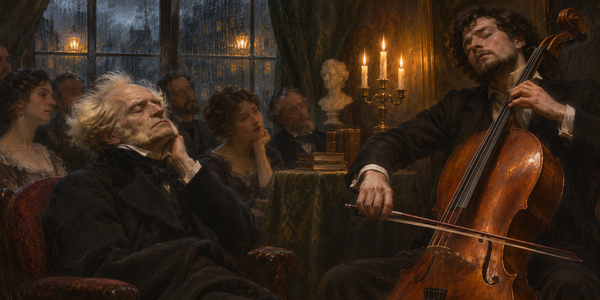
After such a severe diagnosis, a natural question arises: are there moments when human beings cease to be driven from one lack to another? Schopenhauer answers through his aesthetics. Art can temporarily interrupt the ordinary regime of desire because it allows us to contemplate things without immediately subordinating them to personal needs. In such a moment we do not ask what we will gain, what threatens us, or how we can use what we see. Attention is released from the ceaseless calculation of advantage and disadvantage.
Imagine someone walking by the sea after an exhausting day. At first their thoughts concern unanswered messages, money, obligations, and unresolved conflicts. Then their gaze settles on the movement of waves, the light on the water, and the rhythm of the horizon. For a brief interval they stop experiencing the world as a list of tasks. The sea is neither a problem to solve nor an object to acquire. It is an image in which attention discovers its own wholeness. Such a moment does not eliminate difficulties, but it changes the way consciousness exists among them.
Schopenhauer describes aesthetic contemplation through the concept of the pure subject of knowledge. In ordinary life we view things through personal interests. In artistic experience, the individual self that constantly wants and worries temporarily recedes. This does not mean literally losing one’s identity. It means that private advantage ceases to govern attention. For a moment the world appears not as a battlefield but as something worthy of calm and concentrated understanding.
Here Plato‘s influence becomes visible. Schopenhauer argues that art allows us to grasp Ideas: enduring grades or forms of the will’s objectification that are not exhausted by particular accidental objects. An artist does not simply copy an individual tree, face, or building. The artist discovers within it a significant form overlooked by ordinary practical vision. This theory is not equivalent to the modern belief that art must be beautiful or realistic. For Schopenhauer, artistic insight can reveal the tragic, ugly, and terrifying, provided it frees attention from narrow self-interest.
Different arts possess different possibilities. Architecture makes visible relationships of weight, stability, and resistance. Sculpture and painting reveal forms of embodiment and character. Poetry and drama reach the complexity of human motives and conflicts. Tragedy occupies an especially high place because it presents suffering as an essential feature of life rather than merely the result of an isolated malicious act. Through the fate of dramatic characters, spectators see how fragile plans, virtues, and hopes are before forces that exceed them.
Music, however, receives an exceptional status. According to Schopenhauer, it does not represent Ideas in the same way as the other arts, but expresses will itself more immediately. That is why musical experience can be profoundly moving without telling a particular story or depicting a definite object. Melody moves through tension, deviation, expectation, and resolution; in this rhythm the philosopher recognizes an analogy with the movement of desire. Music does not tell us exactly what we long for. It confronts us with the general form of longing.
This high estimation of music strongly influenced nineteenth-century culture, including Richard Wagner during a particular period of his development. Nietzsche would later revise and contest aspects of Schopenhauer’s aesthetics while retaining the conviction that art is philosophically significant rather than mere entertainment. In this respect, Schopenhauer helps overcome the division between thinking and artistic experience. Art is not decoration added to real life; it reveals a distinctive route toward understanding its structure.
Nevertheless, aesthetic liberation is temporary. After the concert ends, the book closes, or the gallery is left behind, desires return. This transience makes art both precious and insufficient as a final solution. It demonstrates that consciousness is not entirely condemned to slavery under self-interest, but it does not automatically transform our entire relationship with life. For a deeper change Schopenhauer turns toward morality and compassion.
Compassion and Morality: How Another’s Pain Breaks Through the Walls of Egoism

Schopenhauer’s moral philosophy is among the strongest and most humane parts of his legacy. At first glance this seems paradoxical. How does a philosopher who describes the world as a blind struggle of will arrive at compassion as the foundation of morality? The answer is that the shared vulnerability of living beings undermines egoism’s claim to be the final truth. If suffering is not an accidental exception but a permanent possibility for every living organism, another’s pain cannot be dismissed as something wholly unrelated to ourselves.
In On the Basis of Morality, Schopenhauer contrasts compassion with moral theories that derive good action primarily from abstract duty or rational rules. For him, moral significance emerges when another person’s suffering directly becomes a motive for our action. We help not only because we expect a reward, fear punishment, or want to appear respectable. We help because another’s pain concerns us in itself. It ceases to be a distant fact and becomes a reason for care.
This does not mean compassion requires us to experience exactly what another person experiences. We never fully occupy someone else’s place. But we can recognize suffering as significant independently of our own advantage. Someone who stops to help a stranger does not necessarily receive any material benefit. Someone who cares for a sick animal expects no moral praise from it. Schopenhauer sees in such actions a breakthrough in the usual rule of personal interest.
He distinguishes justice and loving-kindness as fundamental expressions of moral concern. Justice restrains us from causing harm; it places a boundary upon our desires when satisfying them would injure someone else. Loving-kindness goes further and motivates active assistance. The first says that another’s suffering must not be produced for our advantage. The second says that when we encounter suffering, we can be moved to relieve it. Both arise through overcoming our absolute enclosure within ourselves.
The metaphysics of will provides compassion with a deeper explanation. Individual beings appear strictly separated in space and time, but according to Schopenhauer the same inner essence manifests within them. Compassion is a moment when this apparently absolute separation weakens. Someone ceases to regard another as a completely alien object and recognizes the commonality of vulnerable existence. This is a philosophical attempt to connect moral experience with a metaphysical picture of the world.
We should distinguish two claims. The first is psychological and moral: compassion really can motivate selfless help. The second is metaphysical: this capacity reveals the common essence of all beings as will. Someone may accept the importance of the first without agreeing with the second. Contemporary philosophical debates about empathy, altruism, and moral motivation do not necessarily require Schopenhauer’s metaphysics. His contribution remains significant because he places the real suffering of others at the center of moral attention.
His defense of animals is particularly noteworthy. Schopenhauer criticizes views that exclude animals from moral concern merely because they do not belong to the human species. An animal’s pain does not cease to be pain because the creature lacks human speech or rational argument. This position distinguishes him from influential traditions that draw a much harder boundary between human dignity and animal existence. For him, cruelty toward animals is not a minor moral lapse but evidence of an inability to recognize another being’s vulnerability.
Compassion is not sentimental admiration for our own goodness. It is difficult because it requires allowing another’s suffering to disturb our comfort. Sometimes helping costs time, money, peace of mind, or personal risk. Sometimes it requires admitting that we caused harm even while believing ourselves right. Sometimes it forces us to see suffering society has become accustomed to ignoring. In this respect, Schopenhauer’s ethics is not an invitation to passive pity but to moral awakening.
Of course, compassion has limits and difficulties of its own. Human feelings can be partial; we more easily sympathize with those close to us and with people whose stories we know. Moral decisions often require rules, fair procedures, and attention to long-term consequences, not merely immediate sympathy. Schopenhauer does not resolve these problems definitively. But he reminds us of something no system of rules should forget: behind every abstract category stands a being for whom pain is an immediate reality.
The Denial of the Will: Asceticism, Liberation, and the Difficult Question of Meaning
If will is the source of unceasing suffering and art only temporarily releases us from its power, what would the deepest possible liberation look like? Schopenhauer arrives at the idea of the denial of the will to life. This is the most radical and controversial element of his system. It does not mean merely losing interest in one goal or giving up a particular habit. It means transforming our entire relationship with desire, so that the ceaseless assertion of the self is no longer accepted as existence’s highest law.
Schopenhauer connects this transformation with ascetic practices, restraint, voluntary simplicity, and renunciation of certain pleasures. In his account, saints and ascetics from different traditions demonstrate the possibility of not being governed entirely by the usual impulses toward possession, enjoyment, and power. He sees similarities between Christian asceticism and certain Indian teachings, although he interprets them through his own metaphysical framework. For him the decisive point is not outward membership in a particular religion but an inward change in one’s relationship to will.
A misunderstanding easily arises here. Denying the will is not equivalent to claiming that suicide constitutes philosophical liberation. Schopenhauer explicitly distinguishes the two. According to his reasoning, suicide does not destroy will as a metaphysical essence; it terminates an individual’s particular appearance, often precisely because someone desires a life without the suffering they are experiencing. This distinction belongs to the structure of his philosophy. It is not practical behavioral advice and must not replace actual care for people in crisis.
The more important idea is that freedom does not consist exclusively in satisfying more desires. It can include the ability not to follow every impulse that arises. Someone who constantly compares themselves with others does not become free merely by winning the next competition. They remain dependent on comparison. Someone unable to tolerate silence without continuous entertainment does not command their own time, however many options they possess. In this sense, relinquishing certain desires can increase freedom rather than diminish it.
Yet Schopenhauer goes further than ordinary moderation. He questions the will to life itself as the foundation of individual existence. This creates a difficult philosophical problem: if will is the essence of the world, how can it deny itself through a being that it produces? Schopenhauer answers through the idea that knowledge of suffering and of the shared essence of beings can transform how will manifests itself. In certain cases consciousness ceases to be merely an instrument for satisfying impulses and becomes a condition for their quieting.
Critics raise serious questions. Does denial of the will devalue joy, creativity, and human relationships? Does the desire for liberation from desire itself become a new desire? Is asceticism an accessible or desirable path for everyone? Nietzsche would later oppose the ideal of life-denial especially fiercely, despite being deeply influenced by Schopenhauer. For Nietzsche, the task is to affirm and transform life; for Schopenhauer, the deepest insight directs us toward quieting the very striving that holds us captive.
The difference between them reveals the richness of the philosophical problem. One position asks how we can say yes to existence despite suffering. The other asks how we can lessen the power of what continually reproduces suffering within us. Neither question can be exhausted by an easy formula. Human life involves both a need for action and a need for rest, a desire for development and a need for acceptance, a striving for achievement and fatigue from endless competition.
For contemporary readers, the most fruitful encounter with Schopenhauer’s asceticism does not require uncritical acceptance of his entire metaphysics. It begins by asking which desires genuinely deserve our energy. We can distinguish the need for recognition from the need for meaningful connection, the pursuit of sufficiency from insatiable accumulation, and the joy of creation from the compulsion to prove our worth continuously. These are moderate practical implications of a much more radical system. They do not replace its original thesis, but they show why it continues to provoke reflection.
Schopenhauer’s Legacy: A Pessimism That Teaches Us to See More Clearly

Schopenhauer’s influence extends far beyond academic philosophy. His ideas reached literature, music, psychology, and cultural criticism. Richard Wagner found in them a philosophical language for the power of music and the tragic conflicts of desire. Friedrich Nietzsche initially saw Schopenhauer as a model of independent thought before becoming one of his sharpest critics. Writers such as Thomas Mann discovered in his system a dramatic resource for reflecting on death, passion, and human self-destruction. This influence is no accident: Schopenhauer writes about problems that are felt before they are formulated philosophically.
His influence upon emerging psychological conceptions of unconscious motives is also frequently discussed. We must not construct an oversimplified history in which Schopenhauer had already discovered every idea of later psychoanalysis. His will is a metaphysical principle, not the same concept as Freud’s unconscious. Nevertheless, he helped undermine confidence that conscious reason completely controls human behavior. He showed how desires can use thinking for their own purposes and how our explanations of ourselves often arrive after the impulse itself.
In the contemporary world this diagnosis acquires particular force. Advertising constantly presents new objects as solutions to inner deficiencies. Social media turns attention and recognition into measurable indicators. Professional culture frequently suggests that every level achieved is merely preparation for the next. Even leisure can be subordinated to pressure to experience more, visit more places, and turn relaxation into another demonstration of a successful life. Schopenhauer would recognize in these dynamics new forms of an old mechanism: desire, brief satisfaction, adaptation, and renewed desire.
This does not mean his philosophy condemns technology, development, or human ambition as such. It gives us an instrument for distinguishing means from ends. More opportunities do not guarantee greater inner freedom. More information does not guarantee wisdom. More consumption does not guarantee satisfaction. The question is whether we use our acquisitions to live more consciously or have turned acquisition itself into an endless process that never reaches its meaning.
His aesthetics remains relevant as well. In a culture constantly demanding attention and reaction, disinterested contemplation is a rare experience. Listening to music without another task, reading a novel without rushing toward a summary, looking at a painting without immediately turning it into a photograph to display: these are ways to free attention from constant utility. Schopenhauer reminds us that not every valuable encounter with the world must end in a measurable result. Some of our deepest experiences arise when we stop asking what we will obtain from them.
His ethics raises equally contemporary questions. When discussing public policy, economics, animal welfare, or relationships between generations, it is easy to become lost in abstract indicators. Schopenhauerian compassion requires us to remember that behind statistics stand beings for whom pain is not an abstraction. This does not remove the need for reasonable rules and careful assessment of consequences. It prevents rules from turning into soulless procedures that forget why they exist in the first place.
His philosophy also has significant limitations. His views about women include openly discriminatory generalizations that cannot be defended as universal truths about human nature. His speculations concerning sexuality and heredity are limited by the knowledge of his era. The metaphysical thesis of one will behind all appearances lacks empirical proof. And the ideal of denying the will can seem incompatible with the value many people find in active participation in life. An authoritative interpretation does not hide these weaknesses. It separates powerful philosophical insights from claims requiring criticism.
Schopenhauer’s greatest strength is his refusal to comfort us with empty promises. He does not say that every instance of suffering has a secretly beneficial purpose. He does not insist that the world is arranged so that the virtuous must eventually be rewarded. He does not offer the fantasy that enough wealth, power, or recognition will permanently eliminate human anxiety. Instead, he asks us to look at life without embellishment and consider what can actually be changed: circumstances, our relationship to desires, our capacity for contemplation, and our willingness to recognize another’s pain.
There is also a distinctive humility in this philosophy. We are not omnipotent directors of our own biographies. Our bodies have needs, circumstances impose limits, and desires frequently lead us where reason never intended to go. Acknowledging this does not mean abandoning responsibility. It means ceasing to base responsibility on the illusion of absolute control. A person can become wiser by understanding which battles are unavoidable, which are produced by their own vanity, and which do not deserve to be fought at all.
At the same time, pessimism must not become another dogma. There are human experiences-love, trust, play, discovery, creative inspiration-whose value cannot be exhausted by the cessation of pain. There are forms of suffering that can and should be reduced through medicine, just institutions, education, and mutual care. Schopenhauer’s system is most useful when we approach it as a powerful philosophical interlocutor rather than a prohibition against noticing everything that does not fit its pessimism. His insight deserves respect but does not require surrendering our own judgment.
Ultimately, The World as Will and Representation leaves us with a question both simple and endlessly difficult: what does it mean to live well when we cannot eliminate every cause of suffering? Schopenhauer answers through knowledge of the limits of representation, an understanding of will’s blind striving, the liberating force of art, the moral significance of compassion, and the possibility of profoundly quieting desire. Even when we do not accept his ultimate conclusions, he helps us distinguish genuine freedom from the endless pursuit of the next reward.
That is why his philosophy continues to move readers. It begins with the uncomfortable truth that life was not designed around our expectations and reaches the discovery that we are not obliged to turn every expectation into a command. We can look more attentively, desire more thoughtfully, listen to music without self-interest, and show greater mercy toward the beings with whom we share the world’s fragility. Schopenhauer does not promise easy happiness. He offers something rarer: a philosophy that takes suffering seriously and, precisely for that reason, teaches us to value the moments when we cease to be its blind accomplices.
Author: Vasil Stoyanov