
Sufism is a mystical tradition within Islam in which spiritual knowledge, purification of the heart, and love of God occupy a central place. Over the centuries, Sufi teachers have conveyed their understanding of human nature not only through philosophical writings and poetry but also through stories filled with paradoxes, extraordinary encounters, and trials. The following ten narratives are literary retellings of stories from the classical works of Rumi, Farid al-Din Attar, and Saadi. Some are allegorical parables, while others belong to religious tradition and should not be regarded as historically documented events.
Moses and the Shepherd
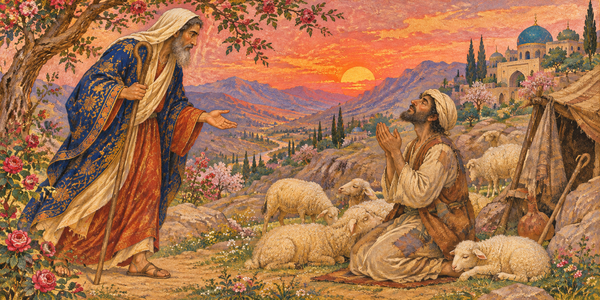
One day, the prophet Moses encountered a shepherd who was speaking to God. The man was alone among his flock, offering his prayers with such intimacy that he seemed to be talking to a dear friend. He promised to mend his Lord’s shoes, comb His hair, wash His clothes, and bring Him milk. Everything he knew how to do for those he loved, he wished to do for God as well.
When Moses heard these words, he was indignant. He asked the shepherd whom he was addressing. The man replied that he was speaking to the Creator of heaven and earth. The prophet rebuked him for attributing a human body and human needs to God. He explained that the Creator had no need of shoes, clothing, or food, and that such words were unworthy of Him.
The shepherd was devastated. Until then, he had believed that he was expressing the purest feeling in his heart, but now he had learned from the lips of God’s prophet that his prayer was wrong. He tore his garment, sighed deeply, and wandered away into the wilderness.
Then Moses received a revelation. God reproached him for separating a sincerely devoted person from Him. His mission was to bring people closer to God, not to drive them away. Each person had been given a different language and a different way of expressing the condition of the heart. God had no need for elegant words of prayer, for He knew what lay behind them.
Moses set out to find the shepherd. When he finally discovered him, he told him that he could pray freely without tormenting himself over the correctness of his expressions. But the shepherd had already undergone a profound inner transformation. His heartbreak had carried him beyond his former understanding of prayer. He thanked Moses and explained that his heart had now entered a state that words could not describe.
The Merchant and His Parrot
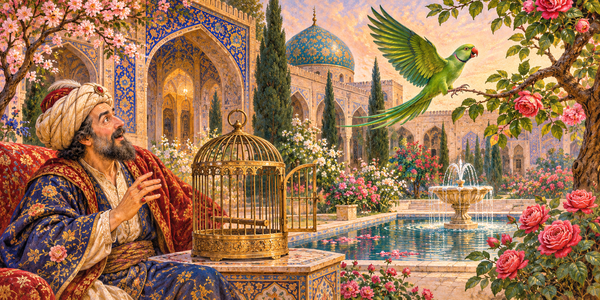
A wealthy merchant owned a beautiful parrot that he kept in a cage. The bird could speak and entertained its master. He cared for it, but however comfortable its shelter might have been, the bars always stood between the bird and the freedom of the outside world.
When the merchant was preparing for a journey to India, he asked the members of his household what gifts they would like. Finally, he turned to the parrot. The bird asked for neither jewels nor delicacies. Instead, it requested that he find the free parrots of India and tell them about its fate. It wanted them to know that one of their own spent its life in captivity while they flew beneath the open sky.
The merchant fulfilled the request. When he saw a flock of parrots among the trees in India, he delivered the message. One of the birds trembled, fell to the ground, and remained motionless. The merchant was saddened and regretted that his words had caused such misfortune. He concluded that the free parrot had died of grief for its captive companion.
Upon returning home, he distributed the gifts. The parrot immediately wanted to know what had happened to its message. The merchant was reluctant to recount the unpleasant incident, but eventually confessed everything. At that very moment, his bird fell to the bottom of its cage and ceased to move.
The merchant was overcome with despair. He mourned the loss of his beloved parrot, opened the cage, and removed its motionless body. No sooner had he placed it outside than the bird spread its wings and flew to a nearby tree.
The astonished merchant demanded an explanation. The parrot revealed that the bird in India had not died. It had conveyed a silent instruction: as long as the captive parrot displayed its talents and entertained its master, it would remain a valuable prisoner. To escape the cage, it had to relinquish the very thing that made it a desirable possession. After bidding farewell to the merchant, the parrot flew away, free at last.
The Elephant in the Dark Room
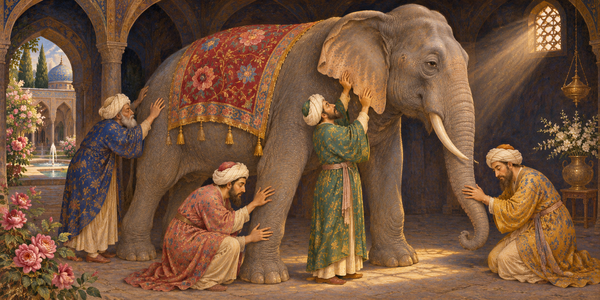
A group of people from India brought an elephant to a country where many had never seen such an animal. They housed it in a dark room. Curious visitors arrived one after another, but there was not enough light inside to distinguish the enormous creature. Their only means of discovering its appearance was through touch.
The first man stretched out his hand and encountered the trunk. Feeling its length and flexibility, he concluded that the elephant resembled something like a water pipe. Another visitor touched its ear. Its broad, flat surface convinced him that the animal was shaped like a fan.
A third man grasped one of the elephant’s legs. Beneath his hands, he felt a solid, massive support resembling a pillar. A fourth touched the animal’s back and decided that the elephant resembled a large bed or throne.
When they emerged from the room, the visitors began comparing their impressions. Each was confident in his own description because it arose from direct experience. The man who had touched the leg could not accept that the elephant was a fan. The one who had held the ear could find nothing in common between his experience and the description of a pillar.
None of them had touched something that did not exist. Each had genuinely discovered a part of the animal. But the darkness prevented them from seeing the relationship between the individual parts and turned their limited observations into grounds for disagreement.
Rumi concludes the parable with the image of light. Had each visitor possessed a candle, the differences between their descriptions would no longer have been irreconcilable. The same animal that appeared in darkness as a collection of incompatible objects would have revealed itself before their eyes as a single whole.
Sheikh Sanan and the Christian Maiden
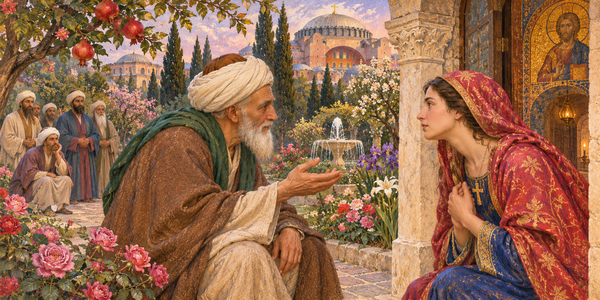
Sheikh Sanan was a respected spiritual teacher who had lived in Mecca for many years. Hundreds of disciples had gathered around him. He was well versed in religious teachings, had undertaken pilgrimages, and was renowned for his devotion. But one night he dreamed that he was in the lands of the Christians, bowing before an idol. The dream recurred and disturbed his peace.
Accompanied by his disciples, the sheikh set out for the lands of Rum. There he saw a beautiful Christian maiden and fell in love with her so intensely that his former self-control vanished. His disciples were appalled. They tried to remind him of his position, his prayers, and his years of spiritual effort, but Sanan could not free himself from his love.
The maiden imposed difficult conditions upon him, including abandoning his former religious allegiance and drinking wine. Overcome by passion, he agreed to drink. Afterward, he lost what remained of his resolve. When it became apparent that he had no means to marry her, the maiden made him tend pigs. The man before whom disciples had once bowed now found himself among the animals, deprived of his honor and standing.
His followers did not know how to help him. Eventually, they returned to Mecca. There, one of his most devoted disciples, who had not accompanied them on the journey, rebuked them for abandoning their teacher in his distress. True loyalty should not disappear the moment a beloved person loses his dignity. They all returned and began praying for him over an extended period.
After days of prayer, the faithful disciple received a vision indicating that the sheikh’s deliverance was near. When they found Sanan, he had already freed himself from the condition that had held him captive. He removed the garments associated with his former downfall, renewed his religious devotion, and set out on the return journey with his disciples.
Meanwhile, the maiden also experienced an extraordinary dream that prompted her to seek the sheikh and follow his spiritual path. He returned for her. She embraced Islam, but her strength soon failed, and the story ends with her death. A love that began with the beauty of a single face transformed both their lives, shattering the teacher’s self-assurance and changing the maiden’s heart.
The Thirty Birds and the Simurgh

One day, the birds of the world gathered to find a ruler. They saw that every kingdom had its sovereign, while they themselves lived without a common leader. Among those assembled stood the hoopoe, who told them about the mysterious Simurgh, the king of the birds, dwelling beyond the distant Mount Qaf.
The journey to reach him was long and filled with trials. Upon learning this, the birds began offering reasons why they could not depart. The nightingale was devoted to the rose and did not wish to leave its beloved. The peacock longed for the lost paradise. The duck felt secure in the water, while the falcon was content with its proximity to earthly rulers. Each bird possessed a treasure it was unwilling to abandon.
The hoopoe answered their objections with stories. It revealed how easily attachment to something transient could appear to be the highest goal. Eventually, the birds resolved to undertake the journey.
To reach the Simurgh, they had to cross seven valleys: seeking, love, knowledge, detachment, unity, bewilderment, and finally spiritual poverty and the annihilation of the separate self. The journey was so arduous that many birds perished, while others gave up or lost their way. Of the enormous multitude, only thirty reached their destination.
The exhausted travelers asked to see their king. At first, they were denied an audience, but when they were finally admitted into his presence, something none of them had expected was revealed. In the Simurgh they saw their own images, and when they looked upon themselves, they beheld the Simurgh. In Persian, the name allows a play on words: si murgh means thirty birds.
They did not discover an ordinary sovereign standing before them as a separate being. The distinction between the seekers and the sought dissolved in a mystical experience. The journey that began with the desire to find a king in a distant world ended with the disappearance of the notions through which they had previously understood themselves.
Ibrahim ibn Adham and the Camel on the Roof
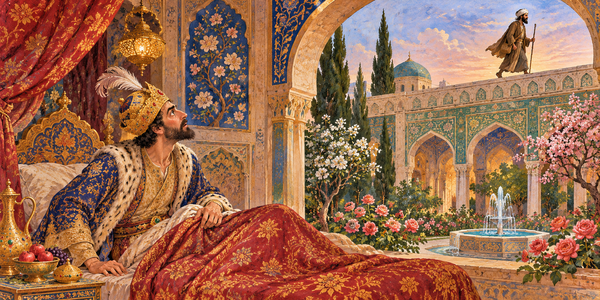
According to tradition, Ibrahim ibn Adham was once the ruler of Balkh. He lived amid the wealth of a royal palace, surrounded by servants and all the comforts his position could provide. One night, while lying in his chambers, he heard footsteps on the roof.
He called out and asked who was there. An unfamiliar voice replied that he was searching for his lost camel. Ibrahim was indignant at the absurdity of the answer. How could anyone search for a camel on the roof of a palace?
The stranger replied that looking for a camel on a roof was no more absurd than seeking God while reclining amid royal luxury. The words penetrated deeply into Ibrahim’s heart. He could not recover his former peace of mind.
The following day, a mysterious visitor appeared at the palace and asked to stay in the building. He called it an inn. The ruler explained that this was his palace, not a place for travelers. The visitor began asking who had lived there before him. Ibrahim named his father and, before him, his earlier ancestors. All had already departed from this world.
The stranger then questioned the very distinction between a palace and an inn. If the occupants of the building came and went, what made it the permanent possession of any one of them? After this encounter, Ibrahim’s unease grew even stronger.
Tradition also recounts his awakening during a hunt, when he heard a call urging him to turn toward the purpose of his life. Eventually, he abandoned his royal position, exchanged his rich garments for humble clothing, and embarked upon the path of asceticism. The man who had once possessed servants and estates began earning his livelihood through labor and living without royal privileges.
Rabia of Basra and the Prayer Mat
In Sufi tradition, Rabia al-Adawiyya of Basra is a woman whose devotion to God transcends the pursuit of reward and the fear of punishment. She lived modestly and spent much of her time in prayer. Her name was revered among early Muslim ascetics, and numerous accounts of spiritual encounters gradually gathered around her life.
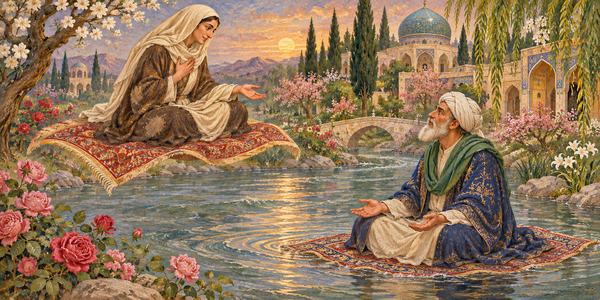
One day, the renowned ascetic Hasan al-Basri encountered Rabia beside a river. According to the story, he spread his prayer mat upon the water and invited her to join him. The mat remained afloat, and this extraordinary occurrence was intended to demonstrate Hasan’s spiritual power.
Rabia, however, was unimpressed. She threw her own prayer mat into the air and rose upon it. From there, she invited Hasan to join her, away from the eyes of other people.
Hasan could not follow her. The man who had initially demonstrated his extraordinary ability suddenly found himself unable to repeat what another person had accomplished. Rabia saw his embarrassment and did not wish to turn the incident into an occasion for self-glorification.
She explained that the ability to remain on water was no particular reason for pride, since fish did so continually. Nor was moving through the air extraordinary, since even insects could fly. The true spiritual work lay beyond such abilities.
Thus Rabia brought the competition to an end before it acquired any significance. Neither her prayer mat nor Hasan’s could measure their closeness to God. Those who understood the value of prayer did not need miracles to turn their devotion into a spectacle.
Bayazid Bastami and the Man Who Wished to Reach God
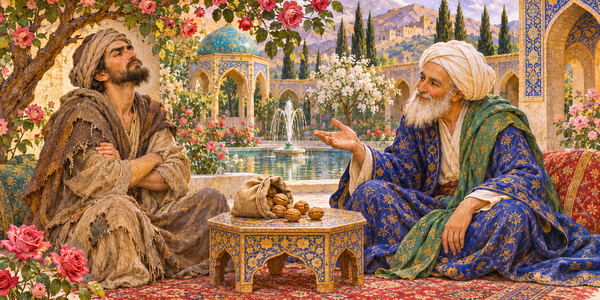
Among the traditions surrounding the Persian mystic Bayazid Bastami is the story of a man who had devoted himself to religious exercises for many years. He fasted during the day, spent his nights in prayer, and made enormous efforts to attain spiritual illumination. Despite everything, he felt that he had not reached the knowledge he sought.
The man went to Bayazid and told him about his years of effort. He could not understand why prolonged abstinence and prayer had failed to reveal what the mystics spoke of. Bayazid explained that even if he continued in the same manner for hundreds of years, he would not reach his goal, because his own self remained a barrier before it.
The visitor asked for a remedy for his condition. Bayazid warned him that he would not accept it. The man insisted that he was ready to follow any instruction. The mystic then proposed a trial entirely unlike the prolonged fasts to which the man was accustomed.
He was to shave his hair and beard, relinquish the clothing that indicated his social standing, and appear in a public place carrying a bag of walnuts. There he was to allow children to strike him on the neck in exchange for a walnut and continue the exercise before the people who knew and respected him.
The man was horrified. He uttered words of religious praise, but Bayazid recognized in his reaction not humility but indignation at the thought of his own humiliation. Years of ascetic exercises had not destroyed his attachment to the image of himself as a respected spiritual person.
The visitor requested an easier instruction. Bayazid replied that the proposed trial was only the beginning. The man who had been willing to endure the physical hardships of fasting and sleepless nights proved incapable of surrendering his public esteem. The very thing he regarded as evidence of his spiritual progress had become part of the barrier preventing him from advancing.
The Dervish Who Wanted No Gift from the King
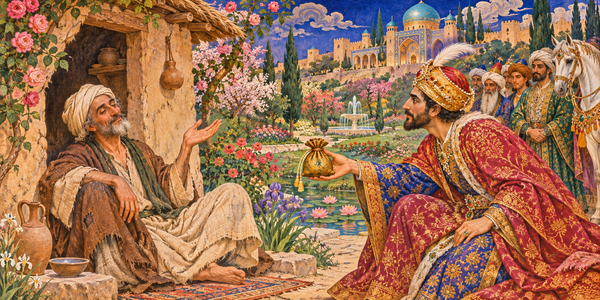
A ruler encountered a dervish who lived in seclusion. The man possessed neither the riches nor the comforts of the royal court, but he also displayed none of the customary eagerness to gain the attention of the powerful. The ruler was intrigued by his words and his attitude toward worldly status.
The dervish spoke about the purpose of royal authority. According to him, wealth and high position do not exist solely for the enjoyment of those who possess them. A ruler bears responsibility for the people who depend upon his decisions. The shepherd cares for the flock, not the flock for the shepherd. The same relationship should exist between a ruler and his subjects.
His words directed the conversation toward the transience of human greatness. One person spends his days in luxury while another suffers from poverty. But when their lives end and their bodies are laid in the earth, the former distinction between rich and poor ceases to be visible.
The king appreciated what had been said and invited the dervish to express a wish. Before him lay the opportunity to receive royal favor, financial support, or a privilege that most people would have welcomed with gratitude. The dervish, however, had only one request: that the ruler leave him in peace.
The king did not immediately abandon the conversation. Once he realized that he could not reward the dervish with a gift, he asked for advice. The ascetic directed his attention toward the truth that people find most difficult to recognize at the height of their power: the time during which they possess wealth and sovereignty is limited. The ruler needed to understand this truth while he still had the opportunity to exercise his authority in a worthy manner.
The King in Paradise and the Dervish in Hell
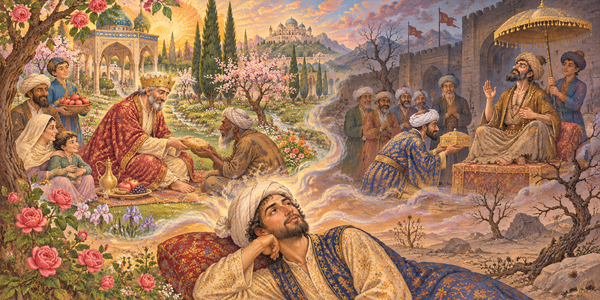
A pious man had a dream that filled him with astonishment. Before him was revealed the fate of two people who had departed from earthly life. One had been a king, accustomed to the reverence of courtiers and everything that power could provide. The other had been a religious ascetic whose outward conduct distinguished him from people devoted to worldly life.
The dreamer expected their fates to correspond to his notions of spiritual worth. In the ruler he saw a man who had lived amid worldly temptations, while in the ascetic he saw someone who had chosen religious service. But his dream revealed precisely the opposite of what he expected: the king was in paradise, and the ascetic was in hell.
Puzzled by what he had witnessed, he asked for an explanation. How could the lives of these two men have led to such an outcome? The answer directed his attention away from their titles and clothing and toward what they had genuinely valued in their hearts.
The king loved dervishes and sought their company. Despite his elevated position, he respected those who had devoted their lives to spiritual seeking. The ascetic, by contrast, was drawn to rulers. Outwardly, he belonged to those who had renounced worldly vanity, but his aspirations were directed toward proximity to the powerful.
In this brief narrative, Saadi contrasts the external signs of spiritual life with a person’s true inner condition. The dervish’s robe, prayer beads, and ascetic appearance cannot change the direction of the heart if it continues to thirst for power and public recognition. Nor does a royal crown in itself prevent a person from respecting spiritual life.
Saadi concludes the story with the thought that a person should acquire the qualities of a dervish rather than rely upon his clothing. When those qualities are genuinely present, outward signs cease to be decisive.
Author: Vasil Stoyanov