Introduction
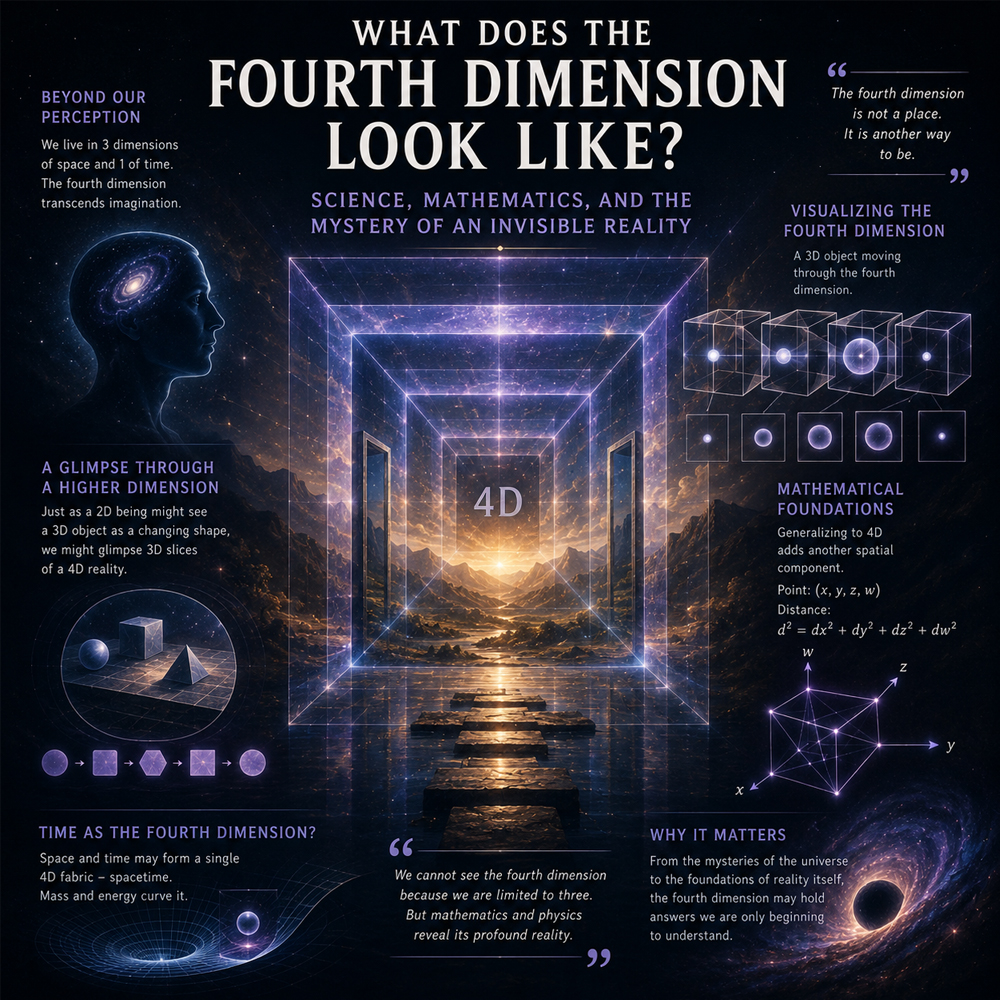
What would the world look like if we could see in four spatial dimensions? Would we be able to look inside a closed box without opening it? Would we see all sides of an object at once? And is it possible that entire dimensions exist around us that we can never perceive because our human senses are limited?
These questions sound like the plot of a science fiction novel, but they actually occupy an important place in modern mathematics and physics. From the geometry of the 19th century to Albert Einstein’s General Theory of Relativity and contemporary theories of quantum gravity, the fourth dimension has become one of the most intriguing ideas in science. It is not merely a philosophical speculation, but a mathematical concept that allows us to describe phenomena that cannot be explained within the framework of three-dimensional space.
At the same time, the fourth dimension has long inspired philosophers, mystics, and writers. Some view it as a higher level of reality, others associate it with consciousness, and still others connect it to the possibility that the universe may possess far more dimensions than we can perceive. Although many of these ideas go beyond the boundaries of established science, they demonstrate how deeply human imagination is drawn to the notion that reality is far richer than it appears.
But what does “the fourth dimension” actually mean? Does it refer to time, to a new direction in space, or to something entirely different? To answer this question, we must first understand what dimensions are and why our brains encounter such great difficulty when trying to imagine a world beyond the three familiar spatial dimensions.
What Is a Dimension?
In everyday life, we use the word “dimension” without thinking much about its meaning. We say that a room has certain dimensions or that an object is three-dimensional. In mathematics, however, a dimension has a much more precise definition. It represents the number of independent directions in which we can move.
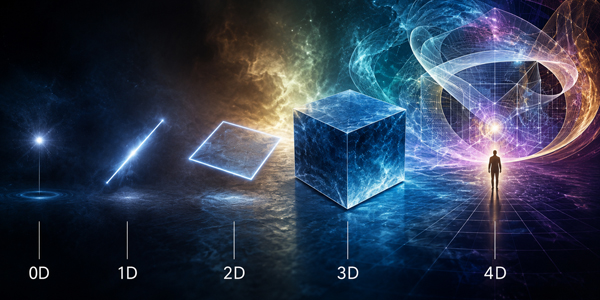
This can be understood most easily by building up the dimensions step by step. Imagine a point. It has no length, width, or height. It exists only as a location. That is why we say that a point is a zero-dimensional object.
If this point begins to move in only one direction, it leaves behind a line. Along this line, we can move only forward or backward. There is no possibility of moving sideways. This is a one-dimensional world.
Now imagine that the line begins to move in a new direction, perpendicular to the first. This creates a square or a plane. We can now move forward and backward, as well as left and right. The second dimension appears.
If the square is then moved in a third, completely independent direction, a cube is formed. This is the world we know. We can move forward and backward, left and right, up and down. These three independent directions make up the space we perceive every day.
Naturally, the question arises: if each new dimension appears through movement in a new independent direction, why shouldn’t there be a fourth such direction? The problem is that the human brain has evolved in a three-dimensional environment. We can describe the fourth dimension mathematically, but we cannot visualize it directly.
Why Is the Fourth Dimension So Difficult to Imagine?

The reason is not that the fourth dimension is necessarily impossible, but that our nervous system has never needed to perceive it. Our eyes collect a two-dimensional image on the retina, and the brain uses perspective, light, and motion to construct the sense of three-dimensionality. All of our senses are adapted to a world with three spatial dimensions.
Try to imagine a new direction that is neither up nor down, neither left nor right, neither forward nor backward. Most people find this practically impossible. Any new “direction” they imagine turns out to be a combination of the three that already exist.
This limitation does not mean that mathematics cannot work with more dimensions. In fact, modern mathematics freely describes spaces with hundreds or even infinitely many dimensions. The limitation exists only in human intuition.
The history of science has repeatedly shown that reality is not obliged to be intuitive. The Earth appears motionless, yet it rotates on its axis at over 1,600 kilometers per hour at the equator. Space appears flat, yet massive objects curve it. Light appears continuous, yet it exhibits quantum properties. Therefore, the fact that we cannot imagine the fourth dimension is not, in itself, an argument against its existence.
The World of Two-Dimensional Beings – The Best Analogy
To understand why the fourth dimension is so difficult to perceive, mathematicians often use a famous thought experiment popularized in Edwin Abbott’s book Flatland.
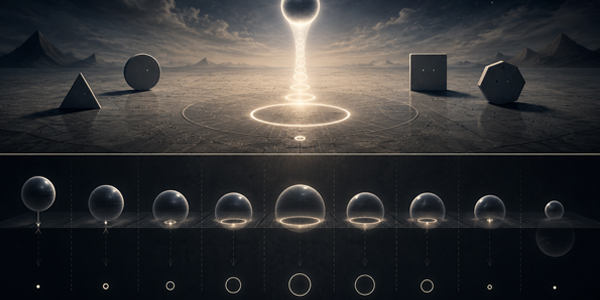
Imagine a world that has only two dimensions – length and width. All its inhabitants are flat figures. They have no concept of height because it simply does not exist in their reality. If you lived as a circle or a square in such a world, you would not see others as whole shapes, but only as lines, because your perception would be limited to the two-dimensional plane.
Now imagine that a three-dimensional sphere passes through this two-dimensional world. What would its inhabitants observe? They would never see the entire sphere. First, a small point would appear. Then the point would gradually become a larger and larger circle. The circle would reach its maximum size, after which it would begin to shrink again until it finally disappears completely.
To the two-dimensional beings, this would look like a mysterious object that appears out of nowhere, changes its size, and then vanishes without a trace. They would never realize that they are actually observing only a cross-section of a three-dimensional sphere.
This analogy is extremely important because it shows how we might appear in relation to a four-dimensional world. If a four-dimensional object passed through our space, we would probably not see the entire object. We would perceive only its three-dimensional “slices,” which would constantly change shape. To us, this might look like an object that materializes, deforms, and then disappears.
What Would a Four-Dimensional Being Look Like?
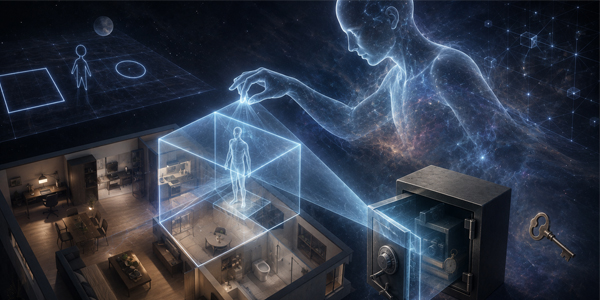
Here, imagination begins to reach its true limits. If a three-dimensional being can see an entire two-dimensional world at once, then by analogy, a four-dimensional being would see our entire three-dimensional world in a way that is impossible for us.
Imagine a closed box. For us, its contents remain hidden unless we open it. For a being that exists in four spatial dimensions, this limitation would likely not exist. It could perceive both the inside and the outside of the box simultaneously, just as a person can see an entire square drawn on a sheet of paper at once.
The same applies to the human body. We cannot see all its sides at once. To observe someone’s back, they must turn around or we must move. For a four-dimensional observer, such a limitation would probably not exist. It would perceive the entire volume of the body at once – both from the outside and the inside.
Such a being could even remove an object from a locked safe without unlocking the door. This sounds like magic, but it is actually a natural consequence of movement in a dimension that we cannot access. Similarly, a person can easily remove an object from a closed two-dimensional boundary simply by lifting it above the surface – something completely impossible for inhabitants of a two-dimensional world.
The Mathematics of the Fourth Dimension
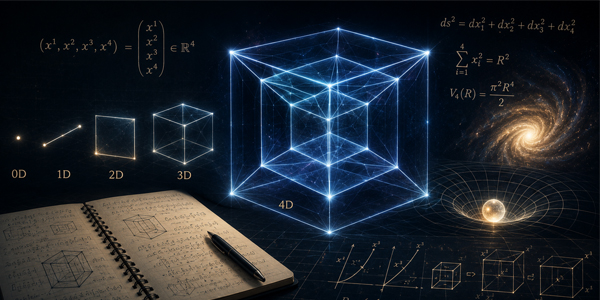
In the 19th century, mathematicians realized that geometry is not limited to what we can visualize. They began to describe spaces with four, five, and even more dimensions using coordinates and algebraic equations. It turns out that mathematical rules work in the same way regardless of the number of dimensions.
Just as the position of a point in our world can be described using three coordinates – such as (x), (y), and (z) – in four-dimensional space we simply add one more independent coordinate. Mathematically, this presents no particular difficulty. The challenge arises only when we try to turn these equations into an image that the human imagination can grasp.
This is where one of the most famous figures in higher geometry appears – the tesseract. If the square is the two-dimensional analogue of the cube, and the cube is the three-dimensional analogue of a higher figure, then the tesseract is the four-dimensional equivalent of the cube. Although we can never see it directly, mathematics allows us to calculate its properties with remarkable precision.
In the next part, we will explore what a tesseract looks like, why it is often depicted as a “cube within a cube,” how the fourth dimension becomes spacetime in Einstein’s theory, and whether modern physics allows for the existence of even higher dimensions hidden from our senses.
The Tesseract – What Does a Four-Dimensional Cube Look Like?
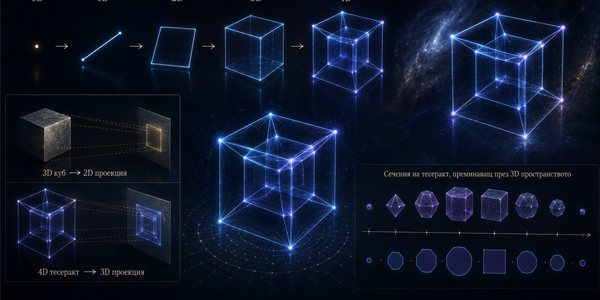
If we want to understand what the fourth dimension looks like, there is no better starting point than the tesseract – one of the most remarkable geometric figures ever created by mathematics. It is not a product of imagination or science fiction, but a completely real mathematical object whose properties can be described with absolute precision. The problem is that no human can perceive it directly, because our brains are limited to three spatial dimensions.
To understand the tesseract, we must once again follow the logic of dimensions. A point that moves in one direction creates a line. A line, moved perpendicular to itself, creates a square. A square, moved into a third dimension, forms a cube. By the same logic, a cube moved in a fourth independent spatial direction creates a tesseract.
Although this seems like a perfectly natural mathematical progression, our imagination reaches its limit at this point. We can easily imagine how a square becomes a cube because we can perceive height. But we cannot imagine the direction in which the cube must move to become a tesseract, because that direction simply does not exist in our sensory world.
That is why mathematics uses projections – the same principle by which a three-dimensional cube can be drawn on a two-dimensional sheet of paper. When we see a drawing of a cube, we are not actually looking at a real three-dimensional object, but at its two-dimensional projection. Similarly, the familiar image of a tesseract as a “cube within a cube” connected by lines does not represent the four-dimensional object itself, but rather its three-dimensional shadow.
This projection often looks strange and confusing, but it is mathematically analogous to the way a cube appears as a square within a square when projected onto a plane. The true form remains inaccessible to our senses, but we can study its properties through mathematics.
What Could a Four-Dimensional Being Do?
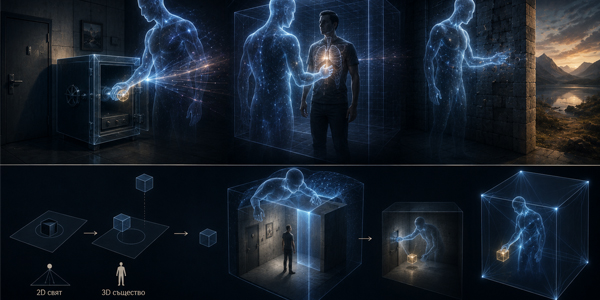
If intelligent beings capable of moving freely in four spatial dimensions actually existed, their abilities would appear almost supernatural to us. This would not be magic, but simply the result of access to one more independent direction in space.
Such a being could see the interior of any closed structure. Walls, safes, or even the human body would not be barriers. Just as we can look into a two-dimensional world without its inhabitants being able to stop us, a four-dimensional observer would have access to the entire three-dimensional volume at once.
Another intriguing possibility is movement through seemingly impenetrable obstacles. Imagine a circle drawn on a sheet of paper. For a two-dimensional being, it is an impenetrable wall. For us, however, it is enough to simply lift an object above the sheet and place it on the other side. Similarly, a four-dimensional being could “bypass” three-dimensional barriers by moving in a direction we cannot perceive at all.
This means that a locked room would not be a true limitation. An object could be moved from inside to outside without opening the door. Such an action would appear miraculous to three-dimensional observers, even though it would simply follow the natural geometry of higher-dimensional space.
These ideas are often used in science fiction, but it is important to emphasize that they arise from entirely serious geometric reasoning. They do not prove that such beings exist, but only show what the logical consequences would be if four spatial dimensions were accessible.
The Fourth Dimension in Einstein’s Theory
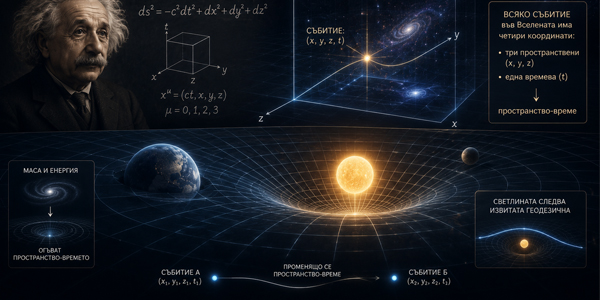
When most people hear the phrase “fourth dimension,” they often think of time. This is no coincidence. In the 20th century, Albert Einstein changed the way science understands space and time by showing that they are not independent quantities, but parts of a single structure – spacetime.
However, it is important to make a distinction. In mathematical geometry, the fourth dimension usually means another spatial direction. In the theory of relativity, the fourth dimension is time. This does not mean that time is the same as space, but that all four coordinates work together in describing every event in the universe.
If we say that an event occurred in Sofia, that information is not sufficient. We must also specify when it happened. Therefore, every event has three spatial coordinates and one time coordinate. Only then is its location in the universe fully defined.
This insight fundamentally changed physics. Instead of space and time being separate stages on which the universe unfolds, they became a unified dynamic structure that can bend, stretch, and change under the influence of mass and energy.
Space Is Not a Rigid Stage
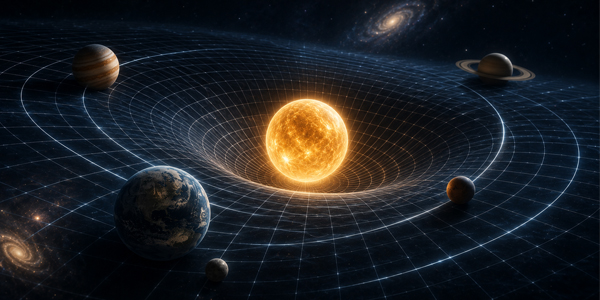
Before Einstein, scientists believed that space was a fixed and unchanging arena in which planets, stars, and galaxies moved. General relativity showed that this is not true.
Massive objects do not simply exert a gravitational force on surrounding bodies. They literally change the geometry of spacetime. Planets orbit the Sun not because some mysterious force pulls them, but because they follow the most natural path in a curved spacetime.
This is often illustrated with an elastic membrane on which a heavy ball is placed. The membrane bends, and smaller balls begin to move along curved paths around it. Although this analogy is not entirely accurate, it helps convey the basic idea – gravity is a consequence of the geometry of spacetime.
This means that the fourth dimension is not just an abstract mathematical concept. It plays a direct role in describing all physical processes in the universe.
Can We Move Freely Through Time?
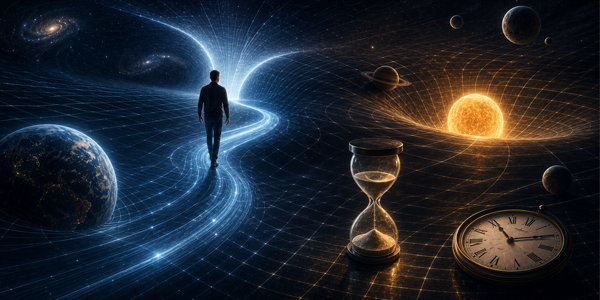
Since time represents the fourth coordinate in spacetime, it is natural to ask whether we might one day be able to move through it as freely as we move through space.
The answer from physics is much more complex than it might seem. In fact, all of us are constantly moving through time, but only in one direction – toward the future. We cannot arbitrarily stop, go back, or jump forward as we can with movement in space.
Nevertheless, the theory of relativity predicts phenomena such as time dilation. At very high speeds or near extremely strong gravitational fields, time passes more slowly relative to observers elsewhere. This is not a theoretical hypothesis, but an experimentally confirmed fact that is even taken into account in the operation of GPS satellites.
Therefore, time is not an absolute clock ticking the same everywhere. It is part of the dynamic structure of the universe and depends on motion and gravity.
Additional Dimensions in Modern Physics
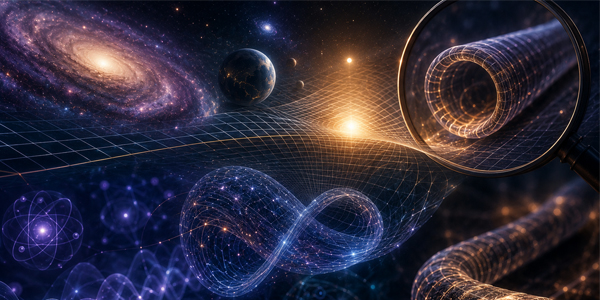
Although the four dimensions of spacetime are sufficient for general relativity, some modern physical theories suggest that reality may be far richer.
One of the most well-known is string theory. According to it, elementary particles are not dimensionless points, but extremely small vibrating strings. For the mathematical equations to be consistent, this theory requires more dimensions than the familiar four. Depending on the specific model, the total number reaches ten or eleven.
Where are all these additional dimensions? The most common assumption is that they are “curled up” or compactified at extremely small scales – so small that no current experiment can directly observe them.
We can imagine this through an analogy with a garden hose. From a great distance, it appears as a one-dimensional line. But if we get close enough, we see that it also has a circular cross-section. Similarly, the universe may appear three-dimensional at everyday scales, while at microscopic levels it contains many more dimensions.
So far, there is no experimental evidence that these additional dimensions exist. They represent a mathematical possibility that could help unify quantum mechanics and gravity – one of the greatest unsolved problems in modern physics.
The Fourth Dimension and Human Imagination
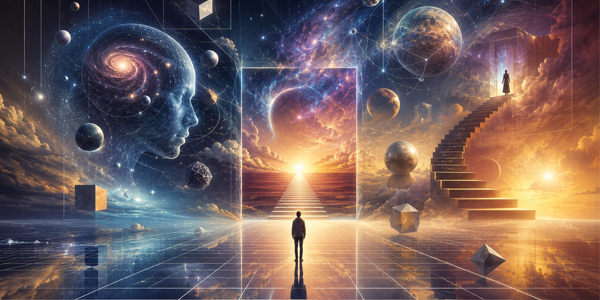
Perhaps no scientific idea has had as strong an influence on human imagination as the fourth dimension. It has been present in literature, cinema, philosophy, and art for more than a century. Artists attempt to depict objects from multiple perspectives at once, writers describe beings from higher dimensions, and filmmakers use the idea to tell stories about time travel and parallel worlds.
This popularity is no coincidence. The fourth dimension symbolizes the boundary between the known and the unknown. It reminds us that human perception likely reveals only a small part of reality. The history of science has repeatedly shown that the universe is far more unexpected than we once believed.
But is the fourth dimension merely a mathematical abstraction, a real physical feature of the universe, or a gateway to something even deeper? It is precisely this question that we will focus on in the final part of the article, where we will explore spiritual interpretations, the most common myths, and what science actually knows – and what still remains a mystery.
Spiritual Interpretations of the Fourth Dimension
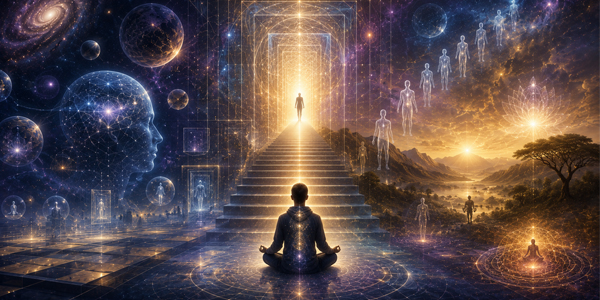
In addition to being a mathematical and physical concept, the fourth dimension has long been present in spiritual teachings. Over the past more than one hundred years, numerous philosophical schools, esoteric movements, and contemporary spiritual authors have begun to use this term as a symbol of a higher level of existence. People often speak of “transitioning into the fourth dimension,” “living in the fourth density,” or “raising consciousness,” with all these ideas suggesting that humans can transcend the limitations of ordinary perception.
However, it is important to make a clear distinction between the scientific and spiritual use of the concept. In science, the fourth dimension has a strictly mathematical definition. It represents an additional coordinate that allows the description of space or spacetime. In spiritual traditions, the term is often used metaphorically to denote a state of consciousness rather than a literal new spatial dimension.
This does not mean that spiritual interpretations are meaningless. They simply address a different type of question. While physics is concerned with how the universe functions, spirituality seeks to understand how humans experience reality and whether deeper levels of awareness exist.
Some mystical traditions claim that our limited perception resembles the life of the two-dimensional beings from “Flatland.” Just as they cannot comprehend the existence of height, humans may not fully grasp the richness of reality. Whether or not this analogy is accurate, it illustrates how naturally the human mind uses the idea of higher dimensions as a symbol of expanded knowledge.
Common Myths About the Fourth Dimension
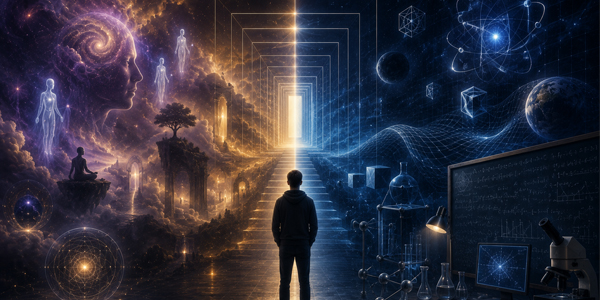
The popularity of the topic inevitably leads to many misconceptions. The internet is full of claims that science has already proven the existence of the fourth dimension as a spiritual realm or that physicists have discovered a portal to other realities. In reality, such claims have no scientific basis.
One of the most widespread myths is that the fourth dimension automatically means a world of spirits or souls. Science has no evidence linking geometric dimensions with religious or spiritual concepts. This does not mean such ideas are impossible, only that they cannot currently be tested using the scientific method.
Another common myth is that physicists already know how to travel between dimensions. Although the existence of additional dimensions is allowed by some mathematical models, no experimental program has yet demonstrated the possibility of humans moving between them.
There is also a belief that quantum physics proves all kinds of esoteric ideas. In fact, quantum mechanics is one of the most rigorously tested scientific theories. Although its results sometimes appear strange and counterintuitive, they do not constitute evidence for mystical dimensions or supernatural abilities.
Distinguishing between established scientific facts and philosophical or spiritual interpretations is important because it allows us to evaluate each idea according to its own criteria. Science cannot confirm all spiritual claims, but spirituality also cannot automatically use scientific concepts as proof of its views.
Is It Possible to Ever See the Fourth Dimension?
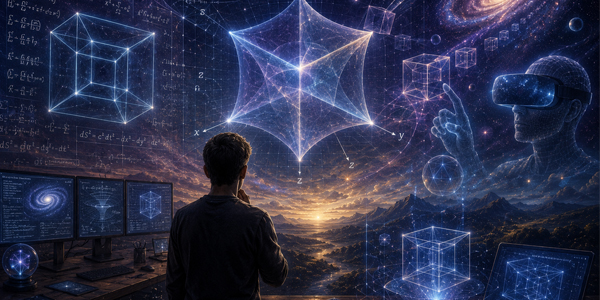
This is a question that continues to inspire scientists and philosophers. For now, the answer is that we will probably never be able to perceive the fourth spatial dimension in the same direct way we see the three familiar dimensions.
The reason is related to the structure of our nervous system. The human brain is the result of millions of years of evolution in a three-dimensional environment. There is no evolutionary mechanism that has developed senses for perceiving an additional spatial direction. This does not mean such a direction could not exist, only that we are not adapted to observe it directly.
Nevertheless, mathematics allows us to explore such spaces with remarkable precision. In the same way, no one has ever seen an electron with their own eyes, yet physicists can predict its behavior with astonishing accuracy. Science often works successfully with phenomena that cannot be directly perceived by human senses.
Advances in computer technology also open new possibilities. Through virtual reality, interactive simulations, and complex mathematical visualizations, scientists can create models that help the human brain partially imagine the behavior of four-dimensional objects. Although this does not represent true perception of the fourth dimension, such models greatly facilitate understanding its geometry.
Why Is the Idea of the Fourth Dimension So Important?
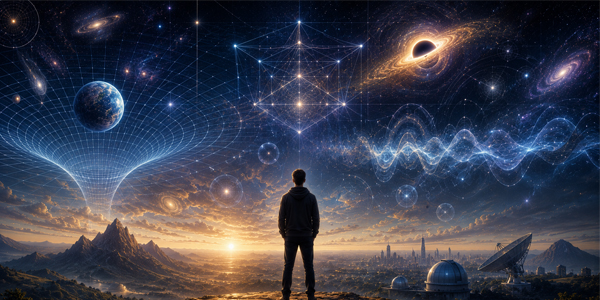
At first glance, the fourth dimension may seem like nothing more than an interesting mathematical concept without practical significance. In reality, however, the situation is quite different. It is precisely the ability of mathematics to work with spaces beyond immediate human experience that has enabled many of the greatest scientific discoveries of the past two centuries.
General relativity, modern cosmology, black holes, gravitational waves, and parts of quantum physics rely on mathematical spaces that go far beyond intuitive human perception. Without this abstract geometry, much of modern physics would be impossible.
Beyond its scientific value, the fourth dimension also has philosophical significance. It reminds us that the limits of human perception are not necessarily the limits of reality itself. Throughout history, people have repeatedly assumed that the world is exactly as it appears. Science has repeatedly shown that the true nature of the universe is far more complex.
We do not see radio waves, yet they exist. We do not feel dark matter, yet astronomical observations suggest it makes up a large portion of the universe’s mass. We do not directly perceive the curvature of spacetime, yet we can measure its effects. In the same way, we cannot automatically dismiss the possibility that reality contains more dimensions simply because we cannot see them.
The Fourth Dimension as a Lesson in Humility
Perhaps the most valuable lesson offered by the idea of the fourth dimension has nothing to do with geometry. It is related to intellectual humility. The history of science shows that the universe almost never conforms to human intuition. The more we study it, the more often we discover that it is stranger, more beautiful, and more unexpected than we imagined.
A few centuries ago, the idea that the Earth moves around the Sun seemed absurd. Later, atoms, quantum mechanics, and the expanding universe sounded just as unbelievable. Today, all of them are an integral part of scientific knowledge.
The fourth dimension reminds us that human imagination has its limits, but mathematics does not. It is mathematics that allows scientists to explore realities we may never be able to see directly. This is one of the greatest strengths of science – the ability to transcend the limitations of the senses through logic, experimentation, and mathematical models.
Conclusion
What does the fourth dimension look like? The most honest answer is that we do not know what it looks like in the literal sense, because the human brain is not capable of visualizing it directly. However, we can understand its geometry, explore its mathematical properties, and use this knowledge to describe phenomena that would otherwise remain unexplained.
Modern physics shows that reality is far richer than what we perceive directly. Space and time form a unified structure, gravity represents the geometry of spacetime, and some theories suggest the existence of additional dimensions hidden at microscopic scales. Although these ideas still contain many unknowns, they are among the most active areas of scientific research.
At the same time, philosophy and spiritual traditions use the fourth dimension as a symbol of expanded consciousness and the limitations of human perception. Whether we interpret these ideas literally or metaphorically, they raise an important question: is the world exactly as we see it, or do our senses reveal only a small part of a much larger reality?
We may never observe a four-dimensional object with our own eyes. But the history of science shows that the inability to imagine something does not mean it cannot exist. That is why the fourth dimension remains one of the most fascinating ideas in human knowledge – a place where mathematics, physics, philosophy, and imagination meet in an attempt to glimpse beyond the boundaries of the visible universe.
Read more:
- The Fermi Paradox: If the Universe Is Full of Life, Why Is No One Her
- Black Holes: What They Are and Why They Hold the Greatest Secrets of the Univers
- The Big Bang and the Different Theories About the End of the Universe
- Quantum Field Theory – Does Anything Truly Exist?
Author: Vasil Stoyanov